

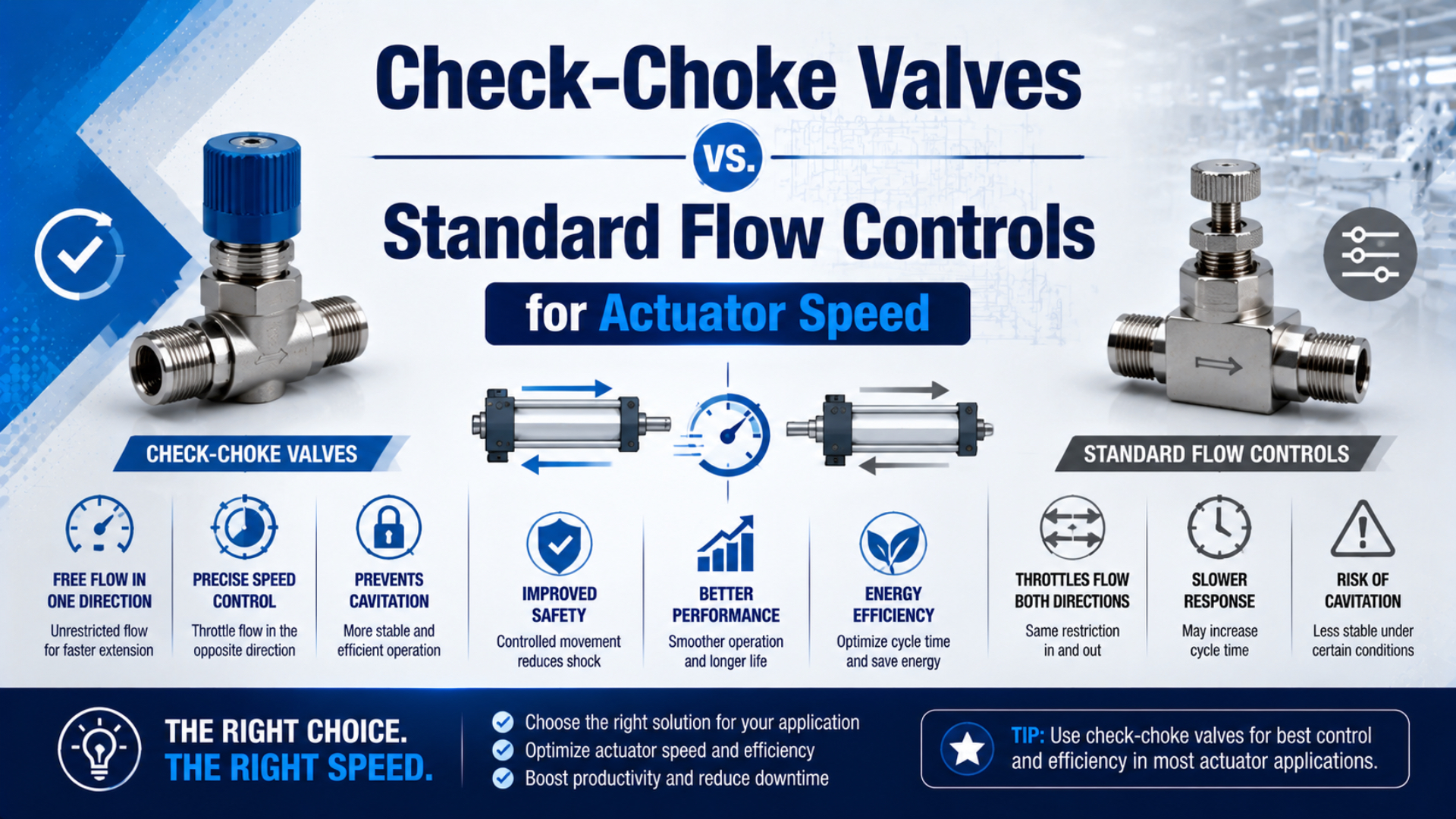
A check-choke valve meters one flow direction and provides a lower-restriction check-valve path in reverse. A basic bidirectional throttle sends both directions through the adjustable restriction. For pneumatic cylinder speed control, that second path changes which stroke is metered, how the opposite chamber fills, and whether extension and retraction can be adjusted independently.
Names alone aren’t reliable. Suppliers also use “one-way flow control,” “speed controller,” “throttle-check,” and “flow control with check valve.” Some catalogs even call the one-way device simply a flow control valve. Read the functional symbol, full model code, controlled-flow direction, and reverse-flow data before deciding how to install it.
Key Takeaways
- Parker recommends 2 one-way controls for independent double-acting cylinder speeds.
- A body arrow has a manufacturer-defined meaning; don’t guess from its physical direction.
- Meter-out often improves control, but it can cause sudden motion if the exhaust chamber is unpressurized.
- A speed controller isn’t a load-holding or anti-drop device.
This guide stays with field identification, installation, and fault diagnosis. For the wider circuit theory, use the existing meter-in versus meter-out engineering guide. For the component-family distinction, see needle valves versus flow control valves.
What Is the Functional Difference Between These Valves?
SMC identifies its direct-mount AS speed controllers with control-type code 0 for meter-out and 1 for meter-in, showing that similar-looking products can have different internal directions (SMC 10-AS Series, retrieved 2026-07-26). The functional path, not the knob, defines the device.
A bidirectional throttle is a valve with one adjustable restriction in the working path. Air moving from port A to port B and from B to A encounters that restriction. The capacity may still differ by direction because the internal geometry isn’t always symmetrical, so “bidirectional” should mean the datasheet permits both directions rather than promising identical flow.
A one-way flow control is a valve that combines an adjustable restriction with a non-return bypass. One direction is forced through the metering path. In reverse, the check element opens and routes air around the needle through a lower-restriction path. Festo describes the same principle: one direction is restricted, while reverse flow is available through the non-return function (Festo, retrieved 2026-07-26).
“Check-choke” can be a useful description, but it isn’t a complete purchase specification. It doesn’t tell you which port connects to the cylinder, what the arrow means, whether the product is fixed meter-out or reversible inline, or how much flow the bypass can carry.
| Feature | Bidirectional throttle | One-way flow control |
|---|---|---|
| Adjustable restriction | Used in both permitted directions | Used in the controlled direction |
| Check bypass | None | Present |
| Reverse direction | Passes through the restriction | Passes through the check path |
| Typical cylinder role | Deliberate two-way restriction or signal timing | Independent meter-in or meter-out speed control |
| Identification evidence | Symbol, model code, direction data | Symbol, arrow definition, control-type code, direction data |
| What the name doesn’t prove | Equal capacity in both directions | Zero pressure drop or a specific controlled direction |
Write the two required behaviours before naming the part: “metered from cylinder to valve” and “lower-restriction from valve to cylinder,” for example. That wording survives catalog terminology changes and makes an incorrect substitution easier to catch.
How Should You Read the Symbol, Arrow, and Model Code?
Parker recommends 2 one-way flow controls for most double-acting cylinders and defines its full-flow arrow as pointing toward the cylinder for meter-out installation (Parker V-650P, retrieved 2026-07-26). That arrow rule belongs to the cited design; other products may mark controlled flow instead.
Start with the functional symbol. A variable restriction is usually shown as a throttling element with an adjustment arrow. A one-way controller adds a parallel non-return path. ISO 1219-1 establishes the graphical-symbol framework for fluid-power components, while ISO 1219-2 covers how those symbols are used in circuit diagrams (ISO 1219-1; ISO 1219-2).
Then check the manufacturer’s arrow definition. It may indicate:
- full-flow or lower-restriction direction
- controlled or metered direction
- permitted general flow direction
- the cylinder-side connection on a direct-mount model
Never convert one supplier’s arrow rule into an industry-wide convention. Parker’s cited inline valve can be installed for meter-in or meter-out by reversing its relationship to the cylinder. In contrast, SMC’s direct-mount 10-AS range uses separate meter-out and meter-in control-type codes. Its male cylinder connection fixes where the product sits.
Finally, decode the complete part number. Record the control type, port thread, tube size, body orientation, adjustment lock, seal or material option, and permitted pressure and temperature. A product photo may show the same elbow body for several variants.
What Does a One-Way Controller Change at the Cylinder?
SMC’s cited 10-AS range specifies operating pressure from 0.1 to 0.7 MPa and publishes controlled-flow and free-flow characteristics separately for each listed configuration and operating condition (SMC 10-AS). The device changes both direction and capacity; “free flow” only means bypassing the adjusted needle.
For a double-acting cylinder, extension fills one chamber while exhausting the other. Retraction reverses those paths. A one-way controller at each cylinder port can therefore meter the exhaust from each chamber independently while allowing the next supply flow through the check path.
Parker states that two controls make independent piston-speed adjustment possible in both stroke directions and recommends locating them between the directional valve and cylinder, as close to the cylinder ports as practical (Parker V-650P). Short controlled volumes also make the installed direction easier to verify.
One controller can be sufficient when only one stroke needs controlled speed. The other stroke will then follow the circuit’s unrestricted path and the capacity of the valve, tubing, fittings, silencers, cushions, and cylinder ports. “Unrestricted” never means infinite flow.
A bidirectional throttle can still slow a cylinder, but both directions encounter the same adjustable passage. That makes it unsuitable when one direction must be metered and the reverse direction must refill or exhaust through a separate lower-restriction path. It may also couple two behaviours that commissioning needs to adjust independently.
The first-pass speed relationship is:
Here, is average piston speed, is actual volumetric flow at chamber conditions, and is piston area or annular area for the active direction. This screen assumes compatible units and does not predict stiction, pressure buildup, acceleration, cushioning, or an assisting load.
If available free-air flow is known, the Cylinder Speed Calculator can provide an initial comparison. Use measured production stroke time for final commissioning.
When Is Meter-Out Appropriate, and What Are Its Limits?
SMC says meter-out stabilizes speed when load fluctuates, but it also states that 100% supply pressure is applied during motion and warns that an unpressurized exhaust chamber can cause sudden extension (SMC AS-R/AS-Q, retrieved 2026-07-26). Meter-out is a default, not a universal guarantee.
Meter-out lets supply air enter the driving chamber through the check path while it meters air leaving the opposite chamber. The resulting exhaust back pressure resists piston acceleration. That often helps when friction changes, gravity assists motion, or a payload varies.
Meter-out control is a circuit arrangement that restricts exhaust leaving the cylinder chamber while providing a lower-restriction supply path in the reverse direction. It changes the pressure history on both sides of the piston, so it must be reviewed with the load and force margin.
However, the controller doesn’t make speed load-independent. A useful extension force balance is:
In this sign convention, positive force drives extension. and are chamber gauge pressures, is full piston area, is rod-side effective area, and the remaining terms oppose motion. Meter-out raises exhaust-side pressure, which can improve damping while reducing net force.
Too much restriction can therefore make a marginally sized cylinder stall. Too little restriction can allow excessive speed or end impact. The correct setting depends on dynamic pressure at both cylinder ports, not just the regulator gauge upstream.
Meter-in has legitimate uses. SMC lists quick startup and reduced pressure according to load among its advantages, while also noting sensitivity to load changes, inertia, and vertical control. Some low-speed systems use combined meter-in and meter-out control to reduce lurch or stick-slip. The article on quantifying cylinder stick-slip covers that separate failure mode.
Most importantly, a speed controller isn’t a holding device. Exhaust restriction may resist motion while pressure remains available, but ordinary pneumatic seals and valves can leak. For a suspended load, define the required safe state and use an engineered holding function such as a rated pilot-check arrangement, mechanical lock, or rod lock. See the guide to pneumatic rod-lock units.
Why Can Meter-Out Cause a Sudden First Stroke?
SMC’s AS-R/AS-Q catalog allows knob adjustment in 45-degree increments, yet its more important warning is independent of the setting: if exhaust-side air is absent or too low, meter-out orifice control is unavailable and the actuator may move rapidly (SMC AS-R/AS-Q).
During normal cycling, the exhausting chamber contains compressed air. The restriction meters that stored air and creates back pressure. After maintenance, exhaust, emergency venting, or a long shutdown, the same chamber may begin near atmospheric pressure. The piston can then move before enough exhaust-side pressure develops for the needle setting to govern speed.
This is why “start fully closed and open by quarter turns” isn’t a universal commissioning procedure. A closed path can build stored pressure, prevent expected motion, or create a delayed release when the adjustment changes. Follow the exact product manual and the machine’s approved restart procedure.
Check the complete starting state:
- which cylinder chamber is already pressurized
- whether the directional valve starts with both work ports exhausted
- whether residual pressure remains behind a closed element
- whether gravity, a spring, or the process load assists the first movement
- whether a soft-start, preload, lurch-prevention, or dedicated startup function is required
- how personnel are kept outside the hazard zone during repressurization
SMC offers dedicated extension-prevention products because ordinary meter-out speed control doesn’t by itself solve every startup state. Its SSC system applies meter-in behaviour during initial pressurization and then resumes the configured normal control mode (SMC SSC).
Commission normal cycling and first-cycle restart as two separate tests. A circuit that runs smoothly after both chambers are charged can still produce an unacceptable first stroke after the system has been fully exhausted.
Why Is the Cylinder Still Jerky When the Valve Direction Is Correct?
SMC’s direct-mount speed-controller family spans ports from M3 and M5 through R1/2, with published flow capacity rising across body sizes (SMC 10-AS). That distinction matters during troubleshooting. Correct orientation can’t compensate for an undersized path, unstable friction, poor alignment, or the wrong startup state.
Use the symptom to choose the next measurement:
| Symptom | Likely checks | Evidence to collect |
|---|---|---|
| Sudden first motion after repressurization | Exhaust chamber starts unpressurized; load assists motion; wrong startup function | Both port pressures and motion trace from zero pressure |
| Adjustment changes the wrong stroke | Wrong variant, reversed inline valve, misunderstood arrow | Complete model code, symbol, arrow definition, port labels |
| Both strokes change together | Bidirectional throttle or shared exhaust restriction | Circuit drawing and direction-by-direction flow path |
| Smooth at no load, jerky with product | Force margin, changing friction, guide alignment, assisting load | Load cases, port pressures, position-time trace |
| Slow with needle fully open | Valve, tubing, fittings, directional valve, silencer, cushion, or supply path too small | Dynamic pressure and flow at the cylinder |
| Creeps and then jumps | Seal stiction, guide friction, side load, low-speed controller mismatch | Breakaway pressure, alignment, velocity trace |
| Slams only near the end | Cushion setting or energy capacity, not main-stroke flow alone | Cushion-entry speed, moving mass, pressure, cushion model |
Measure extension and retraction separately. Record supply pressure near the valve, both cylinder-port pressures during motion, stroke time, load, orientation, needle position, and whether the test began from an exhausted or charged state. A single compressor-room pressure value doesn’t identify the restriction.
In our experience reviewing replacement requests, a photograph of the model code and functional symbol resolves direction mistakes faster than a description such as “the arrow points toward the tube.” Add the pressure trace and stroke time before changing the component.
Blocked silencers and undersized directional valves often imitate a nearly closed speed controller. The guide to flow starvation in pneumatic systems explains how the entire path limits chamber filling and exhaust. For a component-capacity review, use the pneumatic flow-control valve sizing guide.
When Is a Bidirectional Throttle the Better Choice?
Parker’s 338-series bidirectional needle-valve example covers 5 nominal port sizes from 1/8 through 3/4 inch, illustrating that a two-way adjustable restriction is a deliberate product family for controlled two-direction metering rather than an obsolete substitute (Parker Pneumatic Accessories, retrieved 2026-07-26).
Choose a bidirectional throttle when both permitted flow directions should encounter the adjustable restriction. Possible uses include controlled bleeds, small purge flows, manual air-jet adjustment, instrumentation lines, or deliberately slowed pneumatic signal changes. The exact model must support the medium, pressure, temperature, flow direction, and shut-off expectation.
Don’t call a throttle a pressure regulator. It can slow pressure rise in a known downstream volume, but the eventual pressure depends on downstream demand and leakage. A pressure regulator is a feedback device intended to control downstream pressure; a simple restriction is not.
Pilot-signal restriction also needs a circuit-level review. Slowing both application and release may change valve overlap, reset time, fault response, or the machine’s safe state. If one pilot direction must recover quickly, a one-way controller may be preferable. The required timing comes first.
Likewise, don’t assume a bidirectional throttle meters both directions equally. Compare the manufacturer’s flow curve or direction-specific values. Seat geometry and approach direction can produce different capacity even without a separate check bypass.
The selection rule is simple:
- use a bidirectional throttle when both directions are intentionally restricted
- use a one-way controller when one direction is metered and reverse flow needs a lower-restriction bypass
- use a pressure-compensated valve when flow must remain steadier across changing pressure differential
- use a proportional flow valve when an electrical command must change the setpoint
- use a load-holding device when the risk assessment requires controlled holding or drop prevention
What Should the Datasheet and Commissioning Record Contain?
Parker’s instructions call for 2 one-way controls for independent double-acting cylinder speeds and tell the installer to secure the needle locknut after adjustment (Parker V-650P). A controlled record must preserve both the selected function and the final machine setting for future maintenance.
Record these fields before approving a replacement:
| Field | Why it matters |
|---|---|
| Manufacturer and full model code | Identifies the exact control variant |
| Functional symbol | Proves restriction and check paths |
| Arrow definition | Separates full-flow, controlled-flow, and port-direction markings |
| Controlled and reverse-flow data | Confirms capacity in both paths |
| Test method and reference conditions | Keeps SCFM, L/min, ANR, Cv, and ISO 6358 values comparable |
| Critical pressure ratio or cracking pressure | Describes choked-flow transition or check opening behaviour when published |
| Port thread and tube size | Prevents connection mismatch and hidden restriction |
| Pressure and temperature range | Defines permitted operation |
| Medium and air-quality requirement | Protects seals, seat, and check element |
| Adjustment range and lock | Supports repeatable commissioning |
| Leakage or shut-off statement | Prevents using a metering valve as isolation |
| Mounting orientation and torque | Protects the body and threaded cylinder port |
The commissioning record should add machine state: supply pressure, both port pressures, load, orientation, extension and retraction times, first-cycle result after full exhaust, needle setting, cushion setting, sensor timing, and final lock condition.
Photograph the installed symbol and arrow after commissioning, then attach the image to the machine record with the model code. Years later, maintenance can verify the controlled direction without reconstructing the circuit from tube routing alone.
Check-Choke and Flow Control FAQs
SMC’s 10-AS examples operate from 0.1 to 0.7 MPa, while Parker recommends 2 one-way controls for independent double-acting cylinder speeds (SMC 10-AS; Parker V-650P). These answers clearly separate speed adjustment from safety, identification, and startup behaviour on a real machine.
Can a normal check-choke valve hold a vertical load after air loss?
No. A normal one-way speed controller meters flow; it isn’t a rated load-holding function. Leakage through seals, valves, fittings, or tubing can allow movement after air loss. Use the machine risk assessment to select a suitable pilot-check arrangement, mechanical lock, rod lock, brake, or other engineered safe-state measure.
Can the same valve be reversed between meter-in and meter-out?
It depends on the product. Parker’s cited inline valve can be installed in either relationship to the cylinder. Direct-mount elbow models often have a fixed cylinder connection and separate meter-in or meter-out order codes. Check the full model, symbol, and arrow definition instead of assuming the body can be reversed.
Why can a meter-out cylinder jump on the first cycle?
Meter-out needs pressure in the exhausting chamber to create its braking effect. After the system has been fully exhausted, that chamber may start near atmospheric pressure. SMC warns that the actuator can move rapidly before exhaust-side pressure develops. Test first-cycle restart separately from normal charged cycling.
Why is motion still jerky when the controller direction is correct?
Correct direction eliminates only one fault. Check breakaway friction, side load, guide alignment, available force, dynamic supply pressure, exhaust back pressure, tubing, directional-valve capacity, blocked silencers, cushion settings, moving mass, and startup state. Record both port pressures and a position-time trace under the real load.
Does every double-acting cylinder need two one-way flow controls?
Two controllers are the normal arrangement when extension and retraction need independent adjustment. One may be sufficient if only one stroke requires controlled speed and the opposite direction can run through the available circuit capacity. The machine still needs acceptable impact, force, timing, and safe-state behaviour in both directions.
Sources and technical references
- Festo, One-Way Flow Control Valves, functional distinction between controlled and reverse flow; retrieved 2026-07-26.
- Parker, V-650P Flow Control Valve Instructions, two-valve arrangement, mounting position, arrow definition, and adjustment; retrieved 2026-07-26.
- Parker, Pneumatic Flow Controls and Accessories, direction-specific flow-control construction and product data; retrieved 2026-07-26.
- SMC, 10-AS Direct-Mount Speed Controllers, meter-out and meter-in codes, limits, and direction-specific flow data; retrieved 2026-07-26.
- SMC, AS-R/AS-Q Air-Saving Speed Controller, meter-in/meter-out comparison and sudden-extension warning; retrieved 2026-07-26.
- SMC, SSC Extension Prevention System, dedicated initial-extension prevention behaviour; retrieved 2026-07-26.
- SMC, ASP Speed Controller with Pilot Check Valve, separate holding and intermediate-stop function; retrieved 2026-07-26.
- ISO 1219-1 and ISO 1219-2, fluid-power graphical symbols and circuit-diagram rules.