

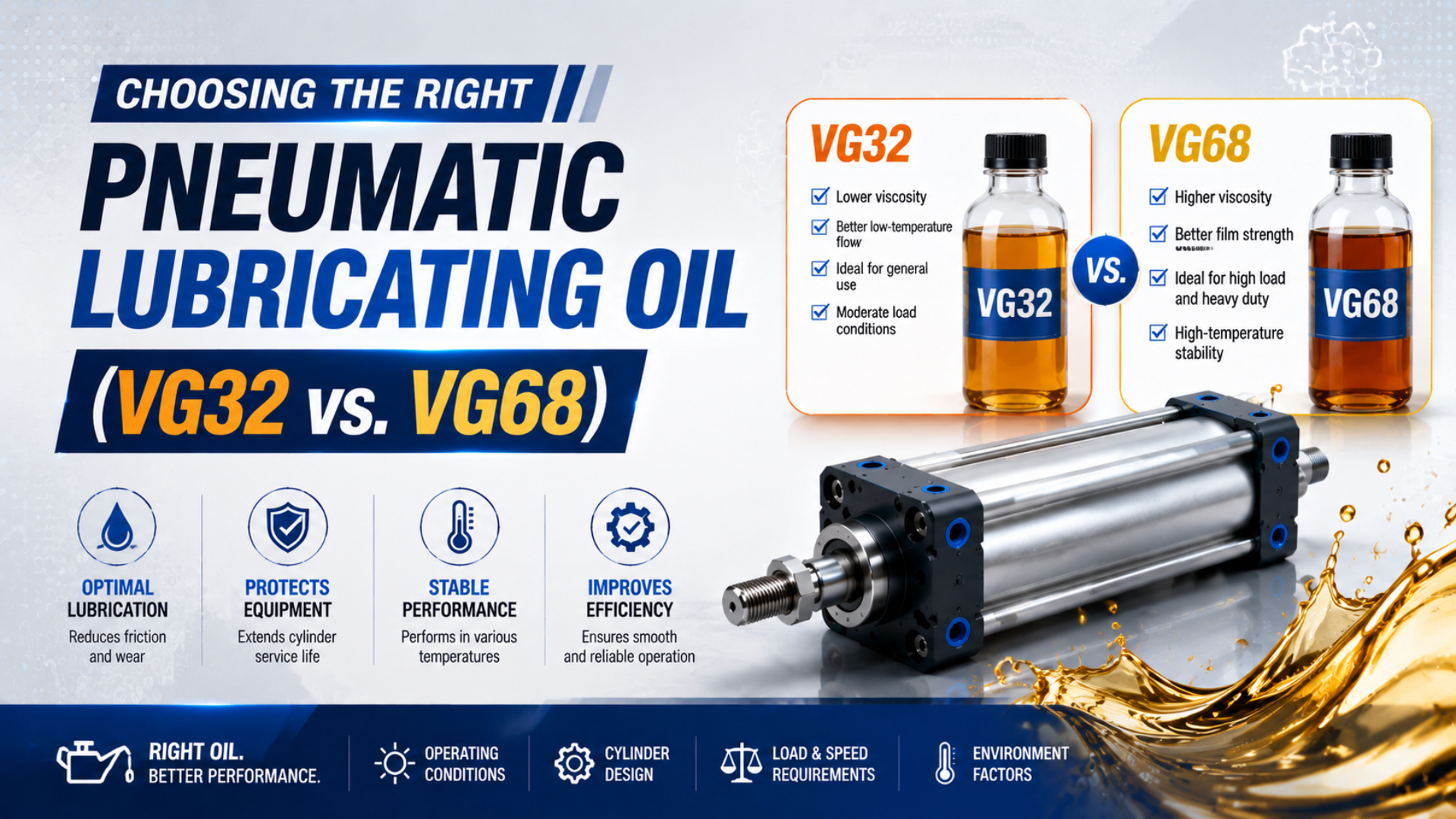
Choose pneumatic lubricating oil from the exact component and lubricator instructions, not from a universal rule that assigns VG32 to normal service and VG68 to hot or heavily loaded cylinders. VG32 is a common airline-oil recommendation for general pneumatic equipment. VG68 can be correct for specific tools, but only when the equipment manufacturer permits that grade and oil chemistry. The first question is whether the circuit should receive added oil at all. Many cylinders and valves are lubricated during manufacture and designed for non-lube service. Adding an airline lubricator may wash away the original grease and create a continuing maintenance requirement.
Key Takeaways
- ISO VG32 and VG68 describe nominal kinematic viscosity at 40°C.
- Many general-purpose pneumatic lubricators specify VG32.
- VG68 is an equipment-specific choice, not a universal high-temperature upgrade.
- Check base oil, additives, seals, delivery method, and hygiene certification.
Pneumatic lubricating oil is oil intentionally metered into compressed air to lubricate downstream equipment that requires or permits airline lubrication. It is different from compressor lubricant, vacuum-pump oil, assembly grease, and oil already incorporated into a self-lubricating seal or bearing.
Why Must the Equipment Instructions Come First?
SMC instructs users to select ISO VG32 turbine oil when supply lubrication is permitted and warns that lubrication must continue after it is introduced because the factory-applied lubricant can be washed away. That is an equipment rule, not a general property of every pneumatic component (SMC Handling Precautions, retrieved 2026-07-26).
Start with the complete order code for every component downstream of the lubricator. Classify each item as one of the following:
- Lubrication prohibited or unsuitable.
- Lubricated for life, with optional airline oil.
- Airline lubrication required.
- Lubrication requirement unknown until the manufacturer confirms it.
A mixed branch is governed by the most restrictive component. A lubricator that helps an air motor can create drag, deposit, contamination, or maintenance problems in a valve or cylinder that was intended to run without added oil. The same principle applies when changing an existing machine. Do not assume that an empty lubricator means the circuit has always been non-lube. Check commissioning records, lubricant labels, maintenance logs, and the downstream equipment manuals before deciding whether to refill, remove, or bypass it. Viscosity selection is the second decision, not the first. If the component does not permit the oil chemistry or does not need airline lubrication, choosing the “correct” VG number cannot make the installation correct.
For the broader air-preparation context, see the FRL system selection guide. The self-lubricating pneumatic seal guide explains why non-lube service can still depend on factory-applied grease.
Reading ISO VG32 and VG68 Correctly
ISO 3448 establishes the viscosity-classification system for industrial liquid lubricants. In that system, VG32 has a nominal kinematic viscosity of 32 mm²/s at 40°C, while VG68 has a nominal value of 68 mm²/s at 40°C (ISO 3448:1992, confirmed 2018; retrieved 2026-07-26).
At 40°C, nominal VG68 viscosity is about 2.1 times nominal VG32 viscosity. That is a narrow comparison. It describes resistance to flow at the classification temperature, not suitability for a cylinder, valve, air motor, seal, or lubricator.
| Question | ISO VG number answers it? | Evidence still required |
|---|---|---|
| Nominal kinematic viscosity at 40°C | Yes | ISO grade or measured value |
| Viscosity at startup or operating temperature | No | Product TDS values and viscosity-temperature data |
| Base oil type | No | Mineral, PAO, ester, glycol, silicone, or other chemistry |
| Additive package | No | OEM permission and oil TDS |
| Seal compatibility | No | Exact elastomer compound and compatibility data |
| Oil-fog delivery | No | Lubricator model, minimum flow, temperature, and approved fluid |
| Food-area suitability | No | Final-product H1 registration and site requirements |
Two VG32 oils can behave differently because their base oils, additives, viscosity indices, pour points, oxidation resistance, and misting characteristics differ. They are not automatically interchangeable. That is also why a simple 50/50 blend cannot be treated as a guaranteed intermediate grade. Viscosity blending is not an arithmetic average, and additive packages may be incompatible. Unless both suppliers and the equipment manufacturer approve the mixture, isolate it as an unknown fluid.
Why Is VG32 Common in General Pneumatic Systems?
Parker lists ISO/ASTM VG32 as the suggested lubricant for its P3L air-preparation lubricator. Festo lists ISO VG32 oil for an MS4 proportional mist lubricator operating with media temperatures from -10°C to 60°C (Parker P3L, 2024; Festo MS4-LOE, retrieved 2026-07-26).
Those documents support VG32 for the named lubricators. They do not prove that every downstream device should be lubricated, nor do they establish a temperature at which the user may substitute VG68. SMC likewise identifies approved ISO VG32 turbine oils for systems where supply lubrication is used. Some SMC products require lubrication, while many rubber-seal and metal-seal valves can operate without it. The exact product precautions decide which case applies.
VG32 is common because many general-purpose air-line lubricators and pneumatic products are designed and validated around that viscosity class. It can also be easier to meter through small lubricator passages than a higher-viscosity oil. Still, the complete fluid specification matters. “VG32” alone does not authorize detergent oil, compressor oil, hydraulic oil, spindle oil, or a user-added additive. Once a non-lube circuit begins receiving airline oil, plan for continuity. An empty bowl, blocked pickup, closed needle, or low-flow condition can then become a maintenance fault. The dry non-lubricated air guide covers the separate effects of very dry air and factory-applied lubrication.
When Is VG68 a Valid Pneumatic Oil Choice?
Atlas Copco publishes a rock-drill airline oil with 65 cSt kinematic viscosity at 40°C, close to VG68, for specific pneumatic rock drills. Its breaker and hammer airline oil is 24.3 cSt at 40°C for a different tool family (Rock Drill Air-Oil, retrieved 2026-07-26; Breaker and Hammer Air-Oil, retrieved 2026-07-26).
That contrast shows the correct use of VG68: as part of a documented product specification. It does not create a rule that every air motor, rotary actuator, large cylinder, high-pressure circuit, or hot production area should receive VG68.
VG68 may be appropriate when all of these conditions are satisfied:
- The exact downstream equipment permits or requires it.
- The lubricator is approved for that oil and can meter it across the operating range.
- The oil’s base stock and additives are compatible with the seals, bowl, tubing, and process.
- Cold-start delivery and low-flow operation have been checked.
- The oil can reach the component without collecting in low points or creating excessive carryover.
- The machine test confirms stable delivery, motion, and return behavior.
Do not confuse compressor oil or vacuum-pump oil with airline lubricant. Both may carry an ISO VG number, but their duties, additive packages, contamination risks, and approved contact materials are different. A compressor manual that specifies VG68 is not evidence that a downstream FRL bowl should be filled with the same oil.
The strongest VG32-versus-VG68 comparison is often a comparison between two complete product data sheets, not two numbers. The winner must fit the equipment, delivery system, materials, temperature range, and process requirement at the same time.
Temperature Does Not Create a Universal Changeover Point
ISO 2909 calculates viscosity index from measured kinematic viscosities at 40°C and 100°C. ASTM D341 also starts with two measured temperatures. A single ISO VG number cannot supply a trustworthy machine-specific temperature curve (ISO 2909:2002, confirmed 2025; ASTM D341-20(2025), 2025).
Temperature still matters, but it must be evaluated using the selected oil’s TDS and the component limits. Check at least:
- Minimum ambient temperature before startup.
- Oil temperature inside the lubricator bowl.
- Compressed-air temperature at the point of lubrication.
- Temperature at the downstream component.
- Maximum continuous and short-duration temperatures.
- The oil’s actual viscosity data, viscosity index, and pour point.
A high-viscosity oil may meter poorly during a cold start even if the machine later becomes hot. Conversely, a synthetic oil with a high viscosity index may retain useful viscosity over a wider range than a mineral oil of the same ISO grade. The grade cannot replace the TDS. Pressure and bore size also fail as universal changeover triggers. They affect seal loading, leakage, air demand, and component stress, but they do not independently define the airline oil. Manufacturers may validate a large cylinder for non-lube operation, specify VG32, or prohibit a fluid that another product accepts.
If wear appears only at high temperature, investigate alignment, side load, contamination, water, surface damage, seal compound, cycle rate, cushion impact, and lubricant delivery before changing viscosity. A thicker oil can mask one symptom while introducing stiction or poor mist delivery elsewhere.
Which Specifications Matter Beyond the VG Number?
Parker’s O-Ring Handbook identifies EPDM as incompatible with mineral-oil products, while NBR is commonly resistant to petroleum oils. That difference blocks any blanket statement that one mineral pneumatic oil works with NBR, polyurethane, EPDM, and PTFE seals (Parker O-Ring Handbook, retrieved 2026-07-26).
Material names are only a starting point. Seal suppliers formulate many compounds within each polymer family, and polyurethane behavior varies with chemistry, additives, water, temperature, and stress. Ask for compatibility with the named oil product, not merely “mineral oil” or “synthetic oil.” Review these specification layers together:
| Layer | Required record | Why it can block the oil |
|---|---|---|
| Equipment | Manufacturer, model, order code, lubrication instruction | Determines whether airline oil is allowed |
| Viscosity | ISO grade and measured values at 40°C and 100°C | Defines flow resistance and temperature trend |
| Chemistry | Base oil, additives, detergency, anti-wear package | Affects deposits, materials, and OEM approval |
| Delivery | Lubricator type, minimum flow, temperature, bowl material | Determines whether oil is metered and transported |
| Materials | Seal compounds, tubing, bowl, coatings, process materials | Prevents swelling, cracking, softening, or contamination |
| Compliance | SDS, TDS, H1 status, ISO 21469 certificate where required | Establishes safety and hygiene suitability |
| Maintenance | Refill oil, setting, inspection interval, change control | Keeps the released condition repeatable |
In our experience, the most useful lubrication audit starts with photographs of the lubricator label, oil container, component nameplates, and current needle setting. Those records often reveal a mixed oil, an unapproved substitute, or a lubricator serving equipment with conflicting instructions before any laboratory analysis is ordered. Never assume that “turbine oil,” “air-tool oil,” and “pneumatic oil” are equivalent descriptions. Preserve the manufacturer, product name, revision, and batch information in the maintenance record. For FRL inspection and setting practices, use the filter-regulator-lubricator maintenance guide.
How Should Food-Grade Pneumatic Oil Be Specified?
NSF describes H1 lubricants as products intended for incidental food contact, while ISO 21469 specifies hygiene requirements for formulating, manufacturing, using, and handling lubricants with incidental product contact. NSF/ANSI/CAN 61 instead evaluates drinking-water system components (NSF Food-Grade Lubricants, retrieved 2026-07-26; ISO 21469:2006, confirmed 2020).
H1 and ISO VG answer different questions. H1 concerns permitted incidental food contact, while VG32 or VG68 describes viscosity classification. A food-area application may require an H1-registered VG32 oil, an H1-registered VG68 oil, another grade, or no airline oil at all. Verify the exact final product in the current NSF White Book or the applicable certification directory. Registration of one ingredient does not automatically register every finished blend, and a supplier statement without a registration number is not equivalent to a current listing.
Also review where exhaust and oil mist can travel. A pneumatic component may sit outside the product zone while its exhaust discharges toward exposed food, packaging, or a clean surface. The machine’s hygienic risk assessment should cover normal exhaust, leakage, maintenance spills, bowl filling, and failure of the air-treatment unit. Do not cite NSF/ANSI/CAN 61 as an H1 lubricant approval. NSF states that Standard 61 concerns materials and products in contact with drinking water (NSF/ANSI/CAN 61, retrieved 2026-07-26). Use the relevant lubricant registration and machine hygiene requirements instead.
An Audit and RFQ Workflow for Lubricated Air
Festo’s MS4 lubricator data lists a 40 l/min minimum flow for lubricator function and states that lubricated operation becomes required for further operation once used. These product-specific limits illustrate why an audit must capture the exact lubricator and operating state, not only the oil bottle (Festo MS4-LOE, retrieved 2026-07-26).
Use this workflow:
- Freeze the architecture. Record each lubricator, branch, downstream component, exhaust destination, tube length, and normally active flow path.
- Freeze product identity. Capture full component and lubricator order codes, manuals, nameplates, and seal compounds where available.
- Freeze the fluid. Record manufacturer, product, ISO VG, base oil, additive class, batch, TDS, SDS, and hygiene registration.
- Measure the state. Record temperature at startup and production, pressure, flow through the lubricator, cycle demand, and current adjustment.
- Inspect delivery. Check bowl condition, pickup, sight dome, adjustment response, downstream deposits, dry components, and pooled oil.
- Resolve conflicts. Split branches when downstream devices require incompatible lubrication states or oils.
- Validate the change. Run representative cold-start, low-flow, peak-demand, and maximum-temperature conditions.
- Release the record. Document the approved oil, setting, inspection interval, acceptance observations, and revision authority.
Do not publish a universal drip-rate number. Droplet size, sight-dome behavior, oil viscosity, airflow, lubricator design, and equipment consumption differ. Set and verify delivery according to the lubricator and downstream equipment instructions. Avoid mixing grades or brands during top-up unless every relevant supplier approves the combination. If a change is authorized, follow the documented drain, cleaning, refill, and recommissioning procedure for the specific lubricator and equipment rather than inventing a fixed flushing time. Acceptance should check more than visible drops. Confirm that the machine starts, shifts, strokes, and returns correctly across its allowed conditions. Inspect for excessive exhaust oil, deposits, swelling, leakage, stiction, and starvation. Connect those observations to the compressed-air quality requirements, especially when filtration or oil-removal equipment changes.
VG32 vs. VG68 Pneumatic Oil FAQs
ISO 3448 classifies industrial lubricants by viscosity, while current SMC, Parker, and Festo documents commonly identify VG32 for named pneumatic products. The 5 answers below keep the choice product-specific and separate viscosity from oil chemistry, delivery, seal compatibility, and hygiene approval.
Can I replace VG32 with VG68 because the plant is hot?
Not without approval for the exact component and lubricator. Higher temperature changes viscosity, but ISO VG alone does not describe the oil’s full temperature behavior or compatibility across startup and full production conditions. Compare both product data sheets. A hot room does not create a universal VG68 changeover point.
Can VG32 and VG68 be mixed during a top-up?
Treat the mixture as unapproved unless the oil suppliers and equipment manufacturer explicitly permit it. Viscosity does not blend as a simple arithmetic average, and different base oils or additives may interact. Identify the existing oil first. If a change is approved, follow the product-specific drain, cleaning, refill, and recommissioning instructions.
Does ISO VG32 or equivalent mean any VG32 brand is acceptable?
No. The VG number classifies viscosity at 40°C, not base oil, additives, misting behavior, seal compatibility, hygiene registration, or OEM approval. “Equivalent” should be demonstrated against the exact specification and supported by current TDS and SDS documents. Record the approved manufacturer and product instead of purchasing by grade alone.
Can airline lubrication be stopped after it has been started?
Not automatically. SMC and Festo both warn in relevant product guidance that lubricated operation must continue after oil has been introduced. Added oil can wash away factory-applied lubricant and change the maintenance state. Before stopping, obtain instructions for every downstream component and document any cleaning, relubrication, replacement, or recommissioning work.
Is food-grade pneumatic oil defined by VG32 or VG68?
No. VG32 and VG68 are viscosity classes. Food-area suitability requires the final lubricant’s H1 registration and any applicable ISO 21469 or plant requirements. Confirm the current product listing, intended incidental-contact use, compatible equipment, and exhaust path. NSF/ANSI/CAN 61 is a drinking-water component standard, not the H1 lubricant category.
Sources and technical references
- ISO 3448:1992, industrial liquid lubricant viscosity classification; confirmed 2018; retrieved 2026-07-26.
- ISO 2909:2002, viscosity index calculated from kinematic viscosity at 40°C and 100°C; confirmed 2025; retrieved 2026-07-26.
- ASTM D341-20(2025), viscosity-temperature equations and charts using two measured temperatures; retrieved 2026-07-26.
- SMC Handling Precautions, ISO VG32 supply-lubrication oils and continuity warning; retrieved 2026-07-26.
- Parker P3L Lite Series, suggested ISO/ASTM VG32 lubricant; retrieved 2026-07-26.
- Festo MS4-LOE data sheet, VG32 oil, minimum flow, temperature, and continuity note; retrieved 2026-07-26.
- Atlas Copco Rock Drill Air-Oil, 65 cSt at 40°C for named pneumatic tools; retrieved 2026-07-26.
- Atlas Copco Breaker and Hammer Air-Oil, 24.3 cSt at 40°C for named pneumatic tools; retrieved 2026-07-26.
- Parker O-Ring Handbook, elastomer and mineral-oil compatibility guidance; retrieved 2026-07-26.
- NSF Food-Grade Lubricants and ISO 21469 Certification, H1 incidental-contact category; retrieved 2026-07-26.
- ISO 21469:2006, hygiene requirements for lubricants with incidental product contact; confirmed 2020; retrieved 2026-07-26.
- NSF/ANSI/CAN 61 Testing and Certification, drinking-water system components; retrieved 2026-07-26.