Introduction
You’ve just received a shipment of 5,000 pneumatic fittings at an unbeatable price. Two weeks later, your maintenance team reports air leaks across multiple production lines. The “bargain” fittings are failing at alarming rates, costing you far more in downtime and labor than you saved on the purchase price. Sound familiar? Poor quality assurance in bulk pneumatic fitting purchases is one of the costliest mistakes in industrial procurement. 😱
Effective bulk purchasing of pneumatic fittings requires implementing rigorous supplier qualification processes, conducting sample testing before large orders, verifying material certifications and manufacturing standards, performing incoming inspection protocols, and partnering with reliable suppliers like Bepto Pneumatics who provide consistent quality at competitive prices.
Last quarter, I spoke with Jennifer, a procurement manager at a food processing facility in Pennsylvania. She’d been burned by three different “discount” fitting suppliers before finding us. After implementing the quality assurance framework I’m about to share with you, she’s reduced fitting-related failures by 87% while still maintaining a 35% cost advantage over OEM parts.
Table of Contents
- What Quality Standards Should Pneumatic Fittings Meet?
- How Do You Qualify Suppliers Before Placing Bulk Orders?
- What Testing Should You Perform on Sample Batches?
- How Can You Implement Effective Incoming Inspection Processes?
What Quality Standards Should Pneumatic Fittings Meet?
Understanding quality benchmarks is your first line of defense against substandard components. 🛡️
High-quality pneumatic fittings should meet ISO 9001 manufacturing standards, comply with regional certifications (CE, RoHS), withstand minimum pressure ratings of 1.5 MPa (10-15 bar for standard applications), feature precision threading to ISO 228 or NPT standards, and utilize corrosion-resistant materials like nickel-plated brass or stainless steel.
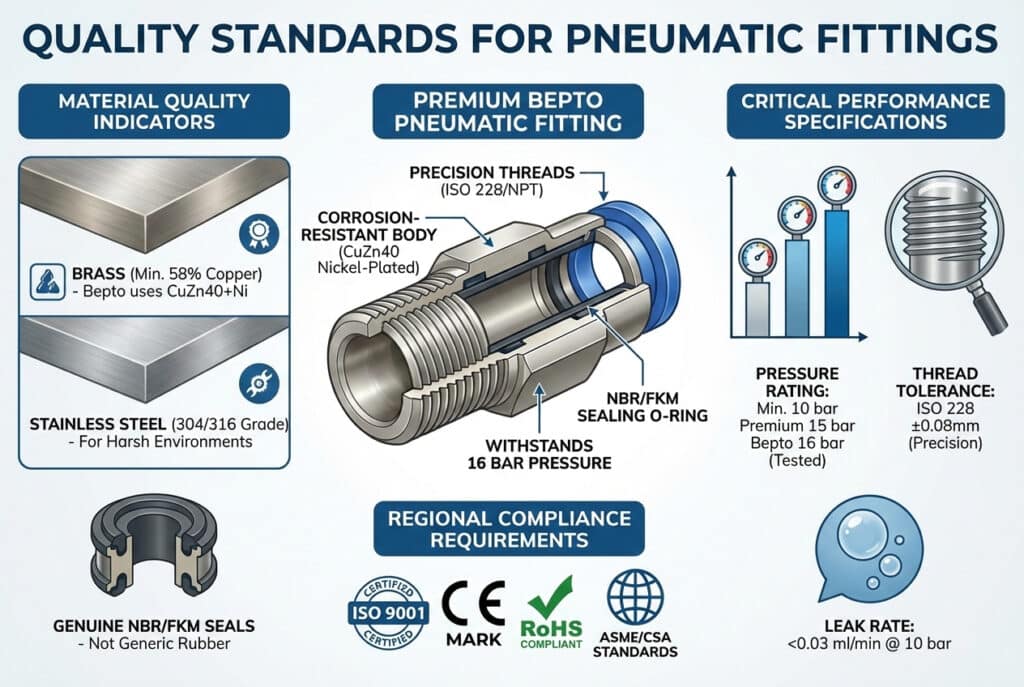
Material Quality Indicators
The material composition directly impacts fitting longevity and performance. Here’s what separates quality fittings from cheap knockoffs:
Brass fittings: Should contain minimum 58% copper content (CuZn39Pb3 or better). Lower copper content leads to premature cracking and thread stripping. At Bepto Pneumatics, we use CuZn40 brass with nickel plating for superior corrosion resistance.
Stainless steel options: Look for 304 or 316 grade stainless steel for corrosive environments. Anything less will rust within months in humid or chemical-exposed applications.
Sealing components: O-rings should be genuine NBR (Nitrile) or FKM (Viton) depending on your application—not generic rubber compounds that harden and crack.
Critical Performance Specifications
| Quality Parameter | Minimum Standard | Premium Standard | Bepto Specification |
|---|---|---|---|
| Pressure rating | 10 bar (145 psi) | 15 bar (217 psi) | 16 bar (232 psi) tested |
| Thread tolerance | ISO 2281 ±0.2mm | ISO 228 ±0.1mm | ISO 228 ±0.08mm |
| Surface finish | Nickel plating 3μm | Nickel plating 5μm | Nickel plating 8μm |
| Leak rate | <0.1 ml/min @ 8 bar | <0.05 ml/min @ 8 bar | <0.03 ml/min @ 10 bar |
| Cycle life | 50,000 connections | 100,000 connections | 150,000+ connections |
Regional Compliance Requirements
Don’t overlook regulatory compliance—it’s not just paperwork, it’s liability protection. For European markets, CE marking and RoHS compliance are mandatory. For North American applications, ensure fittings meet relevant ASME B1.20.1 (NPT2 threads) or CSA standards where applicable.
How Do You Qualify Suppliers Before Placing Bulk Orders?
Never commit to large volumes without thoroughly vetting your supplier. Due diligence saves disasters. 🔍
Supplier qualification should include verifying ISO 9001 or equivalent certifications, requesting factory audit reports, checking customer references from similar industries, reviewing quality control documentation, assessing financial stability for long-term partnerships, and starting with small trial orders before scaling to bulk purchases.
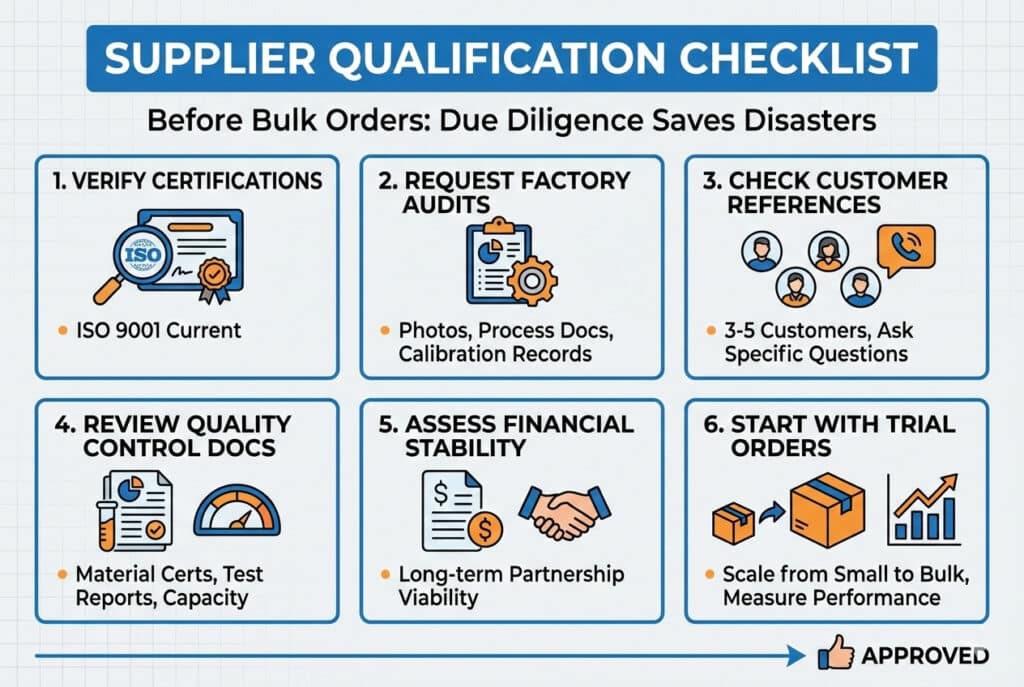
The Supplier Qualification Checklist
I’ve developed this checklist over 15 years in the pneumatics industry. It’s saved our clients millions in avoided failures:
Documentation Review
- ISO 90013 certificate: Current and from accredited body
- Material certifications: Mill certificates for brass/stainless steel
- Test reports: Pressure testing, salt spray testing, thread gauge reports
- Production capacity: Can they handle your volume consistently?
Factory Assessment
You don’t necessarily need to visit in person (though it helps), but request:
- Photos/videos of production facilities
- Quality control process documentation
- Equipment calibration records
- Inventory management systems
Reference Verification
Ask for 3-5 current customers in your industry. When you call them, ask specific questions:
- What’s their defect rate? (Should be <0.5% for quality suppliers)
- How do they handle quality issues?
- Are deliveries on time?
- How’s their technical support?
The Trial Order Strategy
Here’s how I guided Robert, an operations manager at an automation equipment manufacturer in Ohio, through supplier qualification. He needed 10,000 push-to-connect fittings annually but was nervous about switching from his expensive OEM supplier.
We started with a trial order of 100 mixed fittings—enough to install on two production machines. After 60 days of operation with zero failures, he ordered 500 for broader testing. Three months later, with a failure rate of just 0.2% (compared to 0.3% from his OEM supplier), he committed to quarterly bulk orders. Smart, methodical, risk-managed. 👍
What Testing Should You Perform on Sample Batches?
Sample testing is your insurance policy against bulk order disasters. Never skip this step.
Comprehensive sample testing should include visual inspection for surface defects, dimensional verification using calibrated gauges, pressure testing to 1.5x rated pressure, leak testing with soapy water or ultrasonic detectors, thread quality assessment with go/no-go gauges, and installation/removal cycle testing to verify durability.
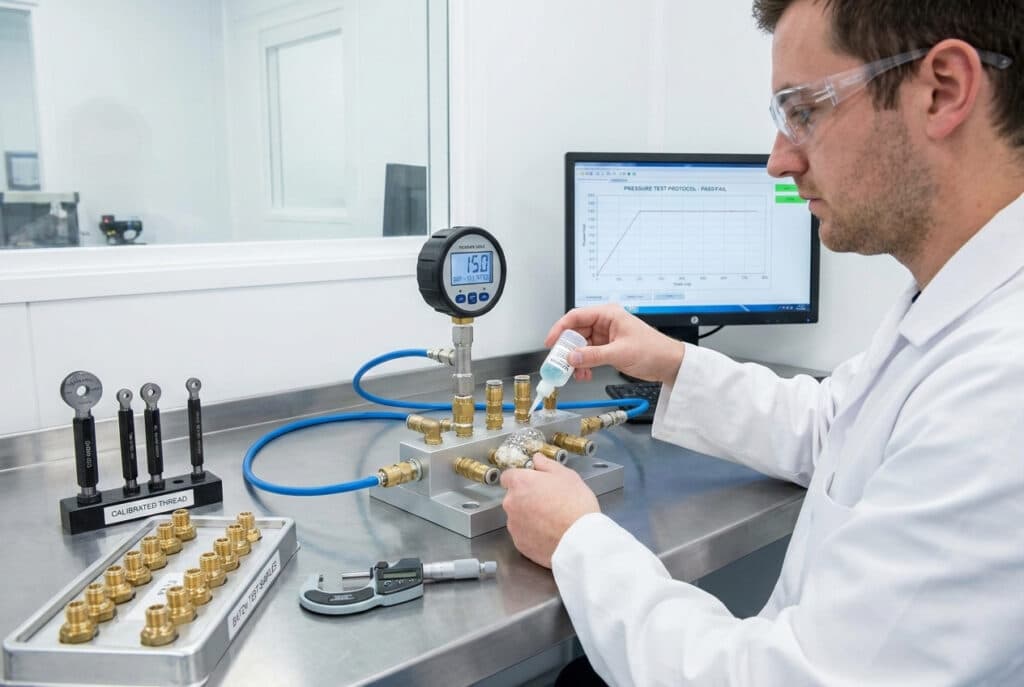
Visual and Dimensional Inspection
Start with what you can see and measure:
Surface quality: Look for consistent plating, no pitting, scratches, or discoloration. Quality nickel plating should be uniform and smooth.
Thread inspection: Use thread gauges (go/no-go gauges) to verify accuracy. Poor threads cause cross-threading, leaks, and premature failure. This is where cheap fittings most commonly fail.
Dimensional accuracy: Verify hex sizes, overall lengths, and port depths match specifications. Inconsistent dimensions indicate poor manufacturing control.
Functional Performance Testing
Now test what really matters—performance under pressure:
Pressure Testing Protocol
- Install fitting on test manifold
- Pressurize to rated working pressure (typically 10 bar)
- Hold for 5 minutes—zero pressure drop acceptable
- Increase to 1.5x rated pressure (15 bar)
- Hold for 2 minutes—zero pressure drop acceptable
- Cycle pressure 0-10 bar 50 times
- Final leak test at working pressure
At Bepto Pneumatics, every production batch undergoes this testing. We don’t ship anything that doesn’t pass. 💯
Leak Testing Methods
Soapy water method: Simple, effective for obvious leaks. Apply soapy water solution to all connection points under pressure. Bubbles = leaks.
Ultrasonic leak detection: For critical applications, ultrasonic detectors identify leaks too small to see. Worth the investment if you’re ordering high volumes.
Pressure decay testing: Pressurize a sealed system and monitor for pressure drop over 10-30 minutes. Quantifies leak rates precisely.
Durability and Cycle Testing
Quality fittings should handle repeated connections without degradation:
- Install and remove fitting 20 times
- Check for thread wear, seal damage, or body cracking
- Perform final pressure test
- Compare to initial test results
If performance degrades after 20 cycles, imagine what happens after 1,000 installations in your facility!
How Can You Implement Effective Incoming Inspection Processes?
Even with qualified suppliers, incoming inspection catches issues before they reach your production floor. 🎯
Effective incoming inspection combines statistical sampling (inspect 2-5% of bulk orders using AQL standards), documented inspection procedures with clear accept/reject criteria, calibrated measurement tools, dedicated inspection workspace, and immediate supplier notification protocols for non-conforming materials.
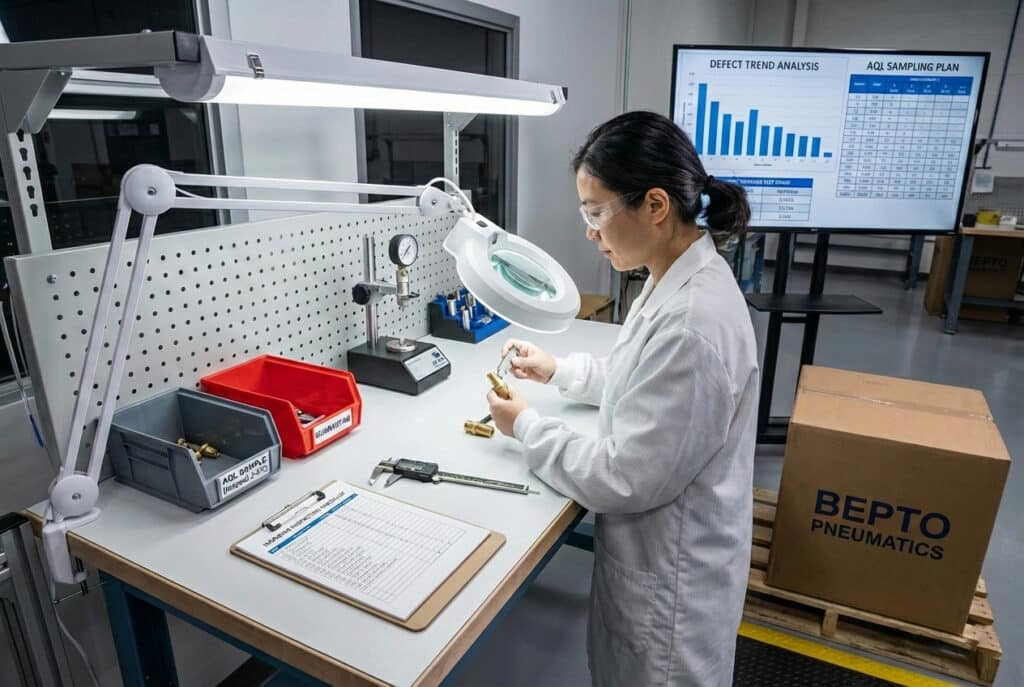
Statistical Sampling Strategy
You can’t inspect every fitting in a 5,000-piece order—it’s not practical or cost-effective. Instead, use AQL4 (Acceptable Quality Level) sampling:
| Order Quantity | Sample Size (AQL 1.5) | Accept if ≤ Defects | Reject if ≥ Defects |
|---|---|---|---|
| 500-1,200 | 50 pieces | 2 | 3 |
| 1,201-3,200 | 80 pieces | 3 | 4 |
| 3,201-10,000 | 125 pieces | 5 | 6 |
| 10,001-35,000 | 200 pieces | 7 | 8 |
This approach, based on ISO 2859-15 standards, balances inspection costs with risk management.
The Inspection Workstation Setup
Create a dedicated incoming inspection area with:
- Calibrated tools: Thread gauges, calipers, pressure test equipment (calibrated annually)
- Inspection checklist: Standardized form for consistent evaluation
- Good lighting: Essential for visual inspection
- Quarantine area: Hold shipments until inspection complete
- Documentation system: Track inspection results over time
Building Supplier Accountability
Here’s what makes our partnership model at Bepto Pneumatics different: we welcome your inspection process. In fact, we encourage it. Why? Because we’re confident in our quality.
I worked with Maria, a quality manager at a pharmaceutical equipment company in New Jersey, to establish a collaborative quality program. When she finds any issues (rare, but it happens), she photographs them, sends me the data within 24 hours, and we immediately:
- Issue a replacement shipment (expedited, no charge)
- Investigate root cause at our facility
- Implement corrective action
- Provide her with a detailed CAPA report
This transparency has built a partnership where she trusts our quality, and we continuously improve based on real-world feedback. That’s how B2B relationships should work. 🤝
Digital Documentation and Trend Analysis
Don’t just inspect and forget—track your data:
- Defect rates by supplier: Identify patterns
- Defect types: Threading issues? Plating problems? Dimensional errors?
- Batch tracking: Correlate issues to specific production runs
- Cost of quality: Calculate inspection costs vs. failure costs
Modern QC software makes this easy, but even a simple spreadsheet provides valuable insights over time.
Conclusion
Bulk purchasing pneumatic fittings doesn’t mean compromising on quality—it means being strategic, systematic, and partnering with suppliers who value your success as much as their own. 🎯
FAQs About Bulk Purchasing Pneumatic Fittings
What’s a reasonable defect rate for bulk pneumatic fittings?
Quality suppliers should consistently deliver defect rates below 0.5%, with premium suppliers achieving 0.2% or lower. At Bepto Pneumatics, our current defect rate is 0.18% based on customer returns and inspection data. Anything above 1% indicates serious quality control issues. Remember, even a 1% defect rate means 50 bad fittings in a 5,000-piece order—that’s 50 potential leak points in your facility.
How much can I save buying bulk fittings vs. OEM parts?
Bulk purchasing from quality alternative suppliers typically saves 30-50% compared to OEM pricing, with savings increasing at higher volumes. For example, a 5,000-piece order of push-to-connect fittings might cost $8,000 from OEM suppliers but only $4,500-$5,500 from Bepto Pneumatics—saving $2,500-$3,500 without sacrificing quality. The key is ensuring those savings don’t come at the cost of reliability.
Should I single-source or multi-source my pneumatic fittings?
For standard fittings, maintain 2-3 qualified suppliers to ensure supply continuity and competitive pricing; for critical applications, single-source with a highly qualified supplier who provides consistent quality. I typically recommend a 70/30 split: 70% of your volume with your primary supplier (who gives you best pricing and service), 30% with a qualified backup. This maintains competition while building strong partnerships.
What’s the minimum order quantity for bulk pricing?
Bulk pricing typically begins at 500-1,000 pieces for common fittings, with additional price breaks at 2,500, 5,000, and 10,000+ units. At Bepto Pneumatics, we’re flexible based on your needs. Even if you don’t need 5,000 fittings immediately, we can arrange quarterly shipments against an annual contract—you get bulk pricing, we get predictable orders, and you don’t tie up warehouse space. Win-win-win. 📦
How does Bepto Pneumatics ensure consistent quality across bulk orders?
We implement 100% automated pressure testing on production lines, conduct statistical sampling inspections per ISO 2859-1 standards, maintain full traceability from raw materials through finished goods, and provide material certifications and test reports with every shipment. Our quality management system is ISO 9001 certified, and we treat every bulk order with the same rigor as precision components. Quality isn’t negotiable—it’s our foundation. Give us a call, and I’ll walk you through our quality processes in detail. 🚀
-
Understand the international technical specifications for pipe threads used in pneumatic connections. ↩
-
Explore the specific standards and sealing mechanics of National Pipe Taper threads common in North America. ↩
-
Learn how ISO 9001 standards ensure consistent product quality through rigorous management systems. ↩
-
Discover how statistical sampling plans are used to determine batch quality in industrial manufacturing. ↩
-
Review the international standard for sampling procedures used in manufacturing quality control. ↩