

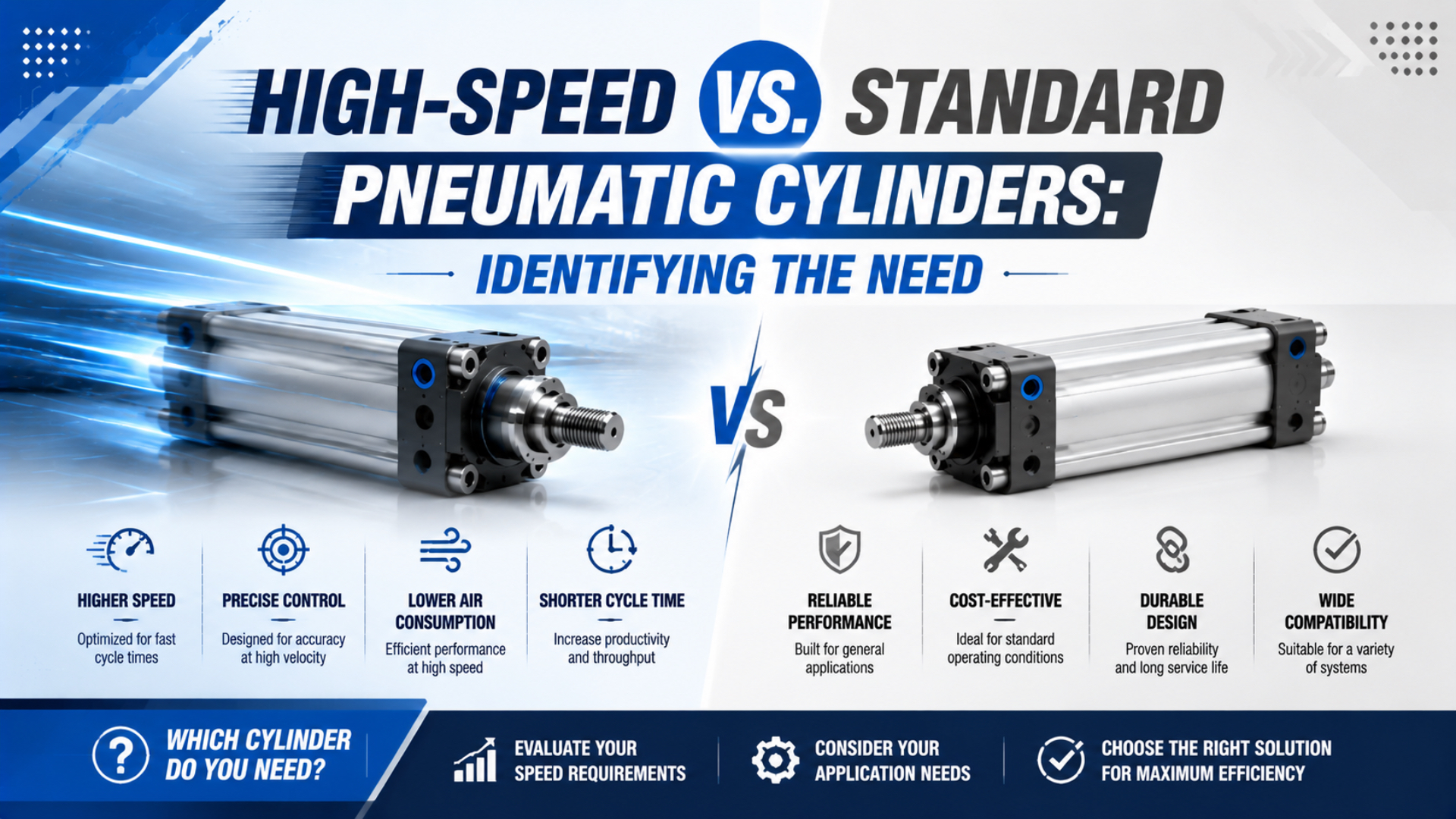
A standard pneumatic cylinder is sufficient when the exact series meets the required stroke time and load at dynamic pressure. Its cushioning limit and sustained-duty rating must also pass. Choose a high-speed version only when manufacturer data show that a standard model fails one of those checks and the special version provides the missing capacity.
There is no universal speed at which every standard cylinder becomes unsuitable; product construction, bore and stroke influence the result. Moving mass, air-path restrictions and stopping method also matter; mounting and cycle profile complete the picture, and the label “high-speed” becomes useful only after those variables are fixed.
Key Takeaways
- SMC lists one standard cylinder at 1,500 mm/s and one high-speed series at 1,000 to 1,500 mm/s.
- Compare exact catalog limits, not generic speed bands.
- Check dynamic pressure and cushion-entry energy separately.
- A fast cylinder cannot compensate for a restrictive valve or tube.
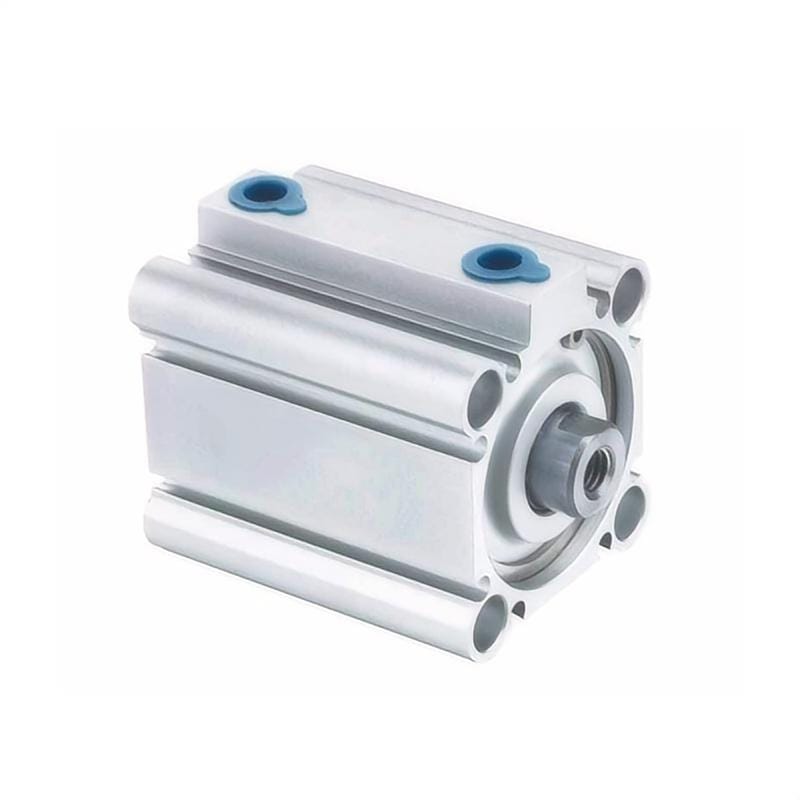
The compact cylinder above illustrates one possible actuator format. Its appearance does not establish a speed rating. Confirm the complete model code and application limits before treating any compact, ISO-profile or guided cylinder as a high-speed design.
Is There a Universal Speed Threshold for High-Speed Pneumatic Cylinders?
Published catalogs do not establish a universal speed threshold separating standard pneumatic cylinders from high-speed models. SMC lists its standard single-acting C85 from 50 mm/s to 1.5 m/s. Its CXS high-speed option reaches 1.5 m/s on smaller bores and 1.0 m/s on 25 and 32 mm bores (SMC C85; SMC CXS-XB19, accessed 2026).
The SMC CXS2 shows why relative improvement also matters. Its published maximum piston speed is 800 mm/s, which SMC describes as 2.6 times that of the preceding model. Although this value is below 1.5 m/s, the model still represents a substantial product-specific speed increase (SMC CXS2, accessed 2026).
| Manufacturer example | Product description | Published piston-speed data | What it proves |
|---|---|---|---|
| SMC C85 | Standard single-acting cylinder | 50 to 1,500 mm/s | A standard product can reach 1.5 m/s |
| SMC CXS-XB19 | High-speed dual-rod option, bores 6 to 20 mm | 30 to 1,500 mm/s | The special option must be read by exact bore |
| SMC CXS-XB19 | High-speed dual-rod option, bores 25 and 32 mm | 30 to 1,000 mm/s | A high-speed label does not guarantee 3 m/s |
| SMC CXS2 | Dual-rod cylinder promoted as a faster development | Up to 800 mm/s | Relative improvement can matter below 1 m/s |
A speed label is relational. It usually compares one design with another product or application envelope, but it cannot replace the model-specific selection data. Two cylinders with the same nominal velocity can present different risks because bore, stroke, moving mass, mounting, cushion geometry and internal flow passages differ. Even two bore sizes within one product family may carry different published limits. Treat the label as a prompt to inspect the catalog, not as approval. The actual selection still depends on the mass-speed diagram, allowable kinetic energy, bearing load, cushioning method and any manufacturer test conditions attached to the complete model code. Published speed limits also do not prove that upstream valves and tubing can meet the motion time or that the piston can dissipate its energy safely at the end of stroke. Those gates remain separate during selection and production validation.
Four Evidence Gates for the Standard-or-High-Speed Decision
A defensible decision needs four independent checks: motion time and dynamic force plus stopping capacity and sustained duty. Parker warns that piston speed at cushion entry can be about 50% higher than average stroke speed, so one average-speed value cannot approve all four gates (Parker P1F, accessed 2026).
Use the gates in this order:
- Motion gate: Meet both commanded stroke times.
- Force gate: Does adequate force remain at the minimum dynamic pressure measured while the load moves?
- Stop gate: Can the built-in cushion or external absorber handle the moving mass at cushion-entry speed?
- Duty gate: Run the intended production sequence long enough to expose pressure-recovery, temperature, leakage and end-of-stroke changes rather than approving the cylinder from a few isolated strokes.
Passing the motion gate does not prove that the stop gate passes. A lightly loaded cylinder may travel quickly but strike the end cap because the cushion is outside its approved mass-speed range. The reverse can also occur: cushioning may be adequate while an undersized valve prevents the required stroke time.
Can a Standard Cylinder Meet the Required Stroke Time?
Cylinder speed cannot be predicted reliably from bore and pressure alone. AutomationDirect states that losses through piping, fittings, valves and ports make speed estimation difficult; higher speed increases those losses and may require testing several component combinations (AutomationDirect, accessed 2026).
Start with the required one-direction average speed:
Here, is average piston speed, is the one-direction stroke length, and is the allowed movement time for that direction. Do not use total machine cycle time unless it excludes valve delay, dwell, processing time and the opposite stroke.
Check the complete air path:
- Record the minimum regulator outlet pressure throughout extension and retraction, including any simultaneous air demand from neighboring actuators.
- Dynamic pressure at the active cylinder port.
- Back pressure at the exhausting cylinder port.
- Valve flow data at the expected pressure ratio.
- Measure tube inside diameter and total routed length in both directions, not only the nominal connection size printed on the fitting.
- Fittings, flow controls, manifolds and exhaust silencers.
- Pressure recovery before the next simultaneous demand.
If calculated flow appears sufficient but port pressure collapses, a different cylinder label will not repair the restriction. Use the Cylinder Flow Requirement Calculator for an initial estimate. Dynamic measurements on the installed circuit must then confirm the result; the separate high-speed cylinder specification checklist covers the full RFQ and acceptance-test workflow.
Speed shortfall is a system symptom before it is a cylinder verdict. A pressure trace at the supply manifold alone cannot locate the restriction because the active chamber may still be starved or the exhaust chamber may retain back pressure. Measure at both cylinder ports during the motion and compare the timing with the valve command and position signal. This separates delayed valve response from chamber filling, restricted exhaust and mechanical breakaway. Approve an actuator upgrade only when the evidence identifies the cylinder’s internal passage or product rating as the failed gate. If the valve, tube, silencer or supply recovery is responsible, address that element directly.
Can the Built-In Cushion Stop the Moving Mass?
Parker explicitly states that cushion-entry speed is typically about 50% higher than average piston speed and instructs users to select from moving-mass and permissible-entry-speed data. This makes stopping capacity a separate approval from catalog travel speed (Parker P1F, accessed 2026).
The minimum kinetic-energy calculation is:
Here, is kinetic energy at cushion entry, is the total moving mass coupled to the cylinder, and is cushion-entry velocity. Include tooling, adapters, guided carriages and the product. Obtain from measurement, a validated motion model or the manufacturer’s approved selection method.
Speed has a squared effect. At unchanged mass:
Doubling entry speed produces four times the kinetic energy. This ratio is physics, but it is not a cylinder rating. Compressed air may continue doing work while the piston enters the cushion zone, and an external vertical load can add or remove energy. Compare the complete result with the exact cushion diagram or allowable-energy method.
If the internal cushion is insufficient the solution is not automatically a different cylinder; corrections may include lower entry speed or moving mass plus a revised profile and suitable high-energy cylinder option. An external shock absorber can address the remaining cases; size it for energy per stroke and per hour, then consult the end-of-stroke force guide because average stopping force is not peak impact force.
When Does a High-Speed Design Add Real Capability?
SMC’s CXS-XB19 high-speed option enlarges the cylinder-port orifice and states approximately four times the allowable kinetic energy of the standard type. Those are measurable product-specific improvements, unlike a generic claim that every high-speed cylinder has steel end caps or one seal material (SMC CXS-XB19, accessed 2026).
A specialized design adds value when its documented change addresses the failed evidence gate. Examples include:
- More internal flow area.
- A higher approved piston-speed range for the required bore and stroke.
- A larger permissible mass-speed envelope or allowable kinetic energy, documented for the required mounting orientation and cushion setting rather than inferred from a different bore.
- A bearing or guide arrangement approved for the application’s moments.
- A seal, lubricant or material option approved for measured temperature and duty.
- A cushion or bumper system validated for the required entry condition.
Ask the supplier to state the comparison explicitly: which standard model fails, which limit it exceeds, which high-speed model replaces it, and which published value or test closes the gap. Without that chain, the upgrade is a marketing label rather than an engineering decision.
When Is a Standard Pneumatic Cylinder the Better Choice?
SMC publishes up to 1,500 mm/s for the standard C85 series, demonstrating that a standard cylinder can be the correct fast-motion choice within its exact limits. A special high-speed option is unnecessary when the standard model passes motion, force, stop and duty checks with documented margin (SMC C85, accessed 2026).
Keep the standard cylinder when:
- Rated speed passes.
- Dynamic port pressure preserves the required force.
- Moving mass and entry speed fall inside the cushion or bumper limit.
- External guides carry prohibited side loads and moments without transferring alignment error or binding force back into the cylinder rod and bearings.
- The valve and tubing can deliver the required flow without unstable motion.
- Sustained production testing shows stable timing, temperature and leakage.
- Standard mounting, seals and wear parts simplify maintenance without sacrificing the requirement.
That decision is not the same as choosing the cheapest cylinder. A standard model is better only when the complete system proves the requirement; dependence on an unexplained catalog boundary leaves the selection unverified.
For long-stroke or high-mass axes, review inertia matching for load deceleration. A larger bore can raise available force while also increasing chamber volume and air demand, so oversizing is not a universal remedy for speed.
What Does a Bad High-Speed Stroke Tell You?
AutomationDirect notes that higher speed increases pressure loss through valves, tubing and ports, while Parker separates travel speed from cushioning capacity. Together, those sources show why one symptom cannot prove that a standard cylinder needs replacement (AutomationDirect; Parker P1F, accessed 2026).
| Observed symptom | First measurements | Likely review path |
|---|---|---|
| Stroke is slow in both directions | Regulator and both cylinder-port pressure traces | Supply, FRL, valve and shared tubing |
| One direction is slow | Active-port pressure and opposing back pressure | Directional-valve path, flow control, tube or exhaust |
| Speed is acceptable but end impact is harsh | Moving mass, cushion-entry speed and cushion setting | Built-in cushion, motion profile or external absorber |
| Tooling rebounds at the end | Position trace, stop contact and pressure trace | Cushion adjustment, mechanical stop and structural stiffness |
| Timing drifts during sustained cycling | Temperature, leakage, pressure recovery and duty | Seal condition, lubrication policy, supply recovery and thermal limit |
| Rod or guide binds | Alignment, side load, guide preload and mounting deflection | Mechanical redesign rather than a speed-grade change |
Avoid diagnosing end-cap fracture, seal hardening or bore scoring from speed alone. Begin with the damaged parts and the operating record: pressure traces, actual cycle sequence, load orientation, temperature trend and recent maintenance. Inspect alignment and the load path before attributing rod or bearing damage to velocity. Contamination evidence should be compared with filtration and lubrication history, while end-cap marks should be checked against cushion settings, stops and entry speed. A repeated symptom that follows one direction may implicate an asymmetric valve or exhaust path. Failure analysis becomes useful only when evidence from the actual component connects the observed damage to a specific operating condition.
The useful distinction is not “standard failure versus high-speed success” but air-path limit, force limit, stop-energy limit, duty limit or mechanical-load limit. Naming the failed limit makes the corrective action testable.
A Defensible Standard-vs-High-Speed Decision
The cited SMC examples span 800 to 1,500 mm/s across products described as standard, improved or high-speed, while Parker warns that cushion-entry velocity may be 50% above average. A defensible selection therefore follows evidence gates instead of one speed threshold (SMC; Parker, accessed 2026).
Write the final decision as a short approval record:
- Motion times.
- Minimum dynamic pressure and measured exhaust back pressure.
- Exact cylinder model, bore, stroke and published speed range.
- Moving mass, measured or manufacturer-approved cushion-entry speed, cushion setting, and the exact diagram or allowable-energy method used to approve the stop.
- Sustained test duration plus timing and temperature trend.
- Failed gate, corrective action and final acceptance result.
High-Speed vs. Standard Pneumatic Cylinder FAQs
SMC publishes a standard-cylinder example at 1.5 m/s and a high-speed example at 1.0 to 1.5 m/s. Five recurring buyer questions therefore cannot be answered by one velocity boundary. The answers below separate product ratings from airflow, stopping energy and installed verification (SMC, accessed 2026).
Is every application above 1.5 m/s a high-speed-cylinder application?
No. Some standard products are rated to 1.5 m/s, while some high-speed versions are rated at or below that value. Check the exact series and bore first. Then verify stroke, moving mass, cushioning and duty. A generic threshold cannot replace the manufacturer’s speed and mass-energy limits.
Can a larger valve make a standard cylinder suitable for high speed?
Only an air-path limit can be corrected with a larger valve; measure dynamic pressure and exhaust back pressure before reviewing the valve and tubing. Extra flow cannot correct inadequate cushioning or mechanical defects, and it cannot legitimize operation outside the cylinder rating.
Should average piston speed be used for cushion selection?
Not by itself. Parker warns that cushion-entry speed may be about 50% higher than average speed. Use measured or manufacturer-approved entry velocity with total moving mass, then follow the exact cushion diagram or allowable-energy method. Include drive energy when the manufacturer’s procedure requires it.
Does a high cycle rate automatically require a high-speed cylinder?
Cycle rate has no universal boundary across bore sizes and product families; record sustained rate and burst duration while tracking temperature plus leakage and pressure recovery alongside end-of-stroke behavior. Select a special model only if the standard series fails a documented limit.
When should an external shock absorber be used?
Use an external absorber when the cylinder manufacturer’s built-in cushion limit is exceeded or when the machine stop requires an independently rated energy absorber. Size it from impact mass and velocity plus drive force. Check energy per stroke and energy per hour separately. Confirm mounting alignment and stroke engagement from its manufacturer data.