Introduction
You’ve built a successful automation business, and your customers are asking for pneumatic cylinders under your brand. The opportunity is clear: higher margins, brand differentiation, and customer loyalty. But you’ve heard the horror stories—inconsistent quality, missed deadlines, intellectual property theft, and products that damage your hard-earned reputation. Choosing the wrong private label manufacturer can destroy what took years to build. The stakes couldn’t be higher. 😰
Identifying reliable private label pneumatic cylinder manufacturers requires verifying manufacturing capabilities and certifications (ISO 9001 minimum), assessing quality control systems through factory audits, evaluating intellectual property protection and NDA compliance, confirming customization flexibility for branding and specifications, reviewing customer references and production track records, and establishing clear communication channels and project management processes.
Last year, I worked with Rebecca, who owns a fluid power distribution company in Ohio. She’d been burned by two private label manufacturers before finding us—one delivered cylinders that leaked within weeks, another missed every deadline by months. After implementing the evaluation framework I’m about to share, she’s been successfully selling Bepto-manufactured cylinders under her brand for 18 months with zero quality complaints and growing sales. 📈
Table of Contents
- What Manufacturing Capabilities Should Private Label Cylinder Producers Have?
- How Do You Verify Quality Control and Consistency?
- What Intellectual Property Protections Should You Require?
- How Do You Evaluate Communication, Flexibility, and Partnership Potential?
What Manufacturing Capabilities Should Private Label Cylinder Producers Have?
Not every cylinder manufacturer can successfully execute private label production—specific capabilities are essential. 🏭
Reliable private label manufacturers must demonstrate comprehensive in-house production capabilities (not just assembly operations), proven experience with custom specifications and modifications, flexible MOQ (minimum order quantities) that match your business scale, capacity to handle both standard and specialized designs, established supply chains for quality raw materials, and documented experience producing for other brands without conflicts of interest.

The Full Manufacturing Capability Assessment
Don’t assume every “manufacturer” actually manufactures. Many are assemblers or traders. Verify:
Core Production Capabilities
Machining and fabrication:
- CNC machining centers1 for precision components
- Tube cutting and honing equipment
- Thread rolling and tapping capabilities
- Surface treatment facilities (plating, anodizing, painting)
Assembly and testing:
- Clean assembly environments (especially for rodless cylinders)
- Automated or semi-automated assembly lines
- Pressure testing equipment (100% testing capability)
- Leak detection systems
- Quality inspection stations
Engineering support:
- In-house engineering team for custom designs
- CAD/CAM capabilities for design modifications
- Prototyping facilities for new products
- Testing labs for validation
At Bepto Pneumatics, we control the entire manufacturing process from raw material inspection through final testing. We’re not assembling someone else’s components—we’re manufacturing pneumatic cylinders from the ground up. That’s the level of control you need in a private label partner. 💪
Product Range and Specialization
Question to ask: “What types of pneumatic cylinders do you specialize in?”
Look for manufacturers with:
- Depth in your product category: If you need rodless cylinders, work with rodless cylinder specialists
- Breadth for growth: Capability to expand into related products as your brand grows
- Custom design experience: Not just catalog products with your logo
| Manufacturer Type | Strengths | Limitations | Best For |
|---|---|---|---|
| Specialized (e.g., rodless only) | Deep expertise, superior quality | Limited product range | Focused brands, high-performance needs |
| Broad pneumatics | One-stop solution, economies of scale | May lack specialization | Full-line distributors, diverse needs |
| Custom/OEM focused | Design flexibility, engineering support | Higher MOQs, longer lead times | Unique applications, differentiation |
| High-volume commodity | Low cost, fast production | Limited customization, quality variance | Price-sensitive, standard products |
Minimum Order Quantity (MOQ) Alignment
This is where many private label relationships fail:
Manufacturer’s MOQ too high: You’re forced to carry excessive inventory or can’t get started
Your volume too low: You’re not a priority customer, service suffers
Sweet spot: Your typical order represents 5-15% of their monthly capacity—significant enough to matter, not so large you’re dependent on them alone.
I worked with Marcus, a machine builder in Texas who wanted to private label specialty rodless cylinders. His initial volume was only 50 units quarterly. Most manufacturers quoted 500-unit MOQs. We structured a program starting at 100 units with a path to higher volumes—giving him reasonable inventory levels while making the business worthwhile for us. Two years later, he’s ordering 300+ units quarterly. That’s how partnerships grow. 🌱
Supply Chain and Material Sourcing
Critical question: “Where do you source your raw materials and key components?”
Quality private label manufacturers:
- Source aluminum extrusions and steel from certified suppliers
- Use genuine seal brands (Parker, SKF, etc.) or equivalent quality
- Maintain material certifications and traceability
- Have backup suppliers to prevent material shortages
Red flags:
- Vague answers about material sources
- Unwillingness to provide material certifications
- “We use the cheapest available supplier”
- No traceability systems
How Do You Verify Quality Control and Consistency?
Your brand reputation depends on consistent quality—every cylinder, every batch, every time. 🎯
Verify quality control through factory audits (virtual or in-person), reviewing documented quality management systems (ISO 9001 minimum), examining actual test reports and inspection records, conducting pilot production runs with rigorous testing, establishing clear quality specifications and acceptance criteria, and implementing ongoing quality monitoring with statistical process control.
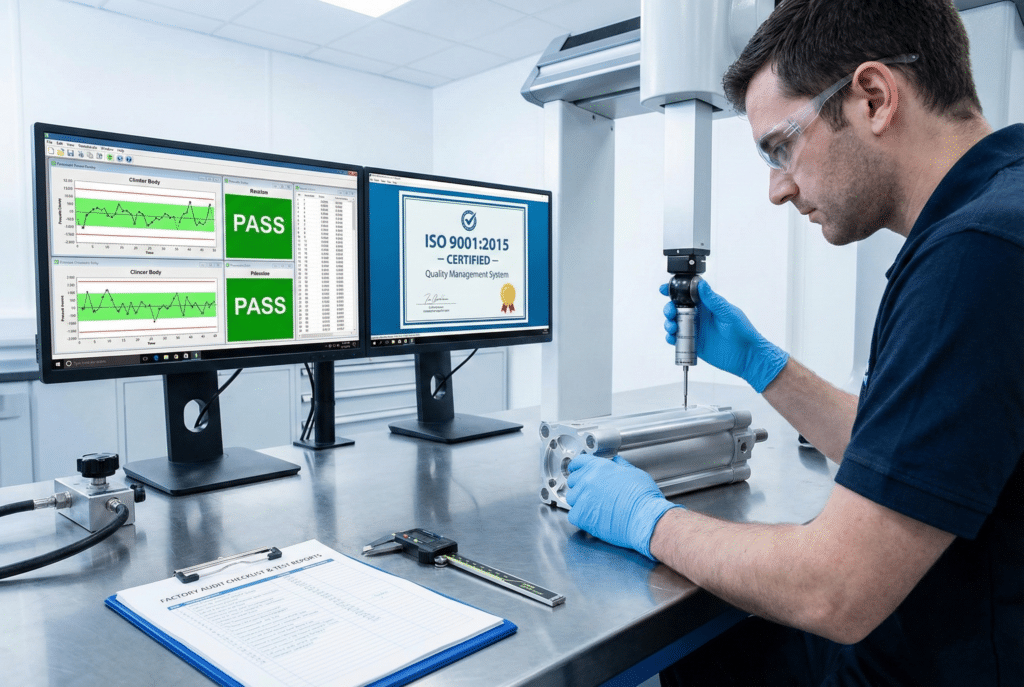
The Factory Audit Checklist
Whether virtual or in-person, systematically evaluate:
Production Environment
- Cleanliness and organization: 5S methodology2 implemented?
- Equipment condition: Well-maintained, calibrated machinery
- Workflow layout: Logical, efficient production flow
- Environmental controls: Temperature, humidity control for precision work
Quality Control Infrastructure
- Inspection equipment: CMMs3, pressure testers, leak detectors, thread gauges
- Calibration program: Regular calibration with documented records
- Inspection frequency: In-process and final inspection protocols
- Defect tracking: How defects are identified, documented, and resolved
Documentation and Traceability
- Batch tracking: Can they trace any cylinder back to raw materials?
- Test records: Documented pressure tests, dimensional inspections
- Non-conformance reports: How are quality issues handled?
- Continuous improvement: Evidence of corrective actions and improvements
The ISO 9001 Verification
ISO 9001 certification is your baseline requirement, but verify it properly:
Check certificate authenticity:
- Verify certification body is accredited (IAF member)
- Confirm scope includes “pneumatic cylinders” or relevant products
- Check validity dates and surveillance audit status
- Search certification body’s public database
Request audit reports:
- Most recent surveillance or recertification audit
- Any non-conformances and corrective actions
- Management review meeting minutes (shows commitment)
At Bepto Pneumatics, our ISO 9001:2015 certification specifically covers “design, manufacture, and supply of pneumatic cylinders and components.” We share our audit summaries with private label partners because transparency builds trust. 📋
The Pilot Production Strategy
Never commit to large volumes without testing:
Phase 1: Sample evaluation (10-20 units)
- Full dimensional inspection
- Pressure and leak testing to your specifications
- Functional testing in your application
- Durability/cycle testing if critical
Phase 2: Pilot production (50-100 units)
- Evaluate batch consistency
- Test in customer applications
- Monitor for any field failures over 60-90 days
- Assess packaging and documentation quality
Phase 3: Full production
- Only after pilot proves quality and consistency
- Establish ongoing quality monitoring
- Set up regular audit schedule
I helped Jennifer, a packaging equipment manufacturer in Pennsylvania, through this process. Her pilot batch revealed a minor dimensional inconsistency we corrected before full production. That $3,000 pilot investment saved her from a $50,000 quality disaster. Smart risk management. ✅
Establishing Quality Specifications
Create crystal-clear quality agreements:
Dimensional tolerances:
- Critical dimensions: ±0.05mm or tighter
- Non-critical dimensions: ±0.2mm
- Thread specifications: ISO 2284 or NPT with go/no-go verification
Performance requirements:
- Pressure rating: Minimum 16 bar tested (for 10 bar working pressure)
- Leak rate: <0.03 ml/min at working pressure
- Cycle life: Minimum 100,000 cycles for standard applications
- Operating temperature range: -10°C to +80°C
Cosmetic standards:
- Surface finish requirements
- Plating thickness and quality
- Acceptable defect levels
- Packaging and labeling standards
Acceptance criteria: AQL5 (Acceptable Quality Level) sampling plans
- Major vs. minor defect definitions
- Rejection and return procedures
Ongoing Quality Monitoring
Quality isn’t verified once—it’s monitored continuously:
Monthly quality reports:
- Defect rates by type
- Test results summary
- Customer complaints and resolutions
- Corrective actions implemented
Quarterly performance reviews:
- Trend analysis
- Comparison to quality targets
- Process improvements
- Supplier development initiatives
What Intellectual Property Protections Should You Require?
Your brand, designs, and customer relationships are valuable assets that need protection. 🔒
Essential IP protections include comprehensive Non-Disclosure Agreements (NDAs) before sharing any information, clear contractual terms prohibiting the manufacturer from selling your branded products to others, trademark usage agreements specifying how your brand can be used, design ownership clauses for custom specifications, customer confidentiality provisions, and geographic exclusivity if appropriate for your market.
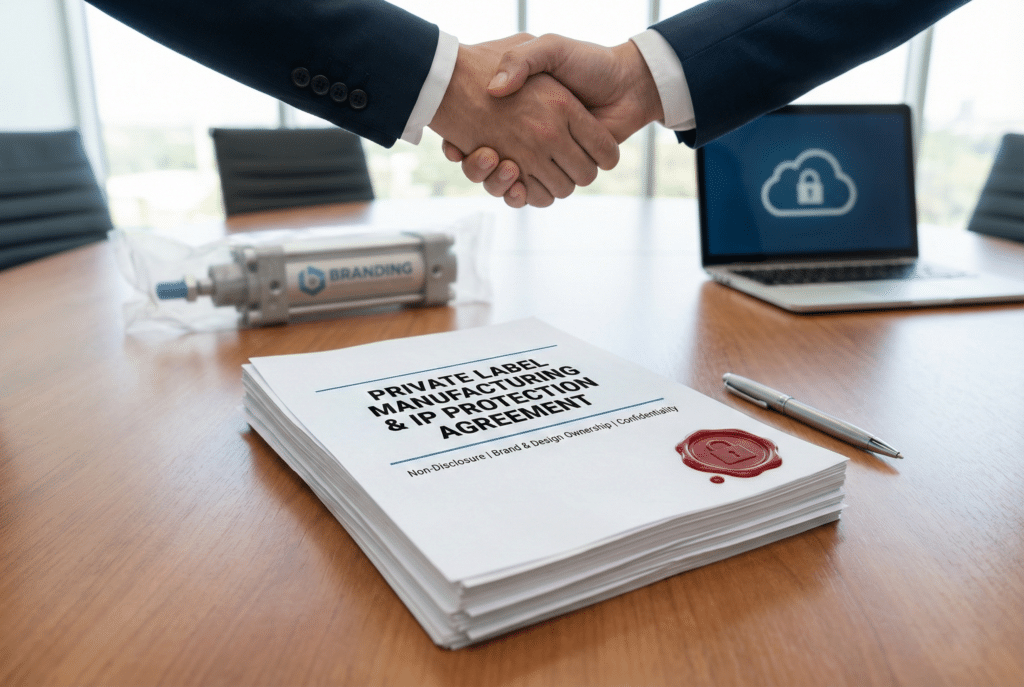
The Non-Disclosure Agreement (NDA)
This is your first line of defense—sign it BEFORE sharing anything:
What should be covered:
- Confidential information definition: Specifications, designs, customer lists, pricing, business plans
- Obligations: How confidential information must be protected
- Duration: Typically 3-5 years after relationship ends
- Remedies: What happens if NDA is breached
- Jurisdiction: Which country’s laws govern disputes
Red flags:
- Manufacturer refuses to sign NDA
- NDA has major loopholes or exceptions
- NDA duration is too short (<2 years)
- Vague language that doesn’t clearly protect your interests
The Private Label Manufacturing Agreement
Your master agreement should explicitly address:
Brand Protection Clauses
Exclusivity provisions:
“Manufacturer agrees not to sell products bearing Customer’s trademarks, logos, or branding to any third party without express written consent.”
Trademark usage:
“Manufacturer may use Customer’s trademarks solely for the purpose of manufacturing products under this agreement and shall not register or attempt to register any similar trademarks.”
Customer confidentiality:
“Manufacturer shall not disclose Customer’s identity as a client or share Customer’s specifications, designs, or business information with any third party.”
Design Ownership
Custom specifications:
“Any custom designs, modifications, or specifications developed for Customer shall remain the exclusive property of Customer.”
Tooling and molds:
“Customer-funded tooling, molds, or fixtures shall remain Customer’s property and shall not be used for production for other parties.”
Geographic and Market Protections
Consider whether you need exclusivity:
Geographic exclusivity:
“Manufacturer agrees not to sell competing products in [North America/Europe/specified territories] during the term of this agreement.”
Market exclusivity:
“Manufacturer agrees not to supply similar products to Customer’s direct competitors identified in Appendix A.”
Balance required: Exclusivity increases your protection but may increase costs or reduce manufacturer’s willingness to partner. Negotiate what’s appropriate for your situation.
I worked with David, who distributes automation components in the Southeast US. He didn’t need global exclusivity, but he did need assurance we wouldn’t supply his direct regional competitors. We agreed to a regional exclusivity clause for his market—protecting his investment while allowing us to serve other markets. Fair and practical. 🤝
Enforcement and Monitoring
Legal agreements only work if you can enforce them:
Monitoring mechanisms:
- Periodic market checks for unauthorized use of your brand
- Mystery shopping to verify manufacturer isn’t selling your branded products
- Online monitoring for trademark infringement
- Customer feedback about product sources
Enforcement provisions:
- Clear breach definitions
- Audit rights to verify compliance
- Financial penalties for violations
- Termination rights for material breaches
Practical reality: Choose manufacturers in countries with enforceable IP laws and reputable business practices. A great contract with an unethical manufacturer in a jurisdiction with weak IP enforcement is worthless.
The Trust Factor
Beyond legal protections, evaluate the manufacturer’s ethics:
Questions to ask references:
- “Has this manufacturer ever violated confidentiality?”
- “Do they respect your customer relationships?”
- “Have you ever found them selling your products to competitors?”
- “Would you trust them with sensitive business information?”
At Bepto Pneumatics, we’ve built our private label business on trust and integrity. We’ve never violated an NDA, never sold a partner’s branded products to others, and never competed with our private label customers. Our reputation is worth more than any short-term gain from unethical behavior. That’s the kind of partner you need. 💼
How Do You Evaluate Communication, Flexibility, and Partnership Potential?
Technical capabilities matter, but partnership quality determines long-term success. 🤝
Evaluate partnership potential through communication responsiveness (24-48 hour response times), language and cultural compatibility for clear understanding, flexibility in accommodating your specific requirements and changes, project management capabilities for on-time execution, willingness to grow with your business, and alignment of business values and long-term vision.
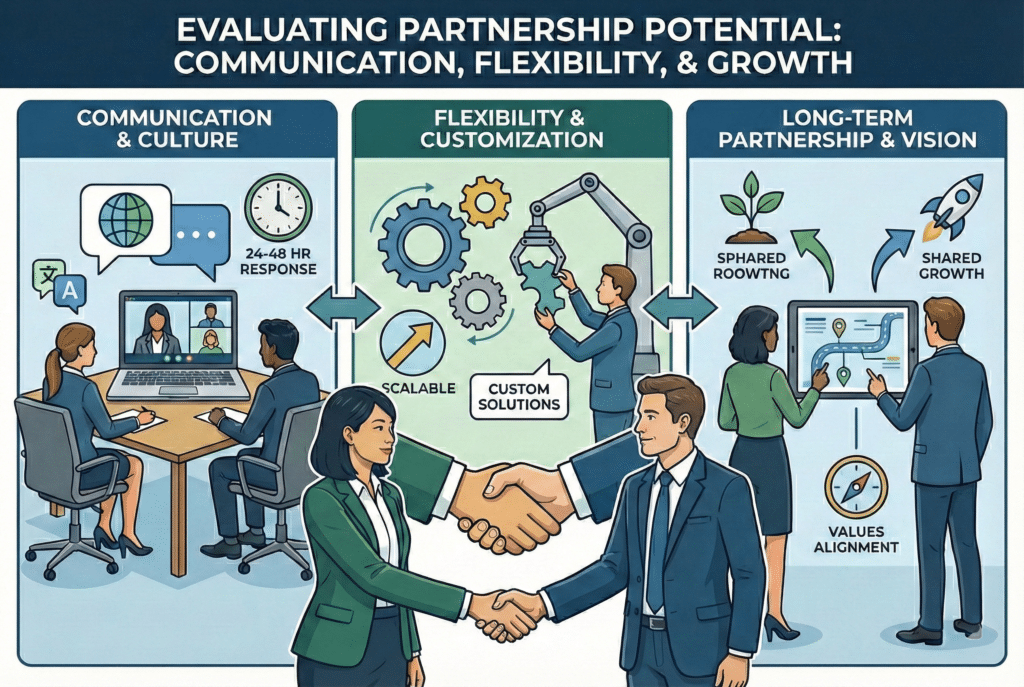
The Communication Assessment
Test communication before committing:
Initial inquiry response:
- How quickly do they respond? (Within 24 hours is professional)
- Is the response thoughtful and detailed, or generic?
- Do they ask intelligent questions about your needs?
- Is communication in clear, understandable language?
Technical discussion quality:
- Can they explain technical concepts clearly?
- Do they understand your application requirements?
- Do they offer suggestions and alternatives?
- Is there genuine engineering expertise, or just sales talk?
Project management capability:
- Do they provide detailed timelines and milestones?
- Are there clear points of contact for different issues?
- How do they handle questions and concerns?
- Do they proactively update you, or only respond when asked?
Language and Cultural Considerations
For international partnerships, this is critical:
Language proficiency:
- Is there someone who speaks your language fluently?
- Are technical documents translated accurately?
- Can they handle complex technical discussions?
- Is there potential for misunderstandings?
Cultural compatibility:
- Do they understand your market’s expectations?
- Are business practices compatible (contracts, payments, etc.)?
- Do they respect your timeline and urgency expectations?
- Is there alignment on quality standards and priorities?
Time zone management:
- Is there overlap in working hours for real-time communication?
- Do they accommodate your schedule for calls and meetings?
- How do they handle urgent issues outside their business hours?
At Bepto Pneumatics, I personally manage our private label partnerships. I speak English fluently, understand Western business practices, and I’m available during US business hours for urgent issues. Communication isn’t a barrier—it’s a strength. 📞
Flexibility and Customization Capability
Test their flexibility early:
Scenario 1: “Can you modify this standard cylinder with a custom mounting bracket?”
- Flexible partner: “Yes, let me get our engineering team to review and provide options.”
- Inflexible partner: “We only make standard products, no modifications.”
Scenario 2: “Our initial forecast was 100 units, but we might need 150. Can you accommodate?”
- Flexible partner: “We can scale up to 200 units with 2 weeks notice.”
- Inflexible partner: “You must commit to exact quantities 3 months in advance.”
Scenario 3: “We need to add a second product to our private label line.”
- Flexible partner: “Great! Let’s discuss specifications and timelines.”
- Inflexible partner: “That would require a completely new contract and minimum commitments.”
The Growth Partnership Test
Your business will evolve—can they evolve with you?
Questions to ask:
“What if our volume doubles in the next year?”
- Can they scale production capacity?
- Will pricing improve with volume?
- Can they maintain quality at higher volumes?
“What if we want to add new product variations?”
- How do they handle product line expansion?
- What’s the process for introducing new SKUs?
- Are there engineering resources to support development?
“What if we need technical support for our customers?”
- Can they provide technical training for your team?
- Will they support your customer applications?
- Can they help with troubleshooting and warranty issues?
I remember working with Lisa, who started with just one rodless cylinder model under her brand. Over three years, we’ve expanded to seven different cylinder types, custom configurations, and we now provide technical training for her sales team. That’s the kind of growth partnership that creates mutual success. 📈
The Values Alignment Discussion
Beyond capabilities, do your values align?
Quality philosophy:
- Do they view quality as a cost or an investment?
- How do they handle quality issues when they arise?
- Are they committed to continuous improvement?
Business ethics:
- Do they operate with integrity and transparency?
- How do they treat their employees and suppliers?
- Are they financially stable and well-managed?
Long-term vision:
- Are they building for the long term or chasing quick profits?
- Do they invest in technology and improvement?
- Are they interested in partnership or just transactions?
The Reference Check Process
Always, always check references:
Questions for current private label customers:
- “How long have you worked with this manufacturer?”
- “What’s been your experience with quality consistency?”
- “How do they handle problems when they arise?”
- “Would you recommend them for private label production?”
- “What’s one thing you wish you’d known before starting with them?”
- “On a scale of 1-10, how satisfied are you with the partnership?”
Red flags in references:
- Manufacturer won’t provide references
- References are vague or unenthusiastic
- References mention recurring quality or communication issues
- References indicate the manufacturer is difficult to work with
The Trial Period Approach
Start small and prove the relationship:
Month 1-3: Initial trial
- Small pilot order
- Evaluate communication and responsiveness
- Test quality and consistency
- Assess problem-solving when issues arise
Month 4-6: Expanded trial
- Larger production order
- Introduce minor customizations
- Test their flexibility and engineering support
- Evaluate delivery reliability
Month 7-12: Full partnership
- Commit to regular production schedules
- Expand product line if appropriate
- Establish long-term agreements
- Build strategic partnership
Conclusion
Identifying reliable private label pneumatic cylinder manufacturers isn’t about finding the cheapest option—it’s about finding a partner who protects your brand, delivers consistent quality, communicates effectively, and grows with your business for long-term mutual success. 🎯
FAQs About Private Label Pneumatic Cylinder Manufacturing
What’s the typical minimum order quantity (MOQ) for private label pneumatic cylinders?
MOQs vary widely from 50-500 units depending on the manufacturer, product complexity, and customization level—specialized products like rodless cylinders typically have higher MOQs (100-200 units) than standard cylinders (50-100 units). At Bepto Pneumatics, we work with growing brands and can start as low as 100 units for standard configurations, with flexibility to grow. We’d rather build a long-term partnership than force you into unrealistic inventory levels. The key is finding a manufacturer whose MOQ aligns with your realistic sales projections.
How much does private labeling cost compared to reselling OEM brands?
Private label manufacturing typically offers 30-50% better margins than reselling OEM brands, though you’ll need to invest in initial setup (branding, packaging, documentation) ranging from $2,000-$10,000 depending on complexity. For example, if you’re reselling OEM cylinders at $500 with a 25% margin ($125 profit), private label might cost you $250-300 to manufacture, allowing you to sell at $450 with a 40% margin ($150-200 profit) while still being price-competitive. The investment pays back quickly at reasonable volumes.
How long does it take to launch a private label pneumatic cylinder line?
Expect 4-6 months from initial contact to first production delivery: 1 month for supplier evaluation and NDA/contract negotiation, 1-2 months for product specification and sample development, 1 month for pilot production and testing, and 1-2 months for full production and shipping. Rushing this timeline increases risk significantly. I’ve seen companies try to launch in 60 days and regret it—quality issues, specification problems, and brand damage. Invest the time upfront to do it right.
Can I private label just a few products, or do I need a full product line?
You can absolutely start with 1-3 core products that represent your highest volume or best differentiation opportunity, then expand your private label line as sales grow and you gain confidence in the partnership. Most successful private label programs start focused—perhaps one or two rodless cylinder models or your most popular standard cylinder sizes—then expand based on customer demand and market response. This minimizes initial investment and risk while proving the concept.
How does Bepto Pneumatics support private label partners?
We provide comprehensive private label support including flexible MOQs starting at 100 units, full customization of specifications and branding, ISO 9001 certified quality with documented testing, engineering support for custom designs, confidential manufacturing with strict NDA compliance, and dedicated account management throughout the partnership. We’ve successfully supported private label partners in North America, Europe, and Asia for over a decade. Your brand success is our success—we’re invested in your growth. Let’s schedule a confidential discussion about your private label goals and how we can help you achieve them. 📞
-
Discover how CNC machining centers deliver high precision and repeatability in the manufacturing of pneumatic components. ↩
-
Learn how the 5S methodology improves workplace organization and safety, leading to higher manufacturing quality. ↩
-
Explore the technical role of CMMs in verifying tight dimensional tolerances and ensuring product consistency. ↩
-
Understand the international standard for pipe threads used in pneumatic systems to ensure leak-proof seals. ↩
-
Read about the statistical principles of Acceptable Quality Level (AQL) used to verify batch quality in industrial manufacturing. ↩