Introduction
Picture this: your pneumatic cylinder reaches its target position perfectly during testing, but under load it deflects by several millimeters, causing quality issues and rejected parts. You’ve checked everything—the cylinder, the controller, the valves—but the problem persists. The hidden culprit? Your pneumatic tubing is acting like a soft spring, robbing your system of the stiffness it needs. 😟
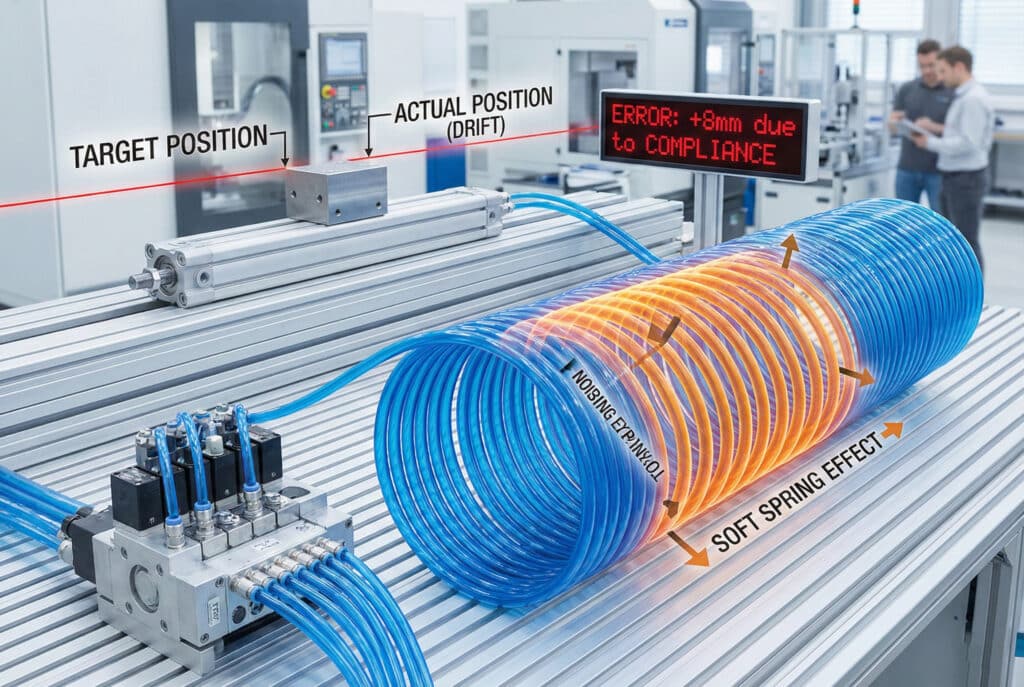
Tubing compliance refers to the elastic expansion and contraction of pneumatic hoses and tubes under pressure changes, which directly reduces the positioning stiffness of pneumatic cylinders. A typical 10-meter run of 8mm polyurethane tubing can reduce system stiffness by 40-60%, causing position deviations of 2-5mm under varying loads. This compliance effect becomes the dominant factor limiting positioning accuracy in pneumatic systems with long tube runs or high-volume tubing.
I recently worked with an engineer named Robert from an assembly plant in Michigan. His robotic pick-and-place system was missing targets by 3-4mm despite using high-quality cylinders and servo valves. After analyzing his pneumatic circuit, we discovered that 15 meters of flexible tubing was creating a “pneumatic cushion” that compressed under load. By optimizing his tubing design and upgrading to our Bepto rodless cylinders with integrated manifolds, we cut his positioning error by 75%. Let me show you how tubing compliance affects your system and what you can do about it. 🎯
Table of Contents
- What Is Tubing Compliance and Why Does It Matter?
- How Does Tubing Compliance Reduce Cylinder Positioning Stiffness?
- What Factors Influence Tubing Compliance in Pneumatic Systems?
- How Can You Minimize Compliance Effects for Better Positioning?
- Conclusion
- FAQs About Tubing Compliance and Positioning Stiffness
What Is Tubing Compliance and Why Does It Matter?
Understanding tubing compliance is critical for anyone designing precision pneumatic positioning systems. 🔍
Tubing compliance is the volumetric expansion of pneumatic tubing when pressurized, effectively creating an air spring between the valve and cylinder. This compliance acts as a soft element in series with your cylinder, reducing the overall system stiffness by 30-70% depending on tube length, diameter, and material. The result is position drift under load, slower response times, and reduced natural frequency1 that causes oscillation and overshoot.
The Physics of Pneumatic Compliance
When you pressurize a pneumatic tube, two things happen:
- Wall Expansion: The tube walls stretch radially according to their elastic modulus2, increasing internal volume
- Air Compression: The air itself compresses according to the ideal gas law3 (PV = nRT)
Both effects combine to create what engineers call “pneumatic capacitance”—the system’s ability to store compressed air. While air compressibility is unavoidable, tubing compliance adds significant additional capacitance that degrades performance.
Real-World Impact
Consider a typical industrial scenario:
- Cylinder: 40mm bore, 300mm stroke rodless cylinder
- Tubing: 10 meters of 8mm polyurethane tube
- Operating Pressure: 6 bar
The air volume in the cylinder chamber is approximately 377 cm³. The tubing adds another 503 cm³ of volume. When that tubing expands by just 5% under pressure (typical for polyurethane), it adds an extra 25 cm³ of compliance—equivalent to 8mm of cylinder stroke! 😱
Why Traditional Approaches Fail
Many engineers focus solely on cylinder quality and control algorithms while ignoring the pneumatic circuit. I’ve seen countless cases where expensive servo valves and precision cylinders were installed, yet performance remained poor because 20+ meters of soft tubing undermined the entire system.
How Does Tubing Compliance Reduce Cylinder Positioning Stiffness?
The relationship between tubing compliance and positioning stiffness is direct and quantifiable. ⚙️
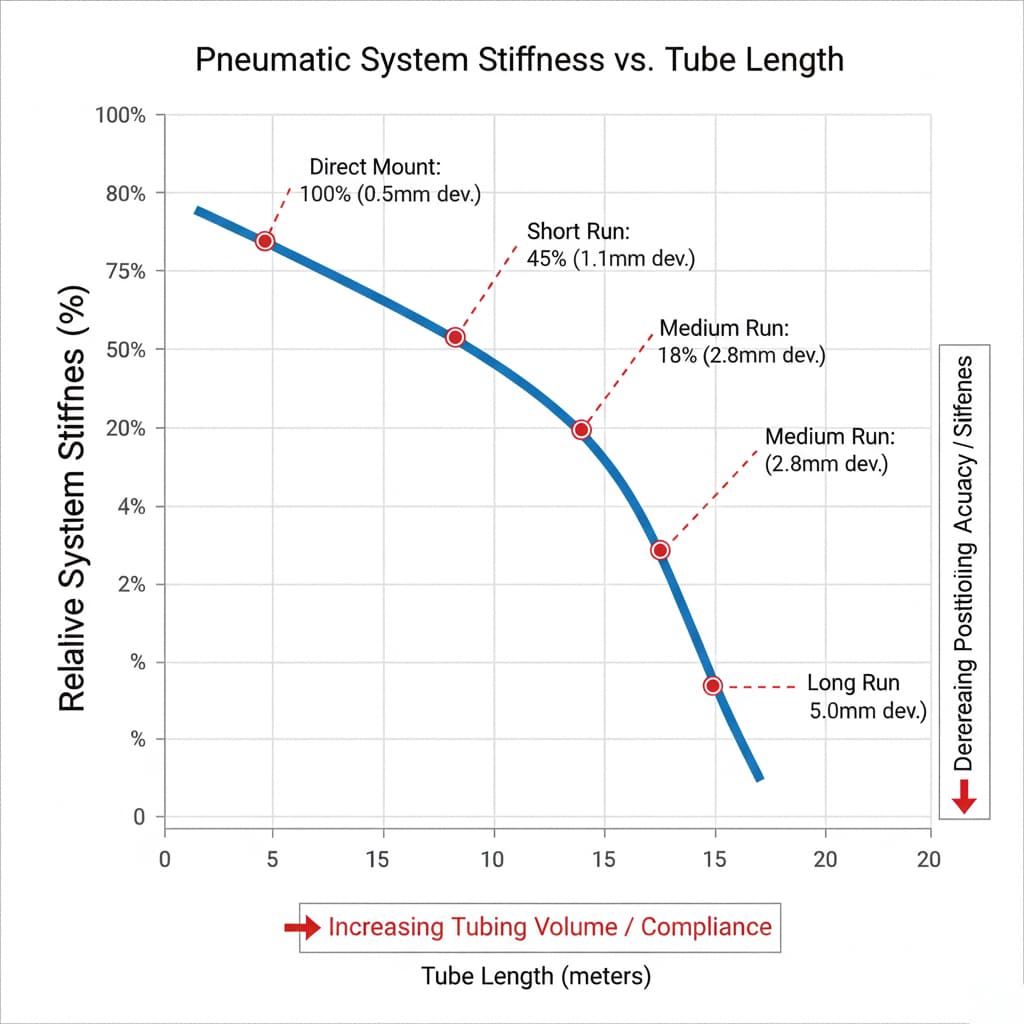
Tubing compliance reduces positioning stiffness by creating a “soft spring” in series with the cylinder’s pneumatic spring. When external forces act on the cylinder, pressure changes cause the compliant tubing to expand or contract, allowing the cylinder to move from its commanded position. System stiffness decreases proportionally to total pneumatic capacitance: doubling tube volume typically halves positioning stiffness, resulting in doubled position deviation under load.
Mathematical Relationship
The positioning stiffness (K) of a pneumatic system can be expressed as:
$$
K = \frac{A^{2} \times P}{\,V_{cyl} + V_{tube} \times C_{tube}\,}
$$
Where:
- A = cylinder piston area
- P = operating pressure
- V_cyl = cylinder chamber volume
- V_tube = tubing volume
- C_tube = tubing compliance factor (1.05-1.15 for typical materials)
This equation reveals a critical insight: stiffness is inversely proportional to total compliant volume. Every meter of tubing you add reduces your system stiffness.
Stiffness Comparison Table
| Configuration | Tube Length | Tube Volume Ratio | Relative Stiffness | Position Deviation @ 100N |
|---|---|---|---|---|
| Direct Mount (baseline) | 0.5m | 1.0x | 100% | 0.5mm |
| Short Run | 3m | 4.0x | 45% | 1.1mm |
| Medium Run | 10m | 13.3x | 18% | 2.8mm |
| Long Run | 20m | 26.6x | 10% | 5.0mm |
Dynamic Effects
Compliance doesn’t just affect static stiffness—it dramatically impacts dynamic performance:
- Natural Frequency: Reduced by √(stiffness ratio), causing slower settling times
- Damping: Increased phase lag leads to oscillation and instability
- Response Time: Longer tubes mean more air volume to pressurize/depressurize
- Overshoot: Lower stiffness allows momentum to carry the load past target
I worked with a packaging machinery manufacturer in Ontario named Jennifer. Her vertical pick-and-place application was experiencing 15% overshoot, causing product damage. We calculated that her 12-meter tube runs were reducing system natural frequency from 8 Hz to just 3 Hz. By relocating valves closer to the cylinders and switching to rigid aluminum tubing for the final 2 meters, we restored natural frequency to 6.5 Hz and eliminated overshoot entirely. 🎉
What Factors Influence Tubing Compliance in Pneumatic Systems?
Multiple variables affect how much compliance your tubing introduces into your pneumatic circuit. 📊
The primary factors influencing tubing compliance are material type (elastic modulus), tube diameter, wall thickness, tube length, and operating pressure. Polyurethane tubing exhibits 3-5 times more compliance than nylon, while doubling tube diameter increases compliance by 4x for the same length. Wall thickness has an inverse square relationship with compliance—thin-walled tubes can expand 10-15% under pressure, while thick-walled rigid tubes expand less than 2%.
Material Properties Comparison
| Tubing Material | Elastic Modulus (GPa) | Typical Expansion @ 6 bar | Relative Compliance | Cost Factor |
|---|---|---|---|---|
| Polyurethane (PU) | 0.02-0.05 | 8-12% | 5.0x (highest) | 1.0x |
| Nylon (PA) | 1.5-2.5 | 3-5% | 2.0x | 1.3x |
| Polyethylene (PE) | 0.8-1.2 | 4-7% | 3.0x | 0.9x |
| Aluminum (rigid) | 69 | <1% | 0.2x | 3.5x |
| Steel (rigid) | 200 | <0.5% | 0.1x (lowest) | 4.0x |
Critical Design Parameters
1. Tube Length
Every meter of tubing adds compliance linearly. This is why valve-on-cylinder configurations perform so much better than remote valve mounting.
Rule of thumb: Keep tubing runs under 3 meters for precision applications, under 1 meter for high-stiffness requirements.
2. Tube Diameter
Larger diameter tubes have exponentially more compliance because:
- Volume increases with diameter squared (πr²)
- Wall stress increases proportionally, causing more expansion
- More air volume means more compressibility
Rule of thumb: Use the smallest diameter that meets your flow requirements. Don’t oversize “just to be safe.”
3. Wall Thickness
Thicker walls resist expansion better, but add weight and cost. The relationship follows hoop stress4 equations:
$$
Wall\ Stress = \frac{P \times D}{2 \times t}
$$
Where P = pressure, D = diameter, t = wall thickness
4. Operating Pressure
Higher pressures create more wall stress and more air compression. Compliance effects increase roughly linearly with pressure.
Practical Selection Guide
For different application requirements:
High Precision (±0.2mm):
- Use valve-on-cylinder mounting
- Maximum 1m of 6mm nylon or aluminum tube
- Consider rigid manifolds
Medium Precision (±1mm):
- Keep tubes under 5m
- Use 6-8mm nylon tubing
- Minimize fittings and connections
Standard Industrial (±3mm):
- Tubes up to 10m acceptable
- 8-10mm polyurethane suitable
- Focus on other error sources first
At Bepto, we’ve designed our rodless cylinders with integrated valve mounting options specifically to minimize tubing compliance effects. Our engineers can help you calculate the optimal tubing configuration for your specific application—and we ship worldwide with 48-hour delivery to minimize your downtime. 🚀
How Can You Minimize Compliance Effects for Better Positioning?
Reducing tubing compliance requires a systematic approach combining smart design, proper component selection, and sometimes creative solutions. 💡
The most effective strategies to minimize tubing compliance are: (1) mount valves directly on cylinders to eliminate long tube runs, (2) use rigid tubing materials (nylon, aluminum) instead of soft polyurethane, (3) reduce tube diameter to minimum required for flow, (4) implement pressure feedback control to compensate for compliance, and (5) use accumulators strategically to provide local air storage. Combining these approaches can restore 60-80% of the stiffness lost to tubing compliance.
Strategy 1: Minimize Tube Length
Best Practice: Mount valves as close to cylinders as possible.
Implementation options:
- Valve-on-Cylinder: Direct mounting eliminates 90% of tubing (our Bepto rodless cylinders offer integrated valve mounting)
- Manifold Mounting: Cluster valves near cylinder groups
- Distributed I/O: Use fieldbus-connected valve islands at point of use
Real-world example: A machine builder in Texas named Carlos was struggling with a 4-axis gantry system. His centralized valve bank was 18 meters from the furthest cylinder. By switching to distributed manifolds and our Bepto cylinders with valve mounting, he reduced average tube length from 12m to 1.5m, improving positioning accuracy from ±4mm to ±0.8mm. His cycle time also improved by 18% due to faster response. 🏆
Strategy 2: Optimize Tubing Material and Size
Material Selection Matrix:
| Application Type | Recommended Material | Diameter Guideline |
|---|---|---|
| High-Precision Positioning | Aluminum or thick-wall nylon | Minimum required for flow |
| Dynamic Motion Control | Nylon PA12 | Calculate for <2 m/s flow velocity |
| Standard Automation | Polyurethane (short runs only) | Standard sizing acceptable |
| High-Cycle Applications | Nylon with anti-kink design | Consider wear resistance |
Sizing calculation: Use the Cv (flow coefficient5) method to determine minimum diameter, then select one size smaller than “safe” oversizing would suggest.
Strategy 3: Implement Advanced Control Strategies
When physical changes aren’t possible, control algorithms can compensate:
Pressure Feedback Control
Install pressure sensors in cylinder chambers and use them in a closed-loop control system. The controller adjusts valve commands to maintain target pressure despite compliance effects.
Effectiveness: 40-60% improvement in stiffness
Cost: Medium (sensors + programming)
Complexity: Medium
Feed-Forward Compensation
Predict position deviation based on load and pre-compensate the pressure command.
Effectiveness: 30-50% improvement
Cost: Low (software only)
Complexity: High (requires accurate system model)
Adaptive Algorithms
Learn the compliance characteristics during operation and continuously adjust compensation.
Effectiveness: 50-70% improvement
Cost: Medium
Complexity: High
Strategy 4: Use Pneumatic Accumulators
Small accumulators (0.5-2 liters) mounted near cylinders provide local air storage that reduces the effective compliance of long tube runs.
How it works: The accumulator acts as a stiff pressure source close to the cylinder, isolating it from the compliant tubing to the main supply.
Best for: Applications where valve relocation isn’t possible
Typical improvement: 30-40% stiffness increase
Strategy 5: Hybrid Pneumatic-Mechanical Solutions
For ultimate stiffness, combine pneumatic actuation with mechanical locking:
- Pneumatic clamps: Lock position mechanically after pneumatic positioning
- Brake cylinders: Integrated brakes hold position under load
- Detent mechanisms: Mechanical stops at key positions
Complete System Optimization Checklist
✅ Calculate required stiffness based on load variation and tolerance
✅ Audit current tubing (length, diameter, material, routing)
✅ Identify opportunities for valve relocation or manifold consolidation
✅ Select optimal tubing material and size for each run
✅ Consider control enhancements if hardware changes are insufficient
✅ Measure and validate actual stiffness improvement
The Bepto Advantage
Our rodless cylinders are engineered with positioning stiffness in mind:
- Integrated valve mounting eliminates long tube runs
- Low internal volume reduces inherent pneumatic compliance
- Precision bearings minimize mechanical compliance
- Modular manifold options for multi-cylinder systems
We’ve helped manufacturers across North America, Europe, and Asia solve compliance problems that were limiting their productivity. When OEM replacement parts are backordered for weeks and costing 2-3x our price, Bepto delivers compatible, high-performance alternatives in 48 hours. 📦✨
Last quarter, we worked with a pharmaceutical packaging company in Switzerland. Their aging OEM cylinders needed replacement, but the manufacturer quoted 10-week delivery and $8,500 per cylinder. We shipped compatible Bepto rodless cylinders with integrated valve mounting for $2,900 each, delivered in 3 days. Not only did they save $168,000 on the project, but the improved design reduced their positioning errors by 45%. That’s the kind of value we deliver every day.
Conclusion
Tubing compliance is the hidden enemy of pneumatic positioning accuracy, but it doesn’t have to limit your system performance. By understanding the physics, calculating the effects, and implementing smart design strategies—especially minimizing tube length and selecting proper materials—you can recover most of the stiffness lost to compliance and achieve the precision your application demands. 🎯
FAQs About Tubing Compliance and Positioning Stiffness
How much does tubing compliance typically reduce positioning stiffness?
Tubing compliance typically reduces positioning stiffness by 40-70% in standard industrial pneumatic systems with 5-15 meter tube runs, resulting in 2-5mm additional position deviation under varying loads. The exact reduction depends on tube length, diameter, material, and the ratio of tube volume to cylinder volume. Systems with tube volume exceeding 3x cylinder volume experience the most severe stiffness degradation. Short tube runs (<2m) reduce stiffness by only 10-20%.
Can I use flexible tubing for precision positioning applications?
Flexible polyurethane tubing is generally unsuitable for precision positioning (±1mm or better) unless tube runs are kept extremely short (<1 meter total). For precision applications, use rigid or semi-rigid tubing materials like nylon PA12, aluminum, or stainless steel. If flexibility is required for moving applications, use armored or spiral-reinforced hoses that resist expansion, and keep the flexible section as short as possible with rigid tubing for the remainder of the run.
What is the optimal tube diameter for minimizing compliance?
The optimal tube diameter is the smallest size that provides adequate flow for your required cylinder speed, typically resulting in air velocities of 5-10 m/s during rapid motion. Oversizing tubing “for safety” dramatically increases compliance without proportional benefit. Use flow calculation formulas (Cv method) to determine minimum diameter, then select that size or one size larger. For a 40mm bore cylinder at 500mm/s, 6mm tubing is often sufficient where 10mm might be unnecessarily specified.
Does operating pressure affect tubing compliance?
Yes, higher operating pressures increase both wall stress (causing more expansion) and air compressibility effects, increasing overall compliance by approximately 15-25% when going from 4 bar to 8 bar. However, higher pressure also increases pneumatic stiffness (force per unit volume change), so the net effect on positioning stiffness is complex. Generally, operating at the minimum pressure required for your application minimizes compliance effects while also reducing air consumption and wear.
How do I measure tubing compliance in my existing system?
Measure tubing compliance by applying a known external force to the cylinder while monitoring position deviation under constant valve command. The stiffness (K) equals force divided by displacement (K = F/Δx). Compare this to theoretical cylinder stiffness calculated from bore area and chamber volume. The difference represents compliance losses. Alternatively, measure system natural frequency through step response testing—lower frequency indicates higher compliance. Professional analysis uses pressure sensors in both cylinder chambers to separate tubing compliance from other effects.
-
Understand the rate at which a system vibrates naturally when disturbed, which is critical for predicting instability. ↩
-
Explore the measure of a material’s resistance to being deformed elastically when a force is applied. ↩
-
Learn the fundamental physics equation describing how gas pressure, volume, and temperature interact. ↩
-
Read about the circumferential stress exerted on the walls of a cylinder or tube under internal pressure. ↩
-
Discover the standard metric used to measure the capacity of a valve or tube to pass fluid. ↩