Introduction
Ever watched a production line grind to a halt because someone didn’t understand the physics behind their vacuum cylinder? 🤔 I’ve seen it happen more times than I’d like to admit. When engineers overlook the fundamental forces governing retraction dynamics, equipment fails, deadlines slip, and costs skyrocket.
Vacuum cylinder physics centers on negative pressure differentials that create retraction force. Unlike traditional pneumatic cylinders that push with compressed air, vacuum cylinders pull by evacuating air from one chamber, allowing atmospheric pressure to drive the piston backward. Understanding these forces—typically ranging from 50-500N depending on bore size—is critical for proper application sizing and reliable operation.
Last month, I spoke with David, a maintenance supervisor at a packaging facility in Michigan. His vacuum cylinder system kept failing mid-cycle, causing product damage and line stoppages. The root cause? Nobody on his team understood the retraction dynamics well enough to diagnose the pressure imbalance. Let me walk you through the physics that could have saved David thousands in downtime.
Table of Contents
- What Forces Actually Drive Vacuum Cylinder Retraction?
- How Do Pressure Differentials Create Retraction Dynamics?
- Why Does Bore Size Dramatically Affect Retraction Force?
- What Factors Limit Vacuum Cylinder Performance?
What Forces Actually Drive Vacuum Cylinder Retraction?
The magic behind vacuum cylinders isn’t really magic at all—it’s pure physics. ⚙️
Vacuum cylinder retraction is driven by atmospheric pressure1 acting on the piston face when air is evacuated from the retraction chamber. The force equals atmospheric pressure (approximately 101.3 kPa at sea level) multiplied by the effective piston area, minus any opposing forces from friction, load, and residual pressure.
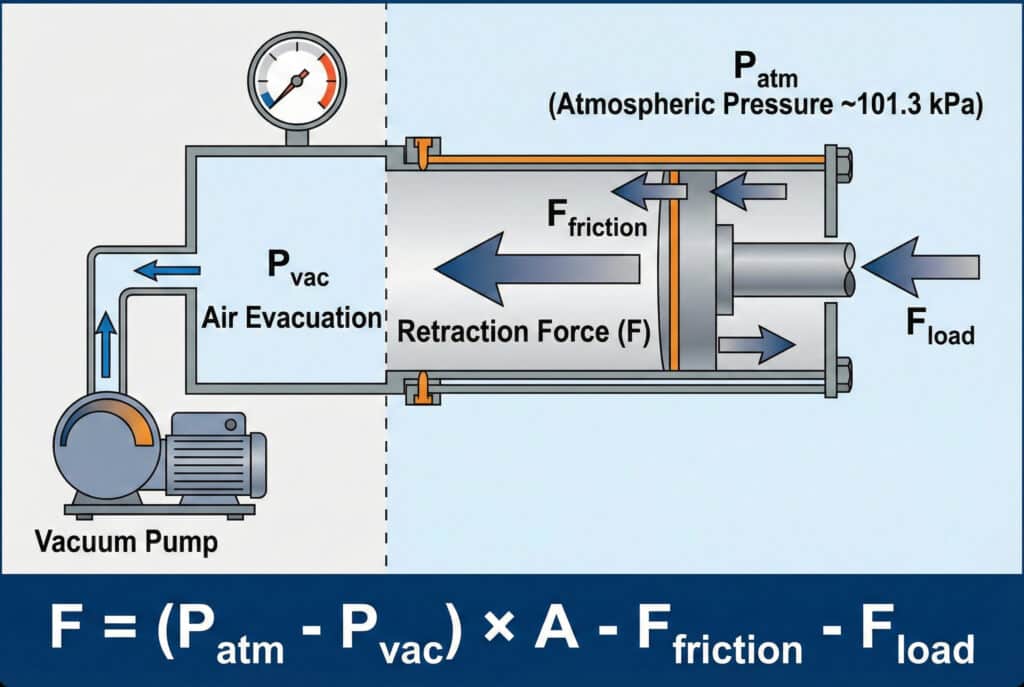
The Fundamental Force Equation
At Bepto Pneumatics, we use this core formula when sizing vacuum cylinders for our clients:
Where:
- = Net retraction force
- = Atmospheric pressure (~101.3 kPa)
- = Vacuum chamber pressure (typically 10-20 kPa absolute)
- = Effective piston area (πr²)
- = internal seal friction2
- = External load resistance
Three Primary Force Components
- Atmospheric Pressure Force: The dominant driving force, pushing the piston toward the evacuated chamber
- Vacuum Differential Force: Enhanced by deeper vacuum levels (higher vacuum pump capacity)
- Opposing Resistance Forces: Friction, load weight, and any back-pressure
I remember working with Sarah, an automation engineer in Ontario, who was specifying vacuum cylinders for a pick-and-place application. She initially selected a 32mm bore cylinder, but after we calculated the actual forces—including her 15kg payload and the friction from her linear guides—we upgraded her to a 40mm bore. Her system has been running flawlessly for two years now, handling over 2 million cycles. 💪
How Do Pressure Differentials Create Retraction Dynamics?
Understanding pressure differentials is where theory meets real-world performance.
Retraction dynamics depend on the pressure differential between the vacuum chamber (typically 10-20 kPa absolute) and atmospheric pressure (101.3 kPa). This 80-90 kPa pressure gradient3 that accelerates the piston. The rate of retraction is governed by vacuum pump flow rate, chamber volume, and valve response time.
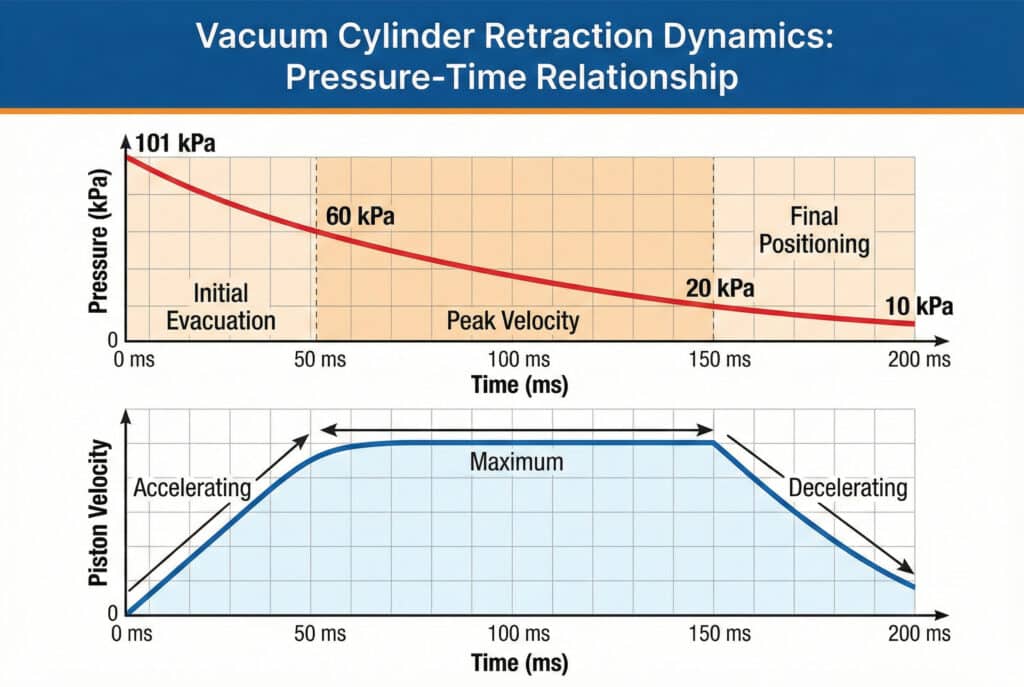
The Pressure-Time Relationship
Vacuum cylinder retraction isn’t instantaneous—it follows a characteristic curve:
| Phase | Duration | Pressure Change | Piston Velocity |
|---|---|---|---|
| Initial Evacuation | 0-50ms | 101→60 kPa | Accelerating |
| Peak Velocity | 50-150ms | 60→20 kPa | Maximum |
| Final Positioning | 150-200ms | 20→10 kPa | Decelerating |
Critical Dynamics Factors
Vacuum Pump Capacity: Higher flow rates (measured in L/min) reduce evacuation time and increase retraction speed. Our Bepto vacuum cylinders are optimized for pumps delivering 40-100 L/min for industrial applications.
Chamber Volume: Larger bore cylinders have greater internal volume, requiring more time to evacuate. This is why a 63mm bore cylinder retracts slightly slower than a 32mm bore under identical vacuum conditions.
Valve Response: The solenoid valve4 switching speed directly impacts cycle time. We recommend valves with response times under 15ms for high-speed applications.
Why Does Bore Size Dramatically Affect Retraction Force?
This is where the math gets interesting—and where many engineers make costly mistakes. 📊
Retraction force increases with the square of the bore diameter because force is proportional to piston area (πr²). Doubling the bore diameter quadruples the effective area, thus quadrupling the retraction force under identical pressure conditions. A 63mm bore cylinder generates approximately four times the force of a 32mm bore cylinder.
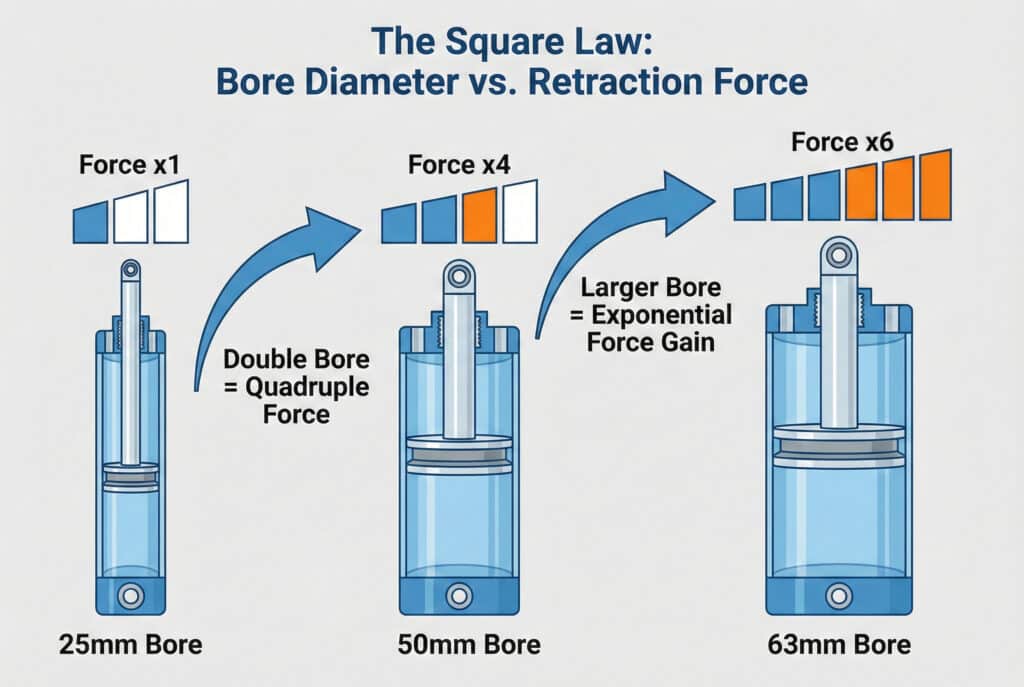
Force Comparison by Bore Size
Here’s a practical comparison using standard vacuum conditions (85 kPa differential):
| Bore Diameter | Effective Area | Theoretical Force | Practical Force* |
|---|---|---|---|
| 25mm | 491 mm² | 42N | 35N |
| 32mm | 804 mm² | 68N | 58N |
| 40mm | 1,257 mm² | 107N | 92N |
| 50mm | 1,963 mm² | 167N | 145N |
| 63mm | 3,117 mm² | 265N | 230N |
*Practical force accounts for ~15% loss due to friction and seal drag
The Square Law in Action
This quadratic relationship means small increases in bore size yield substantial force gains:
- 25% diameter increase = 56% force increase
- 50% diameter increase = 125% force increase
- 100% diameter increase = 300% force increase
At Bepto Pneumatics, we often help clients right-size their cylinder selection. Over-sizing wastes money and slows cycle times; under-sizing causes failures. Our rodless cylinder alternatives to major OEM brands offer the same bore size options at 30-40% lower cost, making it economical to select the optimal size without budget constraints. 💰
What Factors Limit Vacuum Cylinder Performance?
Even perfect physics meets real-world limitations. Let’s talk about what actually constrains your system. ⚠️
Vacuum cylinder performance is limited by four primary factors: maximum achievable vacuum level (typically 10-15 kPa absolute pressure5 with standard pumps), seal friction (consuming 10-20% of theoretical force), air leakage rates (increasing with seal wear), and atmospheric pressure variation (affecting force by up to 15% between sea level and high altitude installations).
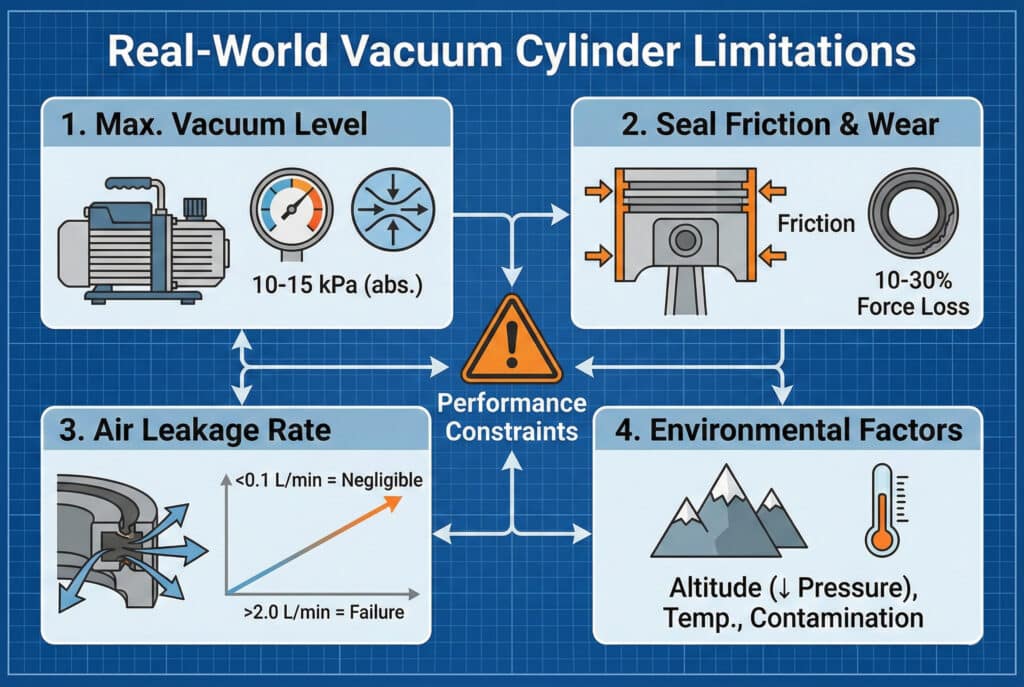
Performance Limiting Factors
1. Vacuum Level Constraints
Standard industrial vacuum pumps achieve 10-20 kPa absolute pressure. Going below 10 kPa requires expensive high-vacuum equipment with diminishing returns—you gain only marginal force increases while dramatically increasing cost and maintenance.
2. Seal Friction and Wear
Every vacuum cylinder has internal seals that create friction:
- New seals: 10-15% force loss
- Worn seals: 20-30% force loss + air leakage
- Damaged seals: System failure
We manufacture our Bepto vacuum cylinders with premium polyurethane seals that maintain consistent friction characteristics over millions of cycles.
3. Leakage Rate Degradation
Even microscopic leaks impact performance:
| Leak Rate | Performance Impact | Symptom |
|---|---|---|
| <0.1 L/min | Negligible | Normal operation |
| 0.1-0.5 L/min | 5-10% force loss | Slightly slower retraction |
| 0.5-2.0 L/min | 20-40% force loss | Noticeably sluggish |
| >2.0 L/min | System failure | Cannot maintain vacuum |
4. Environmental Factors
Altitude Effects: At 2,000m elevation, atmospheric pressure drops to ~80 kPa (vs. 101 kPa at sea level), reducing available force by approximately 20%.
Temperature: Extreme temperatures affect seal elasticity and air density, impacting both friction and pressure differentials.
Contamination: Dust and moisture can damage seals and valves, accelerating performance degradation.
Optimization Strategies
Based on decades of experience supplying vacuum cylinders worldwide, here’s what actually works:
- Regular Seal Inspection: Replace seals every 2-3 million cycles or annually
- Vacuum Pump Maintenance: Clean filters monthly, replace pump oil quarterly
- Leak Testing: Monthly pressure decay tests catch problems early
- Proper Sizing: Use our force calculation tools to select appropriate bore sizes
- Quality Components: OEM-equivalent parts like our Bepto cylinders deliver reliability without premium pricing
Conclusion
Understanding vacuum cylinder physics isn’t just academic—it’s the difference between a system that runs reliably for years and one that fails when you need it most. Master the forces, respect the dynamics, and size appropriately. 🎯
FAQs About Vacuum Cylinder Physics
What is the maximum force a vacuum cylinder can generate?
The theoretical maximum force is limited by atmospheric pressure and bore size, typically ranging from 35N (25mm bore) to 450N (80mm bore) under standard conditions. However, practical forces are 15-20% lower due to friction and seal drag. For applications requiring higher forces, we recommend our rodless pneumatic cylinders which can deliver forces exceeding 2,000N.
How does vacuum level affect retraction speed?
Deeper vacuum levels (lower absolute pressure) create larger pressure differentials, resulting in faster retraction speeds. A vacuum of 10 kPa absolute retracts approximately 30% faster than 20 kPa absolute. However, achieving vacuum levels below 10 kPa requires significantly more expensive equipment with diminishing returns.
Can vacuum cylinders work at high altitudes?
Yes, but with reduced force output proportional to the atmospheric pressure reduction. At 2,000m elevation, expect approximately 20% force loss compared to sea level performance. We help clients compensate by selecting larger bore sizes or switching to compressed air systems for high-altitude installations.
Why do vacuum cylinders retract slower than pneumatic cylinders extend?
Vacuum evacuation takes time—typically 100-200ms to achieve working vacuum—while compressed air delivery is nearly instantaneous. Additionally, vacuum cylinders are limited to atmospheric pressure differential (~85 kPa practical), while pneumatic cylinders commonly operate at 600-800 kPa, providing much higher force and acceleration.
How often should vacuum cylinder seals be replaced?
Replace seals every 2-3 million cycles or annually, whichever comes first, to maintain optimal performance. At Bepto Pneumatics, we stock replacement seal kits for all major brands at competitive prices, ensuring you can maintain your equipment economically. Watch for warning signs like slower retraction, increased cycle time, or difficulty maintaining vacuum—these indicate seal wear requiring immediate attention.
-
Learn more about how standard atmospheric pressure is defined and measured across different altitudes. ↩
-
Explore the different types of seal friction and how they impact the efficiency of pneumatic systems. ↩
-
Understand the fundamental physics behind how pressure gradients drive air movement in mechanical systems. ↩
-
Discover the internal mechanics and response times of solenoid valves in automated control systems. ↩
-
Gain a clear understanding of the difference between absolute and gauge pressure in vacuum technology applications. ↩