


Imagine a robotic arm mounted on a linear slide, extending sideways to pick up a heavy box. The moment it lifts, the entire carriage twists. The movement becomes jerky, the seals start to grind, and accuracy goes out the window. You aren’t just lifting a weight; you are twisting the life out of your cylinder. 🌀
Torsional stress1 refers to the twisting force (torque) applied to the cylinder’s carriage, and determining the maximum roll moment is crucial to prevent guide deformation, seal leakage, and catastrophic mechanical seizure. Unlike standard cylinders that only push and pull, rodless cylinders often carry the load directly, making them susceptible to these complex twisting forces.
I recall helping Maria, a business owner of a specialized printing company in Germany. Her machines used rodless cylinders to move heavy print heads. The print quality was dropping because the heads were vibrating. She thought it was an air pressure issue. I looked at the setup and saw the problem immediately: the print head was mounted too far off-center, creating a massive “Roll Moment” that was warping the cylinder tube.
Table of Contents
- What Is a Roll Moment in Rodless Cylinders?
- How Do Different Guide Systems Handle Torsional Stress?
- Why Is Calculating Torque Essential for Cylinder Longevity?
- Conclusion
- FAQs About Torsional Stress
What Is a Roll Moment in Rodless Cylinders?
In the world of rodless cylinders, we talk about three types of moments: Pitch, Yaw, and Roll. Roll is often the most damaging.
A Roll Moment (Mx) occurs when a load is mounted off-center from the carriage’s longitudinal axis2, creating a lever arm that tries to rotate the carriage around the cylinder tube.
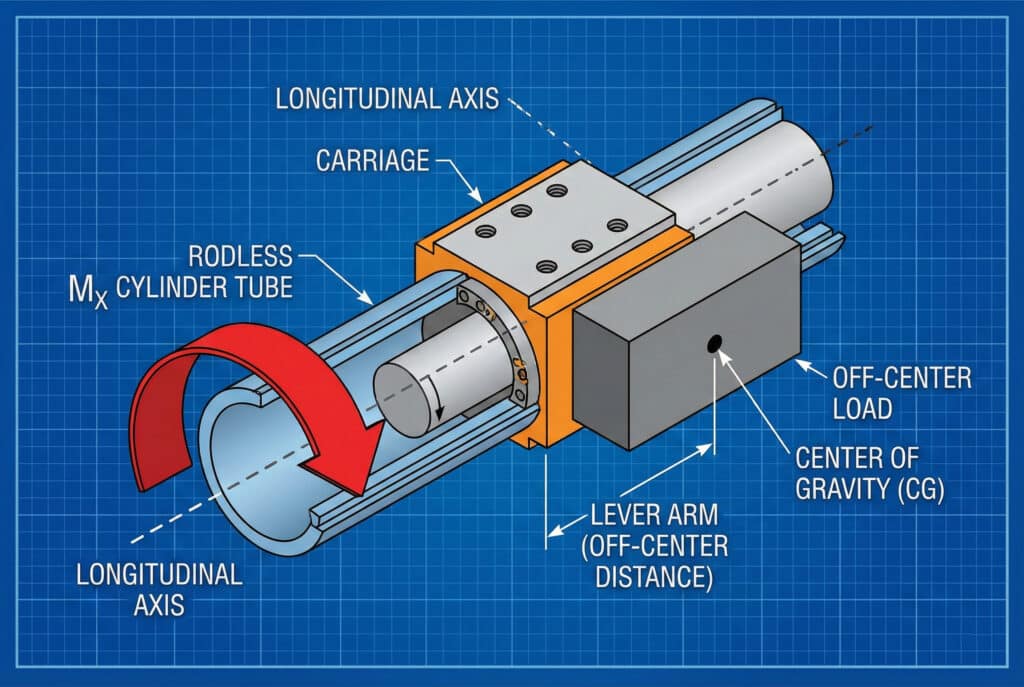
The Invisible Force
Think of it like holding a heavy suitcase with your arm extended straight out to your side. The weight tries to twist your shoulder.
- Center of Gravity3: The further the load’s center of gravity is from the cylinder center, the higher the torque.
- The Limit: Every cylinder has a maximum “Mx” rating. Exceed it, and the internal piston twists, breaking the magnetic coupling4 or grinding the mechanical seal band.
For Maria, her print heads were acting like a wrench, constantly trying to unscrew the carriage. The OEM parts she was using weren’t reinforced for that specific torque, leading to rapid wear.
How Do Different Guide Systems Handle Torsional Stress?
The ability to resist this twist depends entirely on the guide system design. This is where choosing the right Bepto replacement or upgrade makes a huge difference.
Internal guides rely on the piston’s fit within the tube and offer low torque resistance, whereas external guides (like V-rollers or recirculating ball bearings5) provide a wide stance to effectively counter high torsional loads.

Comparing the Options
We analyzed Maria’s setup and proposed a solution.
| Guide Type | Torsional Resistance | Best Application |
|---|---|---|
| Basic Internal Guide | Low | Centered, light loads (pushing only) |
| Plain Bearing Guide | Medium | Moderate off-center loads |
| External Roller Guide | High | Heavy, offset loads (Maria’s case) |
| Recirculating Ball Rail | Very High | Precision, high-torque applications |
We supplied Maria with a Bepto rodless cylinder featuring an external roller guide system. The wider stance of the rollers acted like outriggers on a canoe, stabilizing the load and eliminating the vibration.
Why Is Calculating Torque Essential for Cylinder Longevity?
Ignoring the roll moment is the fastest way to destroy a rodless cylinder. It’s simple physics: Force x Distance = Torque.
Calculating the exact roll moment allows you to select a cylinder size and guide type that operates within its safety margin, preventing uneven wear on the inner tube and ensuring the sealing band remains airtight.
Saving Costs Through Engineering
Maria was worried about the cost of upgrading.
- The Cost of Failure: She was replacing standard cylinders every 3 months ($500 each + downtime).
- The Bepto Solution: Our heavy-duty guided cylinder cost slightly more upfront but has lasted over 18 months without a single issue.
By doing the math and respecting the “Mx” limit, she reduced her annual maintenance budget by 70%. At Bepto, we help you do this math. We don’t just sell you a part number; we ensure the part fits the physics of your application.
Conclusion
Torsional stress is a silent killer for rodless cylinders. If your application involves side-mounted loads or offset weights, you must calculate the Roll Moment. Don’t guess. By choosing a Bepto rodless cylinder with the appropriate external guiding system, you neutralize these forces, ensuring smooth motion, precision, and a lifespan that keeps your production line profitable.
FAQs About Torsional Stress
What happens if I exceed the maximum roll moment?
Exceeding the roll moment causes the carriage to twist, leading to rapid wear of the guide bearings, air leakage from the seal band, and potential decoupling of the piston.
How can I increase the roll moment capacity of my system?
You can switch to a larger bore size cylinder, upgrade to a cylinder with external guides (like rollers or ball rails), or use two cylinders in parallel to share the load.
Does Bepto offer cylinders for high-torque applications?
Yes, Bepto offers a range of rodless cylinders with integrated external guides specifically designed to handle high torsional moments and heavy offset loads. We can help you select the perfect model to replace your failing OEM parts.
-
Gain a comprehensive understanding of how torsional stress impacts mechanical components and design. ↩
-
Learn the precise definition of the longitudinal axis to better visualize 3D force application. ↩
-
Access a detailed guide on calculating the center of gravity to ensure balanced load distribution. ↩
-
Explore the science behind magnetic coupling technology and its application in leak-free pneumatic systems. ↩
-
Discover how recirculating ball bearings provide superior precision and load-handling capabilities. ↩