

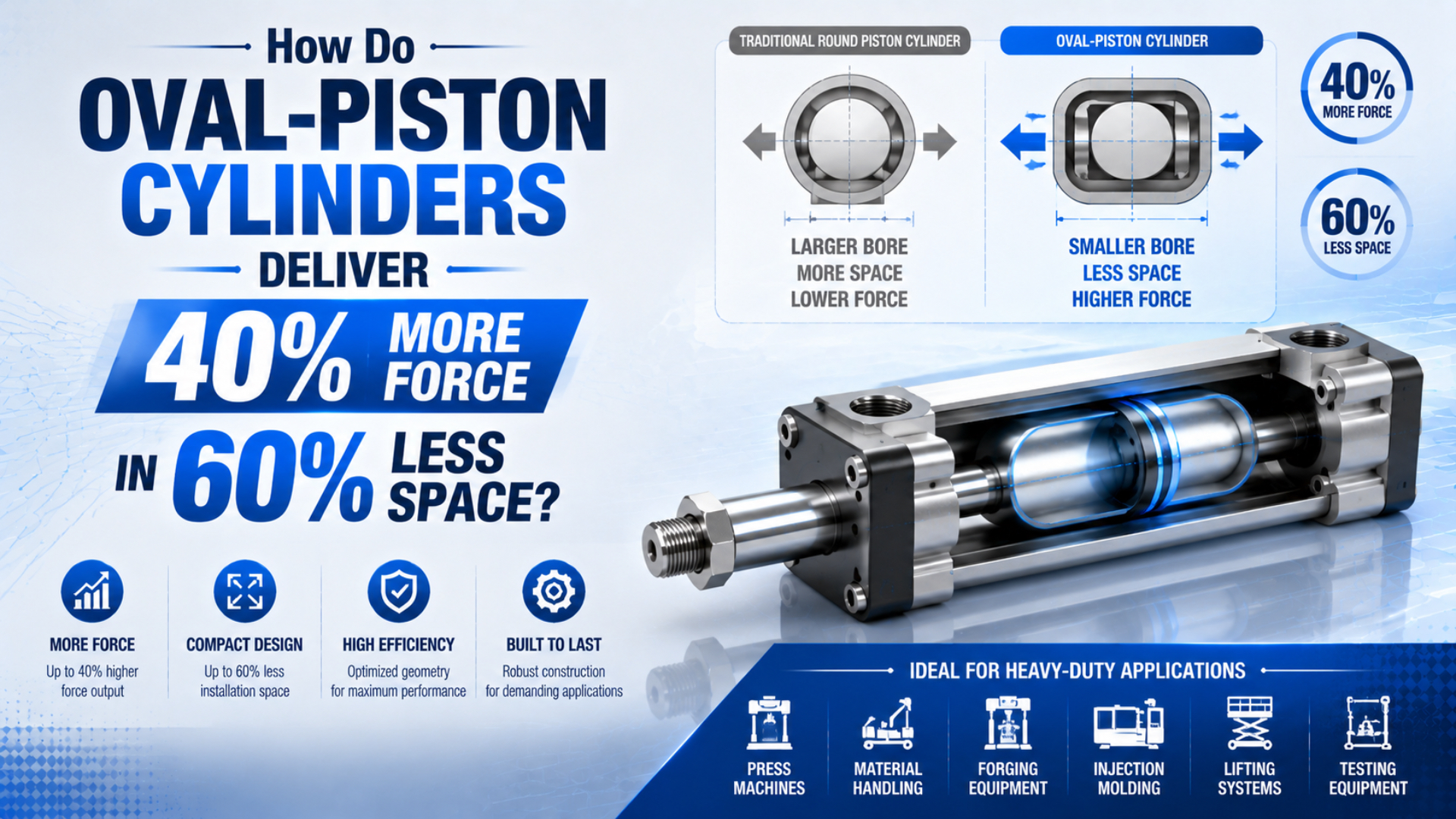
Oval-piston cylinders can produce 40% more theoretical force than the largest round piston that fits a particular low-height envelope, but only when the available width-to-height ratio is 1.4:1. A separate equal-area example can reduce piston-section height by 60%. Neither result is a universal product guarantee, and neither describes the complete cylinder body.
That distinction matters. Force follows effective area and pressure, while installation space comes from the supplier’s complete dimensional drawing. SMC describes its MU plate cylinder as a low-profile elliptical design that maintains force output, and its size codes represent equivalent circular piston areas rather than automatic force gains (Xi lanh dạng tấm SMC MU).
Key Takeaways
- A 1.4:1 oval piston has 40% more area than the largest round piston limited by the same height.
- A 60% reduction must name the dimension being reduced; it does not mean 60% less total cylinder volume.
- Select from catalog force, pressure, speed, stroke, mounting, and load data, not geometry alone.
What Does an Oval Piston Actually Change?
SMC lists five MU plate-cylinder sizes, 25, 32, 40, 50, and 63, by their equivalent circular piston area and permits strokes up to 300 mm (SMC MU/MDU catalog). The oval shape primarily redistributes that area across a wider, lower profile; it does not create force without pressure and area.
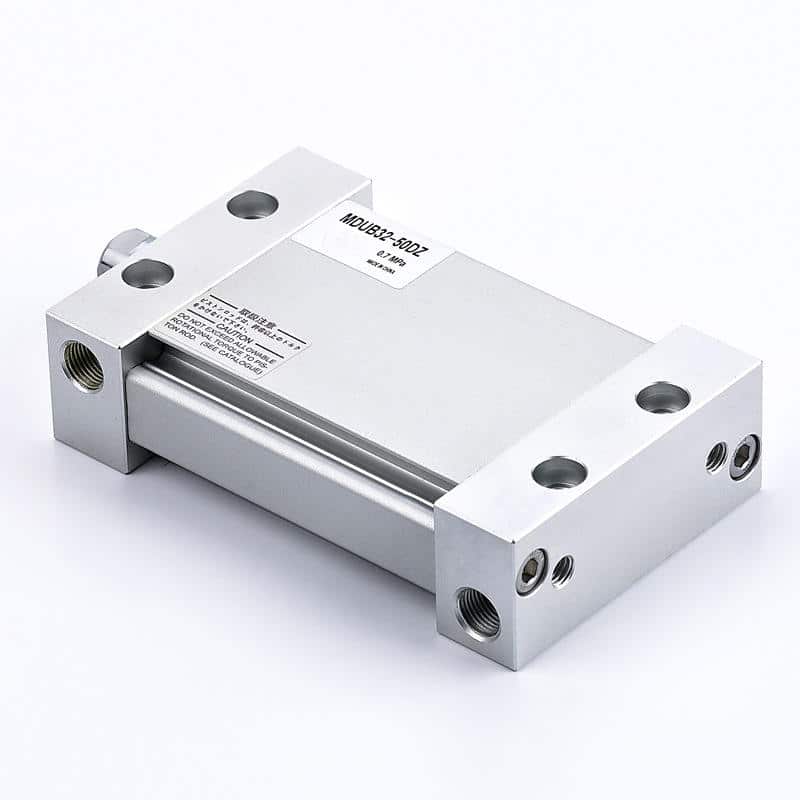
Oval-piston cylinders are pneumatic linear actuators that use a non-circular piston and matching bore. In a plate cylinder, the objective is usually low profile and intrinsic resistance to rod rotation. In a rodless cylinder, an oval piston may also support a low tube height or improve load-carrying geometry. Parker, for example, uses an oval piston in its P1X rodless series for low-profile installations and side-load moment capacity (Parker P1X).
Equivalent circular bore is the diameter of a round piston with the same effective area. If an oval piston has effective area , its equivalent diameter is:
Here, is the diameter of a round piston with the same area. It lets you compare catalog force tables without pretending that the actual piston is circular. It does not establish body width, body height, rod size, port location, or mounting clearance.
This distinction also prevents a common selection error. A size marked “32” may mean area equivalent to a 32 mm round piston, not an oval that is 32 mm wide or high. Read the product’s nomenclature and dimensional drawing before placing the model into CAD.
How Can an Oval Geometry Produce 40% More Force?
Parker defines theoretical cylinder force as pressure multiplied by effective piston area (Sản phẩm cơ cấu chấp hành khí nén Parker). If width is available but height limits the largest round piston, an oval can occupy more of the rectangular slot. A 1.4:1 width-to-height ratio therefore creates a 40% theoretical area advantage before friction and pressure losses.
Let be the full piston width and the full piston height. An ideal ellipse has area:
The largest circle that fits the same height has diameter and area:
Dividing the two areas gives a compact decision rule:
If , the ideal oval area is 1.4 times the area of the height-limited circle. At the same effective pressure, theoretical extension force is also 1.4 times as high.
[UNIQUE INSIGHT] The 40% result comes from the aspect ratio, not from the word “oval.” A 1.2:1 profile gives a 20% ideal area advantage under this comparison; a 2:1 profile gives 100%. Actual catalog products may use modified oval shapes, seal grooves, wall thickness, and clearances that differ from the ideal ellipse.
What Does “60% Less Space” Need to Mean?
Festo states that its compact cylinders can require up to 50% less space than comparable ISO 15552 cylinders, while separately describing flat cylinders as oval-piston designs (Festo compact and flat cylinders). That wording shows why a space-saving percentage must identify the product families, stroke, mounting arrangement, and measured dimension.
“Space” can mean at least four different things:
| Space metric | What to compare | What it does not prove |
|---|---|---|
| Body height | Maximum external profile, including sensor and ports | Total machine footprint or stroke length |
| Body width | Complete width across mounts and fittings | Low height or equal piston area |
| Installed length | Retracted length plus rod and attachment clearance | Cross-sectional compactness |
| Envelope volume | Width × height × installed length, using the same boundaries | Access, tubing bend radius, or service clearance |
For an equal-area geometry example, combine the equivalent-diameter relationship with the ellipse formula:
An ideal oval with and needs . Its piston-section height is 60% below the 50 mm equivalent circular diameter because . This is not yet a cylinder-body dimension. End caps, barrel walls, rod bearings, ports, switches, mounts, and manufacturing limits add space.
Could one product deliver the article title’s two percentages simultaneously? Only if a complete, named comparison proves both under the same pressure, stroke, load ratio, mounting, and envelope definition. Without that evidence, treat 40% and 60% as separate design examples rather than a combined catalog promise.
How Much Force Will the Cylinder Deliver in Practice?
The SMC MU catalog rates the double-acting plate-cylinder family from 0.05 to 0.7 MPa and lists piston speed from 50 to 500 mm/s (SMC MU/MDU catalog). Those limits show that geometric area is only the first force calculation; the actual application also needs dynamic pressure, friction, acceleration, and a suitable load ratio.
Theoretical extension force is pressure multiplied by effective piston area:
Here, is effective pressure at the cap-end chamber during motion, not merely the regulator’s static setting. is the supplier’s effective extension area. When retracting a single-rod cylinder, subtract the rod area:
The corresponding theoretical retract force is . Seal drag, guide friction, exhaust backpressure, tubing loss, valve flow, acceleration, gravity, linkage angle, and pressure variation reduce the force available to the load.
For the 70 × 50 mm ideal example, . At , theoretical extension force is 1,649 N because one megapascal equals one newton per square millimetre. The height-limited 50 mm round piston produces 1,178 N under the same assumptions. Do not select the oval cylinder at exactly 1,649 N required load.
Use the load factor and sizing method specified by the cylinder supplier. Then verify dynamic pressure at the actuator while it moves. The guides on calculating force from pressure and area and understanding the cylinder force factor cover the next step after equivalent area is known.
[PERSONAL EXPERIENCE] In our experience, the most common RFQ error is comparing a round cylinder’s bore diameter with an oval cylinder’s body height. One is an internal force dimension; the other is an external installation dimension. Ask for effective area and the complete CAD envelope as separate data.
Design Trade-Offs Beyond Force Density
Festo’s DZH flat-cylinder documentation identifies an oval piston as both a flat-profile feature and protection against rotation, with adjustable pneumatic cushioning available in the series (Festo DZH documentation). The useful benefits therefore extend beyond force density, but every non-round architecture brings model-specific sealing, guidance, loading, and maintenance limits.
Non-rotation is useful, but not a precision guide
An oval piston resists rotation because the piston cannot freely turn inside the matching bore. That can remove the need for a keyed or flattened rod in some applications. It does not mean the cylinder can carry an unlimited external moment or replace a linear guide. Compare allowable rotational torque, rod non-rotating accuracy, and side-load limits for the exact model.
If the load needs tight angular control, review the available non-rotating cylinder options. If the tooling creates a large offset moment, use external guidance and apply the checks in the side-loading guide.
Seals and spares are product-specific
A non-circular bore needs a matching piston seal, groove, wear surface, and assembly method. A generic round seal cannot replace it. Confirm the seal-kit part number, compound, lubricant, storage availability, and repair procedure before standardizing a custom profile. Low purchase volume can make an elegant geometry difficult to maintain ten years later.
Pressure and speed ratings do not come from geometry
Do not infer pressure capability from an area calculation. The barrel cross-section, wall thickness, end-cap retention, fasteners, fatigue duty, ports, and manufacturing controls determine the product rating. Likewise, a large area may demand more valve flow to reach the target speed. Check the valve, tubing, exhaust path, cushion, and moving mass as a system.
Mounting can consume the saved height
Foot brackets, clevises, sensors, elbow fittings, silencers, tubing bend radius, rod-end joints, guards, and service access can exceed the bare body profile. Import the complete model into the machine assembly. A plate cylinder may fit directly into a block-mounted arrangement where a standard round cylinder needs brackets, but the comparison must include both installed configurations.
For end-of-arm designs, compare these constraints with the compact-cylinder tooling guide. A lighter or flatter actuator is useful only when the wrist moment, hose routing, cycle time, and service access still work.
How Should You Specify an Oval-Piston Cylinder?
The current SMC MU/MDU range combines five equivalent piston sizes with strokes up to 300 mm, a maximum operating pressure of 0.7 MPa, and multiple mounting directions (Catalog trực tuyến SMC MU/MDU). A usable RFQ must turn those catalog variables into one testable machine envelope and load case.
Start with the application, not a preferred piston aspect ratio:
- Define the motion. State extension and retraction stroke, orientation, cycle rate, target time, dwell, stopping method, and expected life requirement.
- Define the load. Provide mass, required process force, gravity direction, friction estimate, acceleration, linkage angle, side load, and overturning moments.
- Define effective pressure. Give minimum dynamic pressure at the cylinder during the worst simultaneous demand, plus maximum supply pressure and exhaust restrictions.
- Freeze the envelope. Supply maximum installed width, height, and length as separate dimensions. Include ports, fittings, sensors, rod-end hardware, brackets, tubing radius, and maintenance removal path.
- Request area data. Ask for extension area, retract area, equivalent bore, theoretical force table, and the supplier’s recommended load ratio.
- Check mechanics. Request allowable side load, moment, non-rotating accuracy, rod torque, cushion energy, speed range, and mounting fastener data.
- Check environment. State temperature, contamination, washdown, corrosion, lubricant policy, compressed-air requirement, and prohibited materials.
- Check lifecycle support. Record the full model code, CAD revision, seal-kit number, lead time, interchangeability, service procedure, and acceptance test.
[UNIQUE INSIGHT] Keep two envelopes in the design record: the pressure-area envelope that establishes theoretical force, and the installed CAD envelope that establishes fit. Mixing them is how a cylinder can pass the force calculation yet still collide with a fitting, bracket, guide, or service tool.
A force comparison should show the full calculation and assumptions. A space comparison should overlay both complete installed configurations. A procurement comparison should then include spares and maintenance access. This sequence is more defensible than selecting the product with the largest percentage printed in a marketing table.
Conclusion: Treat the Percentages as Defined Comparisons
SMC’s MU plate-cylinder range identifies sizes by equivalent Ø25 to Ø63 piston area rather than by a universal force-gain percentage (SMC MU/MDU catalog). That catalog convention captures the right engineering principle: normalize the oval to effective area first, then evaluate the external profile, pressure, load, speed, mounting, and service conditions separately.
The title’s 40% result is valid for an ideal 1.4:1 oval compared with the largest round piston limited by the same height. The 60% result is valid for a separate equal-area example in which ideal piston height falls from 50 to 20 mm. Actual cylinders need complete dimensional drawings before either result becomes a machine-space claim.
Use geometry to identify promising profiles, not to certify the product. Calculate theoretical force, apply the supplier’s sizing method, confirm dynamic pressure, check external loads, and test the installed actuator. The best oval-piston cylinder is the one whose catalog data and complete CAD model satisfy the same documented load case.
Oval-Piston Cylinder FAQs
SMC’s MU family spans five equivalent piston sizes from Ø25 to Ø63 and a 0.05 to 0.7 MPa operating range (SMC MU/MDU catalog). These answers clarify how to compare force, height, equivalent bore, guidance, and replacement parts without turning one geometric example into a universal product claim.
Do oval-piston cylinders always produce 40% more force?
No. The 40% result applies when an ideal oval has a width-to-height ratio of 1.4 and is compared with the largest round piston limited by the same height. Other aspect ratios produce different area ratios. Actual force must use the selected cylinder’s effective area, dynamic pressure, friction allowance, and supplier load factor.
Can an oval-piston cylinder really use 60% less space?
It can reduce a defined dimension by 60% in a specific comparison, but “space” must mean body height, width, installed length, or total envelope volume. The ideal equal-area example in this article reduces piston height from 50 to 20 mm. It does not prove that the complete installed cylinder is 60% smaller.
What is the equivalent bore of an oval piston?
Equivalent bore is the diameter of a round piston with the same effective area. Calculate it as . Manufacturers may already state this value in the model size. Use it to compare theoretical force, but use the full dimensional drawing to compare installation width, height, length, ports, and mounts.
Does an oval piston eliminate the need for external guidance?
No. The shape can resist piston and rod rotation, but it does not automatically carry the tooling’s side load or overturning moment. Check the exact model’s allowable torque, angular accuracy, side-load and moment data. Add a suitable guide when the external load exceeds the cylinder’s published capability or needs tighter alignment.
What information should be included in a replacement RFQ?
Provide the complete model code, effective extension and retract areas, stroke, minimum dynamic pressure, load and moments, cycle time, installed width-height-length envelope, mounting, port orientation, sensors, cushioning, environment, seal-kit number, and CAD file. State which dimension must shrink and how force and fit will be accepted on the machine.
Nguồn và tài liệu kỹ thuật
- Xi lanh dạng tấm SMC MU. Dùng cho thiết kế elip thấp, khả năng duy trì lực đầu ra và chức năng chống xoay vốn có.
- Catalog SMC MU/MDU hiện hành. Dùng cho kích thước piston tương đương, áp suất, tốc độ, hành trình, kiểu lắp, lực và các giới hạn riêng của sản phẩm.
- Catalog trực tuyến SMC MU/MDU. Dùng cho năm kích thước, mục đích tiết kiệm không gian của piston ôvan, khả năng lắp nhiều hướng và các hành trình hiện có.
- Tài liệu xi lanh dẹt Festo DZH. Dùng cho kết cấu xi lanh dẹt, tính năng chống xoay của piston ôvan, giảm chấn, lực, áp suất và dữ liệu kích thước.
- Xi lanh nhỏ gọn, hành trình ngắn và xi lanh dẹt Festo. Dùng để phân biệt mức so sánh nhỏ gọn hơn tới 50% với mô tả riêng về xi lanh dẹt dùng piston ôvan.
- Sản phẩm cơ cấu chấp hành khí nén Parker. Dùng cho quan hệ lực lý thuyết và diện tích piston hữu hiệu.
- Dòng Parker P1X. Dùng làm ví dụ về xi lanh không ty có piston ôvan, hỗ trợ thiết kế thấp và khả năng chịu mô-men do tải ngang.
- Video chọn xi lanh của AutomationDirect, xuất bản ngày 2021-04-16. Dùng cho trình tự chọn kiểu xi lanh theo lực, áp suất, đường kính và hành trình thông dụng.