

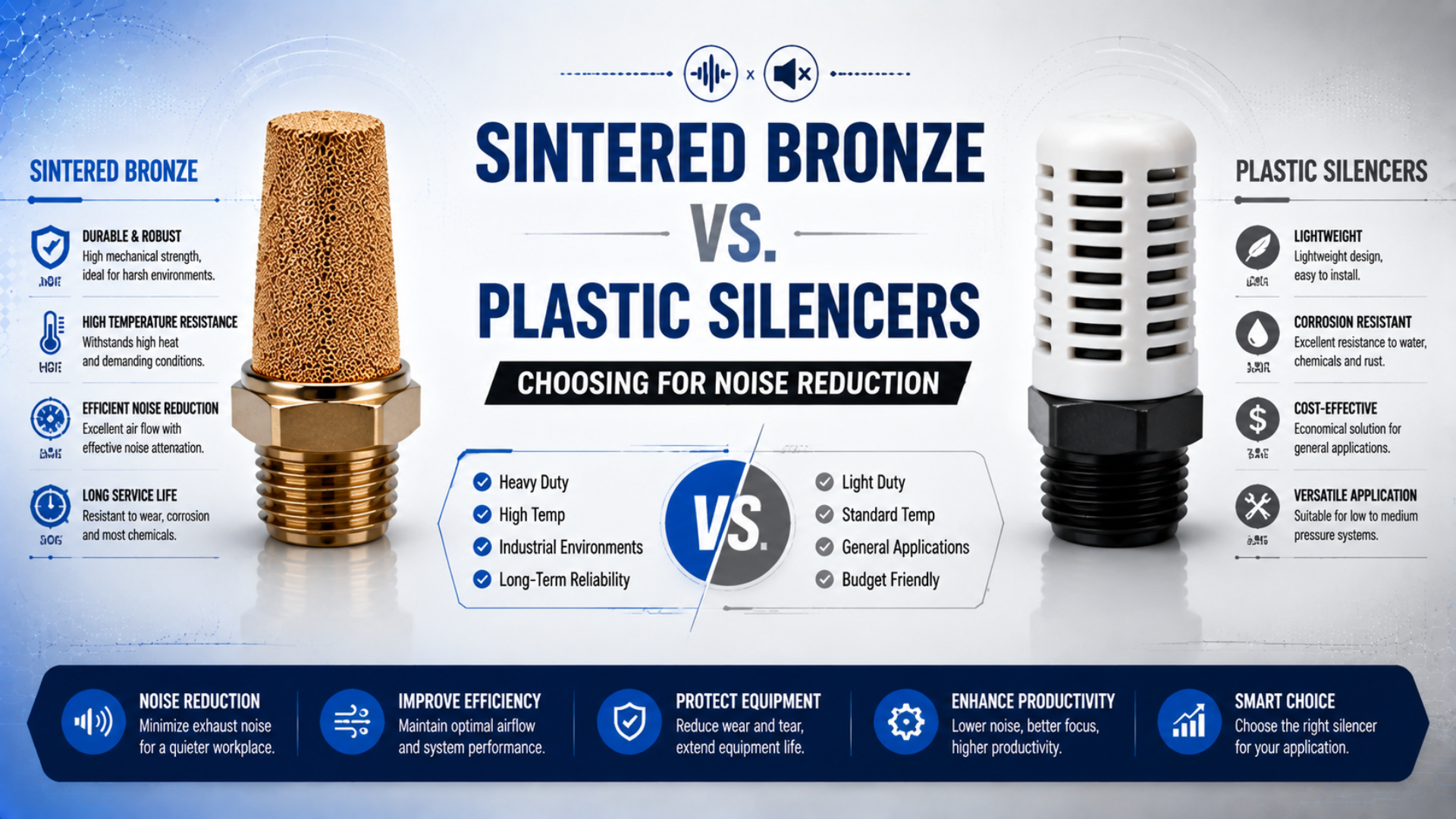
Không phải đồng thiêu kết hay nhựa lúc nào cũng là vật liệu tạo ra bộ giảm thanh khí nén êm hơn. So sánh bộ giảm thanh đồng thiêu kết và nhựa cần bằng chứng theo từng model. Vật liệu ảnh hưởng đến dải nhiệt độ, khối lượng, đặc tính chống ăn mòn, khả năng chịu va đập và lựa chọn bảo trì, nhưng hiệu suất âm thanh và xả khí đến từ toàn bộ thiết kế. Hãy so sánh dữ liệu tiếng ồn, độ dẫn, áp suất thử, ren, môi chất và hướng dẫn bảo trì của đúng mã linh kiện.
Dữ liệu catalog trong cùng điều kiện cho thấy rõ điểm này. Ở 6 bar và khoảng cách 1 m, IMI Norgren ghi model đồng thiêu kết T40 G1/4 ở mức 81 dBA và model nhựa xốp M/S G1/4 ở mức 84 dBA. Với G3/8, thứ hạng đảo ngược: model nhựa ở 81 dBA còn model đồng ở 84 dBA (IMI Norgren T40, 2024; IMI Norgren C/S và M/S, 2024).
Điểm chính cần nhớ
- Chỉ riêng vật liệu không dự đoán được tiếng ồn hoặc công suất xả khí.
- Chỉ so sánh dBA khi áp suất, khoảng cách và phương pháp thử giống nhau.
- Xác nhận độ dẫn, nhiệt độ, môi chất, ren và hướng dẫn bảo trì theo mã linh kiện.
- Chấp nhận bộ giảm thanh đã lắp bằng các phép đo thời gian hành trình có tải và tiếng ồn.
Để hiểu nguyên lý hoạt động cơ bản, hãy bắt đầu với hướng dẫn về bộ giảm thanh khí nén. Bài viết này trả lời câu hỏi mua hàng hẹp hơn: khi hai ứng viên trong catalog dùng vật liệu xốp khác nhau, bằng chứng nào nên quyết định việc lựa chọn?
Nhãn vật liệu chỉ là điểm bắt đầu
IMI Norgren định mức cả series nhựa xốp M/S và series đồng thiêu kết T40 ở 10 bar, trong khi nhiệt độ môi chất cao nhất được liệt kê là 80°C. Các giới hạn chồng lấn này cho thấy vì sao quy tắc chung như “đồng cho áp suất, nhựa cho tải nhẹ” không thể thay thế datasheet của đúng model (IMI Norgren T40, 2024; IMI Norgren C/S và M/S, 2024).
Đồng thiêu kết thường chỉ một phần tử xốp được tạo ra bằng cách nén và liên kết các hạt đồng. Phần tử này có thể kết hợp với đế ren bằng đồng thau hoặc phần cứng đỡ khác. Kích thước hạt, độ rỗng, chiều dày phần tử, diện tích hở và hình học thân đều ảnh hưởng đến bộ giảm thanh hoàn chỉnh.
Bộ giảm thanh bằng nhựa là cách gọi kém cụ thể hơn. Nó có thể chỉ thân bằng polyethylene UHMW xốp, phần tử hấp thụ âm thanh thiêu kết bằng nhựa nằm trong vỏ riêng, hoặc vỏ polymer bao quanh một môi trường khác. Ví dụ, SMC xác định cả thân và vật liệu hấp thụ âm thanh của các model AN nhỏ gọn là nhựa, trong khi các bộ giảm thanh AN thân kim loại cỡ lớn vẫn dùng phần tử hấp thụ âm thanh thiêu kết bằng nhựa (series AN của SMC).
Hãy yêu cầu nhà cung cấp tách riêng các thông tin cấu tạo sau:
| Trường thông tin hỏi giá | Ý nghĩa |
|---|---|
| Vật liệu phần tử xốp | Chi phối nhiệt độ, khả năng tương thích môi chất, phản ứng với nhiễm bẩn và phương pháp bảo trì có thể dùng |
| Vật liệu đế ren và vỏ | Ảnh hưởng đến mô-men lắp đặt, khả năng chịu va đập, khối lượng và mức phơi nhiễm ăn mòn |
| Độ rỗng hoặc thông số phần tử | Ảnh hưởng đến độ cản và đặc tính âm học, nhưng không thể hoán đổi giữa các nhà sản xuất |
| Chỉ số âm thanh và điều kiện thử | Phân biệt áp suất âm thanh đầu ra với suy hao chèn hoặc mức giảm tiếng ồn được quảng cáo |
| Độ dẫn, diện tích hiệu dụng hoặc lưu lượng đã thử | Sàng lọc đường xả cho chu kỳ yêu cầu |
So sánh hữu ích không phải là “kim loại so với nhựa”. Đó là so sánh một cụm lắp ráp có tài liệu với một cụm khác. Vỏ kim loại có phần tử nhựa và bộ giảm thanh hoàn toàn bằng nhựa có thể có đặc tính âm học giống nhau nhiều hơn vẻ ngoài của chúng gợi lên.
Vật liệu nào êm hơn trong điều kiện thử tương đồng?
ISO 20145:2026 xác định hai chế độ thử âm học cho bộ giảm thanh xả khí nén: dòng ổn định ở áp suất phía trước không đổi và xả trong khi áp suất khí nén giảm. Một giá trị dBA chỉ có thể so sánh khi biết rõ chỉ số, chế độ, điều kiện phía trước, khoảng cách và cách bố trí đo (ISO 20145:2026).
Dữ liệu Norgren dưới đây dùng cùng một nhà sản xuất, áp suất vào 6 bar và khoảng cách đo 1 m. Chúng không chứng minh một họ sản phẩm tốt nhất cho mọi van, nhưng bác bỏ thứ hạng vật liệu mang tính phổ quát.
| Cổng danh nghĩa | Đồng thiêu kết T40 | Nhựa xốp M/S | Áp suất âm thanh catalog thấp hơn | So sánh độ dẫn |
|---|---|---|---|---|
| G1/4 | 81 dBA; C = 7.3 dm³/(s·bar) | 84 dBA; C = 7.5 dm³/(s·bar) | Đồng thấp hơn 3 dBA | Nhựa cao hơn một chút |
| G3/8 | 84 dBA; C = 15.0 dm³/(s·bar) | 81 dBA; C = 16.2 dm³/(s·bar) | Nhựa thấp hơn 3 dBA | Nhựa cao hơn |
SMC đưa ra một cảnh báo khác về việc nhầm lẫn chỉ số. Series AN nhựa nhỏ gọn của hãng quảng cáo mức giảm tiếng ồn 30 dB(A), trong khi các model AN đồng thiêu kết hợp kim đồng liệt kê 13, 16, 18 hoặc 21 dB(A), tùy model. Đây là các giá trị suy hao, không phải mức áp suất âm thanh đầu ra được thể hiện trong bảng Norgren (AN nhựa nhỏ gọn của SMC; AN thân thiêu kết BC của SMC).
Phân tích bộ giảm thanh khuếch tán so với hấp thụ giải thích vì sao diện tích phần tử, lỗ rỗng, buồng và hình học xả có thể quan trọng hơn một nhãn vật liệu chỉ gồm một từ.
Công suất lưu lượng và áp suất ngược thay đổi quyết định như thế nào?
SMC liệt kê diện tích hiệu dụng từ 10 đến 90 mm² và độ dẫn âm từ 2 đến 18 dm³/(s·bar) trên các model AN nhựa nhỏ gọn có ren. Vì vậy, chỉ một họ vật liệu đã bao phủ dải diện tích hiệu dụng gấp chín lần. Kích thước cổng và vật liệu không xác lập được công suất xả khí (AN nhựa nhỏ gọn của SMC).
Bộ giảm thanh xả khí nằm nối tiếp với cổng xi lanh, đầu nối, ống, bộ điều khiển lưu lượng, cửa sổ con trượt van, đường ống trong manifold và khí quyển. Nếu độ dẫn ở trạng thái sạch của bộ giảm thanh không đủ, hoặc về sau bị nhiễm bẩn làm giảm độ dẫn, áp suất sẽ còn lại trong buồng lẽ ra phải xả. Điều đó có thể kéo dài thời gian hành trình và làm giảm chênh áp dùng để di chuyển tải.
Đừng so sánh trực tiếp lưu lượng của van với Cv của bộ giảm thanh như thể đó là cùng một đại lượng. Tùy nhà sản xuất và tiêu chuẩn, datasheet có thể công bố:
- độ dẫn âm C tính bằng dm³/(s·bar);
- tỷ số áp suất tới hạn b;
- diện tích hiệu dụng S tính bằng mm²;
- Cv hoặc Kv;
- lưu lượng khí tự do ở áp suất vào đã nêu;
- lưu lượng xả khuyến nghị;
- độ sụt áp tại một hoặc nhiều điểm lưu lượng.
So sánh đúng phải dùng các đại lượng tương thích hoặc phương pháp tính chọn của nhà sản xuất. Nếu hai catalog dùng đơn vị khác nhau, trước hết hãy đổi đơn vị, sau đó giữ nguyên các điều kiện tham chiếu đã nêu. Cổng danh nghĩa chỉ cho biết cần khảo sát họ kết nối nào.
Để đánh giá khi đã lắp đặt, hãy thiết lập đường cơ sở ở trạng thái sạch:
- Ghi thời gian duỗi và thu có tải.
- Đo áp suất tại cửa vào van trong cùng chu kỳ.
- Đo áp suất trong buồng đang xả.
- Ghi cài đặt meter-out và giảm chấn.
- So sánh tiếng ồn tại một vị trí có thể lặp lại.
- Lặp lại sau khi lắp bộ giảm thanh ứng viên.
Máy ít ồn hơn không tự động có nghĩa là kết quả tốt hơn. Nếu âm thanh giảm vì bộ thay thế cản dòng hơn, xi lanh cũng có thể chậm lại và giữ nhiều áp suất xả hơn. Hãy chấp nhận dựa trên cả tiếng ồn, thời gian và áp suất.
Hướng dẫn chẩn đoán tắc bộ giảm thanh trình bày việc theo dõi áp suất và thay thế bằng linh kiện cùng loại đã biết tốt. Hướng dẫn rộng hơn về áp suất ngược khí nén giải thích cách áp suất xả làm thay đổi lực và tốc độ của cơ cấu chấp hành.
Giới hạn áp suất, nhiệt độ và môi chất thực sự cho thấy điều gì?
Festo định mức họ bộ giảm thanh polymer U ở 10 bar, cho phép vận hành với khí có bôi trơn và liệt kê nhiệt độ môi trường từ -10°C đến 70°C. Chỉ riêng họ sản phẩm chính thức này đã bác bỏ các quy tắc chung rằng nhựa chỉ giới hạn ở 6 bar hoặc không thể dùng với khí có bôi trơn (Bộ giảm thanh U của Festo, 2024).
Đồng vẫn có thể là ứng viên tốt hơn khi catalog của đúng model phù hợp với môi trường. T40 đồng thiêu kết của Norgren liệt kê dải -40°C đến 80°C, khí nén có thể có hoặc không có bôi trơn, chân không và khí trơ. M/S nhựa xốp của hãng liệt kê dải -20°C đến 80°C cùng khí nén đã lọc, có hoặc không có bôi trơn, chân không và khí trơ.
Các dải này chồng lấn nhưng không giống hệt nhau. Hãy dùng các điều kiện máy đã cấu hình:
| Điều kiện | Điều cần xác minh đối với đồng | Điều cần xác minh đối với nhựa |
|---|---|---|
| Nhiệt độ | Giới hạn của phần tử, đế, lớp mạ và phớt; nguy cơ nước ngưng đóng băng | Cấp polymer, hiện tượng mềm hóa, giòn hóa và giới hạn đóng băng |
| Sương dầu | Cho phép của nhà sản xuất và mức tích tụ nhiễm bẩn | Khả năng tương thích chất bôi trơn và diễn biến bít lỗ rỗng |
| Dung dịch làm mát hoặc hóa chất vệ sinh | Khả năng tương thích của đồng, đồng thau, lớp mạ và ăn mòn điện hóa | Trương nở, giòn hóa, nứt do ứng suất và hòa tan chiết xuất |
| Rửa trôi hoặc phơi nhiễm ngoài trời | Đường ăn mòn, giữ nước và thoát nước của vỏ bảo vệ | Tia UV, thủy phân, phơi nhiễm hóa chất và giữ nước |
| Rung và va đập | Độ bền đế ren, khối lượng và khả năng đỡ phần tử | Độ dai thân, phương pháp lắp ren và phần nhô không được đỡ |
| Xả khí sạch hoặc nhạy cảm | Phát tán hạt, kéo theo dầu và yêu cầu thu gom phía sau | Phát tán polymer, phê duyệt môi chất và yêu cầu xử lý xả |
Áp suất cũng cần được đặt trong bối cảnh. Hầu hết bộ giảm thanh được lắp ở cửa xả van, nên “áp suất vận hành tối đa” trong catalog có thể mô tả cửa vào van hoặc điều kiện phía trước được phép, chứ không phải áp suất liên tục giữ bên trong bộ giảm thanh. Hãy đọc ghi chú, định nghĩa mạch và hướng dẫn áp dụng cho đúng model.
Đối với tiếng ồn nghề nghiệp, tránh biến một lần đo mức âm thanh thành kết luận pháp lý. OSHA xác định 85 dBA trong 8 giờ là mức hành động cho chương trình bảo tồn thính lực, trong khi bảng phơi nhiễm cho phép của ngành công nghiệp chung liệt kê 90 dBA trong 8 giờ. NIOSH khuyến nghị 85 dBA trong 8 giờ với quy tắc đổi 3 dB (OSHA 29 CFR 1910.95; NIOSH, 2024).
Bảo trì và nhiễm bẩn phụ thuộc từng model
IMI Norgren mô tả rõ các bộ giảm thanh lưới đồng thau MA và MB có phần tử có thể vệ sinh, trong khi SMC cảnh báo không tháo rời bộ giảm thanh AN của hãng. Vì vậy, các khái quát như “kim loại có thể vệ sinh” và “nhựa phải bỏ đi” đều không an toàn. Hướng dẫn của đúng sản phẩm mới quyết định phương pháp bảo trì (MA và MB của IMI Norgren, 2026; series AN của SMC).
Phần tử xốp có thể tích tụ dầu, nước, bụi, mảnh phớt, keo làm kín ren hoặc chất nhiễm bẩn từ quy trình. Độ cản tạo ra phụ thuộc vào cấu trúc lỗ rỗng và mức phơi nhiễm, không chỉ vào việc phần tử là đồng hay polymer. Thân nhựa nứt thường nhìn thấy được; phần tử đồng bị bít dần thì có thể không.
Hãy dùng bằng chứng theo tình trạng thay vì lịch thay thế cố định:
- thời gian hành trình có tải lệch khỏi dải chấp nhận;
- áp suất buồng xả tăng trong khi chuyển động;
- âm thanh thay đổi so với đường cơ sở sạch;
- phần tử có hư hỏng, ăn mòn, trương nở, nứt hoặc giữ chất nhiễm bẩn;
- một bộ giảm thanh cùng loại đã biết tốt khôi phục hiệu suất bình thường;
- đã đạt giới hạn kiểm tra hoặc bảo trì do nhà sản xuất quy định.
Việc vệ sinh không được làm rộng lỗ rỗng, đẩy chất nhiễm bẩn vào sâu hơn, để lại cặn dung môi hoặc làm hỏng đế ren. Không dùng khí nén, nhiệt, vệ sinh siêu âm hoặc hóa chất trừ khi hướng dẫn của đúng sản phẩm cho phép. Hãy thay phần tử không thể bảo trì.
Bộ giảm thanh cũ cũng có thể để chất nhiễm bẩn đi vào qua cửa xả hở khi mạch không có áp. Nếu nguy cơ xâm nhập từ bên ngoài đáng kể, hãy đánh giá hướng lắp, tấm che, hướng rửa trôi và xem bộ bảo vệ cửa xả chuyên dụng có phù hợp hơn bộ giảm thanh xốp thông thường hay không.
Người mua nên so sánh bộ giảm thanh đồng thiêu kết và nhựa như thế nào?
Catalog khí nén của Parker phân tách các phiên bản bộ giảm thanh bằng nhựa, kim loại thiêu kết, toàn kim loại, push-in, có thể điều chỉnh, tải nặng và tự làm sạch. Dải sản phẩm đó cho thấy “đồng hay nhựa?” chỉ là một trường thông tin RFQ cần ghi nhận, không phải toàn bộ quyết định (Catalog khí nén cô đọng của Parker, 2025).
Hãy bắt đầu từ chế độ làm việc, sau đó chọn cấu tạo:
- Xác định nguồn xả. Ghi model van, chức năng cổng, áp suất, thể tích xi lanh, thời gian hành trình và dạng chu kỳ.
- Khớp kết nối. Xác nhận đầy đủ ký hiệu M, G, R, Rc, Rp hoặc NPT, phớt, chiều ăn ren và phương pháp lắp đặt.
- Sàng lọc lưu lượng ở trạng thái sạch. Dùng độ dẫn, diện tích hiệu dụng, Cv/Kv hoặc lưu lượng đã thử trong các điều kiện đã nêu.
- Chuẩn hóa dữ liệu tiếng ồn. Tách áp suất âm thanh đầu ra khỏi suy hao chèn hoặc mức giảm tiếng ồn được quảng cáo.
- Kiểm tra môi trường. Ghi nhiệt độ, dầu, nước, dung dịch làm mát, hóa chất, bụi, rung, tia UV và rửa trôi.
- Xác nhận quy tắc bảo trì. Xác định phần tử cụ thể có thể thay, vệ sinh, không thể bảo trì hay được bảo vệ bởi linh kiện khác.
- Thực hiện phép thử chấp nhận sau lắp đặt. So sánh tiếng ồn, thời gian hành trình, áp suất động, rò rỉ và độ ổn định chuyển động với đường cơ sở đã phê duyệt.
Hãy dùng hồ sơ so sánh thay vì một tuyên bố thiên về sở thích:
| Bằng chứng RFQ bắt buộc | Ứng viên A | Ứng viên B |
|---|---|---|
| Đầy đủ mã linh kiện của nhà sản xuất | ||
| Vật liệu phần tử, đế và vỏ | ||
| Đầy đủ ren và phớt | ||
| Độ dẫn, diện tích hiệu dụng, Cv/Kv hoặc lưu lượng định mức | ||
| Chỉ số âm học và đầy đủ điều kiện thử | ||
| Giới hạn áp suất và nhiệt độ | ||
| Môi chất được phép và điều kiện bôi trơn | ||
| Hướng dẫn vệ sinh hoặc thay thế | ||
| Kết quả tiếng ồn, áp suất và thời gian hành trình sau lắp đặt |
So sánh các loại ren của bộ giảm thanh trình bày chi tiết việc xác minh kết nối. Nên dùng hướng dẫn này trước mọi thay thế khác thương hiệu vì khớp G1/4, R1/4 hoặc 1/4 NPT là nhiệm vụ riêng, không đồng nghĩa với khớp hiệu suất âm học và lưu lượng.
Cần xác minh gì sau khi lắp đặt?
NIOSH dùng quy tắc đổi 3 dB trong khuyến nghị về tiếng ồn nghề nghiệp, nghĩa là thời gian phơi nhiễm khuyến nghị giảm một nửa sau mỗi lần tăng 3 dB. Chênh lệch 3 dBA trong catalog có thể đáng kể, nhưng chỉ phép đo sau lắp đặt tại vị trí người lao động mới xác định được phần đóng góp của máy vào mức phơi nhiễm thực tế (NIOSH, 2024).
Cô lập năng lượng khí nén tích trữ và tuân theo quy trình an toàn của máy trước khi thay linh kiện xả. Lắp ứng viên bằng đúng ren, phớt, dụng cụ và hướng dẫn siết của model đó. Thân nhựa, bộ giảm thanh metric nhỏ và thân lục giác kim loại có thể cần các phương pháp khác nhau.
Sau khi lắp đặt, hãy lặp lại điều kiện vận hành đã ghi nhận:
- cùng cài đặt nguồn cấp và trạng thái máy;
- cùng tải và hướng chuyển động;
- cùng cài đặt bộ điều khiển lưu lượng và giảm chấn;
- cùng vị trí và cài đặt máy đo âm thanh;
- cùng các điểm đo thời gian hành trình;
- cùng vị trí đầu đo áp suất;
- đủ số chu kỳ để bộc lộ diễn biến nhạy với nhiệt hoặc nhiễm bẩn.
Linh kiện thay thế chỉ đạt khi tiếng ồn, áp suất xả động, thời gian hành trình có tải, rò rỉ và độ ổn định chuyển động vẫn nằm trong giới hạn đã phê duyệt của máy. Một linh kiện êm hơn nhưng làm chậm chuyển động không tương đương. Linh kiện khôi phục tốc độ nhưng làm tăng phơi nhiễm của người lao động cũng không đạt.
Hãy lưu đường cơ sở cùng mã linh kiện đã phê duyệt, điều kiện thử và kết quả đo. Khi đó, quyết định thay thế tiếp theo sẽ trở thành một phép so sánh có kiểm soát thay vì lại tranh luận chung chung về vật liệu.
Câu hỏi thường gặp về bộ giảm thanh đồng thiêu kết và nhựa
Catalog SMC ghi bộ giảm thanh nhựa có mức giảm 30 dB(A) và các model đồng thiêu kết hợp kim đồng có mức 13 đến 21 dB(A), trong khi dữ liệu Norgren ở 6 bar trong cùng điều kiện đảo ngược thứ hạng vật liệu giữa G1/4 và G3/8. Vì vậy, các câu trả lời dưới đây dùng bằng chứng theo model thay vì quy tắc vật liệu cố định (series AN của SMC; T40 của IMI Norgren).
Đồng thiêu kết có phải lúc nào cũng êm hơn nhựa không?
Không. Norgren liệt kê model đồng G1/4 ở 81 dBA so với 84 dBA của nhựa, nhưng model nhựa G3/8 ở 81 dBA so với 84 dBA của đồng. Cả bốn giá trị đều dùng 6 bar và 1 m. Hình học phần tử và công suất xả cũng quan trọng bên cạnh vật liệu.
Bộ giảm thanh khí nén bằng nhựa có thể vận hành ở 8 bar không?
Có, nếu đúng model được định mức cho điều kiện đó. Series polymer U của Festo và series nhựa xốp M/S của Norgren đều được liệt kê đến 10 bar. Hãy xác nhận áp suất đã nêu là áp suất tại cửa vào van hay điều kiện phía trước bộ giảm thanh, đồng thời kiểm tra giới hạn nhiệt độ, môi chất và lắp đặt.
Loại bộ giảm thanh nào tắc nhanh hơn?
Không có thứ hạng vật liệu mang tính phổ quát. Tắc phụ thuộc vào cấu trúc lỗ rỗng, diện tích hở, lượng dầu và nước kéo theo, bụi, nhu cầu chu kỳ, hướng lắp và lịch sử bảo trì. Hãy thiết lập đường cơ sở sạch về áp suất và thời gian hành trình, sau đó kiểm tra thay đổi trong cùng chu kỳ có tải thay vì ước tính mức bít từ vẻ ngoài.
Có thể vệ sinh bộ giảm thanh bằng đồng và nhựa không?
Chỉ khi hướng dẫn của đúng nhà sản xuất cho phép. Norgren mô tả các phần tử lưới đồng thau MA và MB cụ thể là có thể vệ sinh, trong khi SMC nói không nên tháo rời bộ giảm thanh AN. Đừng mở rộng quyền cho phép của một model sang các sản phẩm đồng xốp hoặc nhựa có cấu tạo, keo, lớp mạ hoặc giới hạn hóa chất khác.
Cần đo gì sau khi thay bộ giảm thanh khí nén?
Đo âm thanh tại vị trí liên quan đến người vận hành và có thể lặp lại, thời gian duỗi và thu có tải, áp suất cửa vào van và áp suất của buồng xi lanh đang xả. Giữ nguyên tải, nguồn cấp, bộ điều khiển lưu lượng và giảm chấn. Chỉ chấp nhận linh kiện thay thế khi tiếng ồn, thời gian, áp suất, rò rỉ và độ ổn định chuyển động đều nằm trong giới hạn.
Nguồn và tài liệu kỹ thuật tham khảo
- ISO, ISO 20145:2026 Năng lượng chất lưu khí nén - Phương pháp thử để đo mức áp suất phát xạ âm của bộ giảm thanh xả. Truy cập ngày 2026-07-27.
- OSHA, 29 CFR 1910.95 Phơi nhiễm tiếng ồn nghề nghiệp. Truy cập ngày 2026-07-27.
- NIOSH, Hiểu về phơi nhiễm tiếng ồn, 2024. Truy cập ngày 2026-07-27.
- IMI Norgren, Bộ giảm thanh đồng thiêu kết Quietaire T40, 2024. Truy cập ngày 2026-07-27.
- IMI Norgren, Bộ giảm thanh nhựa xốp C/S và M/S, 2024. Truy cập ngày 2026-07-27.
- IMI Norgren, Bộ giảm thanh tải nặng series MA và MB, 2026. Truy cập ngày 2026-07-27.
- Festo, Bộ giảm thanh U, 2024. Truy cập ngày 2026-07-27.
- SMC, Bộ giảm thanh loại nhựa nhỏ gọn series AN. Truy cập ngày 2026-07-27.
- SMC, Bộ giảm thanh loại thân thiêu kết BC series AN. Truy cập ngày 2026-07-27.
- Parker, Catalog khí nén cô đọng của Parker, 2025. Truy cập ngày 2026-07-27.