

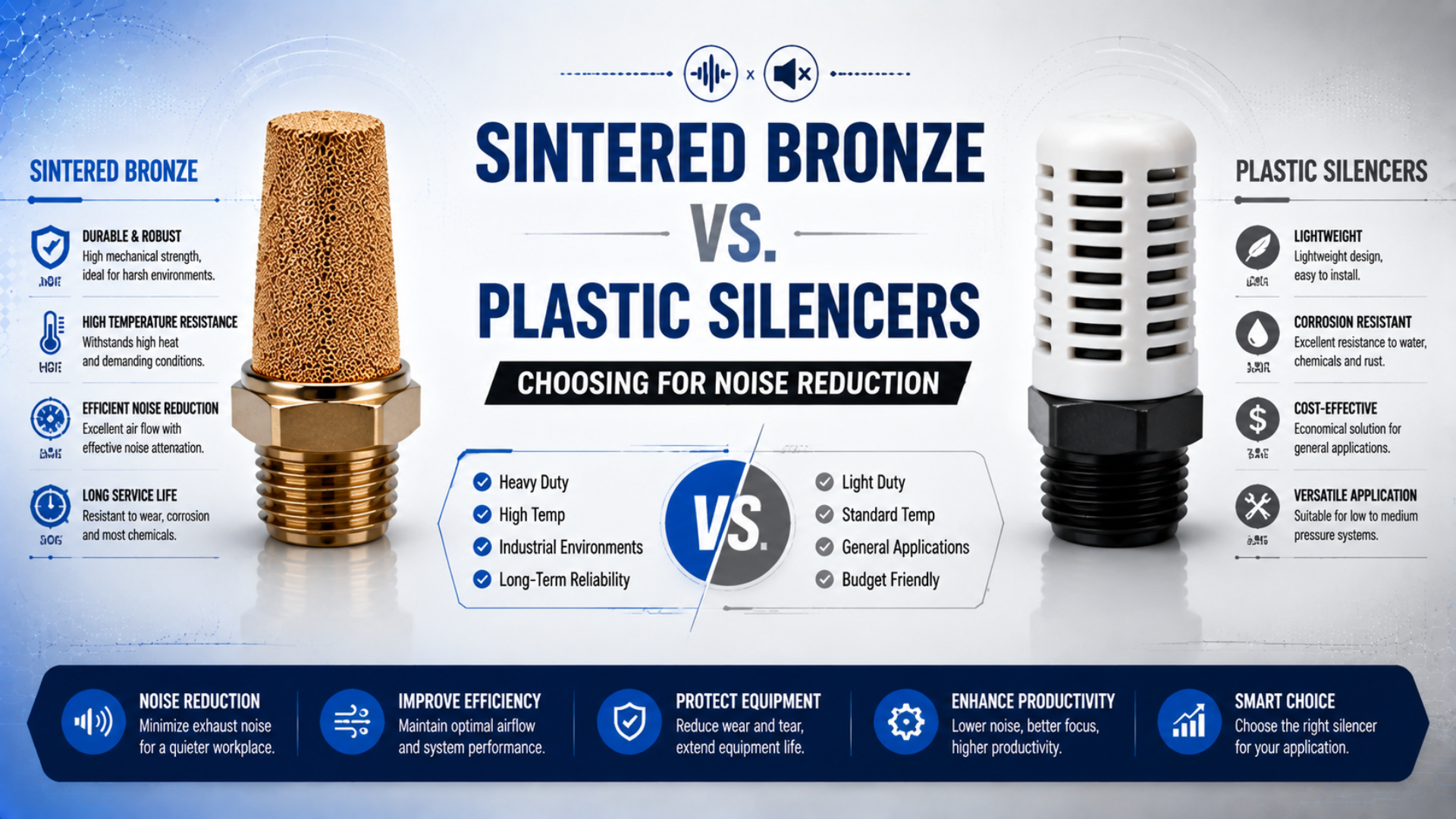
Neither sintered bronze nor plastic is automatically the quieter pneumatic silencer. Comparing sintered bronze vs plastic silencers requires model-level evidence. Material affects temperature range, mass, corrosion behavior, impact resistance, and service options, but sound and exhaust performance come from the complete design. Compare sound data, conductance, test pressure, thread, media, and maintenance instructions for the exact part number.
Matched catalog data make the point. At 6 bar and 1 m, IMI Norgren lists its G1/4 sintered-bronze T40 at 81 dBA and its G1/4 porous-plastic M/S at 84 dBA. At G3/8, the ranking reverses: the plastic model is 81 dBA and the bronze model is 84 dBA (IMI Norgren T40, 2024; IMI Norgren C/S and M/S, 2024).
Key Takeaways
- Material alone does not predict noise or exhaust capacity.
- Compare dBA only when pressure, distance, and test method match.
- Confirm conductance, temperature, media, thread, and service instructions by part number.
- Accept the installed silencer with loaded stroke-time and noise measurements.
For the basic operating principle, start with the pneumatic muffler guide. This article answers the narrower purchasing question: when two catalog candidates use different porous materials, what evidence should decide between them?
The Material Label Is Only the Starting Point
IMI Norgren rates both its porous-plastic M/S series and sintered-bronze T40 series to 10 bar, while their upper listed media temperature is 80°C. Those overlapping limits show why a generic rule such as “bronze for pressure, plastic for light duty” cannot replace the exact model datasheet (IMI Norgren T40, 2024; IMI Norgren C/S and M/S, 2024).
Sintered bronze normally describes a porous element made by compacting and bonding bronze particles. The element may be combined with a brass threaded base or other supporting hardware. Particle size, porosity, element thickness, exposed area, and body geometry all influence the finished silencer.
Plastic silencer is less precise. It may mean a porous UHMW polyethylene body, a resin-sintered sound-absorbing element inside a separate housing, or a polymer housing around another medium. SMC, for example, identifies both the body and sound-absorbing material of its compact AN models as resin, while its large metal-body AN silencers still use a resin-sintered sound-absorbing element (SMC AN Series).
Ask suppliers to separate these construction fields:
| RFQ field | Why it matters |
|---|---|
| Porous element material | Governs temperature, media compatibility, contamination response, and possible service method |
| Threaded base and housing material | Affects installation torque, impact resistance, mass, and corrosion exposure |
| Porosity or element specification | Influences restriction and acoustic behavior, but is not interchangeable between manufacturers |
| Sound metric and test condition | Distinguishes output sound pressure from insertion loss or advertised noise reduction |
| Conductance, effective area, or tested flow | Screens the exhaust path for the required cycle |
The useful comparison is not “metal versus plastic.” It is one documented assembly against another. A metal housing with a resin element and an all-resin silencer may share more acoustic behavior than their outside appearance suggests.
Which Material Is Quieter Under Matched Test Conditions?
ISO 20145:2026 defines two acoustic test modes for pneumatic exhaust silencers: steady-state flow at constant upstream pressure and discharge while pneumatic pressure decreases. A dBA figure is comparable only when the metric, mode, upstream condition, distance, and measurement setup are known (ISO 20145:2026).
The Norgren data below use a common manufacturer, 6 bar inlet pressure, and 1 m measurement distance. They do not prove that one family is best for every valve, but they do disprove a universal material ranking.
| Nominal port | Sintered bronze T40 | Porous plastic M/S | Lower catalog sound pressure | Conductance comparison |
|---|---|---|---|---|
| G1/4 | 81 dBA; C = 7.3 dm³/(s·bar) | 84 dBA; C = 7.5 dm³/(s·bar) | Bronze by 3 dBA | Plastic is slightly higher |
| G3/8 | 84 dBA; C = 15.0 dm³/(s·bar) | 81 dBA; C = 16.2 dm³/(s·bar) | Plastic by 3 dBA | Plastic is higher |
SMC provides another warning about metric confusion. Its compact resin AN series advertises a 30 dB(A) noise reduction, while its copper-alloy sintered AN models list 13, 16, 18, or 21 dB(A), depending on model. Those values are attenuation claims, not the output sound-pressure levels shown in the Norgren table (SMC Compact Resin AN; SMC BC Sintered AN).
The diffusion-versus-absorption silencer analysis explains why element area, pores, chambers, and discharge geometry can outweigh a one-word material label.
How Do Flow Capacity and Back Pressure Change the Decision?
SMC lists effective areas from 10 to 90 mm² and sonic conductance from 2 to 18 dm³/(s·bar) across threaded compact-resin AN models. One material family therefore spans a ninefold effective-area range. Port size and material do not establish exhaust capacity (SMC Compact Resin AN).
An exhaust silencer sits in series with the cylinder port, fitting, tubing, flow control, valve spool window, manifold gallery, and atmosphere. If the silencer has inadequate clean-state conductance, or contamination reduces it later, pressure remains in the chamber that should be venting. That can extend stroke time and reduce the pressure difference available to move the load.
Do not compare a valve’s flow rate directly with a silencer’s Cv as if they were the same quantity. Depending on the manufacturer and standard, a datasheet may publish:
- sonic conductance C in dm³/(s·bar);
- critical pressure ratio b;
- effective area S in mm²;
- Cv or Kv;
- free-air flow at a stated inlet pressure;
- recommended exhaust flow;
- pressure drop at one or more flow points.
The correct comparison uses compatible quantities or the manufacturer’s sizing method. If two catalogs use different units, convert the units first, then preserve the stated reference conditions. A nominal port only tells you which connection family to investigate.
For installed behavior, establish a clean baseline:
- Record loaded extension and retraction times.
- Measure valve-inlet pressure during the same cycle.
- Measure pressure in the chamber that is exhausting.
- Record the meter-out and cushion settings.
- Compare noise at a repeatable position.
- Repeat after the candidate silencer is installed.
A quieter machine is not automatically a better result. If sound falls because the replacement is more restrictive, the cylinder may also slow and retain more exhaust pressure. Accept noise, timing, and pressure together.
The dedicated silencer-clogging diagnostic guide covers pressure tracing and known-good substitution. The broader pneumatic back-pressure guide explains how exhaust pressure changes actuator force and speed.
What Do Pressure, Temperature, and Media Limits Really Show?
Festo rates its polymer U silencer family to 10 bar, permits lubricated operation, and lists ambient temperature from -10°C to 70°C. That single official family contradicts universal rules that plastic is limited to 6 bar or cannot be used with lubricated air (Festo Silencer U, 2024).
Bronze can still be the better candidate when the exact catalog supports the environment. Norgren’s sintered-bronze T40 lists -40°C to 80°C, compressed air that may be lubricated or non-lubricated, vacuum, and inert gases. Its porous-plastic M/S lists -20°C to 80°C and filtered compressed air, lubricated or non-lubricated, vacuum, and inert gases.
Those ranges overlap, but they are not identical. Use the configured machine conditions:
| Condition | What to verify for bronze | What to verify for plastic |
|---|---|---|
| Temperature | Element, base, plating, and seal limits; risk of condensate freezing | Polymer grade, softening, brittleness, and freezing limits |
| Oil mist | Manufacturer permission and contamination loading | Lubricant compatibility and pore blockage behavior |
| Coolant or cleaning chemical | Bronze, brass, plating, and galvanic compatibility | Swelling, embrittlement, stress cracking, and extraction |
| Washdown or outdoor exposure | Corrosion path, water retention, and enclosure drainage | UV, hydrolysis, chemical exposure, and water retention |
| Vibration and impact | Threaded-base strength, mass, and element support | Body toughness, thread-installation method, and unsupported projection |
| Clean or sensitive exhaust | Particle shedding, oil carryover, and downstream collection requirements | Polymer shedding, media approval, and exhaust-treatment requirements |
Pressure also needs context. Most silencers are fitted to valve exhausts, so the catalog’s stated “maximum operating pressure” may describe the valve inlet or permitted upstream condition rather than a continuous pressure retained inside the muffler. Read the notes, circuit definition, and applicable model instructions.
For occupational noise, avoid turning one sound-level reading into a legal conclusion. OSHA identifies 85 dBA over eight hours as the action level for a hearing-conservation program, while its general-industry permissible-exposure table lists 90 dBA for eight hours. NIOSH recommends 85 dBA for eight hours with a 3 dB exchange rate (OSHA 29 CFR 1910.95; NIOSH, 2024).
Maintenance and Contamination Are Model-Specific
IMI Norgren explicitly describes its MA and MB brass-mesh silencers as having cleanable elements, while SMC cautions against disassembling its AN silencers. “Metal can be cleaned” and “plastic must be discarded” are therefore unsafe generalizations. The exact product instructions control the service method (IMI Norgren MA and MB, 2026; SMC AN Series).
Porous elements can accumulate oil, water, dust, seal debris, thread sealant, or process contamination. The resulting restriction depends on pore structure and exposure, not merely whether the element is bronze or polymer. A cracked plastic body is visible; a progressively blocked bronze element may not be.
Use condition-based evidence instead of a fixed replacement calendar:
- loaded stroke time moves outside the accepted range;
- exhausting-chamber pressure rises during motion;
- sound changes relative to the clean baseline;
- the element shows damage, corrosion, swelling, cracking, or retained contamination;
- a known-good identical silencer restores normal performance;
- the manufacturer-defined inspection or service limit is reached.
Cleaning must not enlarge pores, drive contamination deeper, leave solvent residue, or damage the threaded base. Never apply compressed air, heat, ultrasonic cleaning, or chemicals unless the exact instructions permit the method. Replace a non-serviceable element.
The old silencer can also admit contamination through an open exhaust port when the circuit is unpressurized. If external ingress matters, assess orientation, guards, washdown direction, and whether a purpose-designed exhaust protector is more suitable than a conventional porous muffler.
How Should Buyers Compare Sintered Bronze and Plastic Silencers?
Parker’s pneumatic catalog separates plastic, sintered-metal, all-metal, push-in, adjustable, heavy-duty, and self-cleaning silencer versions. That product spread shows that “bronze or plastic?” is only one documented RFQ field, not the complete decision (Parker Pneumatic Concise Catalogue, 2025).
Start with the duty, then select the construction:
- Identify the exhaust source. Record valve model, port function, pressure, cylinder volume, stroke time, and cycle pattern.
- Match the connection. Confirm the complete M, G, R, Rc, Rp, or NPT designation, seal, engagement, and installation method.
- Screen clean-state flow. Use conductance, effective area, Cv/Kv, or tested flow under stated conditions.
- Normalize sound data. Separate output sound pressure from insertion loss or advertised noise reduction.
- Check the environment. Record temperature, oil, water, coolant, chemicals, dust, vibration, UV, and washdown.
- Confirm service rules. Determine whether the exact element is replaceable, cleanable, non-serviceable, or protected by another component.
- Run an installed acceptance test. Compare sound, stroke time, dynamic pressure, leakage, and motion stability with the approved baseline.
Use a comparison record rather than a preference statement:
| Required RFQ evidence | Candidate A | Candidate B |
|---|---|---|
| Full manufacturer part number | ||
| Element, base, and housing materials | ||
| Complete thread and seal | ||
| Conductance, effective area, Cv/Kv, or rated flow | ||
| Acoustic metric and full test condition | ||
| Pressure and temperature limits | ||
| Permitted media and lubricant condition | ||
| Cleaning or replacement instruction | ||
| Installed noise, pressure, and stroke-time result |
The silencer thread comparison covers connection verification in detail. It is worth using before any cross-brand replacement because matching G1/4, R1/4, or 1/4 NPT is a separate task from matching acoustic and flow performance.
What Must Be Verified After Installation?
NIOSH uses a 3 dB exchange rate in its occupational-noise recommendation, meaning the recommended exposure duration halves for every 3 dB increase. A 3 dBA catalog difference can matter, but only the installed measurement at the worker position establishes the machine’s contribution to actual exposure (NIOSH, 2024).
Isolate stored pneumatic energy and follow the machine’s safety procedure before replacing an exhaust component. Install the candidate using the exact thread, seal, tool, and tightening instruction for that model. Resin bodies, small metric silencers, and metal hex bodies may require different methods.
After installation, repeat the documented operating condition:
- same supply setting and machine state;
- same payload and motion direction;
- same flow-control and cushion settings;
- same sound-meter position and settings;
- same stroke-time measurement points;
- same pressure-transducer locations;
- enough cycles to expose thermal or contamination-sensitive behavior.
The replacement passes only when noise, dynamic exhaust pressure, loaded stroke time, leakage, and motion stability remain inside the machine’s approved limits. A part that is quieter but slows motion is not equivalent. A part that restores speed but increases worker exposure also fails.
Preserve the baseline with the approved part number, test condition, and measured results. The next replacement decision then becomes a controlled comparison instead of another material debate.
Sintered Bronze vs. Plastic Silencer FAQs
SMC catalogs resin silencers with 30 dB(A) reduction and copper-alloy sintered models with 13 to 21 dB(A), while Norgren’s matched 6 bar data reverse the material ranking between G1/4 and G3/8. These answers therefore use model-level evidence rather than fixed material rules (SMC AN Series; IMI Norgren T40).
Is sintered bronze always quieter than plastic?
No. Norgren lists its G1/4 bronze model at 81 dBA versus 84 dBA for plastic, but the G3/8 plastic model is 81 dBA versus 84 dBA for bronze. All four values use 6 bar and 1 m. Element geometry and exhaust capacity matter alongside material.
Can a plastic pneumatic silencer operate at 8 bar?
Yes, if the exact model is rated for it. Festo’s polymer U series and Norgren’s porous-plastic M/S series are both listed up to 10 bar. Confirm whether the stated pressure refers to the valve inlet or silencer upstream condition, and check temperature, media, and installation limits.
Which silencer type clogs faster?
There is no universal material ranking. Clogging depends on pore structure, exposed area, oil and water carryover, dust, cycle demand, orientation, and service history. Establish a clean pressure and stroke-time baseline, then inspect changes under the same loaded cycle rather than estimating blockage from appearance.
Can bronze and plastic silencers be cleaned?
Only when the exact manufacturer instructions allow it. Norgren describes specific brass-mesh MA and MB elements as cleanable, while SMC says its AN silencers should not be disassembled. Do not extend one model’s permission to porous bronze or plastic products with different construction, adhesives, plating, or chemical limits.
What should be measured after replacing a pneumatic silencer?
Measure sound at a repeatable operator-relevant position, loaded extension and retraction times, valve-inlet pressure, and the pressure of the exhausting cylinder chamber. Keep payload, supply, flow controls, and cushions unchanged. Accept the replacement only when noise, timing, pressure, leakage, and motion stability all remain within limits.
Sources and technical references
- ISO, ISO 20145:2026 Pneumatic fluid power - Test methods for measuring acoustic emission pressure levels of exhaust silencers. Retrieved 2026-07-27.
- OSHA, 29 CFR 1910.95 Occupational noise exposure. Retrieved 2026-07-27.
- NIOSH, Understand Noise Exposure, 2024. Retrieved 2026-07-27.
- IMI Norgren, T40 Quietaire Sintered Bronze Silencer, 2024. Retrieved 2026-07-27.
- IMI Norgren, C/S and M/S Porous Plastic Silencers, 2024. Retrieved 2026-07-27.
- IMI Norgren, MA and MB Series Heavy Duty Silencers, 2026. Retrieved 2026-07-27.
- Festo, Silencer U, 2024. Retrieved 2026-07-27.
- SMC, AN Series Compact Resin Type Silencers. Retrieved 2026-07-27.
- SMC, AN Series BC Sintered Body Type Silencers. Retrieved 2026-07-27.
- Parker, Parker Pneumatic Concise Catalogue, 2025. Retrieved 2026-07-27.