

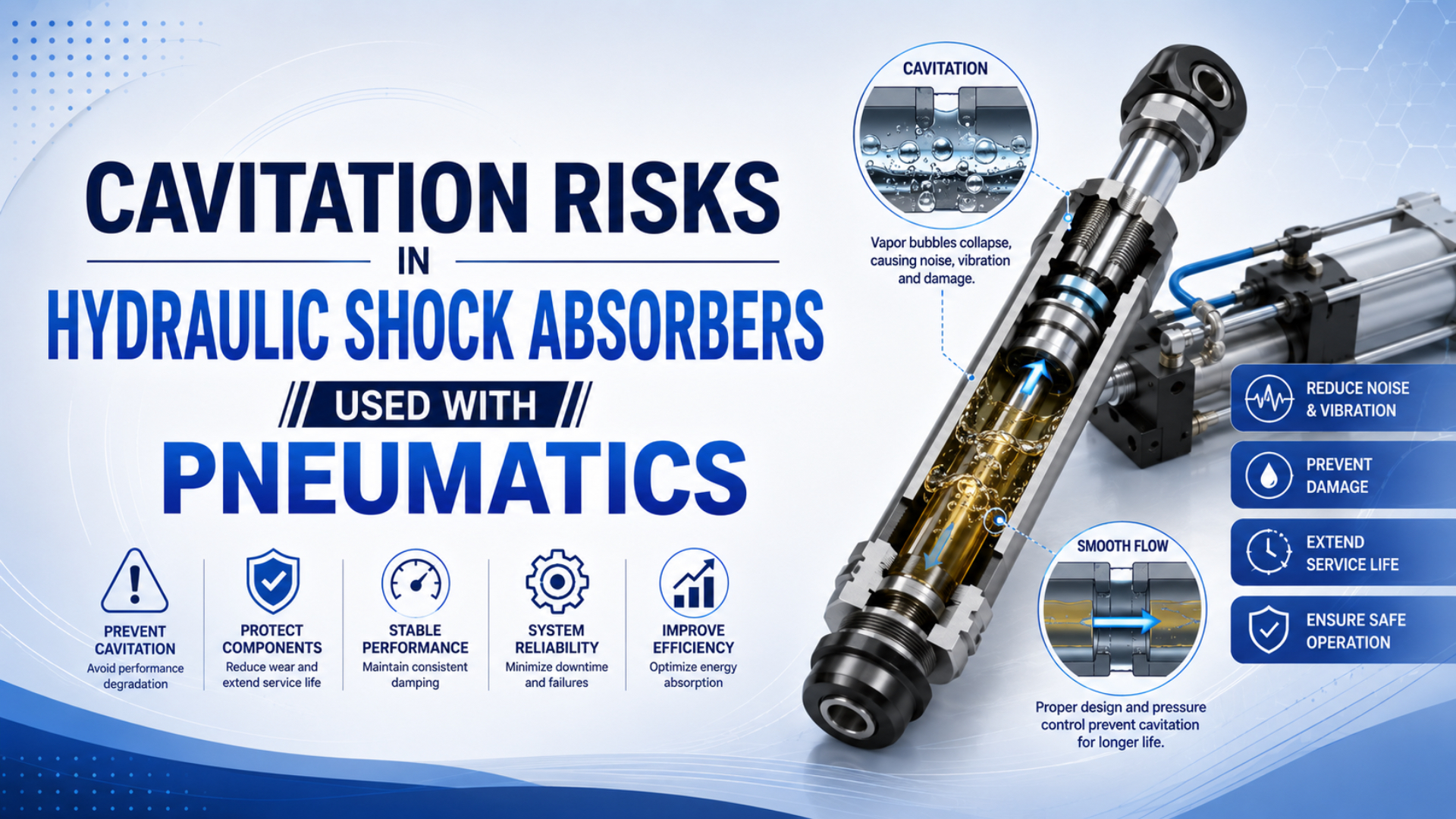
Noise, heat, or inconsistent stopping does not prove that a hydraulic shock absorber is cavitating. True cavitation requires a liquid pressure to fall below the fluid’s vapor pressure, followed by pressure recovery and cavity collapse. A sealed industrial absorber can also suffer from entrained air, incomplete reset, overload, side load, leakage, or ordinary wear.
That distinction changes the maintenance decision. A technician can measure impact behavior, temperature, return, leakage, and alignment without opening the component. Confirming internal cavitation damage normally requires product-specific engineering evidence or a manufacturer failure analysis.
Key Takeaways
- Cavitation, gas release, and external air entrainment are different mechanisms.
- Sound and heat are investigation triggers, not proof of cavitation.
- Check eight model limits before blaming the hydraulic fluid.
- Do not refill a sealed absorber unless its manufacturer provides a service procedure.
What Does Cavitation Mean Inside a Hydraulic Shock Absorber?
Emerson’s control-valve handbook identifies three pressures in liquid cavitation analysis: inlet pressure, the local minimum pressure, and downstream recovered pressure. Cavitation requires the local absolute pressure to cross below vapor pressure and then recover above it (Emerson, Control Valve Handbook, 2026).
Hydraulic shock absorber cavitation is internal liquid vaporization followed by cavity collapse after pressure recovery. An industrial shock absorber converts a moving load’s energy into heat by forcing oil through metering passages, but that operating principle does not prove that a particular unit cavitates. Its internal pressure field depends on product-specific geometry that may not be published.
The term vapor cavitation should therefore be reserved for a specific sequence:
- A local region of the liquid falls below the fluid’s absolute vapor pressure at its current temperature.
- Vapor cavities form in that low-pressure region.
- The cavities move into a region where pressure recovers above vapor pressure.
- Repeated collapse near a wetted surface contributes to internal erosion.
Gauge pressure, surface temperature, and machine sound cannot establish this sequence by themselves. Vapor pressure is an absolute-pressure property, while most maintenance gauges report pressure relative to atmosphere. A valid investigation must keep the pressure reference consistent.
For a broader comparison of liquid cavitation and pneumatic choked flow, see the hydraulic and pneumatic valve cavitation guide. Dry compressed air can choke, cool, or produce aerodynamic noise, but it does not undergo the same liquid-vapor collapse mechanism.
Vapor Cavitation, Gas Release, and Aeration Are Not the Same
Parker reports that air can be dissolved or entrained in hydraulic liquid and describes air as up to 20,000 times more compressible than the surrounding liquid. Dissolved air may remain harmless in solution; free bubbles can instead produce spongy response, heat, foaming, and reduced transmitted power (Parker, Hydraulic Filtration Handbook, accessed July 23, 2026).
Three mechanisms can produce bubbles, but they do not support the same conclusion:
| Mechanism | What forms the bubble | What the observation supports |
|---|---|---|
| Vapor cavitation | The liquid changes phase after local absolute pressure falls below vapor pressure | Possible internal erosion if the vapor cavities later collapse near a surface |
| Gas release | Dissolved gas comes out of solution as pressure falls | Compressibility, delayed response, cloudy fluid, or altered damping may occur |
| Aeration | External air enters through a leak, poor filling, or an open reservoir path | Foam, oxidation, heat, and inconsistent hydraulic behavior may follow |
Milky or cloudy oil is evidence of suspended bubbles, not a chemical identification of their contents. In a sealed miniature shock absorber, maintenance staff may not be able to see the oil at all. An external piston rod with corrosion, scratches, or impact damage is likewise not proof of cavitation on an internal wetted surface.
The useful maintenance question is not “Do I hear cavitation?” It is “Which measured condition distinguishes a hydraulic pressure problem from mechanical impact, incomplete return, leakage, or wear?” This framing prevents a replacement from masking the machine condition that damaged the first unit.
Where Could Low Pressure Develop During a Shock Absorber Cycle?
ACE’s MA-series manual illustrates approximately 400 bar in the pressure chamber during deceleration and 0 bar on the opposite side of its simplified piston diagram. It also describes oil displacement through progressively fewer metering openings (ACE Controls, MA30 to MA900 Operating and Mounting Instructions, 2022).
The high-pressure deceleration chamber is not automatically the most plausible place for vapor cavities. If a low-pressure event occurs, it may instead be associated with the refill side, a return passage, a local high-velocity restriction, incomplete liquid charge, or separation between the oil and an internal volume-compensation element. The actual path is product-specific.
Rapid cycling can matter indirectly. If the plunger has not fully returned, the next striker impact begins with less usable stroke. If hourly energy exceeds the model’s thermal capacity, oil viscosity and seal behavior may change. If the striker is misaligned, friction and side loading can interfere with return. None of these observations proves cavitation, but each can produce hard stopping, heat, or erratic motion that is commonly mislabeled as cavitation.
Do not drill, cut, bleed, or refill a sealed shock absorber to investigate the pressure path. Consult the exact drawing and manual. If root-cause confirmation requires internal inspection, isolate the unit and send it to the manufacturer or a qualified failure-analysis laboratory.
How Do You Separate Suspected Cavitation from More Common Failures?
SMC lists allowable life values of 1.2 million or 2 million cycles for several RB sizes under specified conditions and warns that temperature can shorten the suitable replacement period. It directs users to replace units after abnormal impact noise, vibration, or significant oil leakage (SMC, RB Series Specific Product Precautions, accessed July 23, 2026).
These symptoms indicate a faulty or unsuitable stopping system, not one exclusive failure mechanism. Use the observation pattern to choose the next measurement:
| Observation | Plausible causes to check first | Evidence needed before calling it cavitation |
|---|---|---|
| Hard impact at first contact | Adjustment too hard, effective-mass mismatch, excessive impact speed | Internal low-pressure history or verified internal erosion pattern |
| Hard set-down near full stroke | Overload, adjustment too soft, insufficient stroke, incomplete return | Manufacturer analysis separating erosion from mechanical bottoming |
| Plunger does not fully extend | Short time between impacts, contamination, bent rod, side load, internal wear | Product-specific evidence of refill-side vapor formation |
| Oil on the outer surface | Seal or body leakage | Leakage alone does not identify cavitation |
| Temperature keeps rising | Excess hourly energy, restricted cooling, friction, nearby heat source | Temperature plus a validated pressure/phase-change mechanism |
| Noise or vibration increases | Loose mounting, hard impact, wear, structural resonance | Frequency or damage evidence that excludes mechanical sources |
| Stop position moves | Load/speed variation, flexible bracket, valve/pressure change, damping loss | Internal evidence rather than position variance alone |
Look at the location of damage. Cavitation erosion would occur on an internal wetted surface near a cavity-collapse region. Scratches on an exposed rod, damage to an impact button, a cracked cap, or a loose mounting nut point to different load paths. A “gravel” sound is a reason to stop and inspect, not a standalone diagnosis.
What Should Maintenance Measure Before Replacing the Absorber?
Festo publishes room-temperature reset times of 0.2 or 0.5 seconds for different DYSS sizes and warns that reset may reach 1 second or more at low temperature. Those model-level differences show why cycle rate alone cannot establish adequate return (Festo, Shock Absorber DYSS Datasheet, 2025).
Record the following under a controlled, repeatable production condition:
- Exact shock absorber part number: Include suffixes that identify speed range, seal option, adjustment type, and mounting accessories.
- Moving mass and tooling configuration: Include carriage, payload, gripper, brackets, cables, and any product carried during impact.
- Impact velocity at contact: Measure near the absorber rather than using average cylinder speed.
- Cycle rate and impacts per hour: Count impacts on each absorber, including repeated stations or double-ended motion.
- Plunger return time: Compare measured full return with the time available before the next impact.
- Surface temperature trend: Record ambient temperature, cold-start value, and stabilized value at the same measurement point.
- Contact geometry: Check axial alignment, bracket stiffness, striker location, side-load angle, and positive-stop setting.
- Fault observations: Photograph leakage, rod damage, cap wear, loose hardware, and the exact point in the stroke where impact occurs.
If the unit leaks, has a bent or damaged rod, cannot return fully, or no longer provides controlled resistance, isolate the machine according to its safety procedure and replace the component. Do not keep cycling it merely to collect more temperature or sound data.
For the energy and effective-mass calculations themselves, use the external shock absorber sizing guide. That article separates energy per impact from hourly thermal capacity and avoids duplicating a full calculation workflow here.
Prevention Starts With Catalogue Limits and Baseline Data
SMC’s current RB range spans 0.5 to 147 J of absorbed energy and 4 to 25 mm of absorption stroke across several product groups. Such variation makes a universal “20% margin,” temperature threshold, or replacement interval indefensible without the exact model and duty (SMC, RB Series, accessed July 23, 2026).
Prevent repeat failures by closing each of these application gaps:
- Energy per event: Include moving kinetic energy and work added by cylinder thrust, gravity, springs, or other active forces.
- Hourly energy: Multiply the worst credible event by sustained impacts per hour and compare it with the model’s thermal rating.
- Impact velocity and effective mass: Keep both inside the selected unit’s range. A higher energy rating does not correct the wrong metering profile.
- Usable stroke: Confirm the striker reaches the absorber at the position assumed in the calculation and that any required positive stop is correctly set.
- Full reset: Ensure the plunger is completely extended before every impact at the coldest and hottest credible conditions.
- Axial load path: Correct carriage guidance and bracket deflection instead of asking the shock absorber rod to guide the moving mass.
- Environment: Check temperature, coolant, chips, washdown chemicals, corrosion exposure, and cap or bellows requirements.
- Adjustment: Follow the exact series procedure. Do not copy a setting direction or scale number from another manufacturer.
Treat temperature as a capacity result, not a universal cavitation alarm. A stable surface temperature inside the published model limits does not prove the absence of internal bubbles, while a high temperature can result from hourly overload without cavitation. The useful comparison is the repeatable trend under a documented duty cycle.
Internal pneumatic cushioning can reduce the velocity that reaches an external absorber, but overlapping or poorly tuned stopping elements can also produce an unpredictable force profile. Review the pneumatic cylinder cushioning guide and the end-of-stroke force guide before combining several deceleration methods.
What Does a Defensible Failure Report Contain?
ACE identifies five core sizing inputs: moving mass, impact velocity, additional drive force or torque, parallel absorber count, and cycles per hour. A failure report should preserve those inputs together with the installed model, settings, geometry, and observed damage (ACE Controls, Calculation Bases for Industrial Shock Absorbers, accessed July 23, 2026).
In our experience, the most useful failure reports keep observations separate from conclusions. “The plunger returned in 0.42 seconds” is an observation. “The absorber cavitated” is a conclusion that needs a pressure mechanism or internal damage evidence. This separation lets the manufacturer test competing explanations instead of inheriting the maintenance team’s first assumption.
A useful report contains:
- machine and station identification;
- absorber manufacturer, complete part number, lot or date code, and installation date;
- moving mass, contact velocity, drive pressure or force assumption, and cycle rate;
- stop position, adjustment setting, mounting orientation, and photographs of alignment;
- cold and stabilized surface temperatures at a marked measurement point;
- measured full-return time and time available between impacts;
- leakage, noise, vibration, stop-position, and external-damage observations;
- the failed unit retained uncleaned and unopened when internal analysis is requested.
Do not state that visible damage “confirms cavitation” unless the damaged surface was actually wetted by the hydraulic fluid and its location matches a defensible pressure-recovery region. Even then, material analysis may be needed to distinguish cavitation erosion from particle damage, corrosion, fretting, or repeated mechanical contact.
Cavitation Risks in Hydraulic Shock Absorbers FAQs
SMC gives suitable replacement periods of 1.2 million or 2 million cycles for listed RB sizes at 20 to 25°C, then warns that actual life can be shorter at other temperatures or conditions. The figures belong to those models, not every hydraulic shock absorber (SMC, RB Series Specific Product Precautions, accessed July 23, 2026).
Can a knocking sound confirm cavitation in a hydraulic shock absorber?
No. Knocking can result from bottoming, a loose mount, adjustment error, wear, incomplete return, excessive impact velocity, or structural resonance. Stop and inspect the machine, then compare the application with the exact model limits. Confirming cavitation requires evidence of the internal liquid pressure and collapse region or a qualified internal failure analysis.
Does milky hydraulic fluid prove that vapor cavitation occurred?
No. A cloudy appearance shows that bubbles are suspended in the fluid, but it does not identify vapor, released dissolved gas, or externally entrained air. Many sealed industrial shock absorbers do not permit field inspection of their oil. Do not open or refill one unless the manufacturer’s service procedure explicitly permits it.
Should a leaking or slow-return shock absorber be repaired in place?
Normally not when the unit is specified as sealed or maintenance-free. Isolate the motion and follow the exact manufacturer instructions. Leakage, a damaged rod, incomplete return, or lost damping commonly requires replacement. Correct overload, alignment, cycle-time, temperature, and stop-setting problems before installing the replacement, or the new unit may fail similarly.
Are adjustable shock absorbers less likely to cavitate?
Not inherently. Adjustment changes the deceleration profile, but an incorrect setting can create hard onset or hard set-down behavior. The unit must still pass energy, hourly duty, impact velocity, effective mass, stroke, return-time, temperature, side-load, and mounting checks. Use only the commissioning direction and scale published for the exact series.
What is the best way to prevent a repeat shock absorber failure?
Preserve the failed unit, document the operating point, and correct the demonstrated cause before replacement. Measure impact velocity and return time, calculate event and hourly energy, inspect axial alignment, and record temperature under sustained duty. If those checks pass but internal cavitation remains plausible, request analysis from the manufacturer instead of guessing from sound.
Sources and technical references
- ACE Controls, MA30 to MA900 Operating and Mounting Instructions, retrieved July 23, 2026.
- ACE Controls, Calculation Bases for Industrial Shock Absorbers, retrieved July 23, 2026.
- Emerson, Control Valve Handbook, retrieved July 23, 2026.
- Festo, Shock Absorber DYSS Datasheet, retrieved July 23, 2026.
- Parker, Hydraulic Filtration Handbook, retrieved July 23, 2026.
- Parker, Industrial Shock Absorber Catalogue AU08-1022, retrieved July 23, 2026.
- SMC, RB Series Web Catalogue, retrieved July 23, 2026.
- SMC, RB Series Specific Product Precautions, retrieved July 23, 2026.