

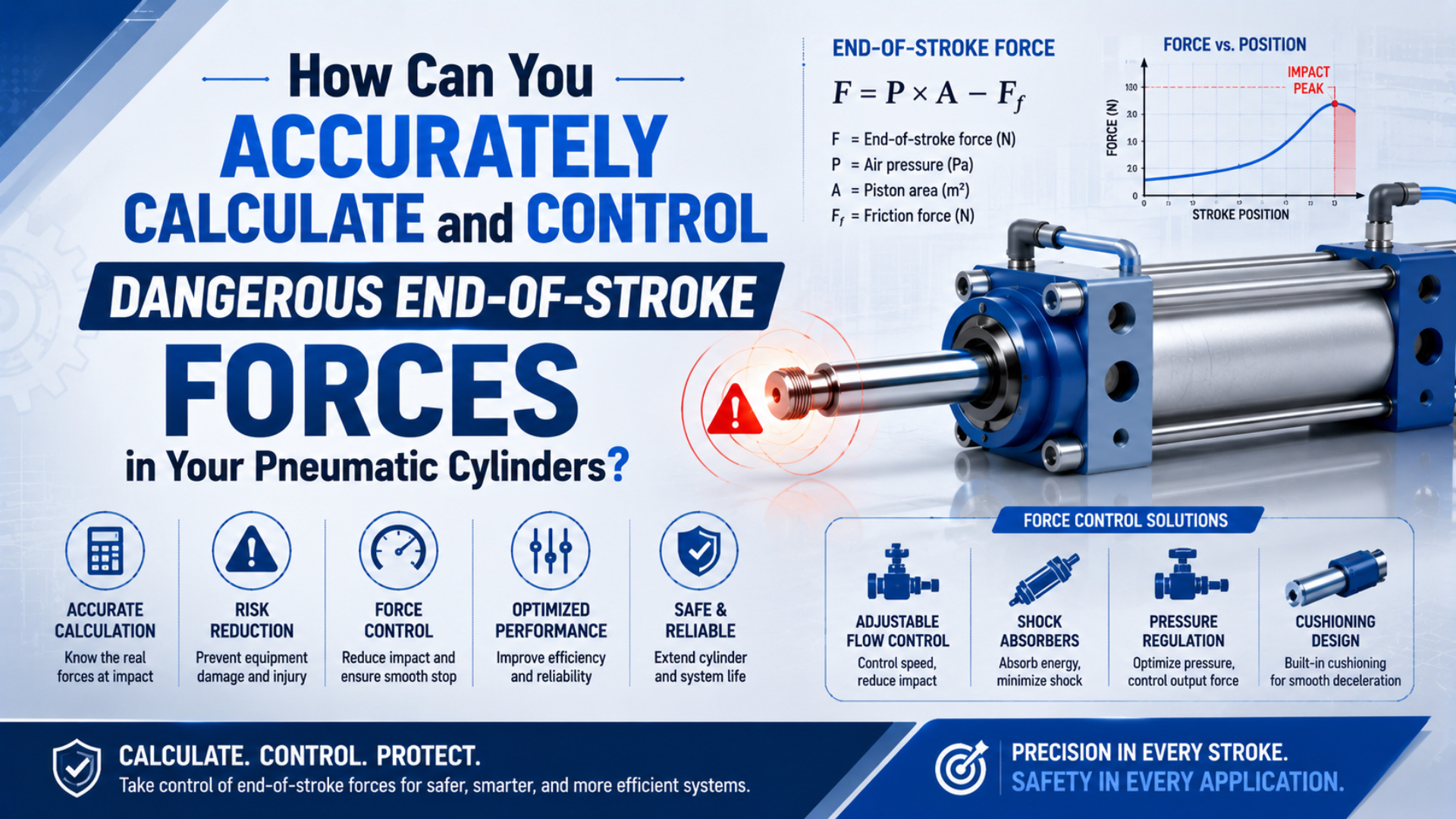
You can’t calculate a trustworthy peak end-of-stroke force from moving mass and stopping distance alone. First calculate the energy the stop must absorb, compare it with the cylinder or shock absorber’s published capacity, and then measure the force-time trace if the machine design needs an actual peak load.
That distinction prevents a common sizing error. Dividing energy by stopping distance gives an average force under defined assumptions. It does not reveal the short peak transmitted through the piston, end cap, mounting, guide, tooling, and machine frame.
Cushion-entry speed is the piston velocity when the end-cushioning phase begins. Absorbed energy is the kinetic, drive, and gravity energy the stopping system must dissipate during one event. Average stopping force is that energy divided by effective stopping distance; it is not the highest instantaneous force in the load path.
Key Takeaways
- Parker says cushion-entry speed is typically about 50% above average speed.
- Size the stop from kinetic energy plus drive and gravity work.
- Treat energy divided by distance as average force, not peak force.
- Verify peak load with a suitable dynamic measurement.
What Must a Pneumatic Cylinder Stop Absorb?
Start with energy, not a guessed force multiplier. Parker says piston speed at the start of cushioning is typically about 50% higher than average stroke speed, so the useful input is cushion-entry speed under load, not stroke divided by time (Parker-Origa, retrieved 2026-07-18).
The moving assembly carries kinetic energy:
Here, is kinetic energy in joules, is the total moving mass in kilograms, and is the measured or conservatively estimated cushion-entry velocity in metres per second. Include the piston, rod, tooling, brackets, carried product, and any mechanism whose motion is reflected into the cylinder axis.
The cylinder may keep pushing while the piston travels through the cushion or external shock absorber stroke. Approximate that additional work as:
is drive work in joules, is the net driving force through the stopping zone in newtons, and is the effective stopping distance in metres. Use dynamic pressure at the cylinder, not only the regulator’s static setting. Subtract opposing friction or process force only when its direction and value are defensible.
For vertical motion, gravity can add or remove energy:
is gravity work, is approximately , and is the travel angle measured from horizontal. Treat as positive when gravity drives the load into the stop and negative when gravity resists the approach.
The initial energy budget is therefore:
This result is the energy the stopping system must absorb per event before applying any documented service factor. It still isn’t a product selection by itself. The next step is to compare it with the exact cylinder cushion, bumper, or shock absorber rating at the actual cycle rate.
For the underlying cylinder force balance, use the pressure-and-area calculation guide. For speed-sensitive applications, the high-speed cylinder specification checklist covers the valve, tubing, pressure, and timing inputs that establish .
An end-of-stroke calculation has two boundaries: the energy boundary tells you what the stop must absorb, while the structural boundary tells you where the reaction travels. A correct energy number can still leave a guide, bracket, or frame overloaded if the stop is placed in the wrong load path.
Average Stopping Force Is Not Peak Impact Force
Energy divided by distance estimates average stopping force, not the highest instantaneous load. SMC publishes model-specific effective cushion lengths and allowable energies, including 11.0 mm and 0.54 J for one 20 mm-bore CM2 example, showing why neither distance nor capacity is universal (SMC, retrieved 2026-07-18).
For a simplified constant-distance stop:
is the average resisting force over the effective stopping distance. This relationship assumes the stated energy is absorbed over that distance. It does not describe the real pressure curve, elastic deformation, clearances, seal friction, contact stiffness, rebound, or structural vibration.
Why can the peak be much higher than the average? The actual force changes throughout the event. A hard contact may produce a narrow initial spike. A tuned pneumatic cushion may build pressure progressively. A hydraulic shock absorber should spread deceleration more evenly, but its force curve still depends on the model and operating point.
Newton’s second law remains valid:
Here, is the measured acceleration over time. This inertial term alone may not equal the force at a particular bracket or stop because drive pressure, gravity, linkage geometry, friction, and local structural response also contribute. If a bolt, guide, or frame has a peak-load limit, measure at the relevant load path or use a validated dynamic model.
Don’t label as an impact-force limit on a drawing. Record it as an average energy-equivalent force, then identify which components require a measured or simulated peak. That wording keeps a screening calculation from becoming an accidental structural guarantee.
How Do You Build an End-of-Stroke Energy Worksheet?
A useful worksheet needs more than mass, bore, and supply pressure. Festo says adjustable pneumatic cushioning depends on mass, speed at damping, target deceleration, working pressure, and cylinder resistance, giving at least 5 operating inputs before model-specific limits are considered (Festo, 2022, retrieved 2026-07-18).
Build one row for every direction, payload, recipe, and abnormal condition that can reach the stop. A single “normal cycle” row can miss the most severe combination.
In our experience, the cleanest acceptance record labels every value as one of four types: measured input, calculated screening value, catalog limit, or measured peak. That simple separation prevents an average-force estimate from being copied into a drawing as though it were a verified structural load.
| Worksheet input | Unit | How to obtain it | Common mistake |
|---|---|---|---|
| Total moving mass | kg | Weigh or sum piston, rod, tooling, brackets, product, and reflected mechanism mass | Using product mass alone |
| Cushion-entry speed | m/s | Measure near cushion entry or obtain from a validated motion trace | Using average stroke speed without margin |
| Dynamic drive force | N | Use effective area and pressure measured during motion, then account for opposing loads | Using static regulator pressure |
| Effective stop distance | m | Use catalog cushion length or shock absorber working stroke | Using visible overtravel or nominal stroke |
| Orientation | degrees or direction | Record horizontal, vertical up, vertical down, or inclined | Ignoring gravity direction |
| Cycles per hour | 1/h | Use sustained worst-case production rate | Using the daily average |
| Published capacity | J/event and J/h | Read the exact model datasheet or mass-speed chart | Copying a value from another bore or series |
| Permitted rebound and stop time | mm, ms | Define from the process and sensor sequence | Accepting “quiet enough” as the only criterion |
Measure extend and retract separately. Rod-side area changes drive force, gravity changes sign, and tooling can engage the process on only one stroke. If the load changes by recipe, use the heaviest mass and the fastest plausible approach as separate cases, then test whether they occur together.
The pneumatic cylinder cushioning guide explains the needle-valve mechanism and adjustment symptoms. The high-speed air-cushion guide goes deeper into cushion-entry velocity. Keep this worksheet focused on the inputs that turn those mechanisms into a defensible selection.
Worked Example: From 56 J to a Defensible Selection
Consider a 10 kg moving assembly entering a 20 mm stopping zone at 2 m/s while the cylinder supplies 1,800 N. ACE bases shock absorber selection on energy per cycle, energy per hour, effective mass, and absorber stroke, so a single force result is not enough (ACE Controls, retrieved 2026-07-18).
Assume horizontal travel so gravity does no work along the axis. The kinetic energy is:
The drive work through the 0.020 m stopping distance is:
The stopping device must therefore absorb at least:
Before any manufacturer-required application or safety factor, the energy-equivalent average resisting force is:
At 600 stopping events per hour, the device must also process:
What should the engineer do with those numbers? Compare 56 J per event and 33,600 J/h with the chosen device’s published limits, check its permitted effective mass and impact speed, and apply only the factors specified for that product and mounting. A generic “2x safety factor” cannot repair a mismatched force curve or thermal rating.
The 2,800 N result does not mean the frame sees a 2,800 N peak. Instrumentation might show a lower, similar, or much higher peak depending on the stopping profile and structural response. That is exactly why the calculation and the validation test have separate roles.
Which Control Method Fits the Energy and Load Path?
Festo divides end damping into 3 broad methods: elastic, pneumatic or servo-pneumatic, and hydraulic. SMC’s published CM2 examples range from 0.54 J to 2.35 J across 20 to 40 mm bores, illustrating that a damping type alone does not define capacity (Festo, 2022; SMC, retrieved 2026-07-18).
Choose the stop architecture from the energy, repeatability requirement, and load path. Don’t begin with a preferred component.
| Control method | Best use | Evidence required | Main limitation |
|---|---|---|---|
| Lower approach speed | Energy is excessive but cycle time has margin | Measured cushion-entry speed and revised cycle time | May reduce throughput; doesn’t correct a poor stop location |
| Elastic bumper | Low energy within the exact cylinder rating | Model-specific allowable energy and speed | Limited stroke and little adjustability |
| Adjustable pneumatic cushion | Load and speed stay inside the cylinder’s cushion envelope | Mass-speed chart, dynamic pressure, no impact or rebound | Sensitive to setting, exhaust restriction, and load variation |
| Self-adjusting pneumatic cushion | Production range fits the manufacturer’s mapped envelope | Approved mass, speed, pressure, and orientation range | Still has a defined capacity boundary |
| External hydraulic shock absorber | Built-in cushion is exceeded or a more controlled stop is needed | Energy per event, energy per hour, effective mass, impact speed, stroke | Needs correct alignment, mounting stiffness, and thermal capacity |
| External mechanical stop near the load | Process repeatability depends on the tooling or carriage position | Stop force, guide moment, frame stiffness, wear plan | A hard stop without damping can move shock into the structure |
| Servo-pneumatic or staged motion control | Approach speed must change by recipe or position | Sensor resolution, valve bandwidth, pressure and flow margin | Control does not remove the need for a physical energy check |
If repeatability belongs at the tooling, place the stop near the tooling or guided carriage rather than asking the cylinder end cap to locate the entire mechanism. The cylinder cushion can still prevent internal piston impact, while the external stop establishes the machine datum.
The most effective “force reduction” can come from moving the stop, not changing the cylinder. A stop close to the load’s center of resistance shortens the moment arm and keeps the reaction out of the piston rod. Review side loading and guide damage before increasing cushion restriction.
How Do You Commission the Stop Without Hiding the Problem?
Parker’s 50% cushion-entry warning means a stroke averaging 0.5 m/s may enter its cushion near 0.75 m/s, depending on the motion profile. Commission at measured production conditions and in both directions; a quiet low-speed jog does not validate the final energy case (Parker-Origa, retrieved 2026-07-18).
Use a controlled sequence:
- Lock out unexpected motion, inspect the guide, mounting, stops, cushion screws, shock absorber alignment, and sensor brackets.
- Confirm the intended payload, orientation, pressure, valve, tubing, speed-control direction, and exhaust hardware.
- Begin below production speed with personnel clear of the load path.
- Measure stroke time and, where practical, velocity near cushion entry. Record dynamic pressure at the cylinder port.
- Increase speed in small steps. Watch the last part of travel for impact, rebound, crawl, oscillation, or inconsistent sensor confirmation.
- Tune each direction separately. The rod-side area, gravity term, process load, and moving mass may differ.
- Run the lightest, heaviest, and fastest permitted recipes, including the warm sustained cycle rate.
- If a structural peak limit matters, capture the force or acceleration time trace with suitable bandwidth and mounting.
- Save the settings, traces, payload, pressure, temperature, cycle rate, and acceptance criteria in the machine record.
Closing the cushion screw until the noise disappears isn’t a complete test. An over-restricted cushion can create a long final crawl, rebound, trapped pressure, or sensor timing variation. Conversely, opening a flow control to recover cycle time may restore the impact. Change one variable at a time.
Use the flow-control valve guide when the cylinder’s approach speed is unstable. If static pressure looks correct but motion pressure collapses, diagnose the complete valve, tube, fitting, and exhaust path before altering the stop.
What Do End-of-Stroke Symptoms Reveal?
OSHA uses 85 dBA as the 8-hour hearing-conservation action level and 90 dBA as the 8-hour permissible exposure limit in general industry. A cylinder impact is only one possible noise source, so diagnose the sound and motion together rather than treating one reading as proof of cushion failure (OSHA, retrieved 2026-07-18).
| Observed symptom | Likely mechanism | First evidence to collect |
|---|---|---|
| Sharp knock at one end | Cushion too open, worn seal, excessive entry speed, or missed external stop | Slow-motion video, entry speed, cap marks, cushion setting |
| Rebound from end position | Cushion too restrictive, high trapped pressure, elastic stop, or load flex | Position trace, pressure trace, sensor transitions |
| Long final crawl | Excess restriction, blocked muffler, low dynamic pressure, or oversized stopping stroke | Stroke-time segments, exhaust back pressure, port pressure |
| Mounting bolts loosen | Repeated reaction load enters the bracket or frame | Bolt condition, stop location, force trace, alignment |
| Guide wear or rod scoring | Stop force creates a moment or side load | Guide clearance, tooling overhang, stop alignment |
| Shock absorber runs hot | Hourly energy or cycle rate exceeds thermal capacity | Events per hour, surface temperature, catalog hourly rating |
| Behavior changes by payload | One setting cannot cover the full mass-speed range | Recipe-specific mass, speed, and pressure records |
A sound meter helps separate workplace exposure from subjective impressions, but it cannot calculate the stop force. Likewise, an accelerometer on the frame may reveal vibration without measuring the exact force in a bolt or guide. Match the sensor location to the acceptance question.
If the impact disappears when speed is reduced slightly, repeat the energy calculation with both velocities. Because the kinetic term contains , a modest speed change can produce a much larger energy change. That comparison is useful evidence, but it doesn’t replace a worn-component inspection.
When Should You Escalate to an External Stop or Redesign?
SMC warns that a cushion may not absorb the impact when load energy is too large, while ACE requires both per-cycle and per-hour energy checks for industrial shock absorbers. Exceeding either boundary is a redesign trigger, not an invitation to close the cushion needle further (SMC; ACE Controls, retrieved 2026-07-18).
Escalate the design review when:
- Required absorbed energy exceeds the exact cylinder’s published cushion capacity.
- The mass-speed point lies outside the manufacturer’s cushion envelope.
- The external absorber passes energy per event but fails energy per hour.
- The load is vertical, overhung, variable, or able to jam near the stop.
- A hard process datum must be located at the tooling rather than the piston.
- The calculated average force is acceptable but measured peak load exceeds a guide, stop, bolt, or frame limit.
- Cushion tuning that prevents impact also causes unacceptable rebound, crawl, heat, or sensor delay.
- The machine must remain safe after air loss, valve de-energization, or a control fault.
Possible remedies include lowering cushion-entry speed, increasing effective stopping distance, selecting a cylinder with a verified cushion envelope, adding a correctly sized external shock absorber, moving the stop into the guided load path, reducing moving mass, stiffening the structure, or changing the motion architecture.
Don’t combine an external shock absorber and an internal cushion blindly. Decide which device absorbs the main energy, check their sequence, and prevent the piston from striking internally after the external stop engages. The component manufacturers’ instructions take priority over a generic arrangement.
Pneumatic Cylinder End-of-Stroke Force FAQs
Parker’s 50% cushion-entry warning and Festo’s 5 principal PPV variables explain why end-of-stroke questions rarely have one universal force number. The answers below separate energy screening, average-force calculation, peak-force measurement, and commissioning so each result is used for the right decision (Parker-Origa; Festo, retrieved 2026-07-18).
Can I calculate peak end-of-stroke force from kinetic energy and stopping distance?
No. Dividing absorbed energy by effective stopping distance gives an average energy-equivalent force. Peak force also depends on the time-varying deceleration, pressure curve, contact stiffness, clearances, and structural response. If a component has a peak-load limit, use a validated dynamic model or measure the force-time trace at the relevant load path.
Should I use average cylinder speed in the energy calculation?
Use measured cushion-entry speed whenever possible. Parker says the speed at the start of cushioning is typically about 50% higher than average stroke speed. If only stroke time is available, treat average speed as an incomplete screening input and add measurement or a defensible motion-profile allowance before selecting the cushion.
Does doubling cylinder speed double the end-of-stroke force?
Doubling speed makes kinetic energy four times larger when moving mass is unchanged. Force does not automatically become four times larger because the stopping distance and force curve may also change. Recalculate energy, confirm the device’s mass-speed envelope, and measure the peak if the structure has a force limit.
What capacity values should I compare with the calculated energy?
Compare the design energy with the exact model’s allowable energy per event, mass-speed envelope, permitted impact speed, effective mass range, and hourly energy or thermal limit. SMC and ACE publish these values by product family. A rating from another bore, stroke, cushion type, or mounting arrangement isn’t interchangeable.
Can a flow control valve replace a cylinder cushion or shock absorber?
A flow control can lower approach speed and therefore reduce kinetic energy, but it does not provide a rated stopping capacity or a structural stop. Load changes, pressure variation, and exhaust restrictions can alter speed. Use flow control to shape motion, then verify the cushion or absorber against the resulting worst-case energy.
Sources and technical references
- Parker-Origa, “OSP-P Pneumatic Rodless Cylinders and Linear Guides,”
https://www.parker.com/content/dam/Parker-com/Literature/Pneumatics-Division-Europe/PDE-Documents/Cylinders/Parker_Pneumatic_OSP-P_Linear_Drive_System_Catalogue---PA4P011GB.pdf. Supports cushion-entry speed guidance, mass-speed selection, and external shock absorber escalation. Retrieved 2026-07-18. - Festo, “Cylinder cushioning: the three most common methods,”
https://www.festo.com/ie/en/e/about-festo/blog/in-practice/cylinder-cushioning-the-three-most-common-methods-id_1518844/. Supports damping-method classification and adjustable pneumatic cushion inputs. Published 2022; retrieved 2026-07-18. - SMC, “Best Pneumatics: Air Cylinders Model Selection,”
https://www.smcworld.com/catalog/BEST-Guide-en/pdf/2-m27-49_en.pdf. Supports model-specific allowable kinetic energy, effective cushion length, and the warning that excessive load energy may exceed cushion capacity. Retrieved 2026-07-18. - ACE Controls, “Calculation Basis for Industrial Shock Absorbers,”
https://www.acecontrols.com/us/cad-downloads/knowledge/calculation-bases-for-the-design-of-industrial-shock-absorbers.html. Supports per-cycle energy, hourly energy, effective mass, and absorber-stroke selection inputs. Retrieved 2026-07-18. - OSHA, “Occupational Noise Exposure,”
https://www.osha.gov/noise. Supports the 85 dBA hearing-conservation action level and 90 dBA permissible exposure limit as 8-hour time-weighted averages. Retrieved 2026-07-18.