

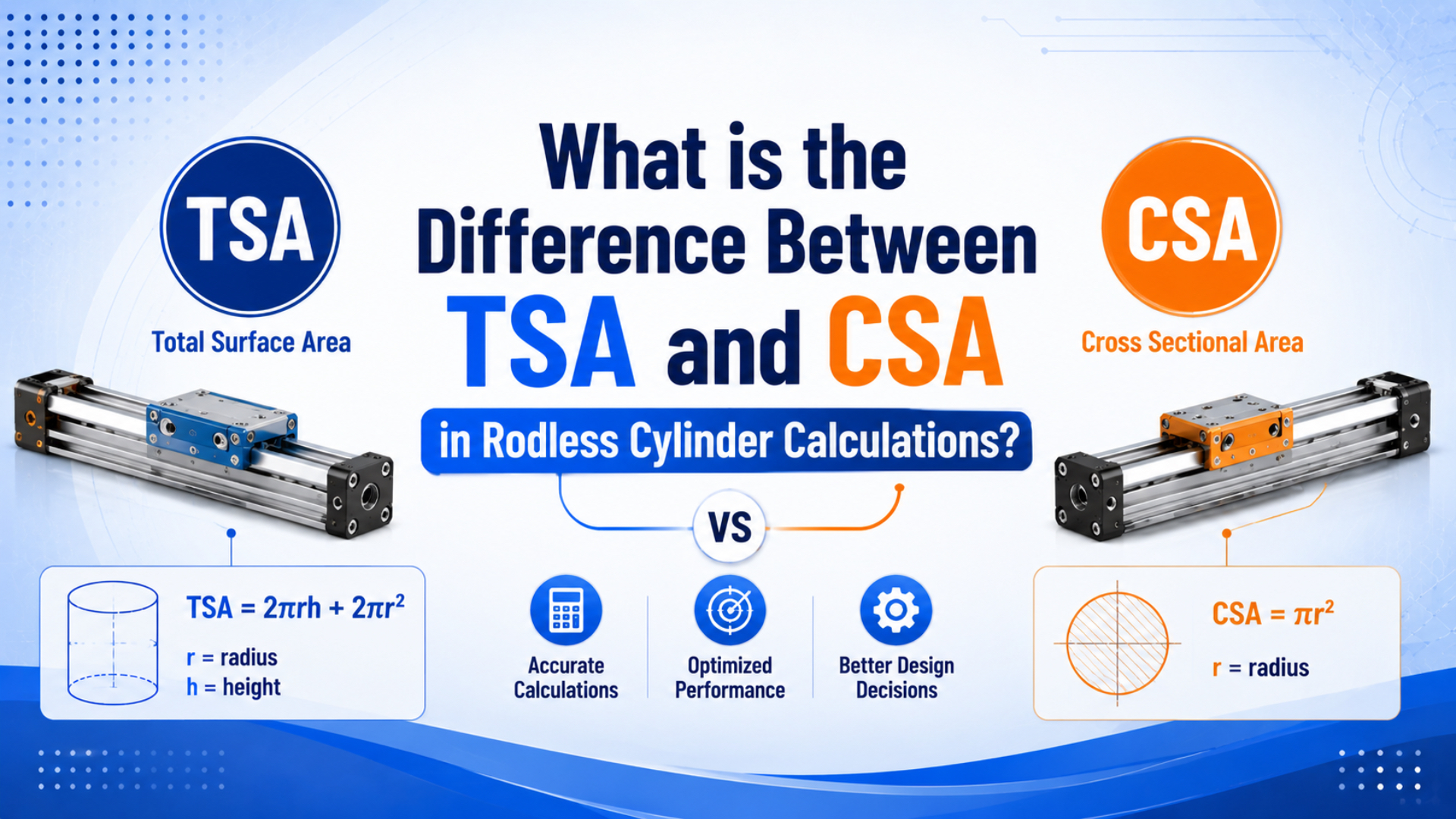
TSA is total surface area: the curved cylinder wall plus both circular end faces. CSA is curved surface area: only the curved wall. Wolfram MathWorld lists lateral surface area as 2*pi*r*h, and Khan Academy gives full cylinder surface area as 2*pi*r*h + 2*pi*r^2 (Wolfram MathWorld, 2026; Khan Academy, 2026).
That is the short answer. In rodless cylinder work, the practical answer depends on what you are buying, repairing, coating, cleaning, or quoting. A tube-only job usually needs CSA. A complete housing, full external finish, or sanitary surface review may need TSA.
Key Takeaways
- CSA is
2*pi*r*h; TSA is2*pi*r*h + 2*pi*r^2.- On an 80 mm diameter, 500 mm long cylinder, TSA is only 8% higher than CSA.
- Use CSA for tube-wall work, and TSA when end faces need coating, inspection, or cleaning.
What Does TSA Include in Rodless Cylinder Calculations?
TSA includes 3 surfaces on a simple closed cylinder: curved wall plus 2 circular end faces. The formula is TSA = 2*pi*r*h + 2*pi*r^2, where r is radius and h is cylinder length (Khan Academy, 2026).
For a rodless cylinder, use TSA when the job includes the complete outside housing, end covers, full coating coverage, cleanability checks, or a full refurbishment. If an end face will be painted, anodized, washed, inspected, or exposed to the same environment as the tube, it belongs in the TSA conversation.
TSA is not always the manufacturing area of the actual part. Rodless cylinders can have slots, carriage rails, profile grooves, mounting holes, sensor channels, caps, and guide blocks. The simple cylinder formula is a quoting and estimating tool. Final manufacturing area should come from CAD or the supplier’s drawing when tolerances, coating thickness, or masking matter.
In our experience with replacement reviews, TSA mistakes usually come from a scope mismatch. The buyer says “complete cylinder,” but the request is really for the tube. Or the buyer asks for “tube coating,” but the environment also attacks the end covers. The formula is easy. The scope is where quotes go wrong.
Use TSA when you need:
- Complete exterior coating or paint coverage.
- Full anodizing or surface-treatment scope on an aluminum housing.
- Cleanability review on equipment used around food, pharmaceutical, or washdown areas.
- Heat-transfer or external exposure estimates for the complete closed shape.
- A quote that includes end caps, covers, or exposed circular faces.
What Does CSA Cover in Pneumatic Applications?
CSA covers 1 surface: the curved wall, also called lateral surface area. For a right circular cylinder, Wolfram MathWorld gives the lateral surface area as 2*pi*r*h, so CSA excludes both circular ends by definition (Wolfram MathWorld, 2026).
In rodless-cylinder maintenance, CSA is useful when the work is limited to the tube barrel or outer sleeve. That includes many tube replacement, polishing, relubrication-access, sleeve-protection, and localized coating discussions. CSA is also the cleaner choice when end caps are reused and not refinished.
The important phrase is “curved wall only.” If the project touches only the long body of a magnetically coupled rodless cylinder, CSA is usually enough for a first estimate. If the project includes covers, brackets, guide rail blocks, or carriage hardware, simple CSA is too narrow.
CSA works well for these cases:
- Tube-only replacement or refurbishment.
- Lateral surface polishing, cleaning, or inspection.
- Sleeve coating when end caps are unchanged.
- Wear-pattern checks along the moving carriage path.
- Fast material estimation before a detailed CAD review.
TSA vs CSA Formula Difference for Rodless Cylinder Tubes
The formula difference is 2*pi*r^2, the area of 2 circular ends. With r = 40 mm and h = 500 mm, CSA is 125,664 mm^2, TSA is 135,717 mm^2, or 8% higher (Khan Academy, 2026).
CSA = 2 * pi * r * h
TSA = 2 * pi * r * h + 2 * pi * r^2
TSA - CSA = 2 * pi * r^2
For an 80 mm diameter cylinder, radius is 40 mm. If the measured length is 500 mm:
CSA = 2 * pi * 40 * 500 = 125,664 mm^2
End area = 2 * pi * 40^2 = 10,053 mm^2
TSA = 125,664 + 10,053 = 135,717 mm^2
The ratio is often more useful than the raw area. TSA / CSA = 1 + r/h. Long cylinders have a small TSA premium because r is small compared with h. Short housings have a larger premium because the two circular ends are a bigger share of total area.
| Cylinder diameter | Length | CSA | TSA | TSA above CSA |
|---|---|---|---|---|
| 40 mm | 300 mm | 37,699 mm^2 | 40,212 mm^2 | 6.7% |
| 63 mm | 500 mm | 98,960 mm^2 | 105,195 mm^2 | 6.3% |
| 80 mm | 500 mm | 125,664 mm^2 | 135,717 mm^2 | 8.0% |
| 100 mm | 1000 mm | 314,159 mm^2 | 329,867 mm^2 | 5.0% |
When Should You Use TSA Instead of CSA?
Use TSA when end faces are included in coating, inspection, washdown, or full refurbishment. Parker lists OSP-P rodless cylinders at 8 bar maximum operating pressure, so surface decisions should stay tied to the actuator family and part scope (Parker OSP-P catalog, 2026).
For a new OSP-P modular rodless cylinder installation or another pneumatic cylinder family, TSA may be useful for high-level coating or environmental exposure estimates. The final quote still needs the part list. A complete assembly has more surfaces than a clean cylinder sketch.
For a tube-only repair, CSA is usually the better first estimate. The tube wall is the surface being replaced, cleaned, refinished, or inspected. End caps and carriage components may remain unchanged.
For food or washdown equipment, be careful. The eCFR requires food plant equipment to be adequately cleanable, and it specifically includes pneumatic, closed, and automated systems in sanitary-condition requirements (21 CFR 117.40, 2026). In that situation, excluding end faces may understate the surfaces that need cleaning review.
The best RFQ wording is not “calculate TSA” or “calculate CSA.” It is: “Tube OD, tube length, end covers included or excluded, coating type, masked areas, operating environment, and whether the carriage/guide parts are in scope.” That sentence prevents more errors than another formula table.
How Do TSA and CSA Affect Coating and Surface Treatment?
Surface treatment scope changes the calculation because anodizing, powder coating, masking, preparation, and inspection depend on which surfaces are exposed. The Aluminum Anodizers Council describes anodizing as an electrochemical conversion of the metal surface into a durable, corrosion-resistant anodic oxide finish (AAC, 2026).
That means area matters, but price is not area alone. Material, alloy, pretreatment, masking, surface roughness, color, sealing, batch size, fixture method, minimum lot charges, and inspection requirements can outweigh a simple mm^2 difference.
Powder coating has the same scope problem. The Powder Coating Institute describes electrostatic spray deposition as the typical method for applying powder to a metal substrate (Powder Coating Institute, 2026). ASTM D7803 also emphasizes surface preparation before powder coating galvanized surfaces, because adhesion depends on proper preparation (ASTM D7803-25, 2025).
So don’t use TSA to promise a universal price premium. Use TSA to define the surface set. The coating supplier can then price the real job from material, finish, masking, and quality requirements.
What Mistakes Cause Wrong TSA and CSA Estimates?
Most TSA and CSA errors come from scope, not arithmetic. A calculator can apply 2*pi*r*h, but it cannot know whether end covers, grooves, slots, guide blocks, or masked surfaces are included. Drawings and photos matter in replacement RFQs (SMC magnetically coupled rodless cylinders, 2026).
The first common error is using diameter as radius. An 80 mm diameter tube has r = 40 mm. If someone enters r = 80 mm, CSA doubles and end area quadruples. That mistake is worse on TSA because the r^2 end term grows faster.
The second error is using the pipe surface area logic without checking whether the part is an open tube or a closed housing. Pipe wall area, flow area, TSA, and CSA answer different questions. Don’t mix them.
The third error is assuming surface area equals cost. It doesn’t. Area helps estimate coating quantity and inspection scope, but finish vendors quote around process details. A small masked part can cost more than a larger simple part.
Before sending a rodless-cylinder RFQ, include:
- Outside diameter and length used in the calculation.
- Whether radius or diameter is shown on the drawing.
- Whether end covers are included.
- Whether the carriage, guide rail, or mounting feet are included.
- Coating or finish type, such as anodizing, powder coating, plating, or paint.
- Masked areas, seal lands, sensor slots, and ports.
- Environment: dry factory, washdown, food area, abrasive dust, or outdoor exposure.
FAQs About TSA and CSA in Rodless Cylinders
The FAQ uses these definitions: CSA is 2*pi*r*h, TSA is 2*pi*r*h + 2*pi*r^2, and added area is 2*pi*r^2. Khan Academy gives the cylinder surface-area relationship (Khan Academy, 2026).
What does TSA stand for in rodless cylinder calculations?
TSA stands for Total Surface Area. For a simple closed cylinder, it includes the curved wall and 2 circular end faces. The formula is TSA = 2*pi*r*h + 2*pi*r^2. Use it when end faces are included in coating, inspection, cleaning, or full refurbishment.
What does CSA mean for rodless air cylinders?
CSA means Curved Surface Area. It covers only the long curved cylinder wall and uses CSA = 2*pi*r*h. In rodless-cylinder work, CSA is usually the right first estimate for tube-only replacement, lateral coating, polishing, or sleeve inspection when end covers stay unchanged.
When should I use TSA instead of CSA?
Use TSA when the job includes end faces, end covers, complete exterior finishing, cleanability review, or a full housing refurbishment. Use CSA when only the barrel or sleeve surface is in scope. If the RFQ includes guide blocks, carriage parts, slots, or brackets, request CAD-based surface area.
How much larger is TSA than CSA?
For a simple cylinder, TSA / CSA = 1 + r/h. An 80 mm diameter and 500 mm long cylinder has r/h = 40/500 = 0.08, so TSA is 8% larger than CSA. Shorter housings have a larger difference because end faces represent more area.
Is TSA or CSA better for magnetic rodless cylinder repairs?
For magnetic rodless cylinder tube replacement, use CSA if the repair covers only the tube wall. Use TSA if the repair includes end covers, full exterior finish, or environmental cleanability checks. For final supplier pricing, include photos and drawings because real assemblies are not perfect simple cylinders.
Sources and Further Reading
The source list below combines math, component, surface-treatment, and cleanability evidence. Retrieval date for all listed sources is June 4, 2026 (Wolfram MathWorld, 2026).
- Wolfram MathWorld, “Cylinder”,
https://mathworld.wolfram.com/Cylinder.html. Supports lateral cylinder surface-area math and cylinder variable definitions. - Khan Academy, “Cylinder volume & surface area”,
https://www.khanacademy.org/math/geometry-home/geometry-volume-surface-area/geometry-volume-cones/v/cylinder-volume-and-surface-area. Supports the total cylinder surface-area formula and provides the embedded formula video context. - Parker, “OSP-P Pneumatic Rodless Cylinders and Linear Guides”,
https://www.parker.com/content/dam/Parker-com/Literature/Literature-Files/pneumatic/parker_origa/BasicCylinder.pdf. Supports the OSP-P rodless-cylinder context and 8 bar operating-pressure reference. - SMC, “Magnetically Coupled Rodless Cylinders”,
https://www.smcworld.com/webcatalog/en-jp/air-cylinders/magnetically-coupled-rodless-cylinders/. Supports the magnetically coupled rodless cylinder family context. - Aluminum Anodizers Council, “What is Anodizing?”,
https://members.anodizing.org/general/custom.asp?page=what-is-anodizing. Supports anodizing as an electrochemical surface-conversion finish. - Powder Coating Institute, “What is Powder Coating?”,
https://www.powdercoating.org/page/WhatIsPC. Supports powder coating process context for metal substrates. - ASTM International, “ASTM D7803-25”,
https://store.astm.org/d7803-25.html. Supports the surface-preparation requirement before powder coating galvanized surfaces. - eCFR, “21 CFR 117.40 Equipment and utensils”,
https://ecfr.io/Title-21/Section-117.40. Supports cleanability and sanitary-condition requirements for equipment, including pneumatic and automated systems.