

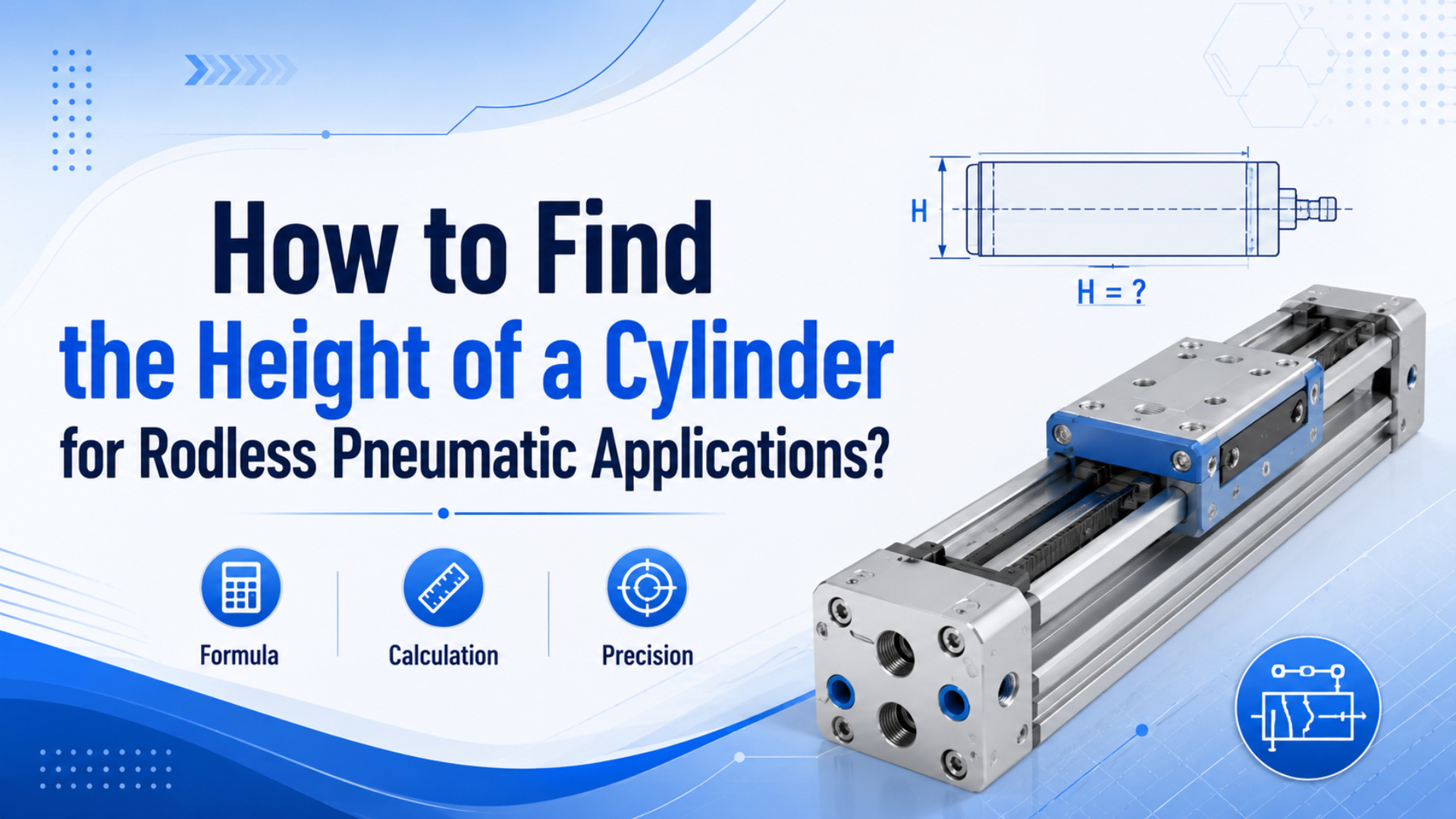
To find the height of a cylinder in a rodless pneumatic application, measure the total body length along the actuator axis from one end cap face to the opposite end cap face. In replacement work, also record the usable stroke, carriage length, mounting hole spacing, port positions, and sensor-slot locations.
That wording needs one caution. In geometry, cylinder height is the distance between two circular bases. In rodless-cylinder catalogs, the practical dimension is usually called overall length, body length, or installation length. The old term can still be useful, but only if everyone agrees which end faces are included.
Key Takeaways
- Cylinder height for this article means total axial body length, not usable stroke.
- ISO 13385-1 covers caliper design and metrological characteristics, so tool choice and calibration matter before a replacement order.
- Parker lists OSP-P standard strokes up to 6000 mm, which proves why body length and stroke must be recorded separately.
The common replacement mistake is not a hard formula error. It is a naming error. A buyer says “height,” a supplier thinks “overall body length,” and a technician actually measured “stroke.” Those three dimensions can describe the same actuator from three different viewpoints.
What Is Cylinder Height in Rodless Pneumatic Systems?
Cylinder height is the total axial distance between the two end faces of the actuator body. ISO 13385-1:2019 covers caliper design and metrological characteristics, and ISO confirmed that edition in 2025 (ISO, 2025). For replacement work, this number should come from a defined measuring method.
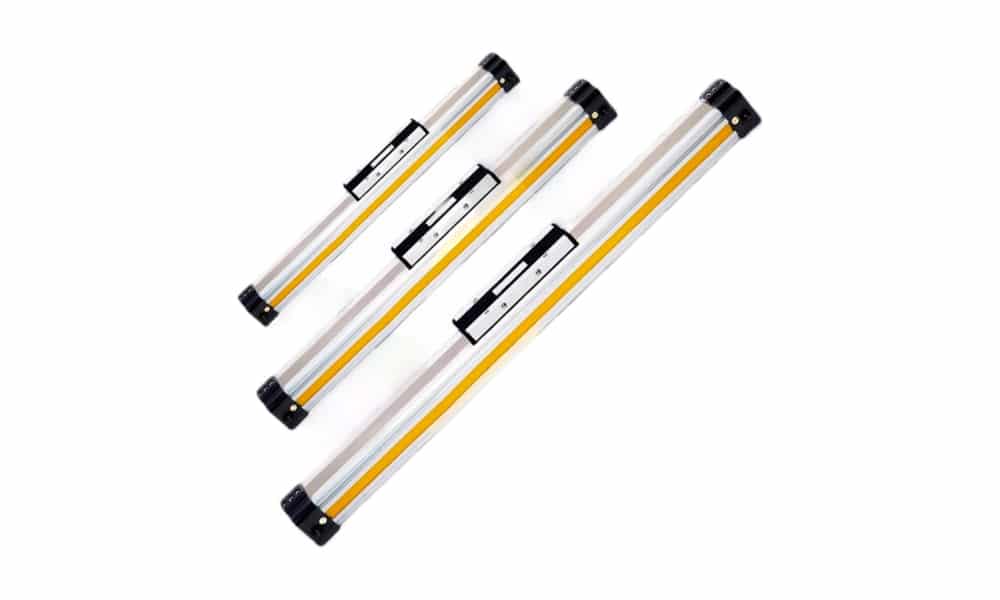
For a rodless cylinder, the measured “height” usually follows the long body axis. It is not vertical height on the machine. A cylinder mounted horizontally, vertically, or upside down keeps the same axial body length.
Use this naming table in RFQs:
| Dimension name | What it means | Include | Do not include |
|---|---|---|---|
| Overall body length | End cap face to end cap face | Cylinder tube and end caps | Brackets, fittings, loose sensors |
| Usable stroke | Carriage travel distance | Working travel between limits | End caps and unused dead length |
| Installation length | Body plus fixed accessories | Mounting plates, fixed stops, shocks if permanent | Flexible tubes, cable slack |
| Carriage length | Moving slide or carriage body | Load plate or carriage footprint | Tooling unless it ships with the actuator |
| Mounting pitch | Hole-center spacing | Fixed hole centers | Edge-to-edge guesses |
If the existing actuator is still installed, take photos before touching the tape. A single photo with the ruler, ports, carriage, and brackets in frame can prevent a dozen emails later.
Height, Body Length, and Orientation
The old article uses “height” because the geometry formula for a cylinder uses height. In real rodless-cylinder selection, use “overall length” or “body length” when talking to suppliers. It is clearer.
What if your drawing says height? Treat it as a warning label. Ask whether the number is:
- The total body length.
- The carriage travel or stroke.
- The mounted installation envelope.
- The vertical clearance above the machine frame.
- The shipping package size.
Those are not interchangeable.
Why Stroke Data Does Not Replace Body Length
Parker lists the OSP-P rodless cylinder series with a maximum stroke length of 6000 mm on its product page (Parker OSP-P Series, 2026). That stroke number tells you travel capability. It does not tell you the full mounted length, end-cap style, port orientation, guide package, sensor location, or shock absorber clearance.
That is the heart of the article. Stroke answers, “How far can the carriage move?” Body length answers, “Will the actuator fit where the old one sits?” You need both.
How Do You Measure Cylinder Height Accurately?
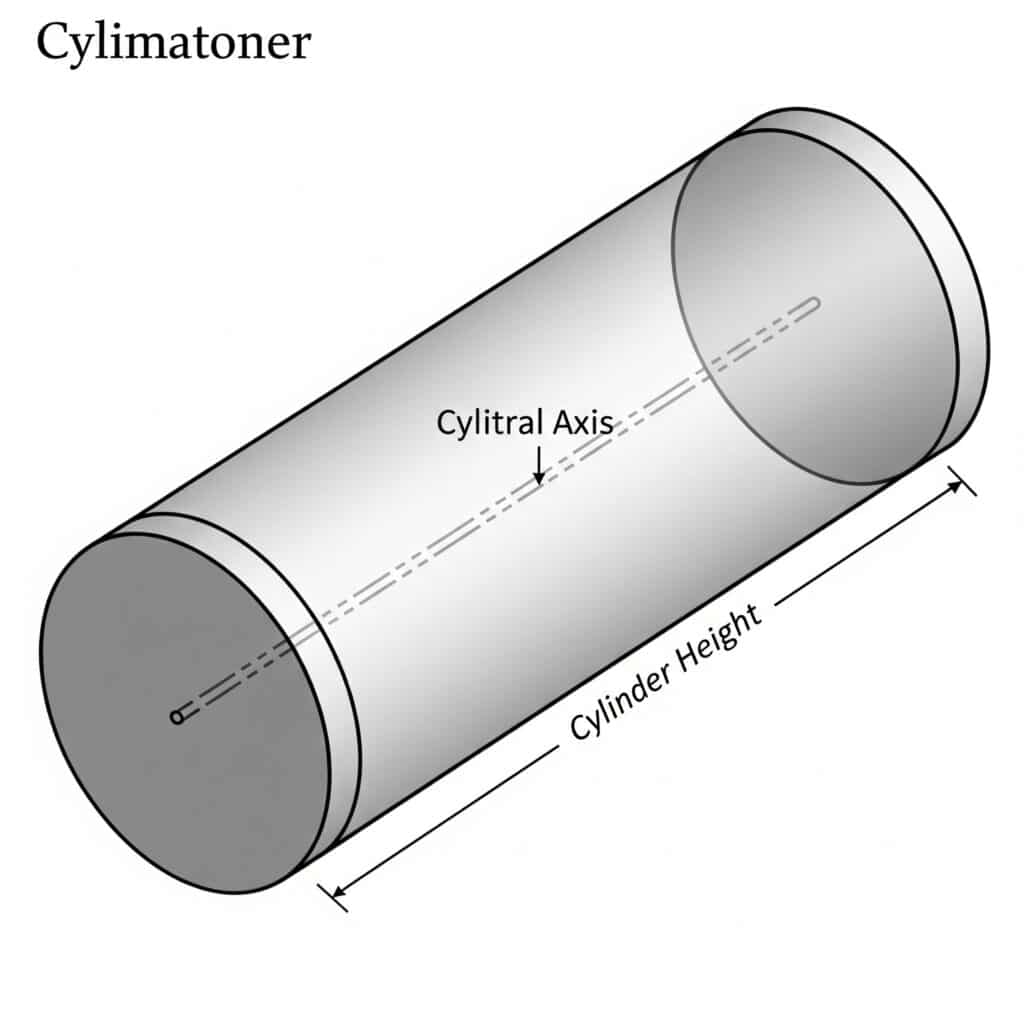
Measure cylinder height by placing a calibrated ruler, tape, or caliper parallel to the actuator axis and reading from one end cap face to the opposite end cap face. Mitutoyo notes that ISO 13385-1 and ASME B89.1.14 separate caliper errors such as partial-contact and scale-shift error (Mitutoyo, 2026).
For short actuators on a bench, use a caliper if the jaws span the dimension. For long rodless cylinders, use a steel tape, a straightedge plus tape, or the manufacturer’s drawing. A 3 m actuator does not become accurate because someone used a tiny caliper on one end and guessed the rest.
Measurement Workflow
- Clean both end faces and any datum surfaces.
- Photograph the cylinder before removal.
- Mark the two end-cap faces you will measure between.
- Align the tape or ruler parallel to the cylinder axis.
- Record total body length, stroke, carriage length, and mounting pitch separately.
- Repeat the measurement from the opposite side.
- Compare the result with any nameplate, drawing, or catalog code.
In our experience, the best field note is boring: “Body length 1258 mm, stroke label 1000 mm, carriage 180 mm, four M8 mounting holes, port side left, sensor slot top.” That note is more useful than “about 1.2 meters, same as the old one.”
Tools and Error Control
Use the tool that fits the length and access:
| Tool | Best use | Practical caution |
|---|---|---|
| Digital caliper | Short end-cap, carriage, and bracket dimensions | Check calibration and jaw seating |
| Vernier or dial caliper | Bench checks without batteries | Read slowly, avoid parallax |
| Steel rule | Medium straight dimensions | Keep the rule on the datum line |
| Steel tape | Long rodless cylinders | Keep the tape straight and parallel |
| CAD drawing | New design or verified part number | Confirm revision and option code |
Mitutoyo’s caliper guide says specifications are maximum permissible error values, not magic guarantees. So, for replacement work, don’t let tool precision create false confidence. If the old cylinder is dirty, bent, modified, or still mounted behind guarding, the measurement setup may dominate the error.
Cylinder Height vs Stroke Length
Stroke length is usable piston or carriage travel; cylinder height here is total axial body length. AutomationDirect explains that a rodless cylinder uses an internal piston connected to an external carriage moving along the body, reducing total length compared with a traditional rodded cylinder (AutomationDirect, 2020).
That compact layout is exactly why the terms get mixed up. A rodless actuator may have a body length only slightly longer than its stroke plus end-cap and carriage allowances. A standard rod cylinder needs clearance for the extended rod as well. So a technician who is used to standard cylinders may ask the wrong question.
The Three Numbers to Record
For rodless-cylinder replacement, record these three numbers first:
| Number | Example | Why it matters |
|---|---|---|
| Overall body length | 1258 mm | Confirms fit in the machine frame |
| Usable stroke | 1000 mm | Confirms travel range |
| Carriage length | 180 mm | Confirms tooling and guard clearance |
Then add the details that make the replacement real:
- Bore size or model code.
- Guide type and carriage type.
- Port position and thread.
- Cushioning or shock absorber style.
- Sensor groove position.
- Mounting hole pitch.
- Load mass and moment arm.
- Working pressure and target speed.
Why Ratios Are Risky
Do not use generic ratios such as 60-80% of total height for a real order. Parker, SMC, Festo, and other suppliers publish model-specific dimensions because end caps, guide packages, cushions, stops, and carriage styles change the relationship.
Use the model drawing when possible. If you do not have the model drawing, measure both dimensions. Guessing stroke from body length is a last resort, not a selection method.
How Does Height Affect Rodless Cylinder Fit and Performance?
Cylinder height affects fit first and performance second. The body must clear the frame, guards, cable runs, ports, and service access. Parker’s rodless catalog notes mid-section supports from certain stroke lengths and allows 0.5 mm maximum deflection between supports in one OSP-P support context (Parker Origa catalog, 2025).
That support detail is more useful than a generic height-to-diameter rule. Long rodless actuators can sag, twist, or bind if the machine frame does not support them correctly. The problem gets worse when the load is offset from the carriage centerline.
Fit Checks Before Ordering
Before ordering a replacement, check:
| Fit check | What to confirm | Failure if skipped |
|---|---|---|
| Body length | End cap face to end cap face | Cylinder will not fit the frame |
| Stroke | Required carriage travel | Machine misses the work position |
| Mounting pitch | Hole centers and bracket style | New part cannot bolt in |
| Port side | Tube routing and clearance | Fittings hit guards or brackets |
| Sensor slot | Switch position and cable path | PLC loses end-position signals |
| Carriage height | Tooling and guard clearance | Load plate collides during travel |
| Support spacing | Long body stiffness | Sag, binding, seal wear |
For a long axis, the support conversation belongs in the RFQ. Do not wait until installation day to discover that the old actuator used a mid-support bracket hidden under a cover.
Performance Checks After Fit
Length itself does not create force. Force still comes from pressure acting on piston area. But length changes the system around that force: longer travel means more air volume, more time for pressure drop to matter, more guide length to align, and more opportunity for the carriage to see moment load.
For the air circuit, review the solenoid valve, FRL unit, pressure regulator, and flow-control valve together. A correctly measured body can still perform poorly if the flow path is undersized.
Need the broader mechanism? This companion article on how rodless actuators work explains the internal piston and external carriage layout. For a magnetic design, use the guide on magnetic rodless cylinder operation.
Replacement RFQ Dimensions
Send a replacement RFQ with body length, stroke, bore or model code, guide type, carriage dimensions, mounting pitch, port position, sensor position, load, speed, and working pressure. Festo says rodless cylinders support long travel, with strokes up to 8.5 m in its category overview (Festo, 2026).
Use this list:
- Overall body length.
- Usable stroke.
- Bore size or full model code.
- Guide type: basic, slide bearing, cam follower, linear guide, high-rigidity guide, magnetic coupling.
- Carriage size and tooling interface.
- Mounting hole pitch and bracket type.
- Port thread, port side, and tube route.
- Cushioning, shock absorber, or end-stop details.
- Sensor type, slot position, and cable route.
- Load mass, offset distance, and orientation.
- Target speed and cycle rate.
- Available pressure and air preparation.
From what we’ve seen, the fastest replacement conversations include two photos: one full-length photo with a tape measure, and one close photo of the nameplate, ports, carriage, and mounting holes. Photos do not replace dimensions, but they catch the details a dimension list forgets.
Simple Field Worksheet
| Field | Value to record | Note |
|---|---|---|
| Existing model code | Photo plus typed value | Include all suffixes |
| Body length | mm | End cap face to end cap face |
| Stroke | mm | Label, drawing, or measured travel |
| Bore | mm | From model code or drawing |
| Carriage length | mm | Include load plate if factory-mounted |
| Mounting pitch | mm x mm | Hole centers, not edge distance |
| Port side | left/right/top/bottom | Note thread if visible |
| Sensors | type and position | Include cable direction |
| Load | kg or N plus offset | Moment matters |
| Working pressure | bar or MPa | Record regulator setting and moving pressure |
For product matching, compare the measured envelope against rodless cylinder options, OSP-P modular rodless cylinders, DGC rodless cylinders, and MY1H guided rodless cylinders. If the old actuator was a compact slide rather than a rodless cylinder, review rodless air slide operation before assuming the same replacement family.
FAQ: Cylinder Height in Rodless Pneumatic Applications
These FAQ answers focus on replacement risk: body length, stroke, guide support, and measurement confidence. Parker’s OSP-P page lists 6000 mm maximum stroke, while ISO 13385-1 defines caliper metrology, so both catalog data and measurement method belong in the same decision (Parker, 2026; ISO, 2025).
How do you measure cylinder height correctly?
Measure parallel to the actuator axis from one end cap face to the opposite end cap face. Keep brackets, loose fittings, and tooling separate unless they are permanent parts of the installation envelope. Record body length, stroke, carriage length, mounting pitch, and port positions in the same worksheet.
What is the difference between cylinder height and stroke length?
Cylinder height here means total axial body length. Stroke length is the usable carriage travel. Parker lists OSP-P maximum stroke as 6000 mm, but a replacement order still needs body length, end caps, carriage, guide type, mounting, ports, and sensors. Stroke alone is not enough.
Should I include mounting brackets in cylinder height?
Do not include brackets in the cylinder body length unless the supplier asks for installed envelope. Measure brackets separately as mounting hardware. A replacement part may match the cylinder body and still fail if a bracket, shock absorber, sensor, or port fitting collides with the machine frame.
What tool is best for measuring a rodless cylinder?
Use a caliper for short features such as carriage width, mounting-hole spacing, and end-cap details. Use a straight steel tape or verified drawing for long body length. ISO 13385-1 and Mitutoyo guidance remind engineers that caliper error depends on measuring faces and setup, not display resolution alone.
How does cylinder height affect performance?
Height affects fit, support, sag, alignment, and service clearance. It does not directly set force. Long bodies need support checks, especially with offset loads. Force still depends on pressure and piston area, while speed depends on stroke, flow path, valve size, load, cushioning, and exhaust restriction.
Sources
- ISO 13385-1:2019: Dimensional measuring equipment, callipers, caliper design and metrological characteristics; confirmed current in 2025. Retrieved 2026-06-04.
- Mitutoyo: Accuracy and Calibration of Calipers, caliper partial surface contact error, scale shift error, and maximum permissible error context. Retrieved 2026-06-04.
- Parker: OSP-P Series Rodless Pneumatic Cylinders, OSP-P maximum stroke length and product-family context. Retrieved 2026-06-04.
- Parker Origa: Rodless Cylinders Catalog, support and deflection context for long rodless cylinder installations. Retrieved 2026-06-04.
- SMC: MY1B Mechanically Jointed Rodless Cylinder Catalog, rodless-cylinder pressure, speed, bore, and stroke data. Retrieved 2026-06-04.
- Festo: Rodless Cylinders, rodless-cylinder category and long-travel capability. Retrieved 2026-06-04.
- AutomationDirect: Rodless Cylinders Provide a Compact Pneumatic Linear Motion Option, internal piston and external carriage explanation. Retrieved 2026-06-04.
- AutomationDirect video: Nitra Rodless Air Cylinders, video used for the embedded rodless-cylinder overview. Retrieved 2026-06-04. .