

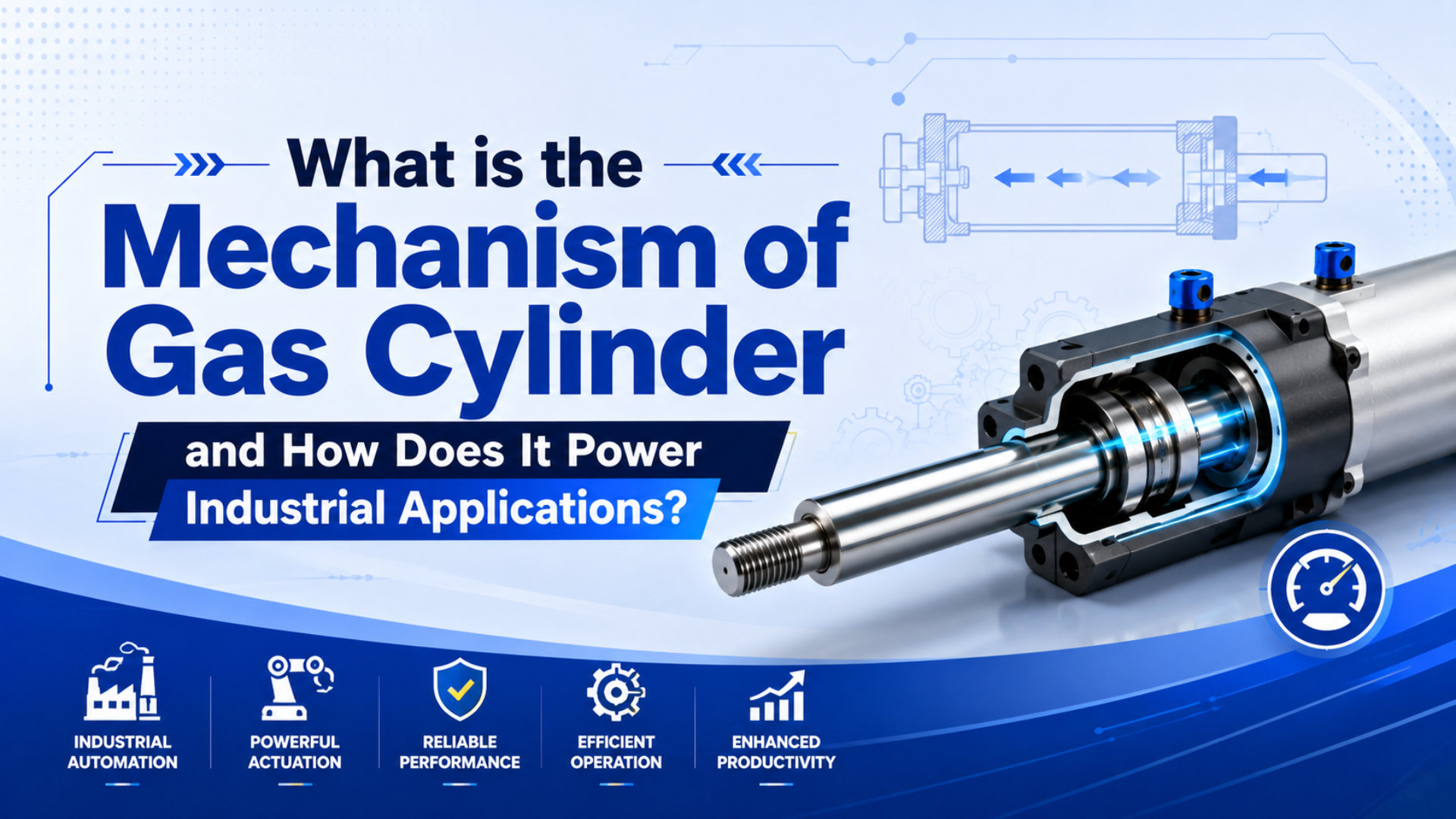
Stored gas pressure can be converted into controlled force, support, damping, or motion through a gas cylinder mechanism. OSHA’s current hazard-communication rules classify gases under pressure at 200 kPa, or 29 psi, gauge at 20C, while industrial nitrogen gas springs commonly work far above that threshold (eCFR 29 CFR 1910.1200, 2026).
In factory conversations, “gas cylinder” can mean two different things. One is a storage pressure vessel for compressed or liquefied gas. Another is a gas spring, gas strut, or nitrogen die spring that uses a sealed piston-rod assembly to make useful force. This article focuses on the industrial mechanism, then separates it from ordinary pneumatic cylinders.
Key Takeaways
- Gas springs use pressure and effective rod area to generate force, so
F = p x Ais the first sizing check.- DADCO lists nitrogen gas spring charging ranges of 15-150 bar, or 220-2175 psi, for many standard series.
- Gas cylinders need safety checks because pressure, temperature, side load, seal wear, and misuse can change force or create stored-energy hazards.
The practical mistake is naming everything a “gas cylinder.” A nitrogen gas spring is not a plant-air pneumatic cylinder, and a compressed-gas storage cylinder is not an actuator. When the words blur, engineers compare the wrong pressure ranges, buy the wrong seals, and miss the stored-energy risk.
What Are the Fundamental Operating Principles of Gas Cylinders?
Gas cylinder mechanisms work because pressure acts over area, and pressure changes when gas volume or temperature changes. OSHA’s 29 psi gases-under-pressure threshold marks the safety baseline; NASA Glenn’s pV = nRT equation explains the pressure-volume-temperature model behind the force (eCFR, 2026; NASA Glenn, 2025).
Inside a sealed gas spring, nitrogen fills the pressure tube. The rod connects to a piston and slides through a sealed guide. Gas can move between chambers through piston passages, while a small amount of oil lubricates the seal and gives damping near the end of travel.
The force comes from pressure and effective area:
Gas spring force = gas pressure x effective rod area

F = p x A
SUSPA explains the same sizing logic: filling pressure acts on piston surfaces, the rod side has less area, and the remaining area difference creates extension force (SUSPA FAQ, 2026). Simple? Mostly. The part that catches people is that real force also includes friction, oil damping, temperature change, and pressure rise as the rod enters the tube.
Mechanism Map
| Mechanism part | What it does | What can go wrong |
|---|---|---|
| Pressure tube | Contains nitrogen and oil | Denting, corrosion, overheating, wrong charging pressure |
| Piston rod | Converts internal pressure into usable linear force | Scratches, side load, dirt on rod, bent rod |
| Piston and passages | Separates chambers and meters gas flow | Poor damping, uneven motion, contamination |
| Seal and guide | Holds pressure while letting the rod slide | Leakage, friction rise, early wear |
| End fittings | Transfer force into the machine structure | Misalignment, loose pins, bending load |
In our experience, the best first inspection is boring but effective: look for rod scratches, side loading, incorrect mounting angles, and oil marks near the seal. If those are present, a new gas spring can fail the same way as the old one.
How Do Different Types of Gas Cylinders Work?
Different gas cylinders work through different pressure states. DADCO lists nitrogen gas spring charging from 15-150 bar, or 220-2175 psi, with selected SCR and U.0400/UH.0400 series reaching 180 bar, or 2600 psi (DADCO, 2026).
That pressure range tells you why gas springs feel different from plant-air cylinders. By contrast, a normal pneumatic cylinder depends on an external compressor, valve, regulator, and exhaust path. Nitrogen gas springs are precharged and self-contained. You don’t feed them with shop air during every stroke.
Nitrogen Gas Springs
Nitrogen gas springs store force in compressed nitrogen. The rod starts extended. When the press, lid, guard, die pad, or load pushes the rod inward, internal gas volume falls and pressure rises. The spring pushes back.
Why nitrogen? DADCO says nitrogen doesn’t react easily with other elements and should be the charging gas for its nitrogen gas springs (DADCO, 2026). SUSPA also identifies nitrogen as the pressure medium in its gas springs (SUSPA FAQ, 2026).
Gas Struts and Dampers
Gas struts support covers, hatches, machine guards, beds, and access panels. The mechanism is similar, but the selection problem is more about weight, hinge geometry, hand force, opening angle, and controlled speed than die pressure.
Oil matters here. A small internal volume can lubricate seals and slow movement at the end of the stroke. That damping helps a guard avoid slamming open or closed.
Compressed-Gas Storage Cylinders
A storage cylinder is a pressure vessel, not an actuator. It stores gas for welding, inerting, testing, inflation, or charging other devices. OSHA 1910.101 requires employers to determine that compressed gas cylinders under their control are in safe condition by visual inspection, with DOT hazardous materials rules used where applicable (OSHA 1910.101, 2026).
Don’t size a storage cylinder like a gas spring. It may supply pressure to a charging tool, but it is not meant to take repeated side-loaded strokes inside a machine.
Pneumatic Cylinders
A pneumatic cylinder uses compressed air from a plant system. It has ports, valves, exhaust flow, cushions, sensors, and a moving piston. Pressure creates force the same way, but the energy source is external and continuously replenished.
This is where internal linking helps the buyer journey. For a moving automation axis, start with a standard pneumatic cylinder, solenoid valve, and FRL unit review. For a die pad or cover-support mechanism, review gas spring geometry first.
What Are the Key Components That Enable Gas Cylinder Operation?
The key components are the pressure tube, rod, piston, seal, oil, guide, port or charging valve, and end fittings. SUSPA states that its F1 force is measured 5 mm from the extended position and at 20C, which is why a force label needs a test condition (SUSPA FAQ, 2026).
The headline force rating is not the whole product. Two gas springs with the same nominal force can behave differently if one has more damping oil, a different piston passage, a stronger guide, or a mount that avoids side load.
Pressure Tube and Rod
The pressure tube is the containment body. It must resist internal pressure, mounting loads, corrosion, and accidental impact. The rod is the moving member. Scratched rods drag dirt through the seal and can turn a slow leak into an early replacement.
Piston, Orifices, and Damping Oil
The piston separates chamber volumes, but gas still has to pass through a route in or around the piston. SUSPA notes that the structural design of this gas-transfer channel affects the resistance that must be overcome as gas moves between chambers (SUSPA FAQ, 2026).
That is how damping is tuned. Bigger passages give freer motion. Smaller or more shaped passages slow the rod. Oil also changes with temperature, so a cold guard may move more slowly than the same guard in a warm plant.
Seal and Guide
The seal has two jobs that fight each other. It must hold pressure, and it must let the rod slide. More seal contact can improve retention but adds friction. Less contact can reduce drag but raises leakage risk.
Mounting is the quiet killer. SUSPA warns against lateral force on the piston rod because it creates one-sided wear on the rod, guide, and seal (SUSPA FAQ, 2026). When a replacement spring keeps leaking, check the brackets before blaming the spring.
Charging Valve or Port
Adjustable and serviceable nitrogen gas springs use a charging interface. DADCO instructs users to set charging pressure with a regulator and verify pressure with appropriate load-cell or pressure-analyzer tools, not improvised impact checks (DADCO, 2026).
That’s a useful boundary for purchasing teams. Field pressure adjustment should be stated in the RFQ. For sealed, maintenance-light motion support, a fixed-force strut may be better.
How Do Gas Cylinders Compare to Pneumatic and Hydraulic Systems?
Gas cylinders, pneumatic cylinders, and hydraulic cylinders all use pressure acting over area, but their pressure source, stiffness, maintenance, and safety profile differ. CAGI says each extra 2 psig of compressed-air operating pressure can add about 1% compressor power, which makes plant-air decisions energy-sensitive (CAGI, 2026).
That does not make one technology universally better. It tells you where each one belongs. Gas springs are compact and self-contained. Pneumatics are clean, fast, and easy to automate. Hydraulics give high stiffness and force density, but the oil system adds leak, cleanliness, and maintenance work.
| System type | Energy source | Best use | Watch point |
|---|---|---|---|
| Nitrogen gas spring | Precharged nitrogen inside sealed body | Die pads, lift assist, guards, covers, counterbalance | Stored pressure, temperature force shift, side load |
| Pneumatic cylinder | Plant compressed air through valves | Fast automation, pick-and-place, clamping, simple motion | Pressure drop, flow sizing, air consumption |
| Hydraulic cylinder | Pressurized oil from pump or accumulator | High force, stiff control, heavy equipment | Oil leaks, heat, filtration, pump maintenance |
| Storage gas cylinder | Compressed or liquefied gas in vessel | Supplying gas, inerting, charging, testing | Handling, requalification, valve damage |
Force and Stiffness
Gas springs often give a flatter force curve than coil springs, but force still rises as the rod compresses and volume falls. Pneumatic cylinders can change force quickly by changing pressure, but the air volume behind the piston makes them softer than hydraulic cylinders.
Need a quick check? Use this hierarchy:
Need repeated programmable motion: pneumatic cylinder
Need compact passive force: nitrogen gas spring
Need very stiff high-force motion: hydraulic cylinder
Need gas supply or charging: compressed-gas storage cylinder
Energy and Pressure Drop
Plant air is convenient, but wasted pressure gets expensive. CAGI says a well-designed compressed-air system should have no more than 10% pressure drop between compressor discharge and point of use, and about 80% of leaks are not audible (CAGI, 2026).
That is why you don’t solve a weak pneumatic cylinder by raising header pressure first. Check filter drop, regulator flow, valve Cv, tube length, fittings, mufflers, and local storage. This companion article on pressure fluctuations in pneumatic systems goes deeper into that failure mode.
Industrial Applications of Gas Cylinder Mechanisms
Industrial applications use gas cylinder mechanisms where compact stored force, controlled support, or damping is more useful than a continuously supplied actuator. ISO 11901-3 covers nitrogen gas springs for press tools with nominal initial forces from 1,700 N to 200,000 N and a +/-5% tolerance (ANSI ISO 11901-3, 2026).
That force range explains why die makers, stamping teams, and fixture builders treat nitrogen gas springs as machine elements, not convenience hardware. A hatch strut may help one person lift a cover. A press-tool gas spring may manage thousands of newtons in a repeated forming process.
Metal Forming and Press Tools
In forming dies, nitrogen gas springs can support stripper plates, pads, lifters, and return functions. Their value is high force from a compact height, plus a more consistent force profile than many mechanical spring stacks.
Use them when the die needs compact force and known travel. Don’t use them as a patch for poor guiding. Without a guided pad, the gas spring rod can become the guide by accident. That tends to end badly.
Machine Guards, Covers, and Access Panels
Gas struts make guards and covers easier to open, hold, and close. Selection depends on weight, center of gravity, hinge distance, opening angle, and hand force.
One practical question helps: should the cover stay open by itself? When it should, select geometry and force around the worst open angle, not just the weight printed on the drawing.
Pneumatic System Support
Gas cylinders and pneumatic systems often meet in the same machine. One gas spring may counterbalance a guard while the pneumatic cylinder selection drives a station. A compressed nitrogen bottle may charge a gas spring. Plant-air cylinders may clamp parts next to die springs.
The systems can coexist, but the maintenance instructions should not be merged. Pneumatic cylinders need air quality, valves, tubing, and FRL checks. Gas springs need pressure, rod, seal, mounting, and temperature checks.
Replacement and RFQ Work
For replacement, send more than a photo. Include extended length, compressed length, stroke, rod diameter, tube diameter, end fittings, force rating, temperature range, mounting orientation, and whether the part is fixed-force or chargeable.
When the old gas spring failed early, add the failure symptom to the RFQ. “Lost force after six months,” “rod scratched,” “oil at seal,” and “cover drops below 20 degrees” all point to different root causes. A catalog match can’t see that context.
Maintenance and Optimization for Gas Cylinder Performance
Maintenance should start with pressure control, visual inspection, safe discharge rules, and mounting alignment. DOT requalification rules require visual inspection whenever covered cylinders are pressure-tested, and OSHA points employers toward DOT and CGA inspection practices for compressed gas cylinders (49 CFR 180.205, 2026; OSHA 1910.101, 2026).
Gas springs and storage cylinders don’t share the same service procedure, but the safety mindset is similar. Stored pressure is invisible until it is released. That’s why labels, protective handling, correct tools, and documented inspection intervals matter.
Inspection Checklist
| Check | What to inspect | Why it matters |
|---|---|---|
| Rod condition | Dirt, scratches, bending, plating damage | Seal life depends on rod surface |
| Mounting | Bracket alignment, pin wear, side load | Side load damages guide and seal |
| Force behavior | Slow loss of support, sagging, drift | Indicates pressure loss or wrong selection |
| Temperature | Cold starts, hot enclosures, high-cycle heat | Force and damping shift with temperature |
| Leakage signs | Oil film, hissing, residue near seal | Pressure loss can become sudden support loss |
| Safety labels | Pressure warning, handling notes, tool ID | Prevents unsafe disassembly or disposal |
Temperature and Force Optimization
SUSPA says extension force changes by about 3.5% per 10C of temperature rise or fall within its operating range (SUSPA FAQ, 2026). Room-temperature selection at 20C can therefore be too weak in a cold area or too strong in a hot enclosure.
For a cover or guard, check force at the lowest and highest realistic operating temperatures. For a press tool, include cycle rate because friction and repeated compression can raise temperature. DADCO’s force-temperature calculator specifically accounts for heat generated by friction in high-production use (DADCO Calculator, 2026).
Charging and Discharging
Use the manufacturer’s charging assembly, regulator, and pressure checking method. DADCO cautions users to wear safety glasses during nitrogen gas spring maintenance and to discharge pressure before disposing of damaged or worn units (DADCO, 2026).
Can you just drill, heat, clamp, or weld a gas spring? No. Don’t. Treat it as a pressure device until it has been discharged according to manufacturer instructions.
Troubleshooting Table
| Symptom | Likely cause | First check |
|---|---|---|
| Force feels weak | Pressure loss, low temperature, undersized force | Compare actual support force to rating at 20C |
| Rod moves slowly | Thick cold oil, restrictive piston passage, contamination | Check temperature and product damping type |
| Oil near seal | Seal wear, rod scratch, side load | Inspect rod and bracket alignment |
| Cover kicks open | Too much force, poor mount geometry, high temperature | Recalculate moment around hinge |
| Repeated early failure | Side load, dirty rod, wrong stroke use | Check mounting travel and rod exposure |
Conclusion
A gas cylinder mechanism is useful when its pressure source matches the job: DADCO’s listed 15-150 bar nitrogen range belongs to gas springs, OSHA’s 29 psi threshold defines gas-under-pressure hazard classification, and plant-air pneumatic cylinders belong in valve-controlled automation (DADCO, 2026; eCFR, 2026).
The buyer’s job is to avoid a naming shortcut. For compact passive force, choose and mount a gas spring correctly. For controlled repeated motion, size a pneumatic or hydraulic actuator. For gas supply, handle the storage cylinder under the right safety and inspection rules.
That line sounds simple. It saves a lot of bad purchases.
FAQs About Gas Cylinder Mechanisms
FAQ answers should be short enough for buyers and AI systems to extract. OSHA’s gases-under-pressure definition starts at 200 kPa, or 29 psi, gauge at 20C, while industrial gas springs often operate in hundreds or thousands of psi (eCFR 29 CFR 1910.1200, 2026).
How does a gas cylinder mechanism work?
Pressure acting over area creates force in a gas cylinder mechanism. In a nitrogen gas spring, compressed nitrogen pushes against an effective rod area, while the piston and oil manage movement and damping. The first sizing equation is F = p x A, then friction, temperature, stroke, and mounting are checked.
What is the difference between a gas spring and a pneumatic cylinder?
Gas springs are usually self-contained and precharged with nitrogen. Pneumatic cylinders use plant compressed air supplied through valves and exhausted every cycle. Gas springs are common for support, counterbalance, and die force. Pneumatic cylinders are better for controlled repeated automation with sensors, valves, and speed controls.
Why is nitrogen used in many gas springs?
Nitrogen is used because it is stable and does not react easily with other elements. DADCO states that nitrogen is the charging medium for its gas springs and that no other gas should be used. That matters because oxygen, moisture, or wrong gases can create corrosion, combustion, or unpredictable pressure behavior.
How much does temperature affect gas spring force?
SUSPA gives a useful rule of thumb: gas spring extension force changes by about 3.5% for each 10C temperature change within its -30C to +80C operating range. Something selected at 20C can feel weaker in cold service and stronger in a hot enclosure.
What should I include in a gas cylinder replacement RFQ?
Include the original title or part number, extended length, compressed length, stroke, rod diameter, tube diameter, end fittings, force rating, mounting orientation, operating temperature, and failure symptom. For chargeable nitrogen gas springs, include pressure range and whether linked-system monitoring is required.
Can I repair or discharge a gas spring myself?
Only follow the manufacturer’s service procedure with the correct tools. DADCO instructs users to wear safety glasses during maintenance, verify pressure with proper equipment, and discharge pressure before disposal. Without the tool, training, and part documentation, replace the unit or ask the supplier.
Sources
- eCFR: 29 CFR 1910.1200, Hazard Communication, gases-under-pressure definition and 200 kPa / 29 psi threshold. Retrieved 2026-06-03.
- OSHA: 29 CFR 1910.101, Compressed Gases, compressed-gas cylinder inspection, handling, and relief-device framework. Retrieved 2026-06-03.
- 49 CFR 180.205: General Requirements for Requalification of Specification Cylinders, visual inspection and pressure-test requirements for covered cylinders. Retrieved 2026-06-03.
- NASA Glenn Research Center: Equation of State, Ideal Gas, ideal-gas law and pressure-volume-temperature relationship. Retrieved 2026-06-03.
- SUSPA: Gas Spring FAQ, force formula, F1 measurement, installation position, seal wear, and temperature-force effect. Retrieved 2026-06-03.
- DADCO: Nitrogen Gas Spring Installation Design and Operation, nitrogen charging range, operating temperature, safety glasses, pressure checking, and discharge guidance. Retrieved 2026-06-03.
- DADCO: Nitrogen Gas Spring Force and Temperature Calculator, isothermal and adiabatic force/temperature modeling note. Retrieved 2026-06-03.
- ANSI Webstore: ISO 11901-3:2021, nitrogen gas spring nominal force range and tolerance for press tools. Retrieved 2026-06-03.
- ANSI Webstore: ISO 11901-5:2021, safety requirements and operating conditions for gas springs used in press tools. Retrieved 2026-06-03.
- CAGI: Working With Compressed Air, pressure-drop target, compressor power rule, leak audibility, and distribution guidance. Retrieved 2026-06-03.
- AutomationDirect: What is a Pneumatic Cylinder?, YouTube-backed explainer used for pneumatic cylinder comparison. Retrieved 2026-06-03.