

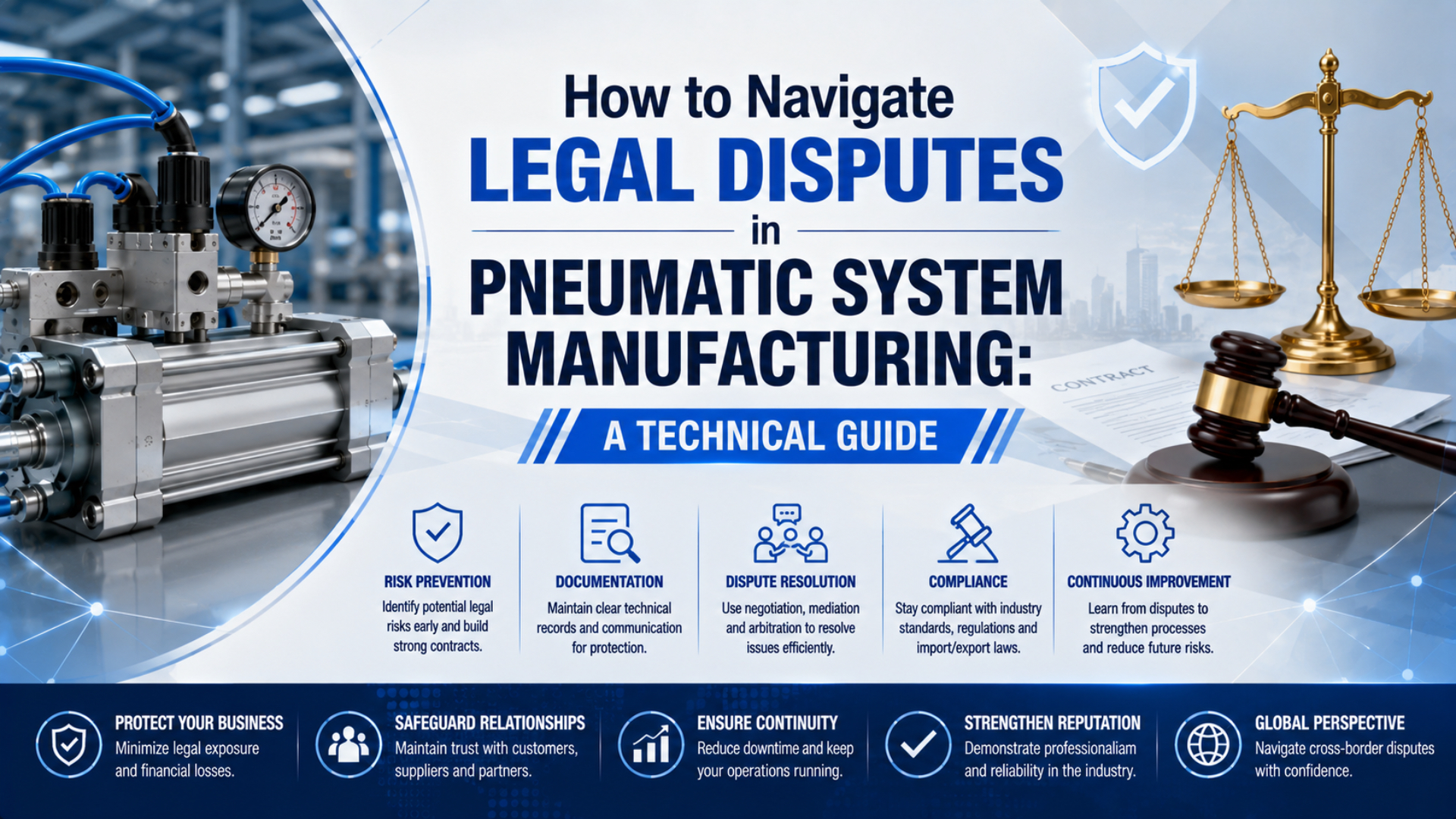
Pneumatic manufacturing disputes are easier to resolve when the engineering team protects the original condition, identifies the governing requirement, and separates observations from conclusions. The useful question isn’t “Who is liable?” It is “What can we prove about the specified product, the delivered configuration, the installation, and the failure event?”
This guide addresses the engineering side of contract, patent, product-failure, and standards disputes. It does not provide legal advice. Applicable law, evidence-preservation duties, privilege, patent scope, and liability must be determined by qualified counsel in the relevant jurisdiction.
Engineering evidence readiness is the ability to link a requirement, product configuration, event, physical item, digital record, test method, and approved conclusion without filling gaps from memory.
Key Takeaways
- Make the machine safe before preserving the component’s as-found condition.
- Freeze drawings, messages, test data, software versions, and physical evidence before routine work overwrites them.
- Use FTA and FMEA to test failure hypotheses, not to assign legal fault.
- Verify each standard by product boundary, market, edition, and contract.
- Route infringement and liability conclusions through qualified counsel.
An engineering file becomes useful when another competent person can reconstruct what was specified, what was built, what changed, how the product was used, and how each test result was obtained. A thick folder without identity, revision, or chronology is still a weak record.
What Should Happen in the First 24 Hours?
OSHA’s 29 CFR 1910.147 treats pneumatic pressure as hazardous energy and requires stored or residual energy to be rendered safe before servicing. The first response therefore has 4 priorities: protect people, stabilize the scene, stop uncontrolled changes, and place the evidence under named custody (OSHA, accessed 2026).
Safety comes first. Isolate electrical, pneumatic, hydraulic, gravitational, thermal, and mechanical energy using the site’s approved procedure. Secure suspended loads and pressure trapped between closed valves. If an emergency action changes the machine or component, record what was moved, by whom, when, and why as soon as conditions allow.
Then stop ordinary work from erasing the record. Don’t reset controller faults, adjust flow controls, replace a valve, clean debris, wipe a rod, update firmware, or ship the component back to a supplier until the authorized incident lead approves the action. Automatic historian retention, CCTV overwrite periods, email deletion, and cloud-log rotation also need immediate attention.
Create an initial incident record containing:
- date, time, location, machine identity, and operating mode;
- product part number, serial or lot number, and visible configuration;
- operator command, load state, pressure settings, sensor states, and alarms;
- wide, medium, and close photographs with an image log;
- names of people who operated, serviced, inspected, or moved the equipment;
- every safety action or unavoidable change made after the event;
- the person responsible for each physical item and digital export.
ASTM E860-22 addresses items that may become involved in civil or criminal litigation. It calls for documentation of an item’s nature and condition and adds specific controls when examination, disassembly, or destructive testing may prevent later examination (ASTM E860-22, 2022).
A clean handoff between safety response and evidence control prevents a common conflict. Emergency work may change the product, but undocumented change is the larger problem. Record the safety necessity, the pre-change condition where feasible, the exact intervention, and the new condition.
Which Records Define the Contract Baseline?
The CISG was adopted in 1980 and entered into force in 1988, but it governs only qualifying international sales of goods and leaves contract validity and property effects outside its scope. Engineers should map technical obligations without assuming which law controls (UNCITRAL, accessed 2026).
Start with the accepted agreement, not the newest drawing in the engineering folder. The controlling baseline may include a signed contract, purchase order, acknowledged quotation, approved drawing, customer specification, deviation permit, change order, validation protocol, acceptance record, and referenced standard. Preserve each document in the form that existed when the obligation was accepted.
Build a requirements matrix with these fields:
| Baseline field | Engineering question | Evidence to preserve |
|---|---|---|
| Product identity | Which model, option, revision, lot, or serial was ordered and delivered? | Order acknowledgment, bill of materials, traveler, packing list |
| Performance | Which pressure, force, speed, leakage, life, or environmental requirement was accepted? | Specification, test method, acceptance limit, results |
| System boundary | Who selected the valve, tubing, air quality, guarding, mounting, load, and controls? | Scope matrix, interface drawing, responsibility list |
| Installation | Which orientation, torque, alignment, filtration, exhaust, and commissioning conditions applied? | Manual, installation record, commissioning report |
| Change control | Which substitutions or revisions were authorized, and when did they take effect? | Change request, approval, effectivity, affected serials or lots |
| Notice and remedy | What inspection, notice, cure, return, warranty, or limitation process was agreed? | Contract clauses, warranty, complaint history, return authorization |
| Governing process | Which law, forum, arbitration rule, and language apply? | Executed agreement and counsel’s interpretation |
Words such as “ISO compliant,” “drop-in replacement,” or “suitable for food use” need a defined boundary. Which ISO standard and edition? Interchangeable by mounting dimensions only, or also by force, cushioning, sensor, flow, and safety function? Suitable for incidental exposure, direct product contact, or a protected dry zone?
The same discipline applies to warranty language. A warranty may address defects in materials and workmanship while excluding misapplication, contamination, side load, unauthorized repair, or operation outside ratings. Review the companion guide on what a pneumatic cylinder warranty should cover before turning a field symptom into a warranty conclusion.
Don’t reconstruct a missing approval after the dispute begins. Preserve the gap, identify what can be corroborated from independent records, and let counsel decide its significance. A late-created summary should be dated as a new summary and point to the underlying records.
Patent Dispute Boundaries for Engineers
The USPTO explains that a U.S. patent grants a right to exclude others; it does not grant the owner a right to make or sell the invention. Patent clearance and infringement are different legal questions, and an engineering similarity review cannot replace an opinion from patent counsel (USPTO, accessed 2026).
Engineering still has an important role. The team can identify the accused product’s exact configuration, obtain controlled drawings and samples, explain how each mechanism operates, and prepare a factual element-by-element comparison for counsel. Keep conclusions such as “infringes,” “invalid,” “equivalent,” or “safe design-around” out of routine technical correspondence unless counsel directs otherwise.
For a U.S. matter, the working package may include:
- the asserted patent, relevant family members, status, and claims identified by counsel;
- the accused product’s part number, revision, sale dates, markets, and representative samples;
- a claim chart with one row for every limitation and direct links to technical evidence;
- drawings, source code, specifications, manufacturing records, and operating demonstrations;
- prosecution-history materials selected with counsel;
- dated design history showing when alternatives were considered and implemented;
- a list of factual uncertainties, missing records, and configuration differences.
USPTO MPEP §2186 describes the doctrine of equivalents as an element-specific inquiry. It asks whether the accused product or process contains an identical or equivalent element for each claimed element and discusses function, way, and result as one analytical frame (USPTO MPEP §2186, updated 2026).
That doesn’t make a function-way-result table a verdict. Claim construction, the all-elements requirement, prosecution history, prior art, jurisdiction, defenses, and the evidence in the case can change the analysis. Prosecution history estoppel also isn’t a simple yes-or-no switch that automatically ends every infringement question.
Freedom-to-operate work belongs before launch, while dispute response begins after a notice or claim. Keep the two files separate. A pre-launch search documents what was reviewed at that time; it does not guarantee that no unexamined, unpublished, later-issued, or foreign right matters.
How Should Engineers Investigate Causation?
Two IEC methods answer different questions. IEC 61025 describes top-down fault tree analysis, while IEC 60812 explains how FMEA identifies potential failure modes, effects, and treatment priorities. Neither standard assigns legal responsibility or a damages percentage (IEC 61025, 2006; IEC 60812, 2018).
Start from a neutral event statement. “Cylinder extended while the guard was open” describes an event. “The valve caused the accident” assumes a cause. Define the machine state, command sequence, load, pressures, environmental conditions, maintenance status, and time boundary before building a causal model.
Use each method for its proper job:
| Method | Useful question | Appropriate output | Misuse to avoid |
|---|---|---|---|
| Event chronology | What happened, and in what order? | Time-aligned facts, logs, video, witness observations | Filling gaps with assumptions |
| Fault tree analysis | What combinations could produce the top event? | Logic branches, assumptions, dependencies, evidence status | Inventing probabilities without data |
| FMEA | How might each item fail, and what could follow? | Failure modes, effects, causes, controls, actions | Treating RPN as legal fault |
| Physical examination | What condition does the item show? | Photos, measurements, deposits, fracture or wear observations | Cleaning or dismantling before documentation |
| Controlled testing | Which hypothesis survives a defined test? | Plan, setup, calibration, raw data, uncertainty, repeat results | Changing multiple variables at once |
| Root-cause analysis | Which controllable conditions allowed the event? | Supported causal factors and corrective actions | Stopping at the first convenient “why” |
Evidence should change the model. Label every branch as supported, contradicted, unresolved, or not tested. Record the source for each status. If a pressure trace is missing, say it is missing; don’t back-calculate a precise transient from a regulator setting alone.
Use a nondestructive-first sequence:
- photograph and identify the complete assembly;
- document port connections, adjustments, fastener positions, seals, debris, and damage;
- inspect external dimensions and condition;
- download native controller and historian files without changing the production system;
- define the teardown order, witnesses, sample splits, and stop points;
- approve any destructive or consumptive test before it begins;
- retain raw results, rejected runs, calibration status, and uncertainty;
- store removed items in labeled, sealed containers with an access log.
Separate the cause model from the responsibility map. The cause model may show that contamination, an undersized exhaust path, and a bypassed interlock contributed to an event. The responsibility map asks who specified, supplied, installed, maintained, altered, or operated those features under the governing agreement and law. Engineering supports the first map and supplies facts to the second.
For related maintenance evidence, the material traceability guide explains how to link a finished actuator to its lot, material, inspection, test, shipment, and installed location.
Which Standards Apply and What Does Compliance Prove?
ISO 4414:2010 addresses pneumatic systems used on machinery but excludes factory compressors and distribution. ISO 13849-1:2023 covers safety-related control-system parts across several technologies but does not prescribe the safety function or PLr for a particular machine (ISO 4414, 2010; ISO 13849-1, 2023).
Standards applicability is a gated decision, not a list of logos. Document:
- the product and system boundary;
- the intended use and reasonably foreseeable misuse considered;
- the target country and placing-on-market date;
- the applicable legislation, contract, and customer requirements;
- the standard’s full designation, edition, amendments, and status;
- the clauses used, exclusions taken, and evidence supporting each conclusion.
ISO 12100:2010 provides machinery risk-assessment and risk-reduction principles. IEC 62061:2021 with Amendment 1:2024 addresses safety-related control systems for machinery. These methods support design and validation; they don’t decide negligence, contract breach, or product defect by themselves (ISO 12100, 2010; IEC 62061, 2021/2024).
For EU products, CE marking means the manufacturer indicates conformity with applicable Union harmonization legislation that requires the mark. The applicable legislation determines whether the manufacturer may use self-assessment or must involve a notified body. A notified body is involved only where the required conformity-assessment procedure calls for third-party participation (European Commission Blue Guide, 2022).
Date control matters. Regulation (EU) 2023/1230 on machinery is scheduled to apply from 20 January 2027, subject to its stated transitional dates. A technical file for an EU machine should therefore record which legal regime applied when the product was placed on the market (EUR-Lex, accessed 2026).
ISO 9001 certification is different again. It evaluates an organization’s quality management system, not the conformity of every product leaving the factory. ISO and IAF explicitly warn that accredited ISO 9001 certification does not mean the product itself is certified (ISO/IAF, accessed 2026).
Use the supplier-certification verification guide to check the legal entity, site, scope, standard edition, certification body, and certificate status separately from product qualification.
Building a Defensible Technical File
ASTM E860-22 requires condition documentation and controls around examinations that may alter evidence. NIST adds preservation concerns specific to digital objects and storage media. Together, they support 2 distinct records: the product lifecycle file and the incident evidence log (ASTM, 2022; NIST, updated 2026).
The lifecycle file explains the product. The incident log explains what happened to the evidence after the event. Don’t merge them in a way that overwrites original records or hides later annotations.
Product lifecycle file
- intended use, limits, interfaces, and system boundary;
- controlled specifications, drawings, software, and bill of materials;
- design calculations, reviews, and approved deviations;
- risk assessment, safety functions, and validation;
- material, process, supplier, inspection, and release records;
- test plans, acceptance criteria, equipment identity, raw data, and reports;
- instructions, warnings, installation, commissioning, and maintenance requirements;
- change control with effectivity by date, lot, serial number, or software version;
- complaints, returns, field incidents, corrective actions, and customer notices.
Incident evidence log
- unique item identifier and description;
- source, collection location, collector, date, and time;
- photographs of seals, packaging, labels, connections, and condition;
- every transfer, custodian, storage location, and access event;
- native digital file, export method, metadata, and integrity check where appropriate;
- requested examination, approved method, witnesses, and stop conditions;
- samples removed, material consumed, and remaining quantity;
- raw observations, measurements, uncertainty, calculations, and signed report;
- departures from the approved plan and the reason for each departure.
NIST defines a chain of evidence as the process and record showing who obtained an item, where and when it was obtained, who secured it, and who controlled or possessed it (NIST CSRC, accessed 2026). A spreadsheet can support that record, but software alone cannot cure missing custody or an undocumented teardown.
Preserve native data as well as readable exports. A PDF trend chart may omit tag definitions, sampling rate, alarm configuration, time-zone settings, and values outside the visible range. Keep the original historian export, PLC project, HMI recipe, firmware identifier, audit history, and the tool needed to interpret them where feasible.
Retention isn’t one universal number. Counsel, applicable regulation, contract, insurance requirements, expected product life, complaint procedures, and corporate policy may set different periods. Suspend routine disposal when authorized counsel or the responsible authority issues a preservation instruction.
The strongest technical file is built for two questions: “Can we reproduce the acceptance decision?” and “Can we identify every affected configuration?” The first needs requirements, methods, raw data, and approvals. The second needs revision, lot, serial, shipment, installation, and change-effectivity links.
A Six-Step Escalation Workflow
Six controlled handoffs keep engineers, quality staff, management, insurers, and counsel working from the same facts. The workflow is sequential at first, then iterative as evidence changes the failure model. It should be assigned before an incident, not invented during a customer call.
- Classify the event. Identify injury, property damage, regulatory reporting, production loss, warranty notice, patent notice, confidentiality issue, and affected markets. Do not minimize or characterize legal exposure.
- Make the system safe. Apply the site’s energy-control and emergency procedures. Record every necessary change to the scene or component.
- Preserve the record. Secure physical items, native digital data, communications, drawings, samples, packaging, and custody records. Stop automatic deletion where authorized.
- Map the governing baseline. Assemble the accepted contract, configuration, requirements, standard editions, interfaces, and change history. Record gaps instead of filling them.
- Approve and execute the investigation. Define hypotheses, nondestructive work, teardown order, tests, witnesses, sample allocation, acceptance criteria, calibration, uncertainty, and stop points.
- Separate findings from decisions. Engineers report supported facts, methods, limitations, and corrective-action options. Counsel and authorized management address privilege, notice, settlement, admissions, liability, and regulatory submissions.
Keep external communication factual and controlled. “The returned valve did not shift during Test 3 under the stated conditions” is an engineering observation. “Our valve caused the incident” is a legal conclusion that may also ignore system design, maintenance, installation, control logic, or evidence not yet reviewed.
Corrective action doesn’t need to wait for a courtroom conclusion when a credible safety risk exists. Use the organization’s approved risk, regulatory, and customer-notification processes. Preserve the pre-change configuration and the technical basis for interim containment, permanent correction, and validation.
Pneumatic Manufacturing Dispute FAQs: What Should Teams Ask?
Four recurring questions expose the boundary between ordinary troubleshooting and dispute-controlled examination. ASTM E860-22 governs condition-changing evidence work, IEC 60812 defines FMEA as a failure-analysis method, and ISO guidance separates management-system certification from product certification. None authorizes engineers to decide legal responsibility (ASTM, 2022; IEC, 2018).
Can we dismantle a failed pneumatic cylinder immediately?
Not when the cylinder may be evidence and authorized review has not occurred. First make the system safe, photograph the installed and removed condition, identify the unit and connected components, and secure custody. ASTM E860-22 calls for added controls when disassembly or testing may prevent another examination. Counsel should approve the protocol.
Does compliance with ISO 4414 prove the manufacturer has no liability?
No. ISO 4414:2010 provides safety requirements for pneumatic systems and components used on machinery within its scope. It does not decide contract breach, negligence, defect, causation, or damages. Record the applicable clauses, design decisions, tests, interfaces, deviations, and standard edition, then let qualified counsel assess their legal significance.
Can an FMEA or fault tree assign liability percentages?
No. IEC 60812 uses FMEA to identify potential failure modes, effects, causes, and treatment priorities. IEC 61025 uses fault-tree logic to analyze paths to a top event. Both can organize technical evidence, but responsibility depends on contracts, conduct, applicable law, expert evidence, and adjudication or agreement between the parties.
What should engineers send patent counsel after an infringement notice?
Send the notice, asserted patent numbers, exact accused models and revisions, markets and dates, controlled drawings, operating descriptions, representative samples, source code where relevant, and dated design history. Build a factual claim chart only under counsel’s direction. Do not circulate unsupervised conclusions that the product infringes, is equivalent, or is a safe design-around.
Sources and technical references
This source set prioritizes government, standards-body, and primary legal materials. It supports engineering process boundaries, not a legal opinion for any particular dispute.
David Li’s credentials are carried by the page author system. Site ownership and technical scope are described on the About page, and readers can submit corrections through Contact.
- OSHA: 29 CFR 1910.147, Control of Hazardous Energy, pneumatic hazardous energy, isolation, residual energy, and verification. Retrieved 2026-07-27.
- ASTM International: ASTM E860-22, condition documentation and controls for examinations or destructive testing of items that may enter litigation. Retrieved 2026-07-27.
- NIST: Digital Evidence Preservation, preservation considerations for digital objects and storage media. Retrieved 2026-07-27.
- NIST CSRC: Chain of Evidence, custody, collection, control, storage, and preservation definition. Retrieved 2026-07-27.
- UNCITRAL: United Nations Convention on Contracts for the International Sale of Goods, scope, exclusions, formation, obligations, risk, and remedies for qualifying international sales. Retrieved 2026-07-27.
- USPTO: Managing a Patent, patent right-to-exclude boundary and the effect of other rights. Retrieved 2026-07-27.
- USPTO MPEP §2186, element-specific doctrine-of-equivalents discussion and function-way-result context. Retrieved 2026-07-27.
- USPTO: Path to a Patent, Part I, official introduction to intellectual-property types and the patent process. Retrieved 2026-07-27.
- IEC: IEC 60812:2018, FMEA and FMECA planning, performance, documentation, maintenance, and purpose. Retrieved 2026-07-27.
- IEC: IEC 61025:2006, fault-tree assumptions, events, failure modes, symbols, and application guidance. Retrieved 2026-07-27.
- ISO: ISO 12100:2010, machinery risk assessment and risk reduction. Retrieved 2026-07-27.
- ISO: ISO 4414:2010, pneumatic-system safety scope, lifecycle considerations, and exclusions. Retrieved 2026-07-27.
- ISO: ISO 13849-1:2023, safety-related parts of control systems and limits on application-specific safety-function selection. Retrieved 2026-07-27.
- IEC: IEC 62061:2021 with Amendment 1:2024, design, integration, verification, and validation of safety-related machinery control systems. Retrieved 2026-07-27.
- European Commission: Blue Guide 2022, CE marking, manufacturer responsibilities, conformity assessment, and notified-body roles. Retrieved 2026-07-27.
- EUR-Lex: Regulation (EU) 2023/1230 corrigendum, corrected application date for the Machinery Regulation. Retrieved 2026-07-27.
- ISO and IAF: Expected Outcomes for Accredited ISO 9001 Certification, quality-management-system certification and product-certification limits. Retrieved 2026-07-27.