

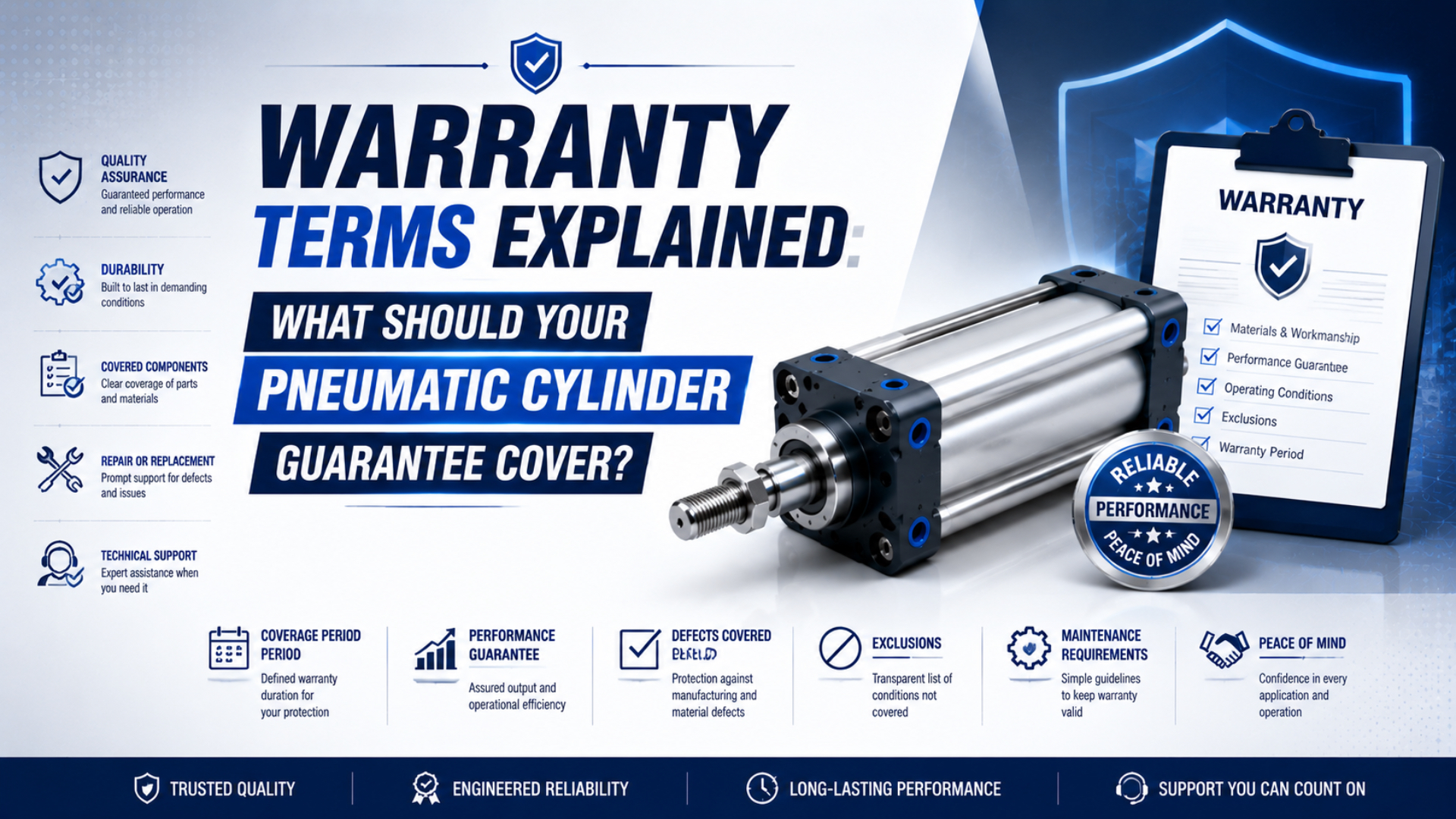
A useful pneumatic cylinder warranty identifies the exact product, the covered defect, the coverage period, the evidence needed, and the available remedy. It also says who pays for inspection, freight, removal, and reinstallation. If any of those fields are missing, the buyer doesn’t yet have an executable claim process.
A pneumatic cylinder warranty is a written promise that allocates responsibility when the supplied cylinder fails to meet specified coverage conditions. It isn’t a substitute for application approval, final acceptance, maintenance planning, spare-parts support, or an uptime agreement.
There is no universal 12-, 18-, or 24-month rule for industrial cylinders. No default applies. Published terms differ by supplier, selling entity, region, product family, and negotiated contract. Read the quotation, accepted purchase documents, incorporated sales terms, and governing law together because this guide is a commercial checklist, not legal advice.
Key Takeaways
- Festo USA publishes a 12-month period from shipment, while one Parker division uses 12 months or 2,000 operating hours, whichever comes first.
- Separate defect coverage from acceptance tests, response-time commitments, spare-stock support, and downtime liability.
- Put 12 warranty fields in the RFQ and preserve application evidence before a failure occurs.
In this guide
- What document actually controls the warranty?
- What should pneumatic cylinder warranty coverage define?
- Warranty period: duration, trigger, and long-stop date
- How is a warranty different from a performance or service commitment?
- Which exclusions are objective and auditable?
- What evidence should buyers preserve after a failure?
- Remedies, freight, labor, and liability
- Pneumatic cylinder warranty RFQ comparison table
- How should a warranty claim proceed?
- Pneumatic cylinder warranty FAQs
What Document Actually Controls the Warranty?
Festo USA’s March 2025 terms make its sales terms part of the contract and require signed written modifications (Festo USA Terms, 2025). A public warranty page alone can’t establish which promise controls. Resolve document precedence before treating a warranty sentence as binding.
Start by collecting every document that may contain a promise or limitation:
- supplier quotation and technical offer
- buyer’s purchase order and incorporated purchasing terms
- supplier order acknowledgment
- product-specific data sheet and configured drawing
- installation and maintenance instructions
- published warranty or terms of sale
- negotiated quality agreement, supply agreement, or service agreement
- accepted deviations and written amendments
Which document wins if the purchase order promises 24 months but the acknowledgment incorporates 12-month sales terms? There is no automatic answer. Record the governing document and conflict rule before order acceptance. Legal counsel should review high-value, safety-related, or multi-jurisdiction agreements.
Names matter. A global brand may sell through different legal entities with different regional terms. Record the warrantor’s legal name, address, selling entity, covered territory, and claim contact. A brand logo alone doesn’t identify the party responsible for the remedy.
Treat the warranty as a controlled configuration. Link the accepted terms to the complete cylinder part number, drawing revision, options, quantity, destination, and order acknowledgment. This prevents a generic warranty page from being applied to a custom seal package or special operating condition it never addressed.
For the broader commercial handoff, use the pneumatic supplier negotiation guide. It covers quote normalization, Incoterms, samples, change control, and delivery definitions beyond the warranty itself.
What Should Pneumatic Cylinder Warranty Coverage Define?
ISO 10099:2001 was confirmed in 2023 and specifies final functional examination and acceptance criteria for one defined scope: double-acting, single-rod pneumatic cylinders (ISO 10099, 2023). That narrow scope shows why warranty coverage must identify the product and promised conformity instead of saying that every cylinder component is covered.
A defensible coverage clause normally answers four questions:
- Which products are covered? State the complete order code, included accessories, custom options, and whether repaired, replacement, prototype, or sample units receive the same coverage.
- Which obligations are covered? Typical language addresses defects in material or workmanship and material conformity to named published specifications.
- When is conformity evaluated? Link the promise to the specification revision, configured drawing, approved sample, or acceptance record that applied when the product was manufactured or supplied.
- Who receives the remedy? State whether coverage belongs only to the original buyer, follows the installed machine, or transfers with written approval.
“All components covered” sounds reassuring, but it leaves the defect test unclear. Seals, bearings, rods, barrels, end caps, sensors, and cushioning parts can fail because of a manufacturing defect, incorrect selection, contamination, side load, damaged installation, or normal consumption. Coverage should turn on defined cause and conformity, not the component name alone.
Acceptance is a snapshot. A first-article or final inspection can confirm dimensions, stroke, leakage, and operation before release. It can’t prove an unlimited service life. For ISO-profile cylinders, the ISO 15552 procurement checklist helps freeze the configuration and required records before purchase.
Define the promised specification
List the specification that a claim will be tested against:
| Coverage field | Buyer should record | Evidence |
|---|---|---|
| Product identity | Complete part number and revision | Order acknowledgment and nameplate |
| Mechanical interface | Bore, stroke, mounting, rod end, envelope | Approved configured drawing |
| Operating envelope | Pressure, temperature, speed, load, duty | Product data and application approval |
| Pneumatic conditions | Media and required air quality | Accepted application sheet |
| Functional acceptance | Stroke, leakage, sensing, cushioning | Named test method and acceptance record |
| Materials and options | Seal compound, coatings, lubricant, accessories | BOM or option-specific declaration |
If a supplier approved a special application, preserve the submitted conditions and its written response. Otherwise, a later claim may depend on two different versions of what the supplier knew.
Warranty Period: Duration, Trigger, and Long-Stop Date
Festo USA uses 12 months from shipment. One Parker division uses 12 months from delivery or 2,000 hours, whichever comes first (Festo USA, 2025; Parker Terms). These examples show why buyers must specify both duration and trigger.
Specify both the duration and the trigger:
- shipment, delivery, commissioning, or installation date
- elapsed months, operating hours, cycles, or the earliest of several limits
- documentation required to prove the trigger date
- treatment of inventory stored before installation
- shelf-life conditions for seals, lubricant, and packaged cylinders
- effect of repair or replacement on the remaining period
- any maximum long-stop date after manufacture or shipment
A longer period isn’t automatically better. A 24-month clause that starts at manufacture, ends after a low cycle limit, excludes freight, and offers repair only may provide less operational protection than a clear 12-month clause with usable evidence and a fast, separately contracted replacement route.
Does warranty duration prove reliability? No. It is one commercial allocation of risk. Reliability evidence comes from product-specific validation, operating conditions, failure data, inspection controls, and field history with a defined denominator. ISO 10099 provides final examination criteria for its stated cylinder scope, but it doesn’t create a universal cycle-life guarantee.
Storage changes the risk. For stocked spare cylinders, record packaging, temperature, humidity controls, preservation actions, and the latest installation date eligible for coverage. Don’t assume an installation-based trigger unless the accepted terms say so.
How Is a Warranty Different From a Performance or Service Commitment?
Parker’s cited terms list 3 possible remedies at the seller’s option: repair, replacement, or refund of the purchase price (Parker Terms). None of those choices, by itself, promises a response time, local stock, installation labor, or compensation for production loss.
Separate the purchase into four layers:
- Product conformity: What exact cylinder, specification, and acceptance criteria must be met?
- Warranty: Which defects are covered, for how long, subject to which exclusions, and with what remedy?
- Service commitment: Who acknowledges the claim, when technical review begins, whether advance replacement is available, and which escalation path applies?
- Liability allocation: Which direct or indirect losses are recoverable, what cap applies, and which law or dispute process governs?
This separation prevents a common purchasing error: assigning downtime value to a product warranty that contains no uptime promise. If line-down response matters, negotiate a named service level, stocked spare, consignment unit, or advance-replacement process. Measure acknowledgment and technical disposition separately. A quick automated reply isn’t a technical resolution.
The manufacturing-partner support guide explains how distributors can assign owners and escalation routes for routine, urgent, line-down, and safety-related requests.
Which Exclusions Are Objective and Auditable?
ISO 8573-1:2010 classifies compressed-air purity for 3 main contaminant groups: particles, water, and oil (ISO 8573-1, 2010). If contamination can affect coverage, identify the required class, measurement point, and evidence. Vague terms can’t be audited.
Reasonable exclusions connect a stated operating limit to a plausible failure mechanism. Common examples include:
- pressure, temperature, speed, or load outside the approved envelope
- side load, misalignment, rod damage, or mounting distortion
- incorrect air quality, incompatible media, or uncontrolled water ingress
- unsuitable lubricant or seal-cleaning chemical
- improper storage, installation, maintenance, repair, or modification
- collision, impact, welding spatter, abrasive ingress, or other external damage
- consumable wear that isn’t caused by a covered material or manufacturing defect
The clause should state how causation will be evaluated. “Misuse” or “abnormal conditions” without a linked limit gives neither party a repeatable test. Conversely, a buyer shouldn’t assume every early seal leak is a manufacturing defect. A scored barrel, contaminated grease, bent rod, cut seal lip, incorrect compound, or damaged port can point to very different causes.
Before comparing exclusions, freeze the application inputs. Record pressure at the cylinder ports, ambient and media temperature, load direction, speed, cycle rate, mounting, cushioning, tubing, valve configuration, air preparation, washdown chemicals, and expected contaminants. The ISO 8573-1 air-quality guide covers how to specify purity at the relevant point in the system.
Normal wear needs the same precision. Ask which parts are treated as consumables, what conditions the expected interval assumes, and whether premature wear caused by an out-of-specification material or build condition remains covered. Avoid a generic cycle number unless it belongs to the exact cylinder configuration and documented duty.
What Evidence Should Buyers Preserve After a Failure?
Notice deadlines can be shorter than coverage. Festo USA requires 10-day notice for certain delivery nonconformities; Parker requires warranty notice within 30 days after discovery (Festo USA, 2025; Parker Terms). Preserve evidence before disassembly.
Build the evidence package before disassembly:
- supplier, order number, invoice, complete part number, serial or lot number
- delivery, installation, commissioning, and failure dates
- machine, station, mounting position, and function
- operating pressure at both ports, temperature, speed, cycle rate, and load
- valve, flow-control, tubing, air-preparation, and exhaust configuration
- specified and measured air quality where contamination is relevant
- photos of the complete installation before removal
- video or trend data showing the symptom
- leak location, drift direction, end-of-stroke behavior, sensor state, and noise
- maintenance, adjustment, and repair history
- containment actions and any secondary damage
- custody of removed seals, bearings, grease, debris, and failed hardware
Why photograph the entire installation rather than only the damaged part? Failure causation often depends on alignment, plumbing, mounting, side load, pressure, or contamination that disappears once the cylinder reaches a workbench.
Don’t destroy evidence during troubleshooting. Mark port connections, cap open lines, preserve debris, and obtain return authorization before shipping. If a safety event occurred, follow the site’s incident-control and evidence-preservation procedures before energizing, moving, cleaning, or dismantling equipment.
Use symptom-specific diagnostics as supporting evidence, not as a unilateral liability decision. That distinction matters. The internal seal-bypass drift guide separates seal leakage from valve leakage and load-driven motion. The barrel scoring and piston damage guide helps record contamination, guidance, lubrication, and alignment evidence.
Use two records, not one. The claim record establishes notice, identity, symptom, and requested remedy. The joint failure-analysis record preserves observations, tests, competing hypotheses, findings, and corrective action. Mixing them too early can turn a technical investigation into an argument about liability before the cause is known.
Remedies, Freight, Labor, and Liability
The cited Parker terms offer 3 seller-selected remedies, repair, replacement, or refund, while also excluding specified consequential damages and limiting stated liability to the product purchase price (Parker Terms). Buyers must therefore negotiate remedy and cost allocation as separate fields.
At minimum, state whether each party pays for:
| Cost or action | Questions to resolve before purchase |
|---|---|
| Technical review | Is remote evaluation included? Can an inspection fee apply? |
| Return freight | Who issues authorization, selects the carrier, and bears transit risk? |
| Import charges | Who pays duty, tax, brokerage, and re-export costs? |
| Removal and reinstallation | Is labor excluded, capped, pre-approved, or covered? |
| Replacement delivery | Standard or expedited freight? Advance replacement or return first? |
| On-site work | Who approves travel, labor rate, safety induction, and access? |
| Failure analysis | Is a written report included? Who pays if no covered defect is found? |
| Secondary damage | Is damage to connected equipment addressed separately? |
| Production loss | Is downtime excluded, capped, insured, or covered by another agreement? |
UCC Section 2-719 allows agreements to provide additional or substitute remedies and to limit or alter available damages, subject to its conditions (UCC 2-719). Actual enforceability depends on the adopted state law, contract language, facts, and jurisdiction. Have counsel review liability caps, consequential-damage exclusions, indemnities, and dispute provisions.
Operational fit decides. Repair-only terms aren’t automatically improper, and seller discretion isn’t automatically a loophole. Ask whether the selected remedy can restore the application within the required time. If not, an on-site spare or advance-replacement agreement may be more useful than broader warranty wording.
Pneumatic Cylinder Warranty RFQ Comparison Table
UCC Section 2-313 recognizes that an express warranty can arise from an affirmation or promise, a description of goods, or a sample or model (UCC 2-313). Put every relied-upon statement into one 12-field comparison so marketing copy, drawings, samples, and contract terms don’t conflict.
| # | Warranty field | Buyer requirement | Supplier response and evidence |
|---|---|---|---|
| 1 | Warrantor | Legal entity, territory, claim contact | |
| 2 | Covered products | Part numbers, revisions, options, accessories | |
| 3 | Covered obligation | Material/workmanship defect and named specification conformity | |
| 4 | Duration | Months, hours, cycles, or combined limit | |
| 5 | Start and end trigger | Shipment, delivery, commissioning, installation, or earliest limit | |
| 6 | Claimant | Original buyer, machine owner, distributor, or approved transferee | |
| 7 | Exclusions | Objective limits linked to documents and causation | |
| 8 | Notice | Method, deadline, required initial information | |
| 9 | Inspection and return | Authorization, custody, test method, fees, freight | |
| 10 | Remedy | Repair, replacement, refund, credit, or seller/buyer choice | |
| 11 | Service level | Acknowledgment, technical disposition, escalation, advance replacement | |
| 12 | Cost and liability | Labor, duty, travel, downtime, damage limits, governing law |
Send the same matrix to every bidder. Require complies, deviates, supplier proposes, or not applicable in each row, then request the controlling document as evidence. Silence isn’t agreement.
For private-label programs, add branding, drawing ownership, traceability, change notice, field-correction responsibility, and end-customer claim routing. The private-label cylinder manufacturer qualification guide covers those controls in more depth.
How Should a Warranty Claim Proceed?
Festo USA’s published warranty requires prompt written notice and supplier examination, creating at least 2 distinct claim events before a remedy is confirmed (Festo USA Terms, 2025). A workable industrial process adds containment, evidence preservation, technical disposition, corrective action, and closure without promising unsupported response times.
Use this sequence:
- Make the equipment safe. Isolate energy, contain the failure, and follow site safety procedures.
- Send written notice. Identify the product, order, failure date, symptom, application, and requested support.
- Preserve evidence. Photograph the installed condition and retain failed parts, contamination, settings, and operating records.
- Agree on immediate containment. Decide whether to use a spare, temporary repair, advance replacement, or return authorization.
- Perform preliminary technical review. Compare the configuration and operating evidence with the accepted specification and exclusions.
- Issue a documented disposition. State what is approved, rejected, or pending, what evidence supports the decision, and which remedy applies.
- Complete failure analysis where needed. Record observations, tests, root cause, affected population, and corrective action.
- Close the claim. Confirm the remedy, cost allocation, returned-product ownership, corrective-action status, and any recurrence monitoring.
A target such as “acknowledge within one business day” can be useful, but define the clock, time zone, required inputs, working days, severity class, and escalation point. Don’t call acknowledgment resolution. Complex metallurgical, contamination, or batch investigations may require more time than a replacement decision.
The UCC text states that a buyer who has accepted goods must notify the seller of breach within a reasonable time after discovery or be barred from a remedy (UCC 2-607). Because contract deadlines can be more specific, report suspected failures promptly and preserve the accepted notice channel.
Conclusion: Make the Warranty Executable
The FTC states that the Magnuson-Moss Warranty Act doesn’t apply to products sold for resale or commercial purposes (FTC Warranty Guide). Industrial buyers should therefore compare all 12 commercial fields, confirm applicable law, and obtain legal review instead of importing consumer-warranty assumptions into a pneumatic cylinder purchase.
A useful warranty isn’t the one with the longest headline. It is the one connected to the exact cylinder, accepted specification, application envelope, claim evidence, remedy, cost allocation, and responsible legal entity. Keep service response and downtime protection in separate, explicit commitments.
Before releasing the purchase order, ask one final question: could a new maintenance engineer follow the documents and know exactly what to record, whom to notify, and what remedy may follow? If the answer is no, the warranty still needs work.
Pneumatic Cylinder Warranty FAQs: What Should Buyers Ask?
Festo USA uses 12 months from shipment; the cited Parker terms use 12 months or 2,000 hours, whichever comes first (Festo USA, 2025; Parker Terms). These 5 FAQs compare contract fields rather than supplier labels.
Is an 18-month pneumatic cylinder warranty an industry standard?
No. Published terms vary by supplier, legal entity, region, product, and negotiated agreement. Two official examples use 12 months, but one starts at shipment and the other also applies a 2,000-hour limit. Compare the complete duration rule, trigger, exclusions, evidence, remedy, and cost allocation rather than treating 18 months as a universal benchmark.
Does a manufacturing-defects warranty cover every seal failure?
No. A seal can fail because of material or workmanship defects, but contamination, incompatible chemistry, side load, scoring, heat, damaged installation, or ordinary consumption can produce similar symptoms. Preserve the seal, lubricant, debris, barrel condition, air-quality evidence, operating limits, and installation photographs so the parties can evaluate causation against the accepted specification.
Must the supplier pay removal, reinstallation, and expedited freight?
Only if the controlling terms or a separate agreement allocate those costs to the supplier. Product replacement does not automatically include troubleshooting, travel, duty, removal, reinstallation, or premium freight. Spell that out. Put each cost in the RFQ matrix and require written approval before incurring third-party charges the buyer expects to recover.
Can a warranty claim be rejected because notice was late?
Potentially. Published commercial terms can contain notice requirements that are much shorter than the product warranty period. Festo USA, for example, states a 10-day notice requirement for certain delivery nonconformities and requires prompt written warranty notice. Report suspected failures quickly through the accepted channel, even when root cause is still under investigation.
Does a replacement cylinder restart the warranty period?
Not automatically. The applicable terms might continue the original period, grant the replacement a new period, or apply a separate rule to repaired and replacement products. Ask the supplier to state the effect before purchase, including the trigger date, long-stop date, covered claimant, and treatment of advance replacements.
Sources and technical references
- Federal Trade Commission, Businessperson’s Guide to Federal Warranty Law
- Festo USA, Terms and Conditions of Sale, revised March 2025
- Parker, Nichols Division Terms of Sale
- ISO 10099:2001, Pneumatic fluid power cylinders, final examination and acceptance criteria
- ISO 8573-1:2010, Compressed air contaminants and purity classes
- Uniform Commercial Code Sections 2-313, 2-607, and 2-719
This article provides a commercial and engineering checklist. It does not provide legal advice or determine the enforceability of any warranty, disclaimer, remedy limitation, or liability clause. Applicable law and the accepted transaction documents control.