

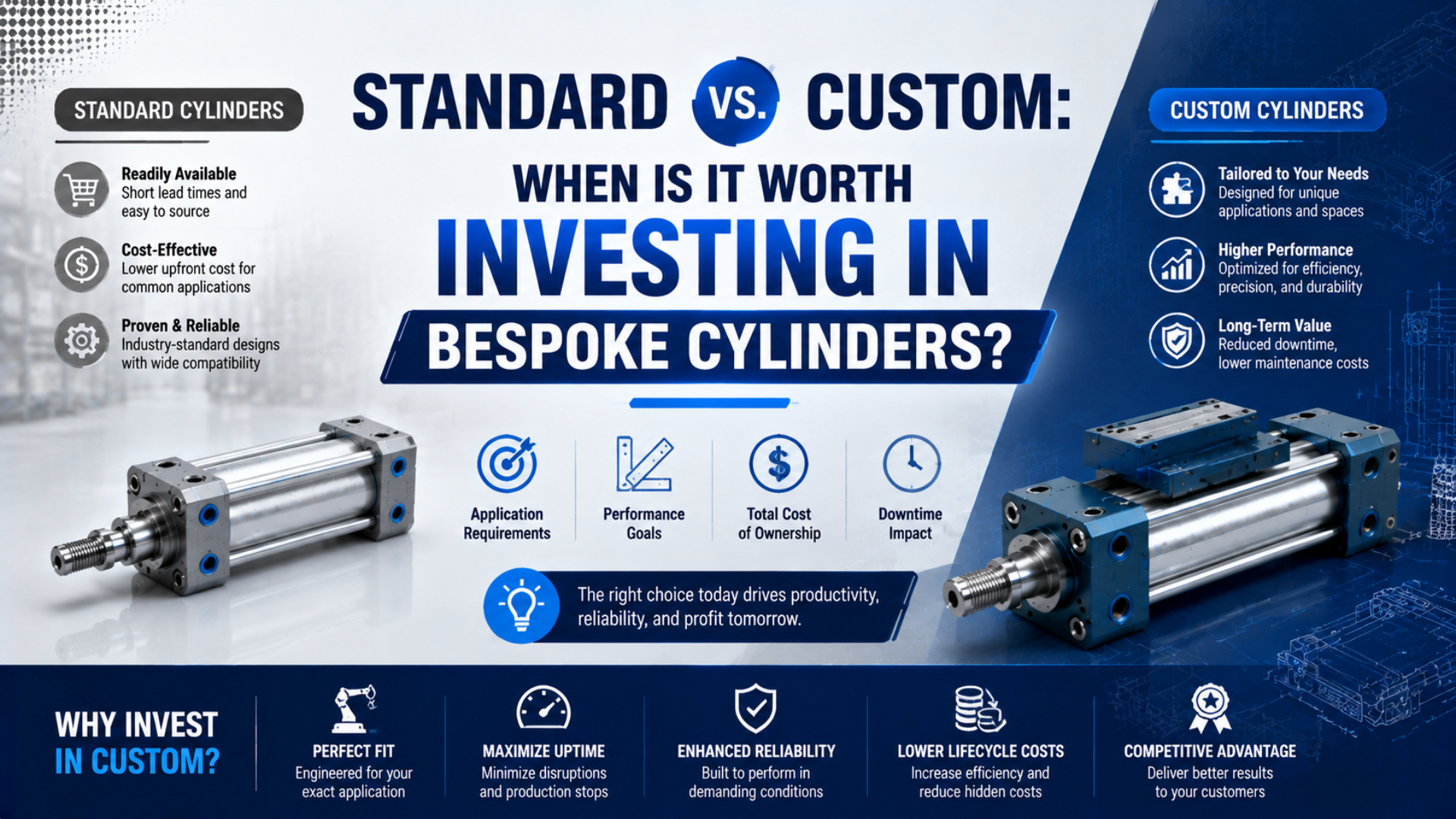
A bespoke pneumatic cylinder is worth considering only when a catalog or configured product cannot satisfy a documented requirement, and when the value of removing that constraint exceeds the added engineering, validation, inventory, and change-control exposure. If a standard platform passes the application and interface checks, standard should remain the default.
That answer is more demanding than comparing two unit prices. NIST says more than half of a manufacturer’s total spending occurs in the supply chain on average, and its procurement guidance treats lead time, freight, inventory, management overhead, and lost sales as total-cost inputs (NIST Supply Chain Management, updated 2025). The real decision is therefore technical first, commercial second.
Key Takeaways
- Compare three paths: catalog standard, configured standard, and true custom.
- Leave the catalog only for a documented constraint, not a preference.
- Compare committed cost, including NRE, tooling, validation, inventory, and change exposure.
- Release custom production only after drawing, test, service, and revision evidence is approved.
What Does Standard Versus Custom Actually Mean?
ISO 15552:2018 defines an interchangeable dimensional series for detachable-mount pneumatic cylinders from 32 mm to 320 mm bore at a maximum rated pressure of 1,000 kPa. It standardizes basic, mounting, and accessory dimensions, but it does not classify a cylinder as suitable for every load, speed, environment, or machine (ISO 15552, confirmed 2025).
The purchasing choice is easier when it is divided into three paths:
| Path | What stays within an existing platform | What the buyer must still verify |
|---|---|---|
| Catalog standard | Published bore, stroke, mounting, port, seal, sensor, and accessory combinations | Load, force, speed, pressure, environment, interfaces, service access, and availability |
| Configured standard | An existing platform with supplier-approved options, such as a listed stroke, seal package, scraper, sensor, port, or mounting combination | Whether the exact option set retains the required ratings, documentation, repair parts, and delivery status |
| True custom | Geometry, materials, interfaces, sensing, acceptance criteria, or manufacturing content outside the established platform | Design ownership, NRE, validation, minimum commitment, spare parts, revision control, and obsolescence |
Catalog standard means an exact configuration selected from an established product platform. Configured standard means a supplier-approved option set that remains inside that platform. True custom cylinder means project-specific content requires new engineering, production, validation, or lifecycle control beyond the established platform.
“Configured standard” is a useful procurement label, not an ISO classification. One supplier may treat a non-stock stroke as a normal option, while another treats the same request as a drawing-controlled special. The quotation should state which platform, ratings, service parts, and warranty rules apply.
In our experience, requests described as “custom” at the inquiry stage often separate into two groups after the interfaces are frozen. Some return to a configured platform. Others reveal a load path, environment, or acceptance requirement that genuinely needs project-specific engineering.
The important boundary is not whether a drawing exists. Many catalog products have drawings. The boundary is whether project-specific content creates new engineering approval, production setup, validation evidence, or supply obligations that the buyer must own.
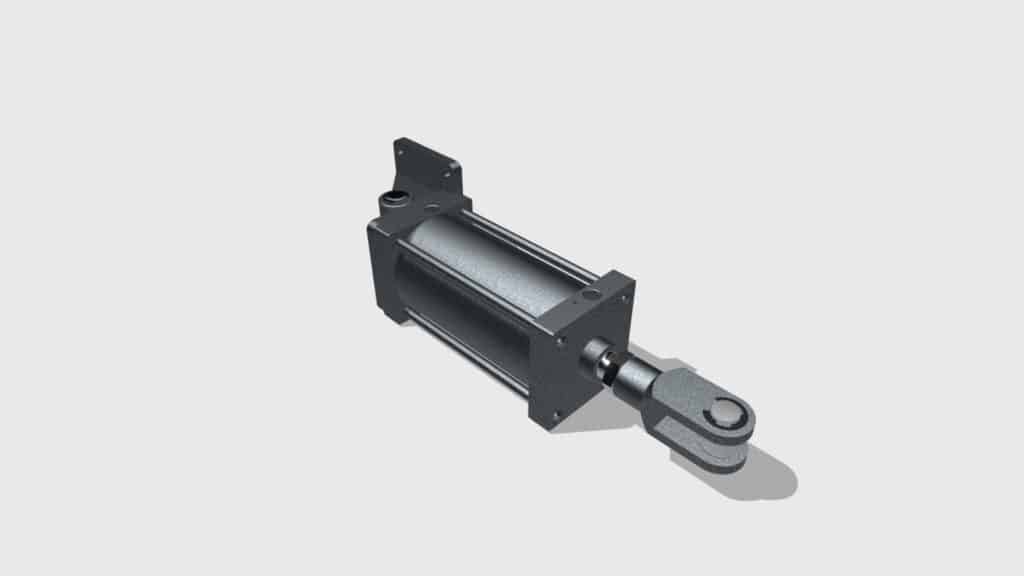
Mounting faces, rod-end geometry, ports, sensors, and surrounding clearance are interface requirements. A different-looking cylinder is not necessarily custom, and a familiar-looking cylinder is not necessarily interchangeable.
Start With the Catalog Boundary
ISO 15552 covers detachable mountings and cylinders with or without magnetic-sensor provision, but its scope is dimensional interchangeability within a 10 bar series. A matching mounting pattern therefore clears only one gate. The exact catalog must still confirm force, cushioning, allowable load and moment, speed, temperature, media, seals, and sensing (ISO 15552, confirmed 2025).
Start with the machine requirement, then map it to the catalog. Do not begin with a preferred bore or a photograph.
Record these items before asking whether custom is necessary:
- Motion: stroke, usable travel, dwell, cycle rate, stopping behavior, and restart position.
- Load: required force in both directions, moving mass, external guidance, side load, moment, impact, compression-buckling concern, and the exact position of each applied load.
- Pneumatic conditions: minimum point-of-use pressure during motion, available flow, exhaust restriction, air quality, allowable leakage, and supply recovery.
- Interfaces: mounting datums, fasteners, rod or carriage connection, ports, tube approach, sensor type, cable exit, and maintenance clearance.
- Environment: temperature limits, water, dust, washdown chemistry, corrosion, radiation, vacuum, and cleanliness expectations.
- Safety and service: stored-energy controls, guarded motion, manual recovery, inspection access, seal-kit strategy, replacement procedure, and the expected safe state after loss of pressure or power.
A standard cylinder remains viable if an approved catalog configuration passes all six groups without improvised adapters, derating outside published rules, or undocumented assumptions. The ISO 15552 interchangeability guide explains why bore, stroke, and bolt pattern alone are not a complete interchange check.
When Should a Standard Cylinder Remain the Default?
NIST reports that more than half of manufacturer spending occurs in the supply chain on average. A standard platform can reduce engineering review, spare-part variety, supplier dependence, and revision exposure, but only when its documented envelope fits the machine (NIST Supply Chain Management, updated 2025).
Keep the standard option when all six checks pass:
| Check | Standard remains the default when |
|---|---|
| Performance | A published configuration meets the required motion, force, load, pressure, and environmental conditions |
| Mechanical fit | Mounting and connection interfaces fit without brackets that introduce alignment, stiffness, or service problems |
| Integration | Sensors, cables, ports, and controls can be installed and maintained inside the machine envelope |
| Evidence | The exact model has accessible ratings, drawings, installation instructions, and repair information |
| Recovery | Replacement units and wear parts can be stocked or sourced within the site’s recovery plan |
| Qualification | The machine does not require project-specific component evidence beyond normal installation and acceptance records |
Standardization has value only when the selected configuration is controlled. A “standard cylinder” ordered with an ambiguous suffix, undocumented seal change, or unverified sensor option can create the same revision and service risk as a special design.
We found that standardization is easiest to defend when maintenance can identify the complete configuration from the installed unit, retrieve the same controlled documents, and order the defined wear parts without reconstructing the application years later.
For a replacement project, separate architecture from supplier channel. The article on OEM versus aftermarket rodless-cylinder TCO compares suppliers after the dimensional and functional requirement has been fixed. The present decision happens earlier: can an established platform satisfy the machine at all?
Which Constraints Justify a Custom Cylinder?
ISO 14644-14:2026 assesses equipment suitability for cleanrooms using airborne-particle sizes from 0.1 micrometres to 5 micrometres or larger, yet it explicitly excludes cleanability, material selection, biocontamination, and process optimization. That boundary shows why one label or material callout cannot replace application-specific qualification (ISO 14644-14, 2026).
A custom design is justified by a hard constraint that survives a disciplined search of standard and configured platforms. Common triggers include:
Geometry or interface conflict
The required stroke fits, but the body, carriage, rod end, ports, sensor groove, or mounting datums cannot fit the machine. Before creating a new cylinder, test whether a different mounting family, compact platform, guided actuator, rodless architecture, or redesigned machine bracket resolves the conflict with less project-specific content.
Load path outside the catalog envelope
The cylinder can produce enough axial force, but the installed side load, moment, unsupported rod length, carriage load, impact, or stop position exceeds a published limit. A larger bore does not automatically correct the load path. External guidance, a different actuator architecture, or a machine-mounted stop may be the better answer.
Environment outside a listed option
Temperature, corrosive chemicals, abrasive dust, washdown, outdoor exposure, radiation, low pressure, unusual media, or cleanliness requirements may exceed the exact platform’s published conditions. Specify the exposure and acceptance method. “Stainless,” “food grade,” “medical grade,” and “high temperature” are not complete engineering requirements.
Integrated interface that removes system risk
A special port orientation, manifold face, position transducer, lock, brake, valve, or mounting datum can eliminate external plumbing and adapters. Integration is worthwhile when it removes a documented failure mode or installation variable. Fewer parts alone do not prove lower lifecycle cost.
Controlled replacement of an obsolete design
An old machine may depend on a nonstandard envelope that cannot be changed economically. A drawing-controlled replacement can be reasonable, provided the buyer reconstructs the functional requirement instead of copying worn dimensions and unknown material choices.
Custom is not a reward for a demanding application. It is a containment decision. The design should customize only the requirement that cannot be met otherwise, while retaining standard seals, sensors, fasteners, ports, and mounting conventions wherever they do not compromise the application.
Six-Gate Standard-to-Custom Decision
ISO 4414:2010 applies to the design, construction, and modification of pneumatic systems and considers installation, adjustment, uninterrupted operation, maintenance, cleaning, reliability, energy efficiency, and the environment. A cylinder choice should therefore pass more than a fit check before project-specific content is approved (ISO 4414, confirmed 2021).
Use these six gates in order. A “no” at one gate is not automatic approval for custom. It is a prompt to compare a different standard architecture, a configured option, a machine change, and a true custom design.
| Gate result | Preferred action |
|---|---|
| Catalog option passes all six gates | Select the standard cylinder and record the exact configuration |
| Configured option passes with supplier-controlled ratings and service parts | Use the configured platform and preserve its approved suffixes and documents |
| A hard constraint remains, but value or qualification is unclear | Pause; refine the machine requirement and acceptance plan |
| A hard constraint remains and all six gates have owners and evidence | Release a controlled custom-cylinder project |
The sequence prevents a common mistake: pricing a custom drawing before the engineering requirement is stable. It also prevents the opposite mistake, forcing a catalog cylinder into a machine with adapters and derating that no one has evaluated.
How Should You Compare Committed Cost?
NIST says more than half of manufacturer spending occurs in the supply chain and recommends TCO analysis beyond purchase price. For a custom cylinder, the comparison should use one demand horizon and include recurring price, non-recurring work, validation, logistics, inventory, and design-change exposure (NIST Supply Chain Management, updated 2025).
Use the same accepted performance requirement and time horizon for the standard, configured, and custom alternatives:
Here, is the cost tied to the decision horizon, is the binding order quantity, and is the recurring unit price. The remaining terms cover non-recurring engineering, dedicated tooling, qualification, logistics, inventory-related cost, and expected change or obsolescence exposure. Use one currency throughout.
Do not subtract “performance gains” unless operations and finance have defined how the gain will be measured, when it will begin, and which baseline will be used. Likewise, do not insert a generic downtime rate. A site-approved figure should state whether it includes lost contribution, scrap, restart labor, missed delivery, and downstream disruption.
| Cost group | Standard or configured option | Custom option |
|---|---|---|
| Recurring unit content | Quoted unit price and ordinary accessories | Quoted unit price and project-specific content |
| Integration | Brackets, adapters, extra sensors, plumbing, controls changes, installation labor | Direct interfaces, plus any new machine or control work |
| Non-recurring work | Application review and qualification | Engineering, drawings, programming, fixtures, gauges, and tooling |
| Validation | Incoming inspection and machine confirmation | Prototype, first article, special test, reports, and machine trial |
| Supply commitment | Stock policy and standard replacement lead time | MOQ, material commitment, releases, storage, and cancellation exposure |
| Lifecycle | Seal kits, documentation, training, and replacement options | Revision ownership, dedicated spares, supplier change control, and end-of-life plan |
The custom-cylinder MOQ guide explains prototype quantity, production MOQ, release quantity, and forecast separately. Do not treat them as interchangeable.
What Must Be Frozen Before Requesting a Custom Quote?
The 2026 Federal Acquisition Regulation lists special tooling, special test equipment, preproduction engineering, initial rework, initial spoilage, and pilot runs as nonrecurring-cost examples. It does not govern every private cylinder purchase, but it provides useful vocabulary for separating one-time work from recurring unit content (FAR 17.106-1, effective 2026).
A comparable RFQ needs one controlled requirement package. At minimum, freeze:
| RFQ block | Required content |
|---|---|
| Function | Load cases, direction, stroke, speed, cycle profile, dwell, stopping method, and failure consequence |
| Pneumatics | Minimum dynamic pressure, maximum pressure, available flow, ports, tubing, air quality, leakage limits, and exhaust conditions |
| Mechanics | Envelope, mounting datums, fasteners, rod or carriage interface, guidance, side load, moment, impact, and service clearance |
| Environment | Temperature, dust, water, chemicals, corrosion, washdown, radiation, cleanliness, and outdoor exposure |
| Sensing and control | Sensor principle, switching points, analog feedback, connector, cable length, diagnostics, and safe-state behavior |
| Acceptance | Drawing approval, material records, dimensional report, leak and function tests, endurance evidence, FAT, and machine trial |
| Commercial control | Prototype quantity, production quantity, releases, NRE, tooling ownership, lead time, spares, warranty, and cancellation terms |
| Configuration control | Drawing number, revision, approved deviations, supplier-change notification, record retention, and reorder identifiers |
Avoid design language that hides the actual need. “Use stainless steel” is a proposed solution; the requirement might be resistance to a named chemical at a stated concentration and temperature. “FDA seal” is also incomplete. The often-cited 21 CFR 177.2600 applies to rubber articles intended for repeated food contact and includes use-specific formulation and extractives limits (21 CFR 177.2600, current 2026).
The custom-cylinder lifecycle guide continues from specification freeze through drawing approval, manufacturing, FAT, installation, and commissioning. For standard-platform orders, use the ISO 15552 procurement checklist to keep supplier quotations comparable.
Qualification Before Production Release
ISO 19973-3:2015 provides reliability-test and reporting procedures for rod-type pneumatic cylinders and states that cylinder lifetime is usually expressed in cycles or kilometres. It does not supply one universal service-life promise. Qualification must therefore connect the exact configuration, test conditions, acceptance thresholds, and installed machine duty (ISO 19973-3, confirmed 2021).
Separate four evidence levels.
Design evidence includes the approved drawing, bill of materials or controlled material specification, interface definition, calculations, risk review, and acceptance plan.
Production evidence records materials, controlled processes, critical dimensions, assembly checks, leak and functional tests, and every accepted deviation.
Component qualification reproduces the required pressure, load, speed, temperature, contamination, cycling, and failure criteria with an identified sample, method, instrumentation, and threshold.
Installed acceptance checks alignment, plumbing, sensor behavior, controlled low-speed motion, end-of-stroke behavior, safeguards, recovery, and a production-representative machine trial.
A test report is useful only when it identifies the specimen, configuration, method, conditions, measurements, thresholds, and result. “Passed factory test” is not an acceptance criterion. Neither is a catalog cycle value copied from another configuration.
The supplier review belongs in the same release process. The guide to evaluating cylinder-manufacturer capabilities covers drawing control, machining, sealing interfaces, inspection, assembly, testing, and change management. A capable factory is necessary, but the buyer still needs an application-specific acceptance record.
What Should the Final Decision Record Contain?
NIST recommends supplier evaluation, TCO, risk mapping, and supplier scorecards as procurement disciplines. A useful cylinder decision record compares three alternatives under the same requirement: catalog standard, configured standard, and true custom. It states why the selected option passes and why the rejected options fail (NIST Supply Chain Management, updated 2025).
Keep the record concise enough to update:
| Record block | What it must show |
|---|---|
| Identity | Approved requirement revision, decision date, exact suppliers, and configuration identifiers |
| Alternatives | Catalog evidence, unresolved exceptions, and the constraint that triggered custom review |
| Commercial basis | Committed-cost horizon, assumptions, sensitivity items, prototype and production quantities, releases, and spares |
| Release basis | Qualification plan, measurable acceptance thresholds, approval owners, and disposition of any deviation |
| Lifecycle ownership | Drawing, tooling, software, data, test records, change notification, repair parts, reorder package, warranty, and end-of-life response |
From our work, the most useful decision records are not the longest. They expose the unresolved assumption, name its owner, and state the evidence needed to close it. That makes a later change review faster and prevents an old quotation from becoming an accidental specification.
What would reverse the decision? Record that too. A machine-envelope change, new catalog release, lower forecast, unavailable material, failed validation, or revised safety requirement may change the preferred path before production approval.
The strongest custom-cylinder business case is reversible until the evidence is complete. It permits the team to return to a standard platform if the constraint disappears or the custom option fails cost or qualification gates. That is healthier than treating custom engineering as a commitment made at the first quotation.
For projects already committed to a custom path, the custom-cylinder lead-time guide separates drawing approval, material readiness, manufacturing, validation, and logistics instead of relying on one unsupported delivery promise.
Standard vs. Custom Cylinder FAQs
ISO 15552 covers a 32 mm to 320 mm dimensional series at up to 1,000 kPa, yet even that broad range does not decide whether a catalog, configured, or custom cylinder is correct. The five answers below preserve the same rule: prove the requirement, compare controlled alternatives, and qualify the selected configuration (ISO 15552, confirmed 2025).
Is a non-standard stroke automatically a custom cylinder?
No. A supplier may offer the requested stroke as a configured option within an established platform, with published ratings and standard service parts. Ask whether it receives a normal configuration code or a project drawing, and whether pressure, cushioning, sensing, warranty, lead time, and repair support remain within the documented platform.
How many units make a custom cylinder worthwhile?
There is no universal quantity. Compare the binding order, expected consumption, recurring price, NRE, tooling, validation, logistics, inventory, and change exposure over one demand horizon. FAR 17.106-1 is not a private-purchase rule, but its separation of recurring and nonrecurring costs provides useful quotation vocabulary.
Does an FDA-compliant seal prove cleanroom or medical suitability?
No. 21 CFR 177.2600 addresses repeated-use rubber articles under specified food-contact conditions, while ISO 14644-14:2026 addresses equipment suitability by airborne-particle concentration. Neither label alone proves cleanability, biocontamination control, chemical compatibility, process suitability, or complete-machine compliance. Define the actual exposure and acceptance method.
How should custom-cylinder lead time be compared?
Compare the same controlled milestones: requirement freeze, drawing approval, material readiness, prototype, production, validation, and shipment. Separate working time from buyer approval time and contingency. A quoted number without an approved drawing, test plan, material status, and release quantity is not a dependable project schedule.
Can a custom cylinder remain interchangeable with an existing machine?
Yes, if interchangeability is an explicit, verified requirement. Match mounting datums, envelope, ports, fasteners, rod or carriage interface, sensors, stroke references, force, allowable loads, speed, cushioning, environment, and service access. Preserve the approved drawing revision and acceptance evidence so a future reorder reproduces the same interfaces and function.
Sources and technical references
- ISO 15552:2018, dimensional series for detachable-mount pneumatic cylinders; confirmed 2025; retrieved 2026-07-26.
- ISO 4414:2010, general rules and safety requirements for pneumatic systems; confirmed 2021; retrieved 2026-07-26.
- ISO 19973-3:2015, reliability assessment by testing for rod-type pneumatic cylinders; retrieved 2026-07-26.
- ISO 14644-14:2026, equipment suitability for cleanrooms by airborne-particle concentration; retrieved 2026-07-26.
- NIST Supply Chain Management, TCO, supplier evaluation, and supply-risk guidance; updated 2025; retrieved 2026-07-26.
- FAR 17.106-1, recurring and nonrecurring cost vocabulary; effective 2026-03-13; retrieved 2026-07-26.
- 21 CFR 177.2600, rubber articles intended for repeated food-contact use; current through 2026-07-23; retrieved 2026-07-26.