

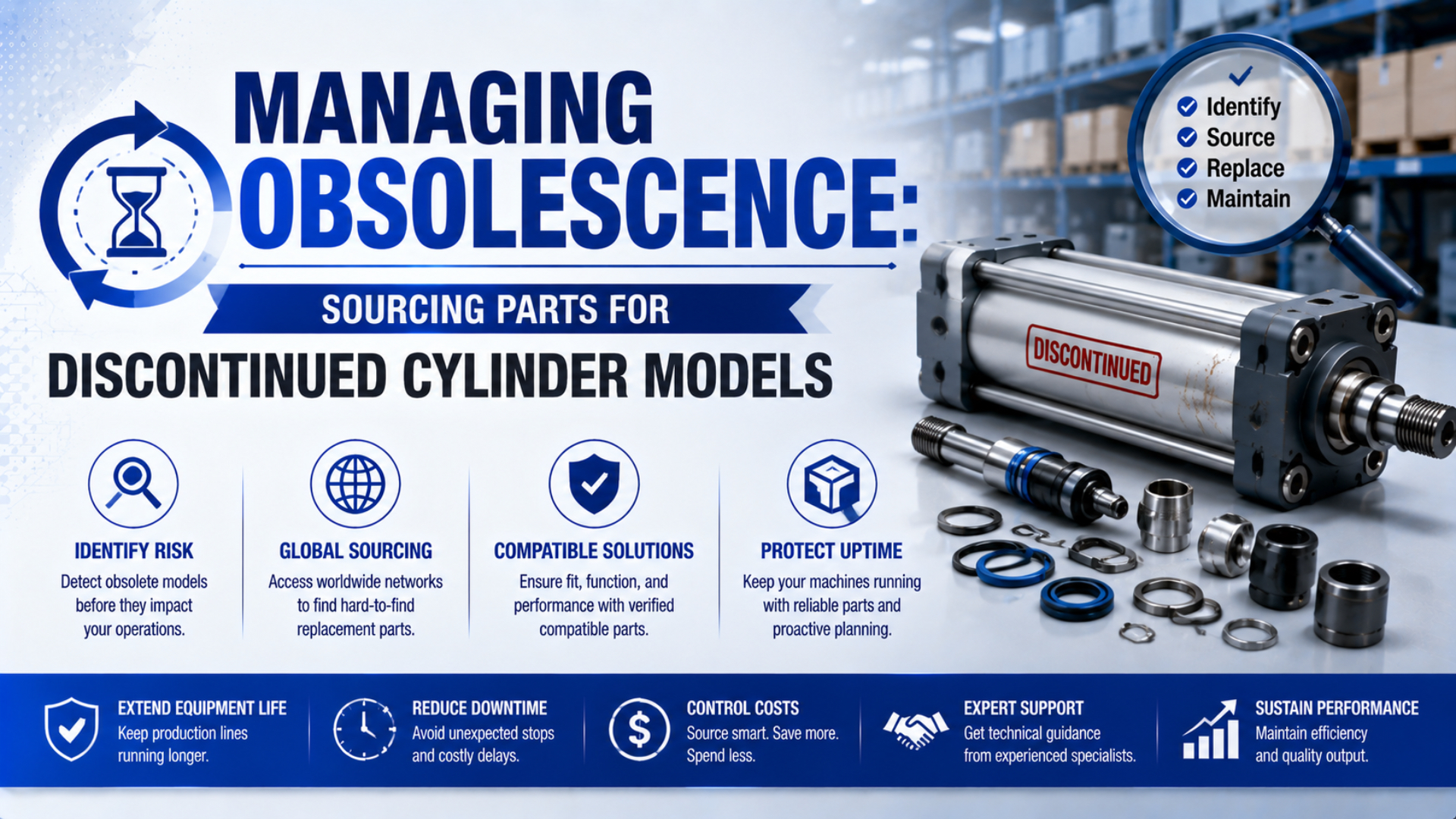
A discontinued pneumatic cylinder does not automatically require a custom copy or a machine redesign. Start by confirming the exact part number and lifecycle status. Then compare the lowest-change resolution paths: an OEM successor, an approved repair, traceable new-old stock, a qualified equivalent, a custom replacement, or a controlled redesign.
The hard part is not finding something with the same bore and stroke. It is proving that the selected configuration fits the machine, produces the required force and motion, survives the environment, connects to the existing controls, and can be ordered again under change control.
Discontinued pneumatic cylinder replacement is the controlled process of restoring an obsolete actuator function through a verified repair, successor, equivalent, custom unit, or machine change. The deliverable is an approved repeatable configuration, not merely a part that can be bolted into the available space.
Key Takeaways
- IEC 62402:2019 treats obsolescence as a lifecycle process, not an emergency purchasing task.
- ISO dimensions define only part of cylinder interchangeability.
- Qualify replacements through controlled drawings, interface checks, application limits, safe installation, first-article testing, and a frozen procurement record.
Publisher information and a route for technical corrections are available through About Us and Contact.
What Should You Confirm Before Declaring a Cylinder Obsolete?
IEC 62402:2019, published in 2019 with a stated stability date of 2028, requires a managed process across an item’s lifecycle (IEC, 2019). Before sourcing a substitute, confirm whether the exact cylinder is discontinued, regionally unavailable, temporarily constrained, superseded, or still supported through repair parts.
Record the complete manufacturer code, not only the series name. Suffixes can change the rod, carriage, cushioning, sensors, seal material, temperature range, port thread, mounting, corrosion protection, or special function. A lifecycle notice for one variant does not prove that every member of the family has the same status.
Use the manufacturer’s current product page, discontinuation notice, successor database, distributor system, or written technical response. Capture the date and source. If the answer comes by email, save it with the asset record. Purchasing memory is not lifecycle evidence.
Distinguish three conditions:
- Commercial obsolescence: the configured product is no longer offered for new orders.
- Service obsolescence: repair kits or replacement subassemblies are no longer supported.
- Application obsolescence: the cylinder still exists, but it no longer meets the machine’s safety, environment, control, or production requirements.
These conditions lead to different actions. A commercially obsolete cylinder may remain serviceable for years with approved kits. A current cylinder can still be obsolete for the application after a control or process change. Treat “obsolete” as a documented status plus an operational consequence, not a label attached to old equipment.
The first record should therefore answer: What is unavailable? From whom? In which region? From what date? Which repair parts remain? What successor does the OEM identify? What differences does the OEM disclose?
Choosing an Obsolescence Resolution Path
The U.S. Defense Standardization Program updated its SD-22 guidebook in January 2026 and states that it covers both mechanical and electrical parts obsolescence (DSP, 2026). Its cost, schedule, and performance framing supports a lowest-change resolution sequence rather than an automatic jump to redesign.
Choose the route that controls present risk without creating a larger unsupported configuration:
- OEM repair or service kit: use when the body and load-bearing features remain serviceable and the exact kit is supported.
- OEM successor: prefer the manufacturer-issued path, then verify every disclosed difference.
- Traceable new-old stock: use as a controlled bridge when identity, condition, storage, and support are acceptable.
- Qualified third-party equivalent: compare the complete configured interfaces and prove the application.
- Custom equivalent: create a controlled specification when no catalog route meets the installed constraints.
- Machine redesign: use when the existing interface prevents a safe, supportable, or economical long-term solution.
What should reverse the decision? New evidence. If the OEM successor needs an unavailable controller change, a qualified equivalent may be lower risk. If new-old stock has uncertain storage history, a custom cylinder with controlled materials and tests may be more defensible. If the installed design repeatedly overloads the actuator, copying it preserves the failure mechanism.
How Do You Qualify an OEM Successor or Cross-Reference?
ISO 15552:2018 covers detachable-mount pneumatic cylinders from 32 to 320 mm bore at a maximum rated pressure of 1,000 kPa, or 10 bar (ISO, confirmed 2025). Those dimensions support interchangeability, but they do not prove that two configured cylinders have equal performance, options, materials, or service access.
A cross-reference is a candidate, not an approval. Compare six evidence layers:
| Approval layer | Evidence required | Common hidden difference |
|---|---|---|
| Identity | Complete old and proposed codes, current manufacturer data | Unread suffix or regional variant |
| Dimensional fit | Controlled drawings, installed measurements, envelope review | Port, rod end, sensor, or adjuster interference |
| Functional duty | Force, speed, cycle, cushioning, load and moment limits | Same bore with different usable performance |
| Environment | Temperature, contamination, washdown, lubricant, seal and material data | Seal or coating incompatible with the process |
| Safety and controls | Stored energy, failure behavior, sensing, interlocks, guarding | Different switch logic or unexpected movement |
| Release | First-article report, approved code, drawing revision, change record | Future order repeats an untested configuration |
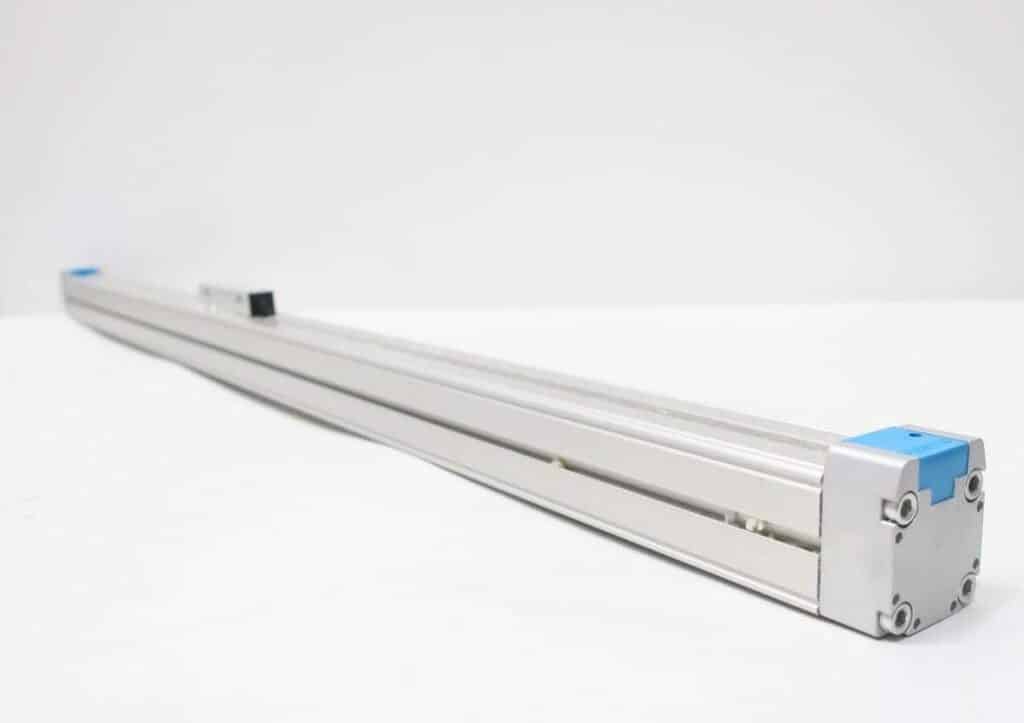
The proposed part must meet the actual machine duty, not merely equal the old catalog headline. For a rodless cylinder, confirm carriage mounting, allowable pitch, yaw and roll moments, external guidance, coupling or sealing design, speed, cushioning, stroke tolerance, ports, sensors, and service access. For a rod cylinder, add rod thread, rod diameter, mounting alignment, buckling direction, and side-load control.
Standards reduce interface uncertainty only within their published scope. They do not transfer application approval from the old configuration to the new one. This is why an ISO-compliant replacement can fit the mounting holes and still fail a cushioning, sensing, temperature, corrosion, or load-moment requirement.
Select the correct dimensional family. ISO 6432:2015 covers commonly used single-rod cylinders from 8 to 25 mm bore at up to 1,000 kPa, while ISO 15552 starts at 32 mm (ISO 6432, confirmed 2020). Neither standard certifies every configured feature or machine duty.
Manufacturer cross-reference tools are still useful discovery evidence. Parker’s tool accepts another manufacturer’s part number or an obsolete Parker number, but the returned equivalent remains subject to application verification (Parker Cross Reference, retrieved 2026).
The Festo DNC replacement guide shows how one successor path can change cushioning and option codes. For broader purchasing evidence, use the ISO 15552 procurement checklist.
What Data Must Be Captured from the Installed Cylinder?
SMC lists mechanically jointed MY1H rodless-cylinder variants discontinued in April 2013 and March 2019, with MY1H-Z successors for the identified configurations (SMC). That model-specific record shows why a series name, photograph, or nominal bore cannot replace the complete code and installed-interface survey.
Photograph the machine before removal. Capture the nameplate, full actuator, mounting datums, ports, flow controls, sensors, brackets, cable routing, moving load, guidance, end clearances, and any field modification. Include a scale or known dimension where useful.
Build one controlled data package:
- manufacturer, full model code, serial or date code, and nameplate ratings;
- bore, stroke, overall retracted and extended envelope;
- mounting style, hole pattern, datums, carriage or rod connection;
- port thread, location, orientation, fittings, tube size, and exhaust controls;
- working and dynamic pressure at the actuator;
- moving mass, external load, force direction, load moments, and guidance;
- target stroke time, cycle rate, duty pattern, and end-position behavior;
- cushioning type, settings, stops, and external shock absorbers;
- sensor type, voltage, output, connector, position, and controller logic;
- temperature, contamination, washdown, chemicals, lubricant, and corrosion exposure;
- observed failure, damaged parts, repair history, and remaining sister units.
When the original drawing is missing, do not pretend that caliper measurements recreate the design. Measurements can establish external interfaces. They cannot reveal seal compounds, heat treatment, internal tolerances, fatigue margins, proprietary cushioning geometry, or allowable moment ratings. Convert unknowns into explicit supplier questions and conservative test requirements.
Use the application to resolve conflicts. If the old nameplate is unreadable but the machine requires a defined clamp force, record load, effective pressure, geometry, and safety requirement. If the actuator carries an offset load, document the moment arm and external guidance. A model match without the duty is incomplete.
When Is New-Old Stock or a Repair Kit Acceptable?
SMC records the CY1B and CY1R magnetically coupled rodless-cylinder series as discontinued in March 2006 and points to CY3B and CY3R replacements (SMC). A surviving CY1 item may still be usable, but its age alone does not establish seal condition, storage quality, traceability, or supportability.
New-old stock is a bridge, not automatic proof. Verify:
- the exact part code and configuration;
- original packaging, source, labels, and traceability;
- storage temperature, humidity, sunlight, ozone, contamination, and handling;
- corrosion, damaged ports, degraded grease, hardened seals, and carriage condition;
- available repair kits and instructions;
- quantity required and what happens after the remaining stock is consumed;
- incoming inspection, leak test, functional test, and return terms.
Do not assign one universal shelf life to every cylinder or seal. Elastomer, lubricant, packaging, environment, and manufacturer guidance matter. If storage history is unknown, treat the unit as unverified inventory and plan inspection or refurbishment before it becomes the emergency spare.
A repair kit is acceptable when it is specified for the exact cylinder revision, the load-bearing structure remains serviceable, the failure cause is understood, and the repair can be completed under an approved instruction. The kit does not correct a bent rod, scored tube, damaged carriage, worn guide, cracked end cap, distorted mount, or repeated side-load problem.
After repair, use defined acceptance criteria. At minimum, inspect assembly condition, verify safe pressure integrity, check leakage, run the complete stroke, confirm cushioning and sensing, and prove the unit under representative machine conditions. Follow the machine’s hazardous-energy procedure during removal, service, and reinstallation.
ISO 4414 asks pneumatic-system designers to consider reliable operation, maintenance, and safety throughout intended use (ISO 4414, confirmed 2021). A repair or replacement that cannot be isolated, accessed, adjusted, or verified safely is not an equivalent maintenance outcome.
When Should You Commission a Custom Equivalent?
ISO 15552 defines interchange dimensions for a 32 to 320 mm bore series up to 10 bar, yet many legacy rodless, guided, compact, special-material, or modified cylinders sit outside that exact scope (ISO, confirmed 2025). A custom equivalent is justified when controlled requirements cannot be met by a current catalog configuration.
Commission a custom unit when the installed envelope, mounting, carriage, rod interface, port location, environment, or machine architecture makes adapters or redesign less acceptable. Do not ask the supplier to “copy the old cylinder” from photographs. Issue a performance and interface specification.
Freeze the following before manufacture:
- controlled external dimensions and datums;
- required force and motion at the available pressure;
- allowable loads, moments, alignment, and guidance assumptions;
- pressure, temperature, speed, cycle, and duty limits;
- port, sensor, electrical, material, seal, lubricant, and surface requirements;
- hazard controls and expected failure behavior;
- inspection characteristics and tolerances;
- pressure, leakage, motion, cushioning, sensing, and endurance tests;
- drawing approval, change control, marking, and future spare-part support.
The custom pneumatic cylinder lifecycle provides the drawing, FAT, installation, and commissioning gates. When a quotation includes tooling, validation, minimum order, inventory, and change exposure, the Custom Cylinder MOQ Commitment Calculator can compare the complete order commitment.
How Many Obsolete-Cylinder Spares Should You Hold?
IATF FAQ 29 lists five elements for effective contingency planning, including risk analysis, alternative measures such as safety stock, regular testing and validation, and customer-specific compliance (IATF, 2022). It does not prescribe one spare cylinder for every machine.
Set quantity from the operating risk:
- installed population using the exact approved configuration;
- production consequence and available bypass or redundancy;
- observed demand for cylinders and repair kits;
- replenishment lead time and its variability;
- repair turnaround and whether failed units are recoverable;
- shelf-life and storage constraints for seals, grease and assembled units;
- supplier minimum order, batch economics and change exposure;
- planned equipment retirement or redesign date.
The right spare is a recovery capability, not merely an object on a shelf. A cylinder without the correct sensors, mounting hardware, fittings, settings, work instruction, or approved test record can remain unusable during a stoppage. Kit the complete change and identify what can be safely reused.
Classify inventory by function:
| Spare class | Appropriate use | Control required |
|---|---|---|
| Ready-to-install cylinder | Critical single-point function with acceptable shelf storage | Approved code, preserved settings, periodic condition check |
| Repairable rotating spare | Unit can be rebuilt and returned to stores | Repair route, acceptance record, status labeling |
| Seal or wear kit | Failure modes are repairable and body remains serviceable | Exact revision, storage control, repair instruction |
| Shared configurable spare | Several machines can use one base unit after controlled setup | Configuration matrix, accessories, trained changeover |
| Bridging new-old stock | Finite stock supports a planned transition | Consumption forecast, condition checks, exit date |
Review the plan after each lifecycle notice, failure, supplier change, long lead-time deviation, machine modification, or inventory discovery. A static spare list will age into the next obsolescence problem.
Build an Obsolescence Plan Before the Next Failure
DSP states that the January 2026 SD-22 update uses proactive practices to reduce obsolescence risk and evaluates results through cost, schedule, and performance (DSP, 2026). A practical cylinder plan therefore links asset data, lifecycle monitoring, resolution ownership, qualification evidence, inventory, and change control.
Start with production-critical functions. Create a register that includes the machine, cylinder code, quantity, lifecycle status, OEM successor, approved alternatives, repair route, spare quantity, storage location, evidence owner, review date, and planned equipment retirement.
Monitor official sources at a frequency suited to the risk. SMC, for example, publishes discontinued air-cylinder series, dates, replacements, and product-comparison links rather than one universal support period (SMC). Supplier communication should supplement that record, not replace it.
Use clear trigger dates:
- lifecycle notice received;
- last-time-buy decision due;
- final OEM order date;
- successor qualification due;
- new-old-stock bridge exhausted;
- custom replacement first article due;
- redesign and machine-validation window;
- legacy configuration retirement.
Supplier diversification also requires qualification. A second quotation is not a second source until the configured product and its manufacturing, inspection, documentation, delivery, change-notification, and support process are accepted. The OEM-versus-aftermarket TCO framework separates technical gates from price, while the supplier-evaluation guide covers audit and commercial evidence.
The deliverable is a controlled recovery path: an approved part or repair, a complete installation kit, a safe work instruction, acceptance criteria, trained personnel, and a record that purchasing can reproduce. That is what turns an OEM discontinuation from an emergency into a scheduled engineering change.
Discontinued Pneumatic Cylinder FAQs
ISO 15552 covers a 32 to 320 mm bore series up to 10 bar, while SMC’s lifecycle database assigns discontinuation dates and successors to specific configurations (ISO, confirmed 2025; SMC). These answers keep dimensional interchangeability separate from complete replacement approval.
What should I do first when a cylinder model is discontinued?
Record the complete part code and confirm the exact lifecycle status through current manufacturer evidence. Ask whether the configured unit is discontinued, superseded, regionally unavailable, or still repairable. Capture remaining kits, the named successor, disclosed differences, final-order dates, and installed quantity before purchasing an alternative or starting a redesign.
What makes a replacement cylinder genuinely drop-in?
A replacement is drop-in only when the configured unit fits every approved mechanical, pneumatic, electrical, and control interface without an unreviewed change and passes the machine’s functional acceptance test. Matching bore, stroke, or ISO mounting dimensions is insufficient when ports, sensors, cushioning, materials, load limits, or service access differ.
Is new-old stock safe to use for a discontinued cylinder?
It can be, provided the exact configuration, source, traceability, storage history, physical condition, seal and lubricant condition, and remaining support are acceptable. Inspect and test the unit before treating it as a production spare. Unknown storage or counterfeit risk can make apparently unused inventory less dependable than a qualified current replacement.
When should I choose a custom replacement instead of redesigning?
Choose a custom replacement when the existing envelope and interfaces remain valid, the required performance can be specified and tested, and preserving the machine configuration is lower risk than changing it. Redesign when the legacy layout is unsafe, repeatedly overloads the actuator, blocks supportability, or requires too many uncontrolled compromises.
How many spare discontinued cylinders should a plant hold?
There is no universal quantity. Base stock on installed population, production consequence, bypass options, failure and repair history, replenishment variability, shelf-life constraints, minimum order, and the machine’s remaining service horizon. Include sensors, mounts, fittings, instructions, settings, and acceptance records so the inventory is a usable recovery kit rather than an isolated component.
Sources and technical references
- IEC 62402:2019, obsolescence-management requirements and lifecycle scope; 2019, retrieved 2026-07-26.
- DMSMS Guidebook SD-22, proactive electrical and mechanical parts-obsolescence practices; updated January 2026, retrieved 2026-07-26.
- ISO 15552:2018, detachable-mount cylinder dimensional-interchangeability scope; confirmed 2025, retrieved 2026-07-26.
- ISO 6432:2015, small-bore single-rod cylinder mounting dimensions; confirmed 2020, retrieved 2026-07-26.
- ISO 4414:2010, pneumatic-system safety, maintenance, and reliable-operation scope; confirmed 2021, retrieved 2026-07-26.
- SMC Discontinued Air Cylinders, model-specific discontinuation dates, successors, and comparison links; retrieved 2026-07-26.
- SMC MY1H Discontinuation Detail, variant dates and identified MY1H-Z successor path; retrieved 2026-07-26.
- Parker Cross Reference, cross-reference search for competitor and obsolete Parker part numbers; retrieved 2026-07-26.
- IATF 16949:2016 FAQ 29, contingency-plan guidance; 2022, retrieved 2026-07-26.