
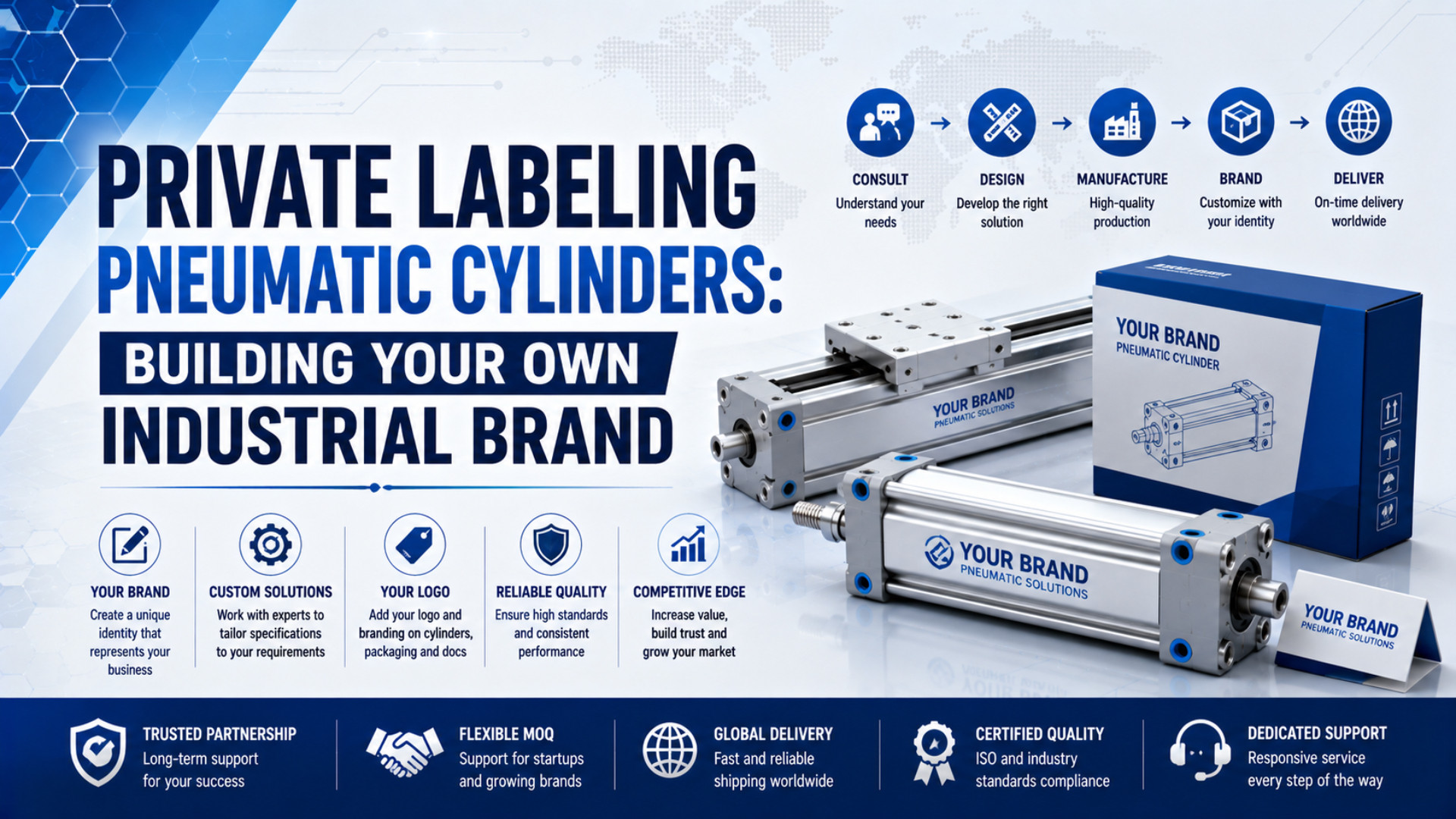
A private-label pneumatic cylinder is a cylinder produced by one organization and sold under another organization’s brand and controlled product identity. Private label pneumatic cylinders therefore require more than a logo on an established product. The brand owner must define what each SKU represents, which organization performs each technical and legal task, what evidence releases a production lot, and how customers will be supported after shipment. The commercial upside is not guaranteed by a new label. It depends on disciplined product control, credible technical support, repeatable supply, and a clear reason for a buyer to choose the branded range.
This guide treats private labeling as a controlled product-launch program. It covers trademark and market-role decisions, configuration records, supplier quality agreements, pilot-lot release, traceability, complaints, engineering changes, and supply continuity. Supplier discovery and factory auditing are separate activities; use the private-label manufacturer qualification guide for that earlier stage.
Key Takeaways
- A brand owner may also be treated as the manufacturer under market-specific product law
- Freeze the sellable SKU, technical baseline, marking, packaging, and evidence package together
- Use samples and pilot lots to validate different risks; one good prototype does not release volume production
- Treat complaints, change notices, service parts, and alternate supply as launch requirements
What Changes When You Put Your Brand on a Pneumatic Cylinder?
The European Commission’s Blue Guide states that a person who has a product made and markets it under their own name or trademark is considered the manufacturer under applicable EU product legislation. Subcontracting production does not remove that manufacturer’s ultimate responsibility (European Commission Blue Guide, 2022).
That rule is specific to the EU framework and products within its scope, but it exposes the central private-label issue: the name on the product can change the brand owner’s role. A contract manufacturer may machine, assemble, test, and pack the cylinder while the brand owner defines the product, places it on a market, handles customer claims, or appears on required documentation. An importer or distributor may have additional duties. The exact allocation depends on the destination, product, intended use, and supply chain.
Before requesting branded samples, create a market-role matrix for every destination. It should name the parties and identify who is accountable for:
-
product definition and design authority;
-
conformity assessment and required declarations;
-
name, address, model, serial or lot, and origin marking;
-
technical-file creation and retention;
-
production release and supplier monitoring;
-
importer or economic-operator obligations;
-
customer instructions, warnings, and local-language information;
-
complaint intake, field investigation, corrective action, and any recall.
Commercial contracts can assign tasks, records, and cost. They cannot erase a legal duty imposed on a particular market participant. Have qualified regulatory counsel or a conformity specialist confirm the matrix for each target market before launch.
Brand and Market Decisions Before Product Design
WIPO explains that trademark protection is generally obtained through national or regional registration, or through the Madrid System for international filings. A trademark search before launch reduces the risk of investing in packaging, tooling, and catalog assets built around a name that cannot be protected in a target market (WIPO, accessed July 26, 2026).
Start with a controlled brand-and-claims register. Record the proposed word mark, logo, owner, classes, territories, search result, filing status, approved use, and any restrictions. Then connect those records to the product range. A private-label model number should not be released until the brand identity and target markets are defined.
The same register should control market-facing claims. Important examples include:
-
dimensional-standard claims such as ISO 6432 or ISO 15552;
-
pressure, temperature, speed, duty, load, and media limits;
-
material, corrosion, clean-service, food-contact, or hazardous-area statements;
-
country-of-origin wording;
-
warranty and service commitments;
-
declarations, marks, and conformity language required by a destination.
Do not add CE marking simply because a product will be sold in Europe. The European Commission states that CE marking is compulsory only for products covered by EU rules that require it and must not be affixed to other products (European Commission, accessed July 26, 2026). Determine which legislation, if any, applies to the exact cylinder configuration and intended use.
Origin claims also need destination-specific review. The US Federal Trade Commission requires an unqualified “Made in USA” claim to meet its “all or virtually all” standard, including US final assembly or processing and negligible foreign content (FTC, accessed July 26, 2026). US Customs and Border Protection separately administers country-of-origin marking for imported goods (CBP, accessed July 26, 2026). A brand name, seller address, assembly location, and legal origin are different facts; approve each statement rather than letting packaging artwork imply an unsupported origin.
How Do You Freeze the Product Behind Every Private-Label SKU?
ISO 10007:2017 gives configuration-management guidance from product concept through disposal and remains the current published edition as of July 2026. It is a useful framework for identifying the approved configuration, controlling changes, recording status, and auditing whether the physical product matches its records (ISO 10007:2017, accessed July 26, 2026).
A sellable SKU needs a configuration baseline, not just a supplier’s cross-reference code. Build a controlled SKU dossier containing:
| Controlled item | Minimum content |
|---|---|
| Commercial identity | Brand, model code, description, barcode if used, sales territory, lifecycle status |
| Mechanical definition | Drawing revision, bore, stroke, rod, mounting, ports, thread, sensors, accessories, interface dimensions |
| Materials | Body, rod, fasteners, seals, wear elements, coatings, lubricants, and approved alternatives |
| Performance envelope | Rated and working pressure, temperature, speed, load, cushioning, media, duty, and application restrictions |
| Manufacturing baseline | Bill of materials, process route, critical suppliers, inspection plan, test method, and acceptance criteria |
| Customer package | Data sheet, installation instructions, warnings, CAD, certificates or declarations, labels, and packaging |
| Traceability | Lot or serial scheme, date code, manufacturing site, record-retention period, and link to test records |
| Change status | Current revision, approved deviations, pending changes, superseded versions, and affected stock |
Treat a family suffix as a configuration choice. A different seal compound, magnet, grease, coating, rod thread, port type, or sensor can change application suitability even when the envelope dimensions are unchanged. The ISO 6432 cross-reference guide shows why a mounting standard alone does not prove complete interchangeability.
The brand owner should define which fields are visible to customers and which remain controlled supplier records. Confidentiality may limit access to proprietary process details, but it should not prevent the owner from knowing the approved product, acceptance evidence, change status, and traceability path.
The Supplier Quality Agreement
ISO 10005:2018 provides guidance for establishing, reviewing, accepting, applying, and revising quality plans for products, services, processes, projects, and contracts. It offers a practical basis for turning a purchase agreement into product-specific controls (ISO 10005:2018, accessed July 26, 2026).
Keep the commercial supply agreement and quality agreement connected but distinct. Price, payment, forecast, Incoterms, and general warranty terms belong in the commercial package. The quality agreement should state how the private-label cylinder is defined, made, released, changed, and investigated.
At minimum, assign:
-
drawing, specification, and bill-of-material ownership;
-
design authority and approval rights;
-
approved materials, components, sub-suppliers, and production sites;
-
critical characteristics and inspection methods;
-
functional, leakage, pressure, endurance, or environmental tests that apply;
-
lot definition, sampling plan, release record, and certificate content;
-
handling of nonconforming product, deviations, concessions, rework, and scrap;
-
advance notification and approval of product, process, material, source, tooling, site, software, test, and packaging changes;
-
complaint response, containment, root-cause analysis, corrective action, and field-return handling;
-
traceability, record retention, audit access, confidentiality, intellectual property, and tooling control;
-
warranty allocation, cost recovery, discontinuation notice, and transition support.
Do not turn ISO 9001 certification into a product-approval shortcut. ISO 9001:2015 remains the current published edition as of July 2026 and specifies requirements for a quality management system; it does not certify the performance of a particular cylinder (ISO 9001:2015, accessed July 26, 2026). Verify the certificate’s entity, site, scope, status, and relevance, then qualify the cylinder and its controls separately. The factory-capability evaluation guide covers the evidence needed for that supplier audit.
Tooling deserves explicit treatment. Identify who pays, who owns, where it is stored, who maintains and insures it, whether it may serve another customer, how modifications are approved, and what happens at termination. Repeat the same exercise for drawings, CAD, inspection fixtures, test programs, labels, and packaging artwork. “Customer owned” is weak language if retrieval rights, access, condition, and transfer records are undefined.
How Should You Choose the First Product Portfolio?
There is no defensible universal launch count for private-label cylinders. A suitable portfolio is the smallest controlled set that covers verified demand and can be supported with complete technical data, stock policy, replacement logic, complaint handling, and service parts.
Use actual quotation, order, installed-base, and lost-sale data. Group demand by interface and application rather than copying every available supplier code. Standard bores and strokes may simplify stocking, but a frequently requested cylinder is still a poor launch candidate if its configuration is ambiguous, field consequences are high, or the brand cannot support selection.
Score each proposed SKU against:
-
trailing demand and credible forecast;
-
number of customers and concentration risk;
-
dimensional and functional definition quality;
-
consequence of incorrect selection or field failure;
-
sample, validation, and documentation effort;
-
minimum order quantity and replenishment time;
-
inventory shelf-life, seal and lubricant sensitivity, and obsolescence exposure;
-
availability of alternates, service parts, and technical support.
Calculate the full first commitment before approval. Include the binding order quantity, unit price, expected consumption during the planning window, non-recurring engineering, tooling, validation, logistics, inventory carrying cost, and exposure if the design changes. The unit price on the quotation cannot show the cost of excess stock or a partially consumed launch lot.
For cross-border sourcing, also model duties, freight, brokerage, insurance, handling, and local delivery with the pneumatic components landed-cost calculator. If the calculated commitment is too high, narrow the range, negotiate phased releases, standardize configurable options, or postpone low-confidence SKUs. Do not recover a weak demand case by lowering inspection or validation requirements.
How Do Samples, Pilot Lots, and Release Decisions Work Together?
ISO 2859-1:2026 defines acceptance-sampling procedures indexed by acceptance quality limit for lot-by-lot inspection. It provides single, double, and multiple sampling plans; it does not establish one universal sample quantity or prove that a process will remain capable in future production (ISO 2859-1:2026, accessed July 26, 2026).
Separate the release program into evidence stages:
-
Documentation review: confirm the drawing, bill of materials, markings, instructions, test plan, and acceptance criteria before hardware is built.
-
Technical samples: inspect configuration, dimensions, materials, workmanship, labeling, packaging, and agreed functional tests.
-
Application validation: run the cylinder in representative mounting, load, pressure, speed, duty, environment, valve, tubing, sensor, and control conditions.
-
Pilot lot: test the normal production route, operators, tooling, purchased materials, inspection, traceability, packing, and release records.
-
Production release: approve a named revision, site, process route, quality plan, and evidence package, not merely the supplier or a photograph of a sample.
-
Post-launch verification: review early lots, complaints, returns, delivery, deviations, and process changes against predefined escalation limits.
Critical characteristics may require verified process controls, error-proofing, or complete inspection rather than a general AQL sample. Destructive and endurance testing may use a defined sample with justified frequency. The quality plan should explain which method applies to each characteristic and what happens after a failure.
In our experience supporting private-label projects, the most useful sample report is a discrepancy log, not a collection of pass marks. It records every difference among the brand owner’s dossier, supplier drawing, physical sample, label, packaging, and test record. Resolving those differences before a pilot lot prevents the sample itself from becoming an accidental and incomplete specification.
What Happens After the First Shipment?
A private-label range is not released when the cartons leave the factory. It is released when the brand owner can identify what was shipped, answer technical questions, contain a suspect lot, investigate a return, and control the next revision.
Build the post-launch loop before accepting orders:
-
capture the model, serial or lot, installation date, application, operating conditions, failure description, photos, and returned-part status for every technical complaint;
-
define who can issue a stop-ship, quarantine stock, notify customers, approve temporary deviations, and resume shipment;
-
require the supplier to preserve evidence and use an agreed problem-solving method;
-
connect corrective action to affected lots, stock locations, customers, documents, and future production;
-
trend complaints by failure mode, application, lot, revision, and exposure rather than quoting a percentage without a valid denominator;
-
retain replacement and service information for the supported life of the product;
-
reconcile warranty decisions with technical findings instead of treating every return as either customer misuse or supplier fault.
Traceability should be proportionate to the field risk. A date code may be sufficient for a stable, high-volume standard cylinder if production records can identify the materials and tests behind that code. A safety-relevant or highly customized assembly may justify serial-level records. The key is whether the identifier supports timely containment and investigation.
Change control is equally important. The supplier should not replace a seal, lubricant, tube, sensor, surface treatment, sub-supplier, production site, inspection method, test program, label, or package merely because the new item fits. The agreement should define notification lead time, evidence required, affected inventory, revalidation, approval authority, and disposition of mixed revisions.
How Can You Build Continuity Without Creating Customer Lock-In?
Brand loyalty should come from reliable products, documentation, availability, and support, not from hiding interfaces or making replacements unnecessarily difficult. Buyers of industrial cylinders need a predictable way to identify, maintain, and replace the installed product.
Create a continuity package for each important family:
-
controlled drawings and data sufficient to support the customer;
-
tooling ownership and retrieval records;
-
approved manufacturing site and critical-source list;
-
notice period for material, source, process, site, and product discontinuation;
-
last-time-buy, service-stock, repair-kit, and warranty plan;
-
transfer requirements for fixtures, inspection methods, test programs, and validation evidence;
-
alternate-source strategy for high-consequence or long-lead configurations;
-
rules for communicating a replacement when form, fit, function, or documentation changes.
An alternate manufacturer is not approved merely because it can reproduce the envelope drawing. It must meet the same controlled product definition and evidence requirements. If the business case does not justify a second source, document the single-source exposure and compensating controls, such as safety stock, reserved capacity, tooling redundancy, or a validated transition plan.
The unbranded versus branded pneumatics guide can help decide which product families justify stronger brand control and which standardized, lower-consequence items can remain commercially sourced. A private label is most defensible where the brand owner adds selection discipline, controlled specifications, documentation, availability, and competent field support.
Frequently Asked Questions About Private-Label Pneumatic Cylinders
Does private labeling automatically make the seller the legal manufacturer?
Not in every jurisdiction or for every product. Under applicable EU product legislation, a person that has a product made and markets it under its own name or trademark is considered the manufacturer. Other markets assign roles differently. Determine the destination, applicable product rules, intended use, and route to market, then have qualified counsel confirm the responsibility matrix.
Does every private-label pneumatic cylinder need CE marking?
No. CE marking applies only when EU legislation requiring it covers the particular product. It must not be added as a general quality badge. Assess the exact cylinder, any integrated electrical or safety functions, intended use, and the machinery or system into which it will be incorporated before deciding which conformity route and documentation apply.
Who should own the cylinder drawings and production tooling?
Ownership is a commercial and intellectual-property decision, not a universal rule. The contract should identify who owns each drawing, CAD file, mold, fixture, gauge, test program, label, and package; who may use it; who maintains it; and how it can be accessed or transferred. The brand owner still needs enough controlled information to define, release, support, and trace the sold product.
How many SKUs should a new private-label range launch?
There is no standard number. Launch the smallest range supported by verified demand, a complete configuration dossier, validated supply, clear replacement logic, and adequate technical support. Add the full MOQ, validation, logistics, inventory, and change exposure before approving each SKU; a broad catalog with weak controls creates more risk than market coverage.
Can one approved sample release normal production?
Usually not. A sample can confirm selected design and conformity questions, but it may have been built outside the normal production route. Use a pilot lot to verify production materials, operators, tooling, inspections, traceability, tests, packing, and release records. Approve the named configuration and process baseline, then monitor early production lots and field results.
Sources
- European Commission, The Blue Guide on the implementation of EU product rules 2022
- European Commission, CE marking
- World Intellectual Property Organization, Trademarks
- US Federal Trade Commission, Complying with the Made in USA Standard
- US Customs and Border Protection, Country of Origin Marking
- ISO 9001:2015, Quality management systems
- ISO 10005:2018, Guidelines for quality plans
- ISO 10007:2017, Guidelines for configuration management
- ISO 2859-1:2026, Sampling procedures for inspection by attributes