

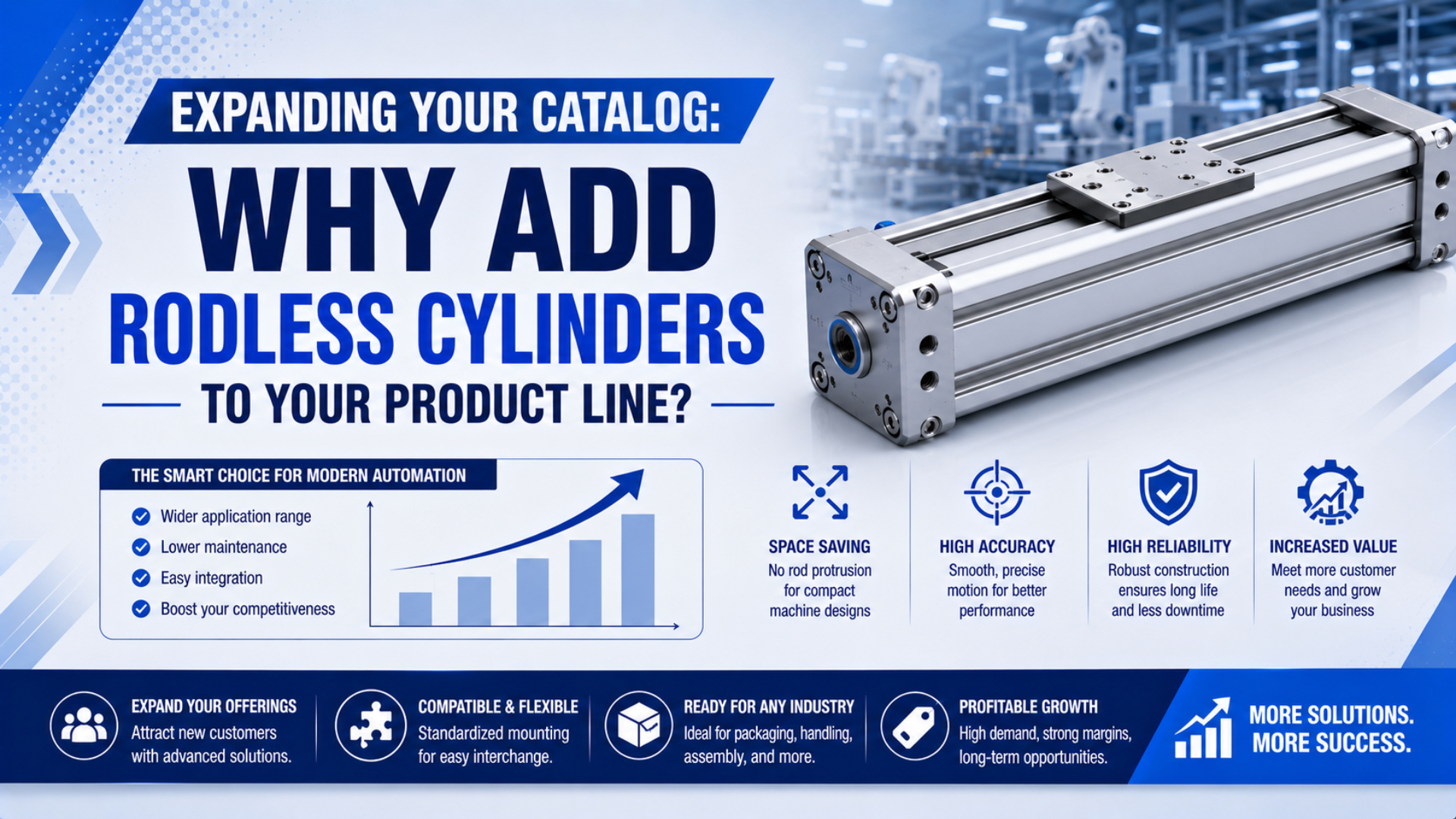
Adding rodless cylinders makes sense when customers already have long-stroke, space-constrained linear-motion problems and your team can support application selection. It doesn’t make sense merely because the products carry higher list prices. The decision should pass six gates: demand evidence, product-family coverage, technical readiness, supplier control, inventory discipline, and a measured pilot.
Industrial automation provides a credible backdrop, but not a sales forecast. The International Federation of Robotics recorded 542,000 industrial robot installations in 2024, the fourth consecutive year above 500,000 (IFR World Robotics 2025, published 2025; retrieved 2026-07-26). Your own quote history must still prove local demand for rodless motion.
Key Takeaways
- IFR counted 542,000 industrial robot installations in 2024, but that doesn’t predict local rodless-cylinder demand.
- Build the catalog around verified applications and manufacturer-defined product families.
- Start with samples, configurable supply, and a controlled pilot before committing to broad stock.
- Judge the launch by contribution, inventory productivity, returns, and support workload.
This article focuses on the portfolio decision. For actuator fundamentals, start with the rodless cylinder type guide. For the machine-level architecture choice, compare rodless and standard cylinders.
Qualified catalog demand is a recorded customer opportunity with a defined application, likely configuration, quantity basis, and decision date.
A controlled product-line pilot is a limited commercial release with approved products, named accounts, acceptance criteria, capped inventory exposure, and a scheduled review.
What Evidence Justifies Adding Rodless Cylinders to a Catalog?
IFR counted 542,000 industrial robot installations in 2024, but that single number cannot justify a distributor’s inventory purchase. Add rodless cylinders only when your own records reveal repeatable applications, qualified accounts, and quote activity that existing cylinder families cannot serve efficiently (IFR, 2025; retrieved 2026-07-26).
Start with evidence already inside the business. Search the CRM, quotation archive, service notes, and lost-order reasons for applications involving long travel, limited installed length, carriage-mounted loads, multi-axis transfer, doors, conveyors, cutting heads, or packaging equipment. A product-line case becomes stronger when several accounts describe the same constraint in their own drawings.
Count qualified opportunities, not casual interest. Each opportunity record should include the customer, application, expected annual quantity, target decision date, incumbent model, known technical requirements, and the reason the existing catalog cannot answer it. Ten incomplete inquiries may be weaker than two projects with drawings, operating conditions, and an approved trial window.
What if customers don’t use the phrase “rodless cylinder”? Search by problem. Buyers may ask for a compact long-stroke axis, a cylinder that fits inside the machine envelope, or a carriage that travels without a projecting rod. Those descriptions are more useful than keyword counts because they reveal the job the product must perform.
Use a simple demand test:
| Evidence | Strong signal | Weak signal |
|---|---|---|
| Quote history | Several application-specific requests with drawings or incumbent models | General questions without a project |
| Lost orders | Recorded losses caused by missing rodless capability | Assumed competitor advantage |
| Installed base | Identified machines, models, and replacement intervals | Anecdotal brand awareness |
| New projects | Named OEM programs with decision dates | Broad automation growth forecasts |
| Technical fit | Repeating bore, stroke, guide, and environment requirements | Unrelated one-off configurations |
The useful forecast is configuration demand, not category demand. A region may have many rodless cylinders yet offer little stock opportunity if most are custom long strokes. Conversely, a smaller installed base can support a focused range when the same bore, guide style, sensor, and port standard recur across several local machine builders.
Which Rodless Cylinder Families Must the Catalog Distinguish?
SMC’s current web catalog separates rodless cylinders into two principal groups: mechanically jointed and magnetically coupled. Its MY1 mechanically jointed range then offers five standardized guide types, showing why one generic “rodless cylinder” category is not enough for quoting or stocking (SMC, retrieved 2026-07-26).
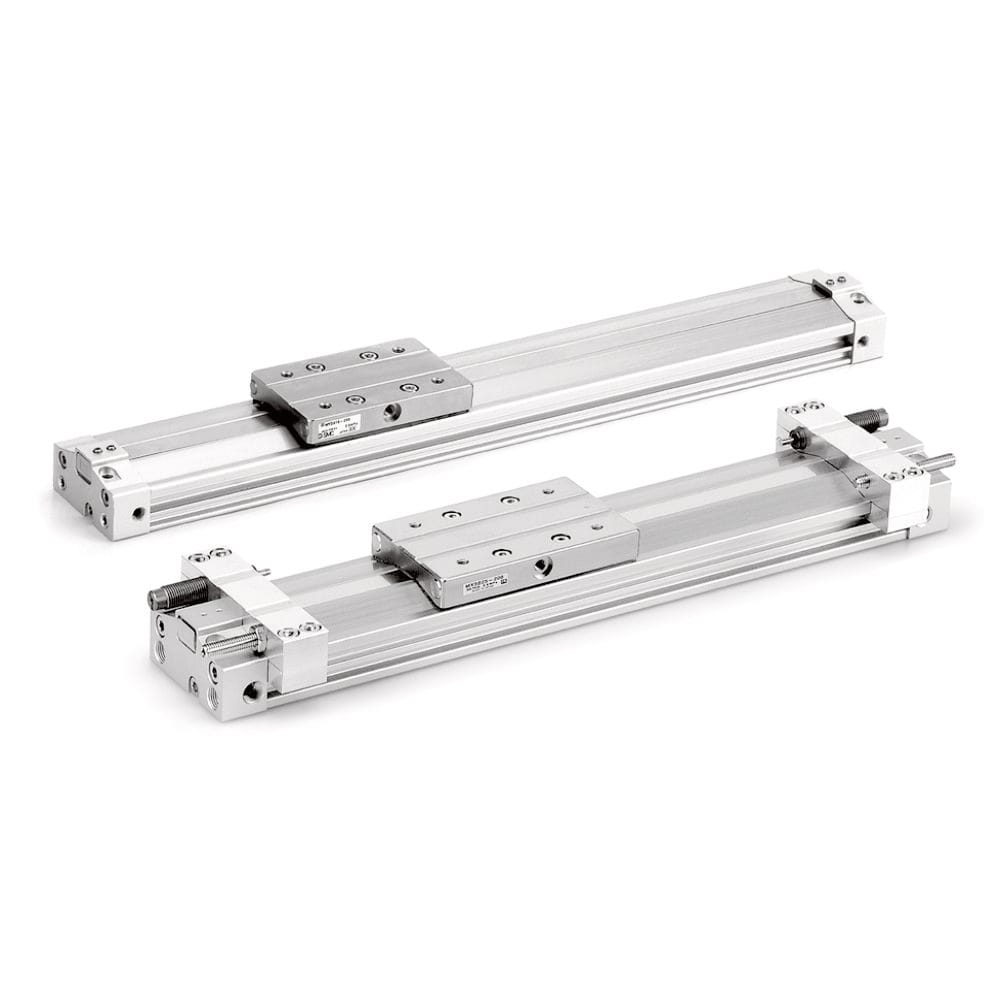
A catalog should first distinguish the drive connection:
- Magnetically coupled cylinders use magnetic force through a closed tube wall to connect the internal piston with the external carriage. They avoid a longitudinal slot, but the application must remain within the model’s coupling force, load, speed, and impact limits.
- Mechanically coupled or slotted cylinders connect the piston and carriage through a slot protected by sealing and cover bands. They can transmit force mechanically, while band condition, contamination control, and installation alignment remain important.
Then separate the load-support arrangement. A basic carriage isn’t the same as an integrated slide-bearing, cam-follower, or linear-guide version. SMC’s MY1 listing, for example, includes basic, slide-bearing, cam-follower, and linear-guide variants across different bore ranges (SMC MY1, retrieved 2026-07-26). The product data must preserve those distinctions.
The coupling technology comparison covers the engineering tradeoffs in detail. The sales catalog should translate them into filters customers can actually use:
| Catalog filter | Why it matters |
|---|---|
| Coupling type | Changes tube construction, overload behavior, sealing, and maintenance |
| Guide arrangement | Determines how the carriage handles force and pitch, yaw, and roll moments |
| Bore and stroke | Defines the available family envelope, not the final selection by itself |
| Cushion or external stop | Connects moving mass and speed to stopping capacity |
| Sensor provision | Controls switch compatibility, mounting, and cable routing |
| Port and thread standard | Affects fittings, manifolds, and regional replacement work |
| Environment options | Separates standard, cleanroom, food, corrosion, and temperature configurations |
| Service parts | Determines whether bands, seals, wipers, and shock absorbers can be supported |
Don’t promise that every rodless design saves a fixed percentage of space. The real comparison uses the installed envelope of two qualified solutions, including fittings, sensors, guide rails, cable tracks, end stops, and maintenance access. The rodless-cylinder advantages guide explains where the architecture can help without turning that benefit into a universal guarantee.
What Technical Capability Must Sales and Application Teams Have?
Parker’s standard OSP-P range lists eight bore sizes from 10 to 80 mm and standard technical specifications up to 6,000 mm stroke. That breadth is useful only when the team collects load, motion, mounting, cushioning, and environment data before selecting a configuration (Parker OSP-P, retrieved 2026-07-26).
The sales team doesn’t need to replace an application engineer. It does need to recognize when a request is incomplete and route it correctly. A useful intake form captures:
- moving mass and any external force;
- stroke, target travel time, and cycles per minute;
- mounting orientation and available installation envelope;
- payload center-of-gravity offsets from the carriage;
- external guidance, if present;
- acceleration, deceleration, end-stop, and cushioning arrangement;
- working pressure measured during motion;
- port, fitting, sensor, and cable requirements;
- dust, washdown, temperature, corrosion, food, or cleanroom conditions;
- required service access and spare-parts expectations.
Why collect center-of-gravity offsets at the inquiry stage? Because catalogue load mass alone doesn’t describe the pitch, yaw, and roll moments applied to the carriage. A load that looks light can still exceed a guide rating when it sits far from the carriage. The maximum roll-moment guide shows why force and moment data must stay together.
Create three routing levels. Level 1 covers complete cross-references where the exact manufacturer model and application are known. Level 2 covers new selections that need a documented sizing review. Level 3 covers unusual environments, safety-related motion, synchronized axes, high impact, or modified mounting, which should go to an application engineer before quotation.
Training should be competency-based, not time-based. A representative is ready when they can identify the construction family, collect the intake fields, explain why bore alone is insufficient, find the relevant catalog limits, and recognize an escalation condition. A fixed number of classroom hours doesn’t prove any of those outcomes.
Supplier Documentation and Catalog Data Control
GS1’s Global Data Model organizes product attributes in four layers: global core, global category, regional category, and country or local attributes. Pneumatic catalogs need a similar discipline so model codes, technical limits, commercial status, and regional options remain consistent across quotations, websites, and ERP records (GS1, retrieved 2026-07-26).
For every sellable configuration, require controlled product data rather than a marketing sheet. The supplier package should identify:
- complete ordering code and option logic;
- current technical datasheet and revision;
- 2D drawing and 3D CAD for the quoted configuration;
- rated pressure, temperature, speed, load, moment, and cushion limits;
- sensor, mounting, port, thread, and accessory compatibility;
- service kits and maintenance instructions;
- country of origin, packing data, and compliance documents where applicable;
- lead-time status, minimum order quantity, and configurable versus stocked status;
- warranty route, nonconformance handling, and engineering contact;
- product-change and discontinuation notification process.
Series status needs its own field. SMC’s CY3 page, for example, states that the CY3B series was discontinued at the end of May 2025 and directs users to CY3B-Z instead (SMC CY3, retrieved 2026-07-26). A copied PDF or stale web table can therefore create quotes for a superseded configuration.
ISO guidance on external providers also calls for current approved-provider information, orders placed against defined criteria, supplier performance monitoring, and verification that requirements were met (ISO 9001 Auditing Practices Group, 2016; retrieved 2026-07-26). Apply those controls to the catalog launch, even if the organization doesn’t seek certification.
Treat the catalog page as an output of the product-data system, not its master record. One controlled record should feed the ERP item, quotation template, website filters, cross-reference sheet, and spare-parts list. When each channel stores its own technical copy, revision drift becomes almost inevitable.
How Much Inventory Should You Stock at Launch?
SMC lists eight bore sizes for the current CY3B-Z magnetic basic series, before stroke, thread, sensor, and made-to-order options are considered. That configuration breadth argues against a universal starter pack. Initial stock should follow observed local demand and supplier response, not an arbitrary SKU count (SMC CY3B-Z, retrieved 2026-07-26).
Divide launch items into four buckets:
- Demonstration units: reusable samples for training, customer reviews, and fit discussions.
- Validated high-runners: configurations supported by repeated local demand and an acceptable replenishment plan.
- Configure-to-order items: technically covered in the catalog but purchased only after the customer approves a complete code.
- Nonstandard projects: special strokes, environments, guides, or accessories that require supplier confirmation before quotation.
Should every popular bore be stocked? No. Bore is only one axis of variation, and the wrong guide, stroke, port, or sensor provision can turn “available inventory” into a non-moving asset. Stock the complete configuration that repeats, not the nominal dimension that appears most often.
Set the initial quantity using lead-time exposure and demand confidence. For each candidate, record qualified annual demand, supplier lead time, order frequency, minimum order quantity, interchange risk, service criticality, and obsolescence risk. Then agree on a review date before placing the purchase order.
For imported inventory, compare offers on a delivered basis with the Pneumatic Components Landed Cost Calculator. Keep freight, duty, customs fees, broker charges, inland delivery, and import tax as separate lines. A single percentage markup can hide which assumption changed.
A good launch catalog can be wider than its launch inventory. Publish only configurations the team can technically support, but mark them accurately as stocked, configurable, or project-only. That gives buyers useful choice without pretending every combination sits on the shelf.
Pilot the Product Line Before Full Rollout
ISO guidance for external providers identifies four practical control areas: current approved-provider information, orders against defined criteria, performance monitoring, and verification of supplied requirements. A rodless-cylinder pilot should exercise all four before the distributor scales inventory or marketing (ISO and IAF, 2016; retrieved 2026-07-26).
Choose a pilot application that is representative but recoverable. It should have a real customer need, complete application data, safe access for inspection, and a fallback if the trial doesn’t pass. Avoid using the first trial on a safety-related motion, a line with extreme downtime consequence, or a custom configuration that won’t teach you about repeat demand.
Write acceptance criteria before ordering:
- exact ordered code and approved drawing revision;
- incoming dimensional and visual inspection;
- installation interface and sensor confirmation;
- no-load and loaded motion checks;
- pressure during motion, travel time, and stopping behavior;
- leakage and carriage condition after the agreed trial period;
- operator and maintenance feedback;
- supplier response to any deviation;
- final release, corrective action, or rejection decision.
The rodless cylinder mounting guide covers alignment and support details that belong in the installation review. If the pilot compares an incumbent model with another source, use the separate OEM-versus-aftermarket TCO workflow rather than declaring equivalence from bore and stroke.
Document what the pilot proves and what it doesn’t. One accepted installation can validate a specific configuration under recorded conditions. It cannot establish a universal lifetime, authorize every stroke, or prove that all customers will accept the same brand. Scale only the portion of the catalog supported by the evidence.
Measure Commercial Performance With Your Own Data
ISO 9001 describes four related performance actions: monitor, measure, analyze, and evaluate. Apply that sequence to the launch instead of comparing results with an unsupported industry margin benchmark (ISO 9001 explained, retrieved 2026-07-26). Your own accepted orders and inventory records are the relevant dataset.
Track a compact scorecard:
| Metric | What it reveals | Useful boundary |
|---|---|---|
| Qualified opportunities | Real demand entering the funnel | Count only records with application data and a decision date |
| Quote conversion | Commercial acceptance after qualification | Separate new designs from repeat orders |
| Contribution per order | Money retained after variable order costs | Use actual net revenue and attributable costs |
| Inventory turns or GMROI | Productivity of stocked capital | Compare by complete configuration |
| Return and misapplication rate | Product-data or selection weakness | Record technical root cause |
| Support hours per accepted order | Cost of application assistance | Separate launch learning from recurring workload |
| Supplier response performance | Operational reliability | Track acknowledgement, corrective action, and closure |
Contribution per qualified order can be defined as:
Here, is order contribution, is net sales revenue, is the delivered product cost, is attributable application and commissioning support, and is the order’s recognized warranty or return cost. Use the same accounting treatment for every product family.
Gross margin return on inventory investment can be tracked as:
In this relationship, is annual gross margin under the company’s accounting policy and is average inventory cost over the same period. GMROI is a commercial comparison, not an engineering approval metric.
What should trigger expansion? Add stock or configurations when qualified demand repeats, applications pass without unusual support, supplier performance is stable, and inventory productivity meets the company’s target. What should trigger a pause? Returns caused by misapplication, stale stock, unresolved documentation gaps, or support effort that consumes the expected contribution.
Keep broader promotion separate from this product-line decision. Once the pilot has defensible application evidence, the industrial distributor marketing guide can help structure local education and follow-up without turning unverified claims into sales copy.
Rodless Cylinder Catalog Expansion FAQs: What Should Distributors Ask?
Parker’s OSP-P family spans eight standard bore sizes, while SMC divides rodless products by coupling and guide arrangement. Those two facts explain why catalog expansion needs configuration control rather than one generic SKU list for every regional market (Parker; SMC; retrieved 2026-07-26).
Do rodless cylinders always produce higher margins than standard cylinders?
No universal margin advantage can be assumed. Calculate contribution from your own net selling price, landed cost, application-support time, warranty exposure, and returns. A higher unit price can still produce weak results when configurations move slowly or require repeated engineering work. Compare accepted orders over the same accounting period.
How many rodless cylinder models should a distributor stock first?
There is no defensible universal number. Stock complete configurations supported by repeat local demand, replenishment risk, and acceptable obsolescence exposure. Keep samples for demonstrations and offer technically approved long-tail configurations as configure-to-order items. Review bore, stroke, guide, ports, sensors, and environment options together before buying inventory.
What information is required before quoting a rodless cylinder?
Collect moving mass, stroke, travel time, cycle rate, orientation, working pressure during motion, payload offsets, external guidance, stopping method, sensors, ports, environment, and mounting constraints. If any guide-load, moment, cushion-energy, or magnetic-coupling limit remains unknown, route the request for engineering review before confirming the model.
Can a distributor cross-reference rodless cylinders by bore and stroke?
No. Bore and stroke establish only part of the envelope. The cross-reference must also verify mounting dimensions, carriage and guide ratings, force, moments, speed, cushioning, ports, sensors, service access, environmental options, and drawing revision. Similar photographs or mounting dimensions don’t prove functional interchangeability under the customer’s operating conditions.
When should a distributor stop or postpone the catalog launch?
Postpone when demand evidence is vague, the supplier can’t provide controlled model data, the team lacks an escalation route, or pilot acceptance criteria are incomplete. Stop expansion when misapplication returns, stale inventory, unresolved supplier deviations, or support workload exceed the business’s agreed limits. Correct the failed gate before adding more stock.
Sources and technical references
- International Federation of Robotics, World Robotics 2025. Global industrial robot installations and regional deployment context. Published 2025. Retrieved 2026-07-26. https://ifr.org/worldrobotics/report-2025
- SMC Rodless Cylinder Web Catalog. Mechanically jointed and magnetically coupled product-family classification. Retrieved 2026-07-26. https://www.smcworld.com/webcatalog/en-jp/categoryID/545
- SMC MY1 Web Catalog. Five guide arrangements and model-specific bore coverage for the mechanically jointed family. Retrieved 2026-07-26. https://www.smcworld.com/webcatalog/en-id/air-cylinders/mechanically-jointed-rodless-cylinders/MY1-E
- SMC CY3 Web Catalog. CY3B discontinuation notice and CY3B-Z replacement direction. Retrieved 2026-07-26. https://www.smcworld.com/webcatalog/api/en-au/guide/?id=CY3-E
- Parker OSP-P Series. Eight bore sizes, standard stroke limit, force, pressure, temperature, guide, cushion, and special-option data. Retrieved 2026-07-26. https://discover.parker.com/OSPPSeries
- GS1 Global Data Model. Four-layer framework for consistent foundational product attributes. Retrieved 2026-07-26. https://www.gs1.org/services/gdsn/global-data-model
- ISO 9001 Auditing Practices Group, External Providers. Supplier approval, purchasing criteria, performance monitoring, verification, and risk-based controls. Published 2016. Retrieved 2026-07-26. https://committee.iso.org/files/live/sites/tc176/files/documents/ISO%209001%20Auditing%20Practices%20Group%20docs/Auditing%20to%20ISO%209001%202015/APG-ExternalProviders2015.pdf
- ISO, ISO 9001 Explained. Process control, documented information, performance evaluation, and evidence-based improvement. Retrieved 2026-07-26. https://www.iso.org/home/insights-news/resources/iso-9001-explained.html