

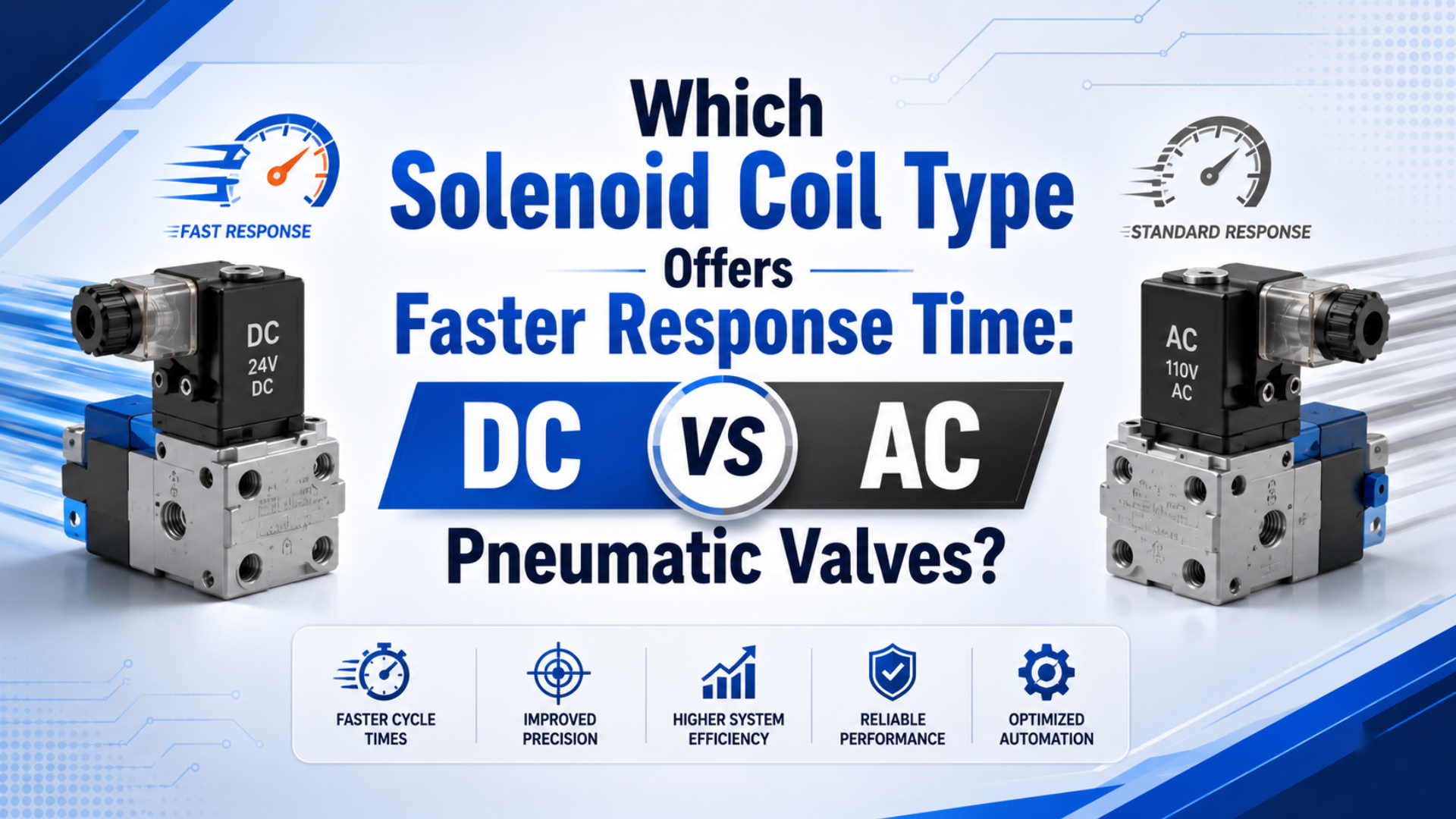
For a pneumatic valve, DC is not automatically faster than AC. AC coils can pick up hard because inrush current is high, while DC coils are steadier and easier to control with PLC outputs and peak-hold drivers. The faster choice is the coil, driver, suppression circuit, valve mechanism, and air path that reaches the sensor first.
Solenoid coil response time is the delay between an electrical command and enough magnetic force to move the armature or pilot stage. Pneumatic valve response time is broader: it includes coil pickup, valve shift, pressure build-up, exhaust flow, actuator motion, and sensor confirmation.
Key Takeaways
- AC coils can draw up to 15 times steady current at pickup, so they are not inherently slow.
- DC coils are usually steadier, quieter, and easier to tune with modern drivers.
- Measure pickup, dropout, valve shift, port pressure, and cylinder arrival before changing coil type.
In our experience, the usual mistake is timing only the electrical command. A valve LED can turn on quickly while the actuator still arrives late because the main spool, exhaust muffler, tube volume, or Cv value is limiting the pneumatic side.
For the electrical physics behind this article, keep the narrower guide on coil inductance and solenoid response time open. This article stays focused on the practical AC-versus-DC selection decision.
Which solenoid coil type is faster in real pneumatic valves?
The honest answer is application-specific: AC coils can pick up quickly because Tameson reports initial excitation current as high as 15 times steady-state current, while DC coils provide stable force and better electronic control in a measured circuit (Tameson AC/DC coil guide, 2024).
That means the old rule “DC is always faster” is too simple. It can be true in a 24 VDC PLC system with a fast driver and a good release clamp. It can be false when comparing a plain DC coil against an AC coil designed for strong pull-in.
Use this practical ranking instead:
| Question | Faster response usually comes from |
|---|---|
| Fast pickup from line power | AC coil with correct shading ring and inrush design |
| Repeatable PLC timing | DC coil with clean 24 VDC supply |
| Fast release | Suppression circuit with controlled higher clamp voltage |
| Fast actuator arrival | Correct Cv, exhaust path, tube ID, and pressure |
| Low noise | DC coil or rectified coil design |
The coil label only tells part of the story. For a production machine, specify the event you need: command to pickup, command to dropout, command to pressure rise, or command to sensor arrival. Those are different measurements.
Why can AC coils pick up fast despite alternating current?
AC coils are not weak by definition; their pickup can be aggressive because the current is high before the armature closes. Tameson gives a possible current spike up to 15 times steady-state excitation current, then lower current after the magnetic path closes (Tameson AC/DC coil guide, 2024).
The reason is impedance. When the plunger is open, the magnetic circuit has a larger air gap and the coil draws more current. Once the armature seats, inductance rises and current drops. That built-in inrush helps an AC solenoid overcome spring force, friction, and pressure-related load during pickup.
AC also needs protection against vibration. Tameson notes that AC solenoid valves use shading rings to keep magnetic force from falling to zero near the waveform crossing. If the shading ring is damaged or contaminated, the coil may buzz, heat, and lose repeatability.
For older machines with 110 VAC or 220 VAC control power already in place, AC may be the cleaner replacement. For new PLC panels, a pneumatic solenoid valve with 24 VDC coil is usually easier to wire, monitor, and protect.
When does DC beat AC for repeatable response?
DC wins when repeatability, quiet operation, and controlled current matter more than raw line-powered pull-in. Texas Instruments lists a 50 us typical DRV110 start-up delay at 20 kHz and describes fast current ramp followed by lower hold current (Texas Instruments DRV110 datasheet, 2018).
That driver behavior is important. A plain DC coil is limited by resistance, inductance, available voltage, cable drop, and temperature. A controlled driver can raise pickup current quickly, hold the valve at lower current, reduce heat, and make timing less dependent on coil warming.
DC also simplifies modern machine control. Many PLC output cards are 24 VDC, so a DC coil avoids an interposing relay needed only to switch AC. Fewer interface parts can reduce timing scatter and make diagnostics clearer.
We usually choose DC when the machine needs event data: PLC output on, coil current rising, pressure switch triggered, cylinder sensor arrived. That sequence is easier to log when the coil is on the same DC control layer as the rest of the machine.
DC is not automatically better for release. A simple flyback diode protects the output but can slow dropout because coil current decays gently. If release timing matters, specify the suppression method and check the PLC output rating before changing the clamp voltage.
How much response time comes from the valve body?
Valve construction can dominate coil type before voltage selection matters. ATO states that direct-acting solenoid valves start faster than pilot-operated designs, while pilot-operated valves may need at least 0.05 MPa differential pressure and can offer larger flow capacity (ATO direct vs pilot guide, 2024).
This is where many AC/DC comparisons go wrong. A small direct-acting DC valve can beat a large pilot-operated AC valve on pickup. A properly sized pilot-operated AC valve can move the actuator faster than an undersized direct DC valve because the main flow path has more Cv.
ATO gives a practical flow contrast: pilot-operated valves can reach Cv 3 or above, while direct-operated valves are usually below Cv 1. Treat those numbers as examples from one guide, not universal catalog limits, but the engineering point is solid: response includes flow capacity.
For broader valve sizing, connect this article to pneumatic solenoid valve operation, pilot-operated valve behavior, and Cv sizing for pneumatic valves.
How should you measure pickup, dropout, and stroke delay?
Measure the event in stages because an RL coil reaches about 63% of a current or voltage transition after one time constant, while SMC ties cylinder speed to airflow using s = 28.8q / A for actuator motion and timing review (RL circuit reference, 2026; SMC cylinder airflow guide, 2026).
Start with a simple timing budget. If you do not split the event, a slow exhaust muffler can look like a slow coil, and a weak pilot supply can look like a bad PLC output.
| Timing point | What to measure | What it proves |
|---|---|---|
| PLC output on | output timestamp or scope trace | command delay |
| Coil energized | voltage and current at the connector | supply and driver behavior |
| Valve shifts | click, pressure switch, or spool sensor | electromechanical delay |
| Port pressure rises | pressure sensor at A or B port | flow path and pilot behavior |
| Actuator arrives | reed switch or external sensor | complete machine response |
If the cylinder is late, check tube length, fitting bore, flow controls, mufflers, regulator recovery, manifold supply, and valve Cv before changing coil voltage. For the air-side method, see air flow to pressure conversion.
Selection matrix: DC or AC for common pneumatic applications
Use the coil that fits the control architecture and timing target, not a generic speed slogan. Tameson says AC coils can suit rapid actuation and available AC supply, while DC coils fit steady force, quiet operation, and DC or battery power (Tameson AC/DC coil guide, 2024).
| Application condition | Better starting point | Why |
|---|---|---|
| New PLC machine with 24 VDC outputs | DC coil | simpler wiring and cleaner diagnostics |
| Existing line-powered panel | AC coil | avoids extra DC power conversion |
| High-speed pickup with AC control already present | AC coil | inrush can support strong pull-in |
| Fast release target | DC with specified clamp, or AC tested on machine | dropout depends on suppression and mechanics |
| Quiet laboratory or medical fixture | DC coil | no AC buzz when correctly powered |
| Battery or solar control | DC coil | matches low-voltage supply |
| Valve manifold with fieldbus | DC coil | common industrial control architecture |
| Large flow with pressure available | pilot-operated valve, either AC or DC | valve mechanism and Cv matter more than voltage |
The most reliable answer is still the catalog response time for the exact valve series. If the catalog does not separate pickup and dropout, ask for both. If the response requirement is tied to a cylinder sensor, ask for the full pneumatic test condition.
RFQ checklist for fast-response AC or DC solenoid valves
A useful RFQ must define the measured event, not only the coil voltage. Tameson lists solenoids as AC or DC types, TI supports 120/230 VAC and 6-48 VDC solenoid-driver use, and SMC shows actuator speed depends on flow and piston area (Tameson, 2024; Texas Instruments, 2018; SMC, 2026).
Send these details before replacing a time-critical valve:
- Required event: pickup, dropout, pressure rise, full stroke, or sensor arrival.
- Coil voltage and power type: 24 VDC, 110 VAC, 220 VAC, rectified AC, or fieldbus manifold.
- Supply tolerance and measured voltage at the coil during actuation.
- Suppression method: diode, MOV, TVS, zener clamp, or built-in connector circuit.
- Valve function: 2/2, 3/2, 5/2, 5/3, direct-acting, pilot-operated, spring return, or double solenoid.
- Operating pressure, minimum pilot pressure, tube ID, tube length, muffler type, and flow controls.
- Actuator bore, stroke, load, target stroke time, and sensor location.
- Environment: heat, washdown, dust, vibration, duty cycle, and noise limit.
The best phrase is not “send me your fastest DC coil.” Use this: “The valve must energize, shift, build pressure at port A, and reach the cylinder sensor within X ms at Y bar.” That forces the supplier to review the whole response chain.
For control architecture context, also review 4-way directional valve control systems.
FAQs about DC and AC pneumatic valve response time
The FAQ answers below keep the AC/DC decision practical and source-linked. They use the same 15x AC inrush point from Tameson, 50 us driver start-up from TI, 0.05 MPa pilot-pressure threshold from ATO, and 63% L/R timing rule from the RL circuit reference, 2026.
Is DC always faster than AC for pneumatic solenoid valves?
No. AC can pick up quickly because the initial current can be much higher than steady-state current. DC can be more repeatable, especially with a peak-hold driver. Compare the exact valve’s pickup and dropout times, then test port pressure and actuator arrival on the machine.
Why do some AC coils feel faster at pickup?
AC coils can draw a large inrush before the armature closes. Tameson gives a possible spike up to 15 times steady-state excitation current. That helps pull the armature across the air gap, but it also means the coil design, shading ring, voltage, and heat limits matter.
Why can a DC valve release slowly?
The usual cause is suppression. A basic flyback diode gives coil current an easy decay path, which protects electronics but can extend dropout. If release time is critical, use the valve maker’s approved connector, TVS, zener clamp, or driver circuit and verify the PLC output voltage rating.
Does valve type matter more than coil type?
Often yes. Direct-acting valves start the main valve directly, while pilot-operated valves use a small pilot stage before the main flow path shifts. ATO lists a 0.05 MPa minimum pressure condition for pilot-operated designs, so poor pilot pressure can dominate the AC/DC choice.
What should I time on a high-speed machine?
Time at least 5 points: PLC output, voltage at the coil, coil current if available, pressure at the actuator port, and cylinder sensor arrival. The coil can be fine while the tube, muffler, regulator, or valve Cv adds most of the delay.
Sources and retrieval notes
The source list below supports coil-response, valve-response, and pneumatic-delay claims. Retrieval date is 2026-07-08 for all web sources below; avoid unsupported case-study percentages when comparing AC and DC coils.
-
Tameson: Solenoid Coil - Choosing AC or DC, AC/DC coil behavior, AC inrush, shading-ring discussion, and selection guidance. Retrieved 2026-07-08.
-
Tameson: Solenoid Valve Types, direct, indirect, and semi-direct solenoid valve operation. Retrieved 2026-07-08.
-
Texas Instruments: DRV110 120- and 230-V AC, 6- to 48-V DC Current Controller for Solenoids, Relays, and Valves, fast current ramp, peak-hold control, and 50 us start-up delay. Retrieved 2026-07-08.
-
SMC: Control Air Flow of Cylinders, cylinder speed formula and port/tubing caveats. Retrieved 2026-07-08.
-
ATO: Direct Acting vs. Pilot Operated Solenoid Valve, direct versus pilot start-up behavior, 0.05 MPa pilot threshold, and Cv comparison. Retrieved 2026-07-08.
-
RL circuit reference, L/R time constant and 63% transition behavior. Retrieved 2026-07-08.
-
AutomationDirect: Understanding Pneumatic Valve Ports and Ways, video background for valve port and way naming. Retrieved 2026-07-08.