

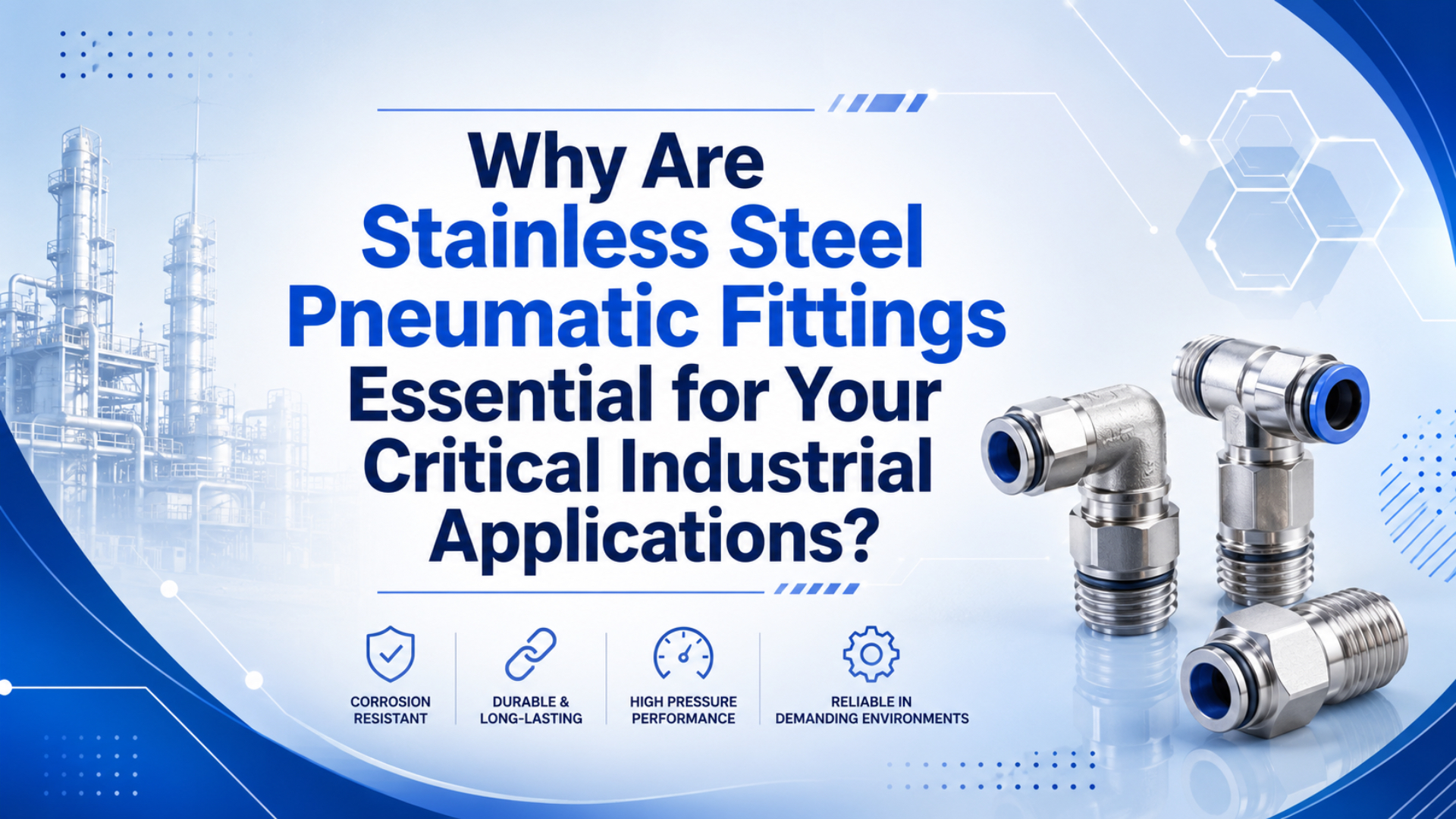
Stainless steel pneumatic fittings are essential when a leak, corroded thread, released tube, or contaminated surface would create unacceptable production, safety, or hygiene risk. They are especially useful around aggressive washdown, chloride exposure, heat, chemicals, and clean manufacturing. Stainless steel alone, however, does not make a connection suitable. The body grade, collet, seal, tube, thread, pressure rating, temperature limit, surface condition, and documentation must work as one assembly. That distinction matters because two fittings sold as “316 stainless” may have different collet alloys, seal compounds, pressure limits, and food-zone restrictions. Reliable selection starts with the actual environment and exact product-family datasheet, not a universal lifespan claim.
Key Takeaways
- Specify the complete connection, not only a “stainless body.” The collet, O-ring, tube, thread, and sealant can become the limiting parts.
- Use 304 or 316L as an environment decision. Molybdenum-bearing 316L is often preferred for chloride exposure, but it is not immune to pitting or crevice corrosion.
- Verify pressure and temperature from one exact fitting series. Parker and SMC stainless families publish materially different limits and installation instructions.
- Treat food, pharmaceutical, marine, and chemical duties as separate evidence packages. Stainless chemistry does not establish hygienic design or fluid compatibility.
- Match push-in fittings to the permitted tube material, outside diameter, hardness, tolerance, temperature, and motion. ISO 14743 covers complete assemblies with thermoplastic tube from 3 to 16 mm outside diameter.
- Use the manufacturer’s thread torque and sealant instructions. Generic stainless torque tables can damage threads or leave an unreliable seal.
- Isolate stored pneumatic energy before service, then inspect tube, seals, supports, and mixed-metal joints.
When Are Stainless Steel Pneumatic Fittings Actually Essential?
Parker rates its LF3800/LF3900 stainless push-in family up to 30 bar for most configurations and from -20°C to 150°C, but those numbers belong to that product family, not to all stainless fittings. Stainless becomes essential when the application risk justifies a documented, corrosion-resistant connection and every component remains compatible with the service.
Good candidates include washdown zones, coastal machinery, hot process skids, chemical equipment, clean manufacturing, and lines where a released tube would have serious consequences. Inside a dry cabinet carrying clean air, nickel-plated brass or engineered polymer may be adequate. Make the upgrade when one or more of these conditions apply:
| Selection condition | Why stainless may be justified | Evidence to request |
|---|---|---|
| Washdown or chemical exposure | Plating damage, seal attack, and crevices become credible | Chemistry, concentration, temperature, time, rinse practice |
| Coastal or marine atmosphere | Chlorides collect at threads and crevices | Grade, component materials, drainage, mixed-metal joints |
| Heat or clean manufacturing | Tube, seal, lubricant, and surface condition may limit use | Peak temperature, cleanability, lubricant, declaration package |
| High consequence of leakage | A released tube can create unsafe motion or major downtime | Proof test, leak test, traceability, maintenance requirements |
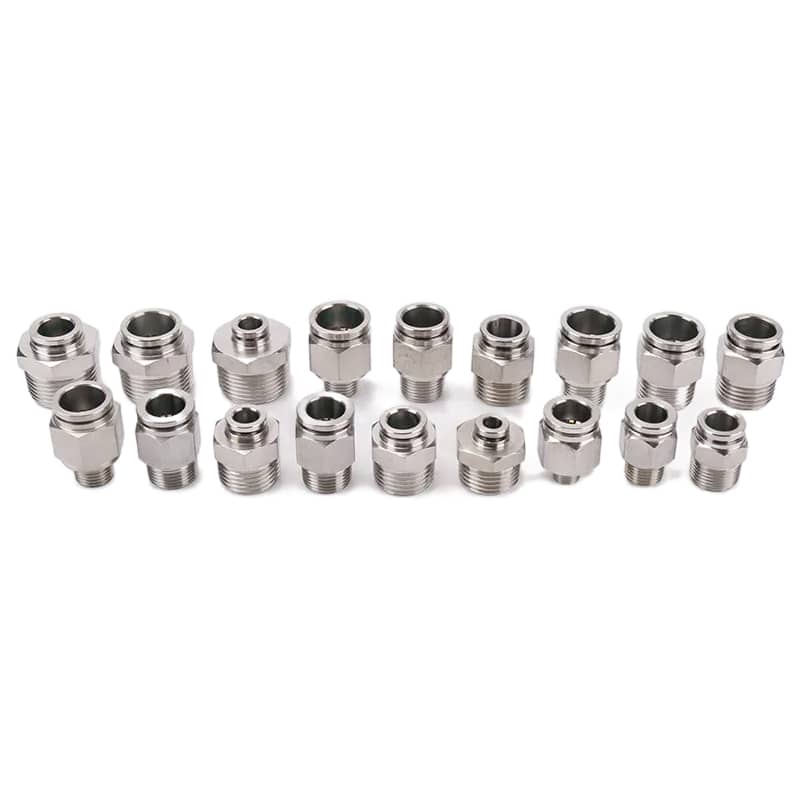
Do not justify stainless with a promised “3 to 10 times longer life.” Service life changes with chemistry, chloride deposits, temperature, tube movement, cleaning frequency, thread installation, and maintenance. A defensible specification states the exposure and acceptance evidence. It does not convert a material label into a lifespan guarantee.
The Complete Fitting Assembly Controls Suitability
Parker’s published LF3800 and LF3900 families both use 316L bodies and FKM seals, yet the LF3800 lists a 303 stainless collet while the LF3900 lists a 316L collet. That one comparison shows why “316L fitting” can be incomplete language: the retained tube depends on more than the body material.
Fitting body means the pressure-retaining metal housing and threaded or union geometry. Collet means the gripping component that holds the tube in a push-in connector. Seal means the elastomeric element, commonly an O-ring, that prevents leakage around the tube or thread interface. Complete connector assembly means the fitting installed with the approved tube and all retention, sealing, and support components.
Our team analyzed the Parker and SMC documents side by side. For example, we found that a complete audit needs five layers:
- Body and thread: Confirm grade, thread form, surface finish, and pre-applied sealant.
- Collet: Confirm the alloy and reconnection rules. A pristine body cannot compensate for lost tube retention.
- Seal and lubricant: Identify compound, temperature, media compatibility, and required declarations.
- Tube: Verify material, outside diameter, tolerance, pressure-temperature derating, and chemistry.
- Support: Keep vibration and branch loads away from the connector.
This prevents a premium body from hiding a weak tube or unknown elastomer. Ask each supplier to identify every wetted, exposed, and tube-retaining material in the exact catalog number offered.
How Do 304 and 316L Differ in Fitting Selection?
Outokumpu lists about 2.1% molybdenum for its Prodec 316L chemistry and no molybdenum in its Prodec 304L chemistry. That compositional difference is one reason 316L is commonly selected over 304 for chloride-bearing environments, but grade alone does not establish chemical compatibility, pressure capacity, or hygienic suitability.
| Decision factor | 304/304L starting position | 316/316L starting position | Required check |
|---|---|---|---|
| Dry indoor air | Often adequate without chemicals or chlorides | Usually optional | Exact series rating and installed cost |
| Marine or chloride washdown | Usually not the default | Better starting point, not immunity | Chlorides, wet/dry cycling, crevices |
| Chemical service | Suitable for selected fluids | Suitable for selected fluids | Compatibility at actual concentration and temperature |
| High pressure or hygienic area | Grade alone is insufficient | Grade alone is insufficient | Geometry, tests, surface, seals, documentation |
Low-carbon “L” grades help control sensitization risk after welding, but many small fittings are machined. Ask what the designation contributes to the actual component. From our analysis, 316L also does not automatically provide higher working pressure. Geometry, size, seal, tube, test method, and temperature control the rating.
For exposed actuator hardware around the same circuit, use the separate marine corrosion-resistant cylinder guide. That article addresses rods, coatings, brackets, and cylinder construction; this guide stays at the fitting-to-tube and fitting-to-port interfaces.
Which Critical Applications Need the Most Evidence?
3-A’s hygienic-design primer states that product-contact surfaces generally need a finish of 32 microinch, or 0.8 µm Ra, or smoother, along with freedom from pits, folds, and crevices. A standard pneumatic fitting outside the product zone does not automatically need that finish, while stainless composition alone does not prove hygienic design.
Food and beverage washdown
First determine the zone. A fitting outside product contact may mainly need washdown resistance. A connection in or above the product zone may face added cleanability, lubricant, drainage, and documentation requirements.
The US equipment rule at 21 CFR 117.40 addresses cleanability and construction. It does not declare every stainless fitting “FDA approved.” Also, 21 CFR 177.2600 concerns rubber articles for repeated food contact, not the stainless body. Map each declaration to the component it covers.
For surrounding actuator choices, see the stainless steel cylinder washdown guide.
Pharmaceutical and clean manufacturing
Clean manufacturing controls particles, residues, lubricants, dead spaces, and cleaning agents. ISO 13485 is a medical-device quality-management standard, not a fitting material certificate. USP Class VI, when relevant, concerns polymeric or elastomeric materials rather than proving the whole connection suitable.
Request the bill of materials, cleaning and packaging condition, lubricant statement, seal data, traceability, and change control. The facility quality team should approve the evidence against process risk.
Marine and outdoor machinery
Chlorides collect at threads and mixed-metal joints. NASA explains that galvanic corrosion needs dissimilar metals, an electrolyte, and a conductive path. Break one condition through compatible materials, isolation sleeves or washers, drainage, or joint design.
Stainless remains passive only under suitable conditions. It can still pit, suffer crevice corrosion, or accelerate corrosion of a less noble adjacent metal. Inspect aluminum valve bodies, zinc-plated brackets, and carbon-steel panels around the stainless fitting rather than evaluating the connector in isolation.
Chemical and process equipment
Never approve a broad “resists acids and alkalis” claim. SMC makes concentration and temperature part of KQG2 compatibility and says its table is not a guarantee. Obtain approval for the named fluid, concentration, temperature, pressure, and exposure duration.
The body can pass while the FKM seal swells, the tube embrittles, or the thread sealant dissolves. Record all four compatibility decisions separately: body, gripping component, seal, and tube.
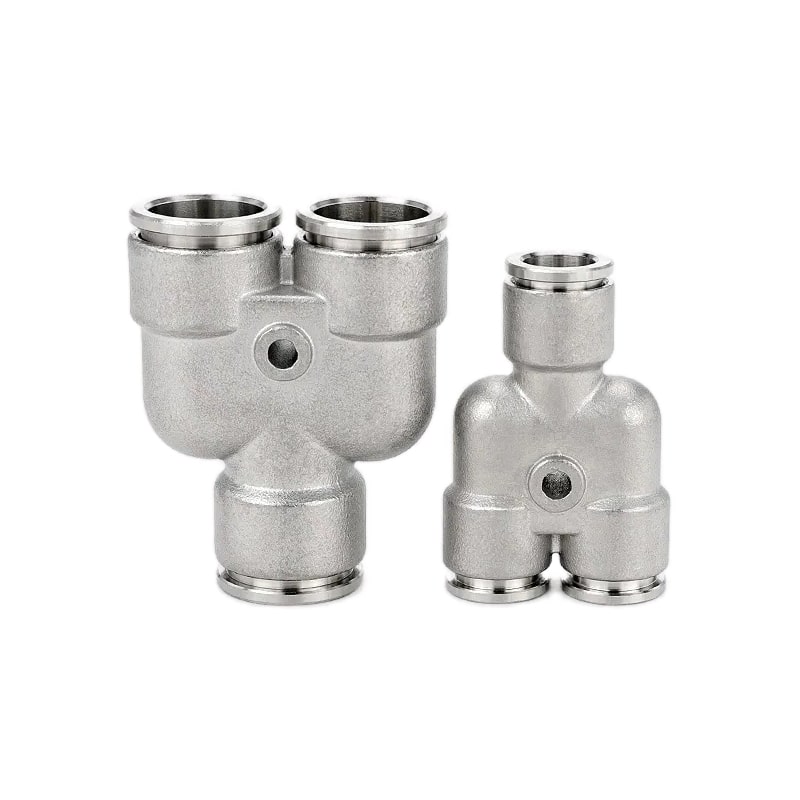
How Should Push-In Fittings Be Matched to Tubing?
ISO 14743:2020 covers general requirements and test methods for complete push-in connector assemblies used with thermoplastic tube from 3 to 16 mm outside diameter. The standard’s assembly scope is the practical lesson: matching the fitting to a nominal tube size is necessary, but tube material, tolerance, temperature, pressure, and motion still matter.
SMC lists FEP, PFA, nylon, soft nylon, polyurethane, and polyolefin tubing for its KQG2 family, subject to product-specific conditions. Parker likewise requires consideration of fitting and tubing materials. A 6 mm tube and a 1/4-inch tube are not interchangeable simply because either enters the port. At high temperature or after long service, dimensions can change. SMC warns that outside diameter may enlarge and advises against reuse in that condition. Replace or cut back tube that is scratched, swollen, hardened, or oval.
Use this installation sequence:
- Confirm tube material and exact outside diameter. Similar-looking metric and inch sizes are not substitutes.
- Cut square and remove dirt, ovality, or deep scratches from the inserted section.
- Insert to the published depth and apply the specified pull check.
- Keep the tube aligned and support tees, Y-unions, long drops, or vibrating branches.
- Test within the lowest rating of every circuit component.
A pressure-drop calculator is not embedded here because it would answer a neighboring question, not the article’s central selection decision. If line loss is the actual problem, use the pneumatic pressure-drop troubleshooting guide after confirming that fittings and tube sizes match the required flow.
Threads, Sealants, Galling, and Galvanic Corrosion
SMC publishes KQG2 thread torques from 3 to 5 N·m for 1/8-inch connections up to 20 to 25 N·m for 1/2-inch connections, plus series-specific tightening guidance. Those values demonstrate why installers should use the exact instructions rather than a universal torque multiplier. Thread form also changes the seal. Tapered threads may use controlled interference and approved sealant; parallel threads often use an O-ring, bonded washer, or face seal. Identify NPT, BSPT/R, BSPP/G, or metric geometry before choosing sealant or torque. Stainless threads can gall under friction, contamination, or repeated assembly. Use clean, aligned threads, slow assembly, permitted lubricant or sealant, suitable material pairs, and the manufacturer’s torque. Stop if the joint binds; more force is not a repair.
Pre-applied sealant is also configuration-specific. Parker notes that some thread-sealant configurations do not meet the cited food-compliance condition. If a declaration matters, confirm the full catalog suffix, not just the metal body and nominal port size.
For mixed-metal joints, use NASA’s three-condition model. A stainless fitting screwed into an aluminum valve body in a wet chloride area creates dissimilar metals, electrolyte, and a conductive path. Drain the joint, isolate where practical, select closer materials, protect the less noble metal, and include the joint in inspections.
How Should Fittings Be Installed and Maintained Safely?
OSHA 29 CFR 1910.147 includes pneumatic energy within hazardous-energy control and requires stored or residual energy to be relieved, disconnected, restrained, or otherwise rendered safe during covered servicing. Closing the air valve is not enough when downstream pressure, moving loads, or trapped actuator volumes remain energized. Before service, follow the site’s energy-control procedure, isolate the supply, exhaust pressure, secure gravity or spring loads, and verify zero energy. Never pull a tube from a pressurized fitting. Also control air quality: water, oil aerosols, and particles can attack valves, seals, and downstream surfaces even when the external connection is stainless. The ISO compressed-air quality guide explains how particle, water, and oil classes should be specified for the process.
Maintain by condition and consequence rather than copying an arbitrary monthly table:
| Inspection trigger | Check | Corrective action |
|---|---|---|
| After washdown or chemistry change | Seal attack, residue, trapped liquid | Rinse as approved and revalidate compatibility |
| During line inspection | Tube scratches, swelling, ovality | Replace or cut back and leak-test |
| After vibration or modification | Side load, unsupported branches, loose threads | Support, align, and reinstall to instructions |
| When leakage increases | Tube, O-ring, collet, thread seal | Isolate the failed interface before corrective work |
What Should an RFQ and Acceptance Plan Include?
ISO 14743 defines testing for complete push-in assemblies, while Parker and SMC publish family-specific pressure, temperature, tube, and tightening data. An effective RFQ identifies the duty and asks for evidence at the catalog-number level. “316 stainless fitting, same as sample” leaves too many interfaces undefined. At receipt, verify catalog number, documents, dimensions, thread, seal option, and condition. During installation, record the approved tube, insertion check, tightening method, supports, and leak test. For critical circuits, the responsible engineer should define acceptance pressure and hold time. This record connects the exposure to the exact assembly and gives maintenance a known replacement. For supplier background, see About Bepto Pneumatic; for an application review, use the contact page.
Send the following information:
- Geometry, tube material and diameter, port thread, mating material, and permitted sealant.
- Minimum, normal, and maximum pressure, including vacuum or proof-test requirements.
- Continuous and peak media, ambient, washdown, sterilization, and tube temperatures.
- Fluid identity, concentration, cleaning chemistry, exposure time, and contamination consequence.
- Body, collet, seal, lubricant, and other material or declaration requirements.
- Chloride, weather, vibration, impact, and repeated-disconnection exposure.
- Drawings, declarations, test reports, traceability, certificates, and change notification.
FAQs About Stainless Steel Pneumatic Fittings
ISO 14743 covers complete push-in assemblies with thermoplastic tube outside diameters from 3 to 16 mm, but many purchasing questions occur before testing begins. These answers separate material claims from assembly evidence so engineers can shortlist fittings without treating stainless steel as automatic approval for every critical environment.
Are 316L stainless steel pneumatic fittings always better than 304 fittings?
No. 316L is generally the stronger starting choice for chloride-bearing or aggressive washdown environments because it contains molybdenum, while 304 may be adequate in dry indoor service. Neither grade automatically determines pressure, seal compatibility, cleanability, or lifespan. Compare the exact product series and actual exposure.
Can stainless pneumatic fittings be used in food production?
They can be used when the installation zone, cleanability, chemical exposure, seal, lubricant, surface condition, and documentation are acceptable. Stainless material alone is not an FDA or 3-A approval. Determine whether the fitting is outside the product zone, in a splash area, or on a product-contact boundary before setting requirements.
What temperature can a stainless steel push-in fitting handle?
There is no universal range. Parker publishes -20°C to 150°C for its LF3800/LF3900 family, while SMC publishes -5°C to 150°C for KQG2 under stated conditions. The usable assembly range may be narrower because of tube material, pressure derating, fluid compatibility, seal choice, or ambient heat.
Are stainless fittings suitable for every acid and alkali?
No. Compatibility depends on the named chemical, concentration, temperature, pressure, exposure duration, contaminants, and each component material. Check the body, collet, seal, tube, and sealant separately. A manufacturer compatibility table is a screening aid, not a guarantee for an unspecified process mixture.
Should stainless threaded fittings receive more torque than brass fittings?
Not by a generic percentage. Use the manufacturer’s instructions for the exact thread form, port size, sealing method, and fitting family. Excess torque can damage a fitting or mating component, while insufficient engagement can leak. Stainless galling risk makes clean alignment and controlled installation especially important.
How do I know whether a push-in tube connection is reliable?
Verify that the tube material and outside diameter are approved, cut the tube square, insert it fully, support side loads, and test the completed circuit within its lowest component rating. Inspect removed tube for scratches, swelling, hardening, or ovality, and never disconnect it while pneumatic energy remains stored.
Sources and Retrieval Notes
- ISO 14743:2020, Pneumatic fluid power, push-in connectors for thermoplastic tubes, accessed 2026-07-14. Used for the complete-assembly scope and 3 to 16 mm tube outside-diameter range.
- Parker LF3800/LF3900 stainless steel push-in fittings datasheet, accessed 2026-07-14. Used for component materials, ratings, torque, and compatibility framing.
- SMC KQG2 one-touch fittings, stainless steel 316, accessed 2026-07-14. Used for tubing, pressure, temperature, compatibility, installation, and maintenance limits.
- Outokumpu Prodec stainless steel grades, accessed 2026-07-14. Used for representative 304L and 316L chemistry.
- NASA Kennedy Space Center, Forms of Corrosion, accessed 2026-07-14. Used for galvanic-corrosion conditions and isolation controls.
- 3-A Sanitary Standards, A Primer for 3-A Standards Practices, accessed 2026-07-14. Used for hygienic surface-finish and cleanability context.
- 21 CFR 117.40, Equipment and utensils, accessed 2026-07-14. Used for US food-equipment construction and cleanability context.
- OSHA 29 CFR 1910.147, Control of hazardous energy, accessed 2026-07-14. Used for pneumatic stored-energy safety during servicing.