

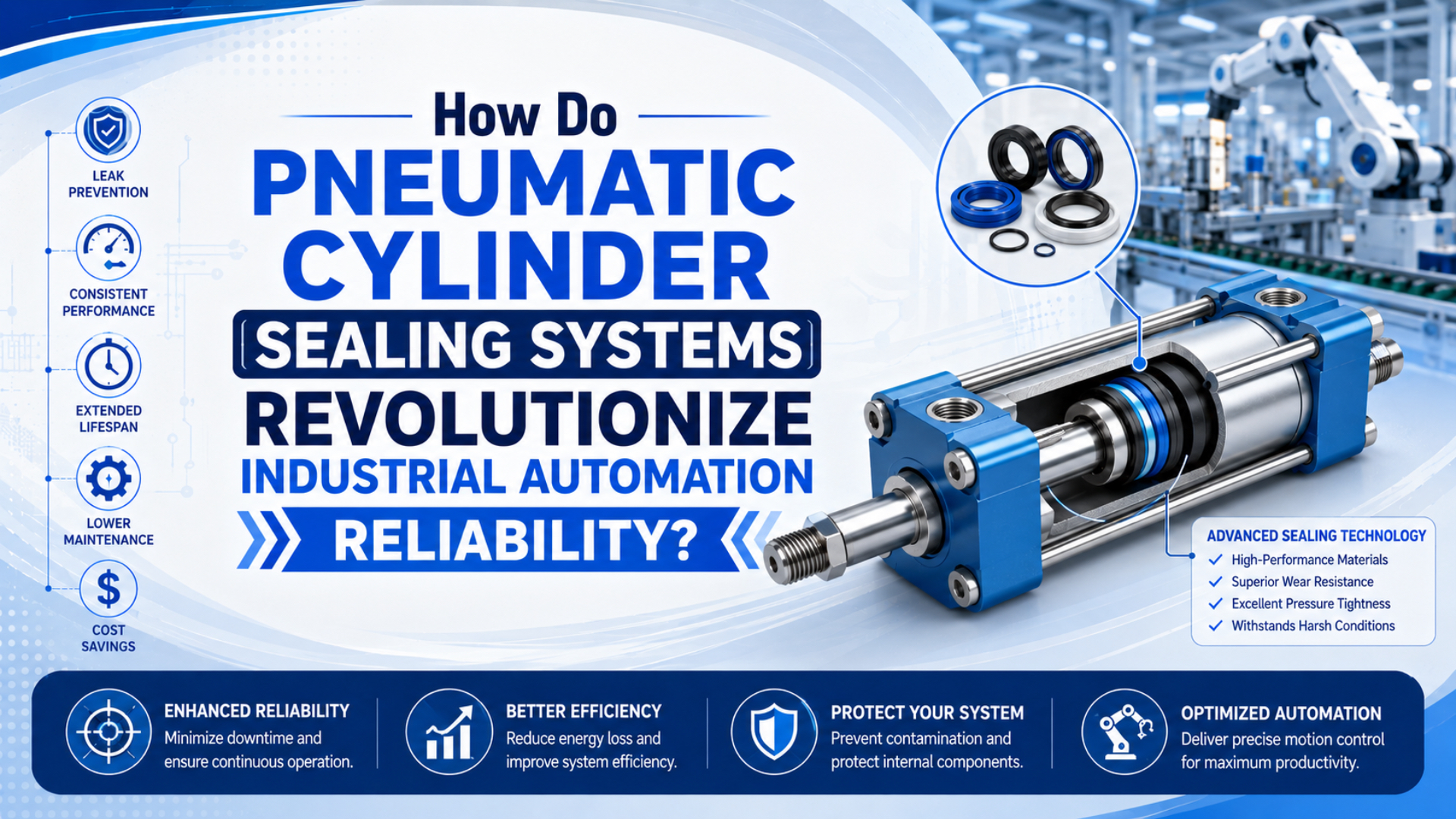
Pneumatic cylinder sealing systems improve industrial automation reliability by keeping pressure differential stable, blocking contamination, protecting the moving rod and bore, and giving maintenance teams measurable warning before force, speed, or repeatability drift. CAGI reports that about 80% of compressed-air leaks are not audible, so reliable sealing has to be checked, not assumed (CAGI, 2026).
The practical change is simple. Stop treating seals as cheap wear parts ordered after a breakdown. Treat the seal set as a pressure-control, contamination-control, and maintenance-data system. Then a leaking cylinder becomes a diagnosable reliability problem instead of a recurring surprise.
Key Takeaways
- CAGI gives a 1/4-inch, 100 psi air-leak example at 104 cfm and about 25 hp, so cylinder leakage can become a real energy and uptime issue.
- ISO 8573-1 defines compressed-air purity by particles, water, and oil; those three contaminants are also common seal-failure accelerators.
- Rebuild decisions should compare the rod, bore, gland, guides, air quality, pressure stability, and leak test result, not the seal material alone.
What Reliability Problem Does a Pneumatic Cylinder Sealing System Solve?
A pneumatic cylinder sealing system solves leakage, contamination, friction, and chamber-bypass problems before they become unstable motion. CAGI says a 1/4-inch air leak at 100 psi can waste 104 cfm and consume about 25 hp, which explains why even “small” sealing faults deserve measured attention (CAGI, 2026).
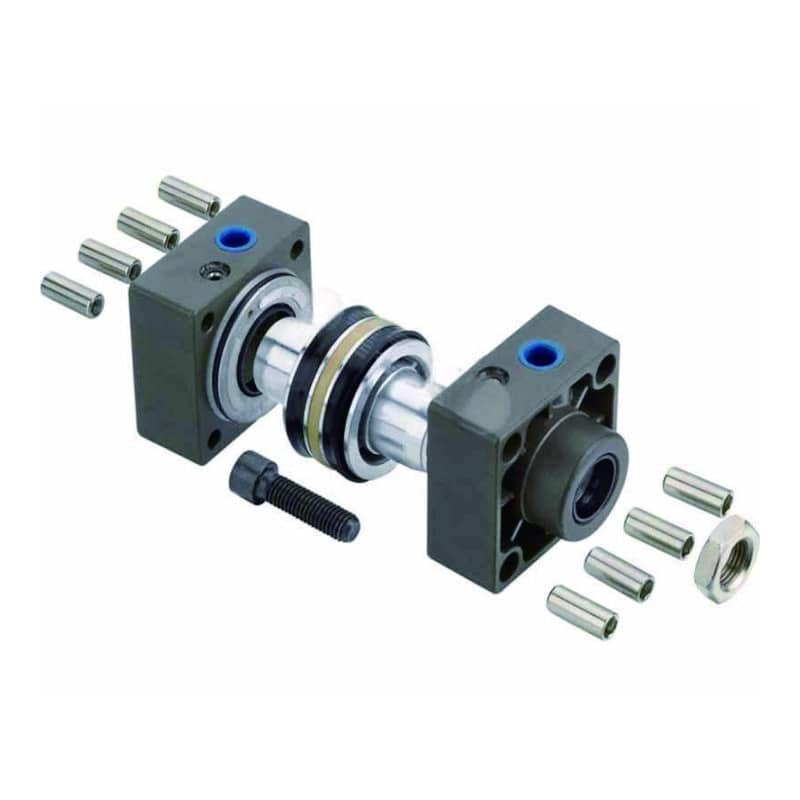
The seal set is not one part. It is a group of pressure seals, exclusion seals, static seals, and guide elements that protect the force path from the valve to the load. If one part fails, the symptom may appear somewhere else.
For example, a worn wiper may not leak pressure by itself. However, it can let dust, washdown water, or cutting debris reach the rod seal. The rod seal then wears, the cylinder starts hissing, and the maintenance note says “rod seal failed.” The first fault was upstream.
Pneumatic cylinder sealing system means the combined rod seal, piston seal, wiper, end-cap seal, cushion seal, static O-rings, guides, lubricant film, rod surface, tube surface, and installation fit that keep compressed air where it belongs during each stroke.
The most useful reliability split is internal leakage versus external leakage. Internal leakage steals pressure differential between chambers. External leakage wastes compressed air to atmosphere. Contamination leakage moves the other way, from the environment into the cylinder. Each path needs a different test.
| Reliability job | Seal-system part involved | What changes on the machine | First evidence to collect |
|---|---|---|---|
| Hold pressure in the working chamber | Piston seal, rod seal, static seals | Weak thrust, drift, unstable clamp force | Port pressure during hold and motion |
| Keep air from escaping outside | Rod seal, end-cap seal, port seal | Hissing, rising air demand, oil film on lubricated units | Ultrasonic leak check or soap test where allowed |
| Keep contamination out | Wiper, scraper, rod finish, breather path | New rod seal fails soon after rebuild | Rod surface photo and contamination type |
| Keep motion aligned | Wear ring, guide ring, mounting, side-load path | One-sided seal wear, bore scoring, sticking | Rod runout, guide wear, load alignment |
| Keep repeatability stable | Complete seal stack plus air supply | Variable stroke time or position | Cycle-to-cycle pressure and timing data |
Where Do Cylinder Sealing Systems Fail First?
Cylinder sealing systems usually fail first at the moving interfaces: rod gland, piston-to-bore contact, wiper edge, guide surface, or rodless sealing band. ISO 8573-1 defines compressed-air purity classes for particles, water, and oil, and those same three contaminant groups are common reasons dynamic seals wear early (ISO, 2010).
Start at the symptom, not the catalog. A rod-end hiss points to the gland area. Weak extension with no visible external leak points toward piston bypass or a supply-pressure problem. A fresh seal kit that fails in weeks points toward rod damage, side load, contamination, or wrong installation.
Here is the field sequence we use when a repeat failure lands on a maintenance desk:
- Mark the exact leak location before disassembly.
- Record operating pressure at the cylinder ports during the fault cycle.
- Photograph the rod, gland, piston, tube bore, old seals, and wear rings.
- Check whether the failed seal is cut, extruded, swollen, polished, cracked, or worn on one side.
- Compare the failure pattern with the machine environment: dust, water, coolant, heat, chemicals, welding spatter, or side load.
In our experience, the fastest wrong order is “send the same seal again.” If the old rod has a scratch line, the bore has scoring, or the guide ring is worn through on one side, the new seal is being asked to fix a mechanical problem it didn’t cause.
Common Failure Paths
| Symptom | Likely path | What it usually means | Better next action |
|---|---|---|---|
| Hiss at rod gland | External rod-seal leakage | Rod seal wear, rod scratch, damaged wiper, gland wear | Inspect rod surface and wiper before replacing rod seal |
| Cylinder drifts while holding | Internal piston bypass | Piston seal wear, bore damage, valve leakage | Isolate cylinder from valve before blaming the piston seal |
| New seal leaks after short service | Contamination or installation damage | Dirty air, sharp groove edge, dry assembly, wrong orientation | Review air quality, groove condition, and assembly method |
| Slow or weak stroke | Pressure loss or bypass | Supply pressure drop, piston bypass, valve restriction | Gauge both ports during motion |
| One-sided seal wear | Side load or guide failure | Misalignment, worn bearing, unsupported load | Check guides and mounting before fitting seals |
How Do Seal Types Affect Reliability Without Becoming a Seal Catalog?
Use seal types to explain failure paths, not to build a second catalog. Trelleborg’s public seal library separates rod seals, U-cup rod seals, wipers, scrapers, PTFE rod-seal installation, and polyurethane piston-seal installation as distinct topics, which reflects how different sealing jobs need different checks (Trelleborg, 2026).
For a full seal taxonomy, use the related guide on industrial cylinder seal types and applications. This article stays focused on reliability. The question here is not “How many seal profiles exist?” It is “Which seal-system function is failing?”
| Seal-system function | Typical component | Reliability question |
|---|---|---|
| External pressure containment | Rod seal | Is compressed air leaking from the gland to atmosphere? |
| Chamber separation | Piston seal | Is pressure bypassing from one side of the piston to the other? |
| Contamination exclusion | Wiper or scraper | Is dirt reaching the dynamic seal surface? |
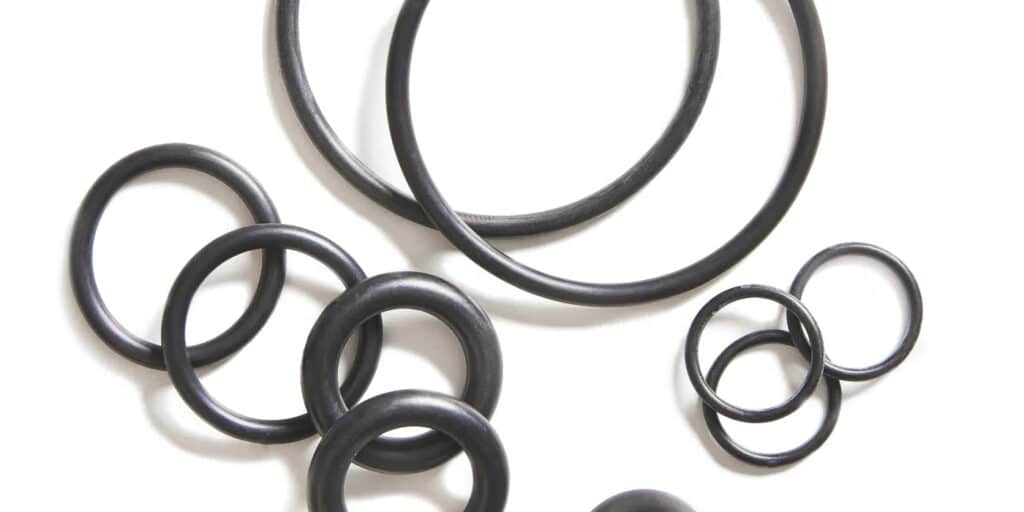
| Static joint sealing | O-ring or gasket | Is a fixed cap, port, or cushion passage leaking? |
| Side-load control | Wear ring or guide ring | Is the seal lip being overloaded because the moving parts are misaligned? |
| Rodless slot sealing | Inner and outer seal bands | Is the carriage slot leaking or dragging after contamination damage? |
The reliable answer is usually a set of parts, not a single ring. A rebuild kit for a standard tie-rod cylinder may include piston seals, rod seals, O-rings, wipers, and wear elements. If the cylinder is rodless, the kit may also involve long seal strips or bands.
Material still matters. NBR, polyurethane, FKM, EPDM, PTFE, and filled PTFE can all appear in pneumatic or fluid-power sealing. But material should come after the failure path, temperature, medium, pressure, movement, surface finish, and groove fit are known.
How Should Maintenance Teams Diagnose a Leaking Cylinder?
Diagnose a leaking cylinder by measuring the leak path, pressure behavior, and rebuild condition before ordering parts. CAGI reports that about 80% of compressed-air leaks are not audible, so a quiet machine can still be wasting air or masking a cylinder fault (CAGI, 2026).
Do the test in a controlled state. Isolate the machine according to site safety rules, lock out hazardous energy, and follow the cylinder manufacturer’s service procedure. Then confirm whether the suspected leak is at the cylinder, valve, tubing, fitting, or exhaust path.
Use this practical sequence:
- Listen and locate: use ultrasonic detection, soap solution where permitted, or a local pressure check.
- Separate valve from cylinder: a leaking valve can look like piston bypass.
- Check both ports: one gauge can hide what happens during motion.
- Run a hold test: pressurize the chamber, stop motion safely, and watch whether pressure decays.
- Inspect surfaces: rod scratches, bore scoring, worn guides, and contaminated grease explain repeat failures.
- Document the old seals: take photos before cleaning. Wear patterns matter.
The pressure-decay method is useful when a flow meter is not installed. It is not magic. The test volume must be known, production demand must be isolated, and temperature changes can distort the result. Still, it gives a maintenance team a repeatable before-and-after number.
When Should You Rebuild the Seal Kit Instead of Replacing the Cylinder?
Rebuild the seal kit when the cylinder structure is sound and the failure evidence points to replaceable sealing or guide parts. CAGI’s pressure-drop brief says filters should be changed when differential pressure exceeds 5-7 psig or at least every six months, which is a reminder that maintenance thresholds should be measurable (CAGI, 2022).
Use the same discipline for cylinders. A calendar interval by itself is weak. A measured leak rate, rod condition, guide wear, pressure-decay result, cycle count, and contamination history create a better decision.
| Condition found during inspection | Rebuild seal kit? | Replace cylinder or major parts? | Why |
|---|---|---|---|
| Rod is smooth, bore is clean, guides are intact | Yes | Usually no | Seal wear is likely the main repair item |
| Rod has light polish but no scratch line | Often | Not usually | Confirm with supplier and check wiper protection |
| Rod is scored or pitted in the seal path | Not by itself | Rod or cylinder replacement likely | New rod seal will ride over the same damage |
| Bore is scored or corroded | Not by itself | Tube or cylinder replacement likely | Piston seal cannot fix the sliding surface |
| Guide ring is worn through on one side | Only with guide and alignment correction | Possibly | Side load will destroy the new seals again |
| Rodless seal band is cut or contaminated | Seal-band service needed | Depends on carriage and rail condition | Long slot sealing is sensitive to debris and band damage |
| Repeated leaks after correct rebuild | No | Diagnose valve, pressure, alignment, and air quality | The cylinder may be only one symptom |
A rebuild is a good reliability move only when it removes the root cause. If the old seal failed because a rod scratch cut it, a new kit is a temporary mask. If the old seal failed from normal wear and the running surfaces are clean, a kit can be the best use of downtime.
For standard cylinder families, send the supplier the full model code and photos of the failed parts. For custom actuators, also include bore, stroke, rod diameter, groove dimensions, port size, mounting style, pressure, cycle rate, and operating environment.
Which Air Quality and Operating Conditions Extend Seal Life?
Air quality extends seal life because particles abrade seal lips, water attacks surfaces and lubricants, and oil carryover can swell or soften incompatible elastomers. ISO 8573-1 specifies purity classes for particles, water, and oil, and identifies additional gaseous and microbiological contaminants in compressed-air systems (ISO, 2010).
That does not mean every cylinder needs the strictest class. It means the air-quality target has to match the machine. A clean indoor indexing cylinder and a washdown packaging line face different seal risks. So do dusty woodworking machines, welding fixtures, cutting-fluid zones, and outdoor equipment.
Connect the seal review to the air system:
- Check filter bowls, drains, dew point, and regulator setting at the machine, not only in the compressor room.
- Compare the cylinder’s required working pressure with the real pressure at the valve inlet and cylinder ports.
- Look for water, rust, pipe scale, oil sludge, or sticky residue in failed parts.
- Confirm whether the machine uses lubricated or non-lubricated components.
- Record the chemical exposure: coolant, cleaner, washdown fluid, oil mist, ozone, UV, or food-processing chemicals.
CAGI says proper compressed-air equipment selection starts with three inputs: demand in cfm, pressure in psig, and air quality (CAGI, 2026). For cylinder sealing, those same three inputs should appear in the maintenance note. If one is missing, the seal choice is partly a guess.
For more detail on air classes, use the guide to ISO air quality standards for pneumatic systems. For moisture problems, the pressure-dew-point guide explains why a filter alone does not define dry air: What Is Pressure Dew Point?.
How Do Pressure Stability and Leakage Affect Actuator Repeatability?
Pressure stability affects repeatability because a cylinder’s useful force comes from pressure differential across piston area. CAGI says most well-designed compressed-air systems have no more than 10% pressure drop from compressor discharge to any point of use, so pressure loss should be fixed before raising compressor setpoints (CAGI, 2022).
A seal leak changes that differential. Piston bypass reduces the pressure separation between chambers. Rod-seal leakage bleeds air from the working chamber. Port or fitting leakage can make a good cylinder look weak. Exhaust-side restriction can slow motion and confuse the diagnosis.
Does that always show up as a complete machine stop? No. Often the first sign is softer:
- Clamp force drifts after a hold period.
- Stroke time changes between morning startup and warm operation.
- A cylinder reaches the end stop, but the next station sees inconsistent part position.
- Compressor duty cycle rises after a maintenance change.
- Operators raise regulator pressure to restore motion, then air use increases.
That last item matters. CAGI’s artificial-demand example says a cylinder needing 1 cubic foot of air at 80 psig can consume 1.21 cubic feet when system pressure is raised to 100 psig (CAGI, 2026). Raising pressure may hide the symptom while increasing air consumption.
If force is the question, review pressure differential in pneumatic physics. If system pressure drop is the question, use what causes pressure drop in pneumatic systems. The sealing system sits between those two problems.
How Do You Build an RFQ for a Reliable Seal Replacement?
A reliable seal-replacement RFQ starts with three operating facts: demand, pressure, and air quality. CAGI uses those inputs for compressed-air equipment selection, and seal RFQs need the same context before a supplier can separate fit, material, and root cause (CAGI, 2026).
Do not send only “need seal kit.” That request forces the supplier to guess. A better RFQ tells them whether you need an exact replacement, a root-cause review, or a material/application check.
Use this RFQ block:
| RFQ data | Minimum detail to send | Why it matters |
|---|---|---|
| Cylinder identity | Brand, series, model code, bore, stroke, rod diameter | Confirms kit compatibility |
| Operating data | Pressure, cycle rate, motion direction, load condition | Explains seal and guide workload |
| Leak evidence | Leak location, pressure-decay result, timing drift, failed-part photos | Points to the real leakage path |
| Air and environment | Dryer/filter details, water or oil evidence, dust, washdown, chemicals | Screens contamination and material risk |
| Repair goal | Exact replacement, longer service, emergency repair, redesign | Sets the technical response |
For urgent breakdowns, the best photo is often the worn part before it is cleaned. Dirt pattern, cut direction, lip wear, and one-sided polishing say more than a perfect catalog-style photo after the evidence has been wiped away.
If the cylinder is part of a broader machine review, link the request to pneumatic cylinder products and include any actuator replacement constraints. If the question is only seal type, link the supplier to the existing industrial cylinder seals guide.
FAQs About Pneumatic Cylinder Sealing Systems
These FAQ answers focus on measurable reliability rather than universal replacement intervals. CAGI’s examples show compressed-air leaks can be silent, costly, and pressure-dependent, while ISO 8573-1 shows air quality must be specified by contaminant class rather than vague terms such as “clean air” (CAGI, 2026; ISO, 2010).
How often should pneumatic cylinder seals be replaced?
Replace pneumatic cylinder seals when measured leakage, drift, weak force, visible damage, or planned overhaul data justifies it. Calendar intervals vary too much by cycle rate, air quality, pressure, rod exposure, and side load. Track pressure-decay results, air use, and inspection photos so the interval comes from evidence.
What causes premature seal failure in automation systems?
Premature seal failure usually comes from contamination, rod scratches, bore scoring, side load, dry assembly, wrong groove fit, incorrect orientation, chemical attack, or air quality outside the machine requirement. ISO 8573-1 separates compressed-air purity into particle, water, and oil classes, which gives maintenance teams a concrete way to discuss contamination.
Can aftermarket seal kits match OEM performance?
Aftermarket seal kits can work well when the supplier has the exact cylinder data, dimensions, material context, and operating conditions. They are risky when selected only by appearance. Ask for fit confirmation, material compatibility, installation guidance, and a post-repair leak test instead of assuming “premium” means better.
How do I tell piston bypass from rod-seal leakage?
Rod-seal leakage usually escapes at the gland and may be audible or detectable outside the cylinder. Piston bypass is internal, so the actuator may drift, lose force, or fail a hold test without visible external leakage. Isolate the cylinder from the valve and measure both ports before deciding.
Should I raise pressure to overcome a leaking cylinder?
Not first. Raising pressure can hide leakage while increasing artificial demand. CAGI gives an example where a cylinder stroke needing 1 cubic foot at 80 psig consumes 1.21 cubic feet at 100 psig. Fix the leak path, pressure drop, or restriction before raising the system setpoint.
What information should I send for a seal-kit quote?
Send the cylinder model, bore, stroke, rod diameter, operating pressure, cycle rate, leak symptom, environment, air-quality details, and photos of the failed seals, rod, bore, gland, and guides. If dimensions are unknown, send clear caliper photos and the full nameplate before requesting a kit.
External Technical References
These references support the article’s technical claims. They do not replace the cylinder manufacturer’s service manual, seal-supplier material data, or site safety procedures.
- CAGI Working with Compressed Air: Supports compressed air as a costly utility, the 80% silent-leak warning, the 1/4-inch leak example at 100 psi, artificial-demand behavior, and the demand-pressure-air-quality selection sequence. Retrieved 2026-07-08.
- CAGI Pressure Drop Technical Brief: Supports the 10% pressure-drop target, 20 ft/s piping velocity guidance, and 5-7 psig filter differential-pressure service signal. Retrieved 2026-07-08.
- ISO 8573-1:2010: Supports compressed-air purity classes for particles, water, and oil, plus the need to specify air quality at the point where it is measured or required. Retrieved 2026-07-08.
- DOE Compressed Air Systems: Lists DOE compressed-air assessment tools, tip sheets, sourcebooks, and training resources for system-performance work. Retrieved 2026-07-08.
- Trelleborg Films and Animations: Supports the distinction between rod seals, U-cup seals, wipers, scrapers, PTFE rod-seal installation, and polyurethane piston-seal installation as separate sealing topics. Retrieved 2026-07-08.
- Trelleborg U-Cup Rod Seal Animation: Used only as a visual reference for U-cup rod-seal geometry; application ratings must come from the selected pneumatic cylinder and seal supplier. Retrieved 2026-07-08.