

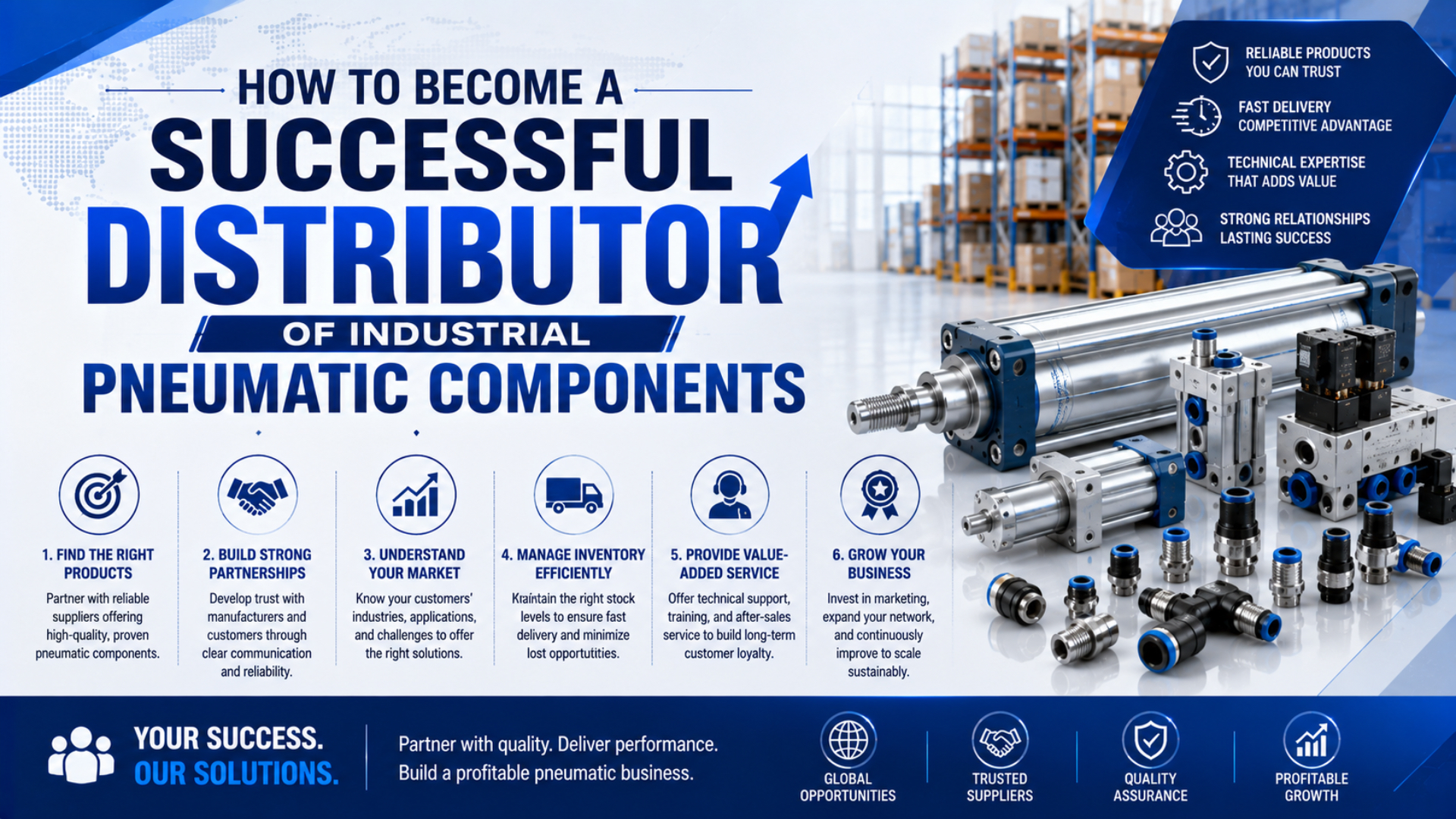
A successful industrial pneumatic components distributor combines five capabilities: a defined territory, a financially viable offer, qualified suppliers, enough application knowledge to prevent specification errors, and an inventory-and-service model that customers can rely on. Buying a broad catalog first and looking for customers later reverses the safest order.
The U.S. Small Business Administration recommends testing demand, market size, location, market saturation, and pricing before launch. Those five questions are a better starting point than a universal claim about required capital or profit margin (SBA market research guide, updated 2026).
Key Takeaways
- Validate five market questions before buying inventory.
- Calculate startup cash and break-even from your own costs.
- Treat ISO 9001 as management-system evidence, not product approval.
- Put the Incoterms 2020 rule and named place in international quotes.
- Expand only after service, inventory, quality, and cash metrics pass.
What Does Success Mean for a Pneumatic Components Distributor?
The SBA separates market validation into five questions covering demand, size, location, saturation, and pricing. A pneumatic distributor succeeds by turning those market facts into a repeatable operating system, not by carrying the most part numbers or advertising the largest discount (SBA, 2026).
Pneumatic component distribution is the controlled supply of cylinders, valves, air-preparation units, fittings, tubing, sensors, and related support between qualified manufacturers and industrial users. The distributor owns more than the transaction. It must control what it promises, what it stocks, how it cross-references parts, and how it handles a nonconforming delivery.
Customers usually need one of four outcomes:
- a standard component supplied on an agreed date;
- an installed part identified and cross-referenced;
- an application reviewed before a product is quoted;
- a failed or obsolete component replaced with controlled evidence.
Each outcome requires different stock, skills, documents, and response rules. An online catalog may serve planned demand. A machine-down request may require local stock and fast technical triage. A custom cylinder request needs drawings, operating data, and a supplier application review.
The useful business boundary is promised capability. List only the products, applications, locations, and response levels your team can support with evidence. A narrow promise that is consistently fulfilled creates more trust than a broad catalog whose availability and technical limits are unclear.
Validate the Territory Before Buying Inventory
SBA market research asks five practical questions before launch: demand, market size, customer location, market saturation, and current pricing. For a pneumatic distributor, answer them with reliable plant-level and machine-level evidence instead of a generic global market forecast (SBA, 2026).
Define the territory in operational terms. A country or province is not a service plan. Record the locations you can visit, the delivery routes you can support, the languages and documentation buyers require, and the applications your team understands.
Build a target-account map with:
| Field | Evidence to collect | Business decision |
|---|---|---|
| Account type | Plant, machine builder, integrator, maintenance contractor, reseller | Which buying route must be supported? |
| Installed base | Known cylinder, valve, FRL, fitting, and sensor families | Which cross-references and spares matter? |
| Demand pattern | Planned projects, scheduled maintenance, urgent failures, repeat consumption | Stock, source to order, or do not offer? |
| Technical consequence | Machine stop, quality loss, safety function, minor convenience | What level of review and escalation is required? |
| Current alternative | Local stockist, national distributor, OEM, direct import | Why would the customer change? |
| Commercial boundary | Typical order size, credit expectation, delivery point, required documents | Can the account be served profitably and compliantly? |
Interview maintenance, engineering, purchasing, and machine builders separately. They see different problems. Maintenance may value identification and availability. Engineering needs controlled drawings and application limits. Purchasing needs comparable quotations and clear logistics.
Do not turn interview interest into a sales forecast automatically. Ask for evidence such as past consumption, installed part numbers, planned projects, emergency orders, and current lead-time failures. Then classify the opportunity as repeatable, project-based, emergency-only, or unproven.
The companion guide to marketing pneumatic parts for local industrial distributors explains how to turn a validated territory into measurable local outreach. Keep marketing separate from the initial market-go/no-go decision.
How Much Capital Does a Pneumatic Distributor Need?
The SBA separates startup costs into one-time and monthly expenses and recommends counting at least one year of monthly expenses, with five years as an ideal planning horizon. That method is more defensible than assigning every pneumatic distributor the same capital range (SBA startup-cost guide, 2024).
Calculate startup cash for your exact model:
- legal setup, licenses, permits, insurance, accounting, and local advice;
- warehouse, counter, office, utilities, and security;
- shelving, handling equipment, inspection tools, and packaging;
- software, product data, website, communications, and cybersecurity;
- sample stock, saleable stock, demo equipment, and quarantine stock;
- salaries, training, travel, vehicles, and customer visits;
- freight, customs, taxes, bank charges, and currency exposure;
- returns, warranty containment, premium freight, and working-capital buffer.
Separate inventory investment from operating runway. Inventory cannot pay salaries or freight until it sells and the customer pays. Credit terms can widen that gap. A profitable order can still consume cash if the distributor pays the supplier before collecting from the customer.
Use the SBA break-even relationship as a first screen:
Here, (Q_{\mathrm{BE}}) is break-even units for the selected period, (F) is fixed cost, (p) is selling price per unit, and (v) is variable cost per unit. Use one currency and one period. The SBA notes that this form is based on a single product or service, so a multi-product distributor needs a weighted contribution model or a product-family analysis (SBA break-even guide, 2024).
Gross margin percentage can be monitored with:
Here, (G) is gross margin percentage, (R) is recognized net sales, and (C) is the corresponding cost of goods sold under the company’s accounting policy. Do not confuse gross margin with markup, cash flow, or net profit. Freight, returns, technical labor, credit losses, and warranty handling may sit outside a simple item-margin view.
The SBA break-even calculator can support the initial model. No universal result proves that the business will break even in a fixed number of months.
Which Product and Technical Capabilities Should You Build First?
ISO 6432:2015 covers commonly used mini cylinders from 8 to 25 mm bore, while ISO 15552:2018 covers detachable-mount cylinders from 32 to 320 mm. Those two ranges alone show why “pneumatic components” is too broad to master or stock as one undifferentiated category (ISO 6432; ISO 15552).
Start with the installed base and repeatable applications found in the territory study. A focused launch might cover standard cylinders, selected solenoid valves, common air-preparation units, and the fittings and sensors needed to complete those assemblies. Another territory may justify rodless cylinders, special materials, or machine-builder project support.
For each product family, define three service levels:
- Catalog supply: The customer provides an exact, current part number. The distributor verifies availability, commercial scope, and revision.
- Controlled cross-reference: The distributor compares complete codes, drawings, interfaces, options, limits, and acceptance requirements.
- Application review: A trained person collects load, pressure, flow, speed, environment, mounting, sensing, safety, and documentation requirements before recommending a configuration.
Do not let sales staff perform application work outside their training. Publish an escalation matrix. It should identify questions the counter can answer, questions an internal specialist owns, and questions that must go to the manufacturer or a qualified engineer.

The image illustrates the minimum mindset: measure the installed interface, use a controlled drawing, and record the result. A photograph or family name is not enough for a replacement decision.
Build training around real buying tasks:
- read cylinder and valve model codes;
- identify bore, stroke, mounting, rod end, ports, cushioning, and sensing;
- distinguish pressure rating from working pressure at the component;
- gather flow, cycle-time, and air-quality requirements;
- recognize side load, stored energy, environmental, and regulatory escalation triggers;
- prepare a supplier RFQ with a compliance matrix;
- inspect samples and document deviations;
- troubleshoot without bypassing the site’s hazardous-energy procedure.
Use the ISO 15552 procurement checklist for cylinder quotations and the pneumatic cylinder troubleshooting guide for maintenance triage boundaries.
Qualify the Supplier and Channel Agreement
Incoterms 2020 contains 11 trade rules, while ISO states that certification is performed by external bodies rather than ISO itself. Together, those facts show why a logo, price list, or handshake cannot define a dependable international supply relationship (ICC; ISO certification).
Separate four approvals:
| Approval | Evidence | Stop condition |
|---|---|---|
| Legal counterparty | Registered entity, address, bank beneficiary, contract authority | Seller, payee, manufacturer, or warranty provider is unexplained |
| Manufacturing source | Site, product scope, process map, controlled documents, sample records | The offered product cannot be traced to a disclosed source |
| Product configuration | Complete code, drawing, datasheet, compliance matrix, deviations | Important interfaces or operating limits remain assumed |
| Commercial channel | Territory, accounts, targets, pricing, support, warranty, data, termination | Obligations, exceptions, or remedies are not written |
ISO 9001 can support the qualification of an organization’s quality-management system. It does not certify each pneumatic component or guarantee perfect conformity. Check the certificate’s legal name, site, scope, certification body, status, and relevance to the offered product.
A distributor agreement should address at least:
- products, territory, customer ownership, and whether rights are exclusive;
- qualification requirements, training, and use of technical claims;
- price lists, currency, payment, taxes, and price-change notice;
- forecasts, minimum commitments, stock obligations, and obsolete inventory;
- order acceptance, lead-time basis, Incoterms rule, and exact named place;
- intellectual property, brand use, data, confidentiality, and online listings;
- warranty start point, evidence, remedy, freight, and field containment;
- product changes, end-of-life notice, records, recalls, and traceability;
- performance review, cure periods, termination, and post-termination obligations.
Local law, competition rules, franchise rules, tax, customs, product regulations, and enforceability vary. Use qualified local legal and tax advice rather than copying a foreign distributor contract.
For the detailed supplier interview and quotation process, use Negotiating with Pneumatic Suppliers: Key Questions to Ask Before Buying. For direct-import economics and factory identity, use the factory-direct pneumatic sourcing guide.
How Should Inventory and Service Work Together?
NIST reports that the U.S. Manufacturing Extension Partnership operates with more than 1,400 advisors and experts across approximately 450 service locations. The example is not a distributor target, but it demonstrates a useful principle: manufacturing support becomes valuable when expertise is connected to accessible local service (NIST MEP, 2026).
Inventory should support a defined service promise. Segment each item by demand pattern and consequence:
- Stocked core: repeat demand, stable configuration, reasonable replenishment, and clear ownership.
- Project stock: linked to a named project, approved specification, and release schedule.
- Emergency spare: low frequency but high downtime consequence, with an agreed stocking owner.
- Source to order: technically understood but not economical to stock.
- Do not offer: insufficient evidence, unacceptable risk, obsolete documentation, or no qualified source.
In our experience, slow inventory problems often begin as promise problems. A team stocks a wide range because it has not defined which applications, response times, or accounts it truly owns. Start with the service decision, then justify each stocked item.
Use reorder points only after recording lead-time basis, demand variability, order constraints, supplier reliability, and obsolescence risk. Keep saleable stock separate from samples, inspection holds, returns, warranty material, and customer-owned consignment.
Inventory turnover is one useful signal:
Here, (T) is annual inventory turnover, (C_{\mathrm{annual}}) is annual cost of goods sold for the same scope, and (I_{\mathrm{average}}) is average inventory value under a consistent accounting basis. A high result is not automatically good if frequent stockouts damage the service promise. A low result may indicate overstock, obsolete variants, or deliberately held critical spares.
Define the service workflow from inquiry to claim:
- capture the customer, machine, request, urgency, and required date;
- classify exact part, cross-reference, or application review;
- assign technical and commercial owners;
- issue a revision-controlled quote with assumptions and exclusions;
- verify the order against the accepted quote;
- inspect, label, pack, and ship the correct configuration;
- retain records for reorders, deviations, and warranty claims.
Consignment and vendor-managed inventory add ownership, counting, replenishment, damage, aging, revision, insurance, and exit obligations. Treat them as controlled agreements, not informal service favors.
Separate Compliance Roles by Market
Section 3.4 of the European Commission’s 2022 Blue Guide identifies distributors as a distinct category of economic operator with specific obligations and a market-surveillance role. That is one regional example of why a distributor must map its legal role for every destination rather than assume the manufacturer owns all compliance (EU Blue Guide 2022).
The business may act as a domestic distributor, importer, exporter, private-label owner, online seller, installer, or more than one role. Duties can change with the product, country, transaction, and whether the distributor modifies or relabels the item.
Before selling into a market, identify:
- contracting seller, manufacturer, importer, distributor, and warranty provider;
- applicable product legislation, standards, declarations, and marking;
- instructions, safety information, and language requirements;
- product, lot, shipment, and customer traceability;
- restricted substances, packaging, recycling, and environmental duties;
- complaint, corrective-action, recall, and market-surveillance contacts;
- customs classification, origin, valuation, export controls, and sanctions screening;
- privacy, marketing, cybersecurity, and record-retention requirements.
Compliance should be designed into the product master. Attach the approved manufacturer, drawing revision, declarations, destination restrictions, document set, and change-notification status to the sellable part record. That prevents a salesperson from treating a component approved for one market as automatically approved everywhere.
Do not use an ISO logo or a certificate image as decoration. ISO states that organizations are not certified by ISO and that the ISO logo cannot be used to demonstrate certification without authorization (ISO).
Which Metrics Should Control Expansion?
The SBA defines break-even as the point where total cost equals total revenue and provides the relationship between fixed cost and unit contribution. A distributor should therefore expand from measured economics and service performance, not from a calendar promise such as “profitable in 12 months” (SBA, 2024).
Run a controlled launch with a limited territory, product scope, supplier set, and stocking list. Freeze the assumptions. Then measure them.
| Metric | Define before use | Decision it supports |
|---|---|---|
| Qualified inquiry rate | What product, application, timing, and account data make an inquiry qualified? | Is the territory generating the intended demand? |
| Quote conversion | Which quotes are eligible and when is a quote won, lost, or expired? | Does the offer solve a real buying problem? |
| Gross margin | Which revenue and cost fields are included? | Does the sale support the operating model? |
| Fill rate | Order, line, unit, promised date, and complete-delivery rule | Is stock supporting the stated service promise? |
| Inventory turnover | COGS scope, valuation method, and average period | Is capital moving without causing stockouts? |
| Return and claim rate | Denominator, failure category, detection point, and exclusions | Are selection, supplier quality, and handling controlled? |
| Cash conversion | Inventory days, receivable days, payable days, and currency | Can growth be funded without a cash gap? |
| Response performance | Start event, stop event, business hours, severity, and exclusions | Is the published support commitment real? |
Avoid universal targets. A critical spare and a fast-moving fitting should not have the same turnover expectation. A project distributor and a walk-in stockist should not use the same conversion or response definition.
If a gate fails, contain the cause before adding scope. Tighten the offer, retrain the team, correct supplier controls, reduce stock, change the service promise, or stop serving the application. Growth is not the only valid decision.
Pneumatic Distribution FAQs: What Should New Distributors Ask?
Incoterms 2020 contains 11 rules, while the SBA lists five core market-research questions. Those two counts summarize the article’s central lesson: commercial success depends on defined choices and evidence, not a universal capital figure, margin promise, or supplier label (ICC; SBA).
How much money do I need to start a pneumatic distribution business?
There is no universal amount. Calculate one-time setup, inventory, inspection tools, warehouse, insurance, software, training, logistics, and at least one year of monthly expenses for your location and model. Add working capital for supplier payments, customer credit, returns, and slow-moving stock before deciding whether the plan is fundable.
Do I need ISO 9001 certification to become a distributor?
Not universally. Customer contracts, tenders, or market expectations may require a certified quality-management system, but ISO does not certify organizations and ISO 9001 does not certify individual products. Confirm the requirements in your target market, then define the quality system and independent certification evidence that buyers actually need.
Is an authorized distributor the same as an ordinary reseller?
No universal legal definition makes them identical. Authorization normally depends on a written manufacturer agreement covering products, territory, brand use, support, targets, warranty, data, and termination. Buyers should still verify the exact product, source, documentation, and commercial responsibility instead of treating an authorization badge as complete technical approval.
Which pneumatic components should a new distributor stock first?
Stock items supported by repeatable local demand, stable specifications, qualified supply, acceptable replenishment, and a defined service promise. Keep project items, emergency spares, source-to-order products, samples, and quarantine material separate. Do not stock a wide family simply because its unit price or theoretical margin looks attractive.
When should a pneumatic distributor expand its territory or catalog?
Expand after qualified demand, contribution, supplier performance, service results, quality, and cash all pass using stable definitions. Add one controlled dimension at a time and preserve the baseline. If fill, claims, support capacity, or working capital deteriorates, contain the problem before adding more products, locations, or commitments.
A successful pneumatic distributor is not the company with the widest catalog. It is the company that makes narrow, verifiable promises; qualifies the supply behind them; trains people to recognize technical limits; and expands only when measured service and economics support the next commitment.
External technical and business references
U.S. Small Business Administration, Market Research and Competitive Analysis: Demand, market size, location, saturation, pricing, and competitive analysis. Updated 2026; retrieved 2026-07-26.
U.S. Small Business Administration, Calculate Your Startup Costs: One-time and monthly startup expenses, inventory, working expenses, and planning horizon. Retrieved 2026-07-26.
U.S. Small Business Administration, Break-Even Point: Break-even definition, formula, required inputs, and single-product limitation. Retrieved 2026-07-26.
ISO, Certification: ISO’s role, external certification bodies, accreditation, and ISO logo limits. Retrieved 2026-07-26.
ISO 6432:2015: Mounting-dimension scope for commonly used 8-25 mm pneumatic mini cylinders. Retrieved 2026-07-26.
ISO 15552:2018: Basic, mounting, and accessory-dimension scope for detachable-mount cylinders from 32-320 mm bore. Retrieved 2026-07-26.
International Chamber of Commerce, Incoterms 2020: Eleven trade rules and allocation of cost, risk, and obligations. Retrieved 2026-07-26.
NIST Manufacturing Extension Partnership: More than 1,400 advisors and experts at approximately 450 service locations. Retrieved 2026-07-26.
European Commission, Blue Guide on EU Product Rules 2022: Economic-operator roles and distributor obligations under applicable EU product rules. Retrieved 2026-07-26.