

Shipping heavy hydraulic and pneumatic parts safely starts with one controlled shipment plan. Record the component’s mass, dimensions, center of gravity, sensitive surfaces, restraint points, corrosion risk, transport modes, transfer points, and destination rules before anyone designs the crate. A heavy box isn’t automatically a protective package.

Key Takeaways
- ISTA separates less-than-truckload Procedure 3B from unitized full-truckload Procedure 3E.
- Restrain the part to a structural base; don’t ask foam to carry the load.
- ISPM 15 covers regulated raw wood packaging, while processed wood such as plywood is generally excluded.
- Name the Incoterms 2020 rule and exact place.
The practical goal is traceability. A buyer should be able to connect the drawing revision to the packed item, the item to its restraint plan, the package to its shipping documents, and any arrival damage to dated evidence. That chain matters more than an unsupported promise that the crate is “industrial grade.”
What Makes Heavy Hydraulic and Pneumatic Parts Difficult to Ship?
ISTA assigns separate general-simulation procedures to different distribution paths, including Procedure 3B for less-than-truckload shipments and Procedure 3E for similar packaged products in unitized full-truckload loads. That distinction shows why package design cannot be reduced to one universal weight threshold or cushioning thickness.
A cylinder can be heavy and still have fragile features. A chrome-plated rod may be damaged by a small hard contact, while a long barrel can bend when supported at poor locations. Ports, sensors, tie rods, valve coils, manifolds, and machined sealing faces may project beyond the main load path. Hydraulic items add leakage and residual-fluid questions. Package restraint is the engineered system that prevents the item from translating, rotating, tipping, or loading a vulnerable feature during handling and transport. It includes the base, attachments, blocks, lashings, and the approved connection points on the product. This definition matters because cushioning and restraint aren’t interchangeable: cushioning limits transmitted shock, while restraint controls movement and establishes the load path.
Start with four risk groups:
| Risk group | Typical failure | Control to specify |
|---|---|---|
| Structural | Bent rod, distorted barrel, cracked casting | Base restraint, blocking, support at engineered locations |
| Surface | Scratched rod, dented tube, damaged port | Non-abrasive wrap, caps, clearance from crate walls |
| Environmental | Corrosion, condensation, dust ingress | Clean and dry item, barrier system, compatible corrosion protection |
| Handling | Drop, tip, fork impact, load shift | Lift points, fork access, center-of-gravity information, verified securing |
The component’s own documentation should drive the plan. Confirm permitted lifting points, allowable support locations, storage orientation, protrusions, and any surfaces that must remain free of preservative. For an unusually long assembly, review the same support and deflection concerns used when specifying a long-stroke pneumatic cylinder.
What if the original carton looks clean and undamaged? That doesn’t prove it can survive a second distribution cycle. Reuse it only when the structural members, cushioning, closures, moisture protection, and labels remain suitable for the new route and the actual packed mass.
How Should You Restrain a Heavy Cylinder or Valve Assembly?
The IMO/ILO/UNECE CTU Code describes two basic outcomes for cargo inside a transport unit: tight stow, where packages fill the boundaries, or secured stow, where blocking and lashing prevent movement. Heavy machinery still needs a defined load path inside its individual package.
Mount the component to a structural skid or base that can transmit expected handling loads. Use saddles, brackets, blocking, bolts, or rated restraints at locations the component can tolerate. Foam can isolate vibration and protect finishes, but soft cushioning shouldn’t be the only element stopping a concentrated metal mass.
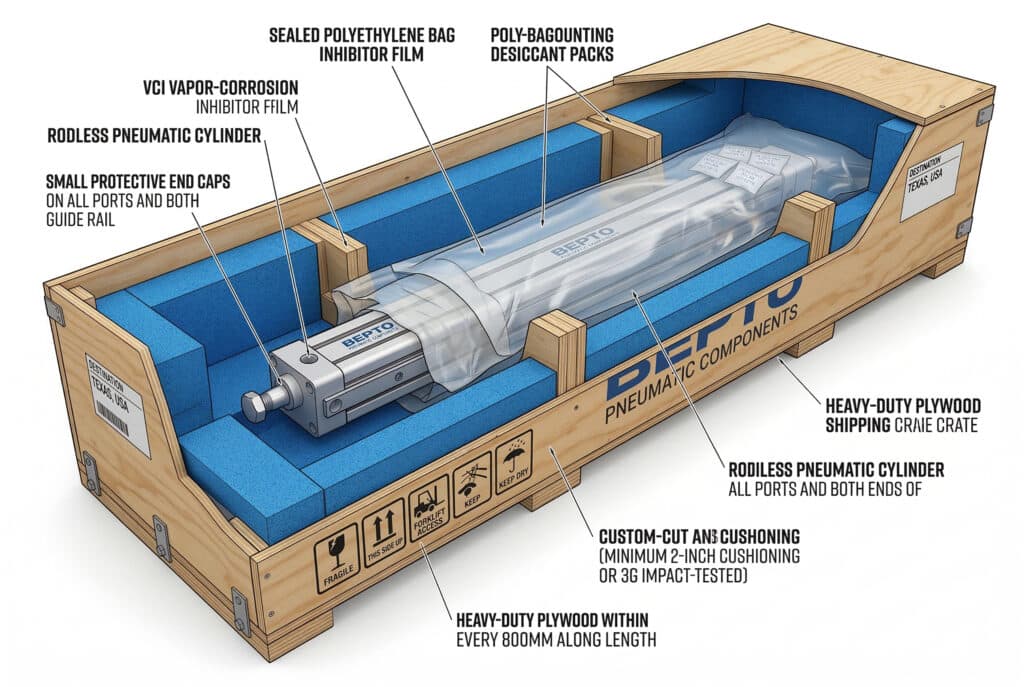
Use this sequence:
- Verify the item identity, drawing revision, accessories, and packed configuration.
- Retract movable rods where the product permits it, then prevent unintended motion.
- Fit clean protective caps to open ports and cover exposed threads or connectors.
- Isolate precision surfaces from staples, fasteners, timber, loose hardware, and abrasive wrap.
- Attach the load to the base through approved structural locations.
- Add blocking or cushioning without loading sensors, fittings, coils, or rod surfaces.
- Check fork-entry clearance, lift access, gross mass, and center of gravity.
- Close the package, record the seal or fastener condition, and photograph every layer.
Treat the crate, skid, restraints, and component as one mechanical system. A strong crate with a poorly restrained cylinder can still fail because the component builds momentum before striking the wall. Conversely, overtightened restraints can distort an aluminum barrel or load a sensor bracket before the shipment moves.
Controlling Corrosion, Moisture, and Contamination
MIL-STD-2073-1E separates cleaning and drying, preservative selection, and volatile corrosion inhibitor criteria within its preservation process. It is a military packaging standard, not a default commercial requirement, but the sequence illustrates a sound rule: protection begins with a clean, dry, compatible item.
Choose the preservation system from the metal combination, expected storage duration, climate, barrier permeability, package volume, and product restrictions. VCI film, contact preservative, desiccant, moisture-barrier material, and humidity indicators perform different jobs. Don’t copy a fixed number of desiccant bags from an unrelated shipment.
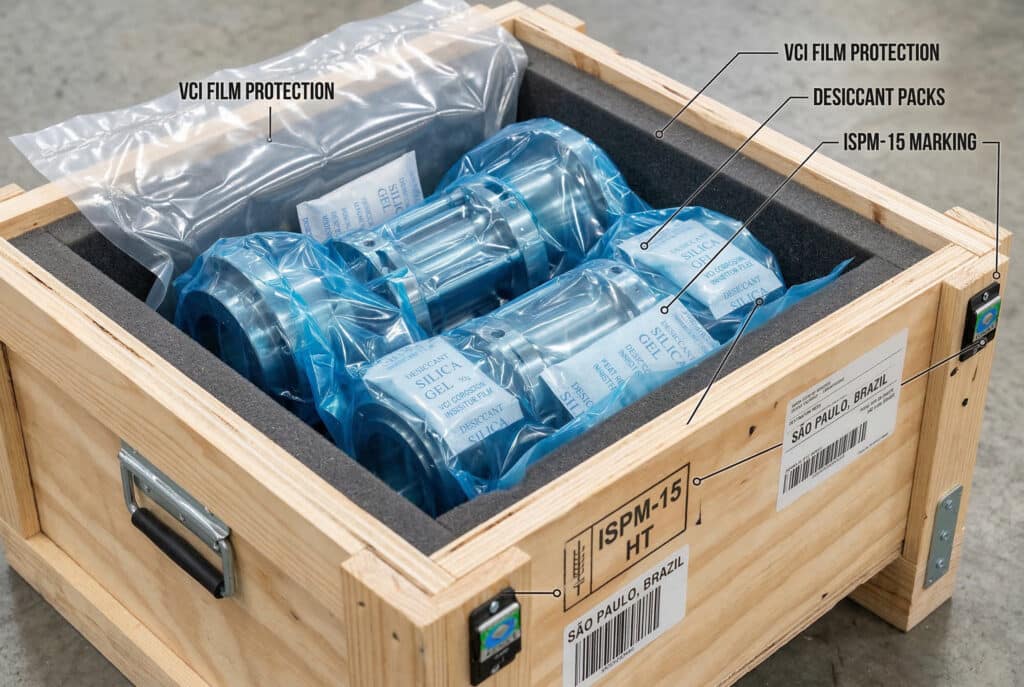
Ask the packaging-material supplier to document the calculation method and compatibility. Then record:
- cleaning and drying method;
- preservative or VCI product and application limits;
- barrier type and seal method;
- desiccant type, quantity, and placement;
- indicator type and acceptance condition;
- maximum planned storage period;
- inspection or resealing instructions.
Never let loose desiccant packs rub against a piston rod or precision seal. Keep barrier films away from sharp corners, and don’t assume a closed bag is intact until its seams and penetrations are checked. If preservation material must be removed before installation, mark that instruction where the receiver will see it.
Hydraulic equipment needs another decision. Identify the fluid, determine whether the assembly has been drained or contains residue, and confirm the transport classification with the carrier or dangerous-goods specialist. A safety data sheet can support that review, but possessing an SDS doesn’t by itself decide whether the packed article is regulated.
When Does ISPM 15 Apply to a Shipping Crate?
ISPM 15 excludes two useful categories from its regulated wood-packaging scope: processed wood materials such as plywood, oriented strand board, and fiberboard, plus wood components no thicker than 6 mm. Raw-wood pallets, dunnage, and crate members may still require approved treatment and marking.
Check the material, not just the word “crate.” A plywood panel can be exempt while its solid-wood cleats, skids, or blocking remain regulated. ISPM 15 compliance means the regulated wood packaging material has received an approved treatment and carries the prescribed traceability mark; it does not certify the strength or performance of the assembled package. The destination country’s national plant protection organization may also impose procedures beyond the shipper’s assumptions, so confirm the current import requirement before packing. Ask three separate questions: is any regulated raw wood present, is its treatment and mark valid, and does the complete package protect and restrain the component? A yes to the first two doesn’t answer the third.
For international shipments, separate three approvals that are often blurred together: phytosanitary acceptance of regulated wood, mechanical adequacy of the complete package, and customs acceptance of the shipment. One document or stamp cannot prove all three. This simple separation prevents a compliant timber mark from being treated as evidence that the cylinder is properly restrained.
Which Documents and Marks Should Travel With the Shipment?
The U.S. Harmonized Tariff Schedule places linear-acting pneumatic power cylinders under heading 8412.31.00, but that number is jurisdiction-specific and product-specific. A hydraulic cylinder, valve, repair kit, combined power unit, or differently configured assembly may require another classification in the destination country.
Build the document pack from the actual transaction and transport mode:
| Record | What to verify |
|---|---|
| Commercial invoice | Seller, buyer, accurate description, quantity, value, currency, origin, agreed delivery term |
| Packing list | Package count, item-to-package mapping, net and gross mass, dimensions |
| Transport document | Correct parties, route, package count, marks, mass, and special instructions |
| Classification support | Product function, material, drawings, prior rulings where relevant, destination tariff code |
| Regulated-goods records | Fluid identity, SDS, declarations, labels, and trained-person review when applicable |
| Origin or compliance records | Only those required by the destination, contract, or applicable program |
Use one identifier across the drawing, packing list, crate mark, invoice, and receiving record. This sounds basic, but what happens when two visually identical cylinders have different seals or sensor packages? The receiver needs a reliable way to identify the correct unit without opening every protected assembly.
Handling marks must communicate real information. Show gross mass, lift points, fork pockets, orientation limits, and center of gravity when they are needed for safe handling and known accurately. Don’t print “fragile,” “do not stack,” or shock limits by habit. Unsupported marks can conflict with the carrier’s operating plan and weaken trust in the instructions that matter.
For a wider purchasing-control framework, connect the pack record to the supplier evidence described in verifying pneumatic supplier certifications and the configuration controls in our guide to “compatible” pneumatic parts.
How Should You Select a Carrier and Packaging Test?
ISTA’s current procedure list distinguishes at least two relevant transport patterns: Procedure 3B for less-than-truckload delivery and Procedure 3E for unitized full-truckload loads. A route with parcel handling, LTL hubs, container transfers, or dedicated truck movement exposes the same component to different hazards.
Map the shipment from pickup to final placement, not merely from port to port. Count terminal transfers, consolidations, container loading, warehouse stops, customs inspections, and final-mile handling. Then ask the packaging engineer or test laboratory to select a defensible protocol and test level for that distribution path.
Carrier selection should cover:
- maximum accepted piece mass and dimensions;
- equipment used at pickup, terminals, and delivery;
- experience with long, unbalanced, or high-value machinery;
- blocking, bracing, and lashing responsibilities;
- prohibited materials and dangerous-goods capability;
- tracking at handover points;
- exception-reporting procedure;
- liability terms, declared-value options, and claim deadlines.
Don’t promise a universal transit time. Mode labels hide substantial variation. A direct truck can be gentler than an LTL network with several transfers, while a well-secured ocean container can still face humidity, cross-modal handling, and long dwell periods.
The CTU Code links serious transport incidents to poor packing practices, including inadequate securing, overloading, and incorrect content declarations. If a container is involved, record how the crate is positioned and secured inside it. The outer crate alone doesn’t stop the entire package from moving.
How Do Incoterms, Insurance, and Liability Fit Together?
ICC publishes 11 Incoterms 2020 rules, and each allocates defined delivery, cost, risk, and customs responsibilities. None of the 11 rules determines product title, payment timing, warranty, package design, or acceptance criteria, so those subjects still need explicit contract language.
State the selected rule as Rule + named place or port + Incoterms 2020. Precision matters. “DAP Germany” leaves too much room for disagreement; a named factory address or terminal makes the delivery point testable. The delivery point is the place at which the seller completes delivery and risk transfers under the selected Incoterms rule. It may differ from the place to which the seller pays carriage. Carrier liability is the carrier’s contractual or legal exposure for loss or damage, subject to applicable limits and defenses; it isn’t the same as cargo insurance. Keep those concepts separate when comparing quotations. Otherwise, a buyer may assume that paid freight, transferred risk, legal liability, and insured recovery all move together when they do not.
FOB applies to sea and inland-waterway transport, with risk transferring when goods are on board the nominated vessel. ICC advises considering FCA for containerized shipments because containers are commonly handed to a carrier before they reach the vessel.
DAP leaves import clearance and import duties with the buyer, while DDP assigns those obligations to the seller. DDP can be impractical where local law prevents the foreign seller from acting as importer. ICC’s delivery-point guidance should be read alongside advice from the customs broker handling the destination.
Cargo insurance and carrier liability are separate. Obtain the carrier’s applicable terms, limits, exclusions, declared-value process, and notice deadlines in writing. Then compare them with the cargo policy’s insured interests, covered risks, deductible, valuation basis, geographic scope, storage clauses, and survey requirements. A percentage copied from another contract isn’t proof of adequate cover.
What Should the Receiver Do When the Shipment Arrives?
The 2014 CTU Code applies across the intermodal chain and addresses people who pack, secure, receive, and unpack cargo transport units. Receiving control is therefore part of the shipment plan, not an informal check performed after the carrier has left.
Give the receiver an inspection sequence before dispatch:
- Check the transport unit, crate, seals, tilt or shock indicators, and visible damage before unloading.
- Photograph all sides, labels, restraints, and exceptions with timestamps.
- Compare package identifiers, gross mass, and piece count with the documents.
- Note visible exceptions on the carrier record before signing where local practice permits.
- Unpack using the stated lift points and safety controls.
- Inspect rods, ports, mounting faces, barrel straightness, sensors, accessories, and preservation condition.
- Quarantine a suspect item. Don’t install or cycle it merely to see whether it works.
- Notify the seller, carrier, insurer, and surveyor within their applicable contractual deadlines.
- Preserve packaging, restraints, indicators, photographs, and cost records until the claim is resolved.
The receiving checklist should mirror the packing checklist. If the shipper photographs the rod protector, base bolts, barrier seal, indicators, and crate closure, the receiver should photograph those same points in reverse order. Matched evidence makes it easier to locate the stage at which a change occurred.
For repeat orders, store the approved packaging specification with the SKU and revision rather than relying on a warehouse photo. That approach also fits a controlled vendor-managed inventory program and helps buyers compare the real delivered scope of factory-direct pneumatic sourcing.
A Shipment Plan Is Stronger Than a Generic Crate Specification
The ICC’s 11 Incoterms 2020 rules and ISTA’s separate 3B and 3E distribution procedures show the same thing from different angles: responsibility and packaging must match the real route. Neither a thick crate nor a familiar three-letter rule can replace a documented handover plan.
Before releasing an order, require the approved product configuration, packed mass and dimensions, restraint drawing, preservation method, packaging material declaration, test basis, transport route, named Incoterm place, document set, insurance decision, and receiving instructions. A high-value shipment becomes manageable when each handover has an owner and evidence.
If you need a supplier to quote both the pneumatic component and its export packaging, send Bepto the destination, transport mode, component drawing, quantity, storage duration, unloading limits, and required documents. Treat packaging as a controlled line item in the RFQ, not an unpriced promise added after the product is built.
Heavy Hydraulic and Pneumatic Parts Shipping FAQs
ISTA lists distinct procedures for less-than-truckload and unitized full-truckload distribution, while ICC publishes 11 Incoterms 2020 rules. These five FAQs address the practical decisions buyers most often need to settle before a heavy pneumatic or hydraulic component leaves the supplier.
Is a wooden crate always required for a heavy pneumatic cylinder?
No. The package must suit the component, load path, handling equipment, distribution hazards, and destination rules. A rigid crate may be appropriate, but weight alone doesn’t decide it. A qualified packaging designer can specify a skid, blocking, cushioning, enclosure, and validation method from the actual route and product vulnerabilities.
Does an ISPM 15 mark prove that the complete crate is export compliant?
No. ISPM 15 addresses phytosanitary treatment and marking of regulated wood packaging material. It doesn’t certify structural strength, cargo restraint, moisture protection, customs classification, or destination documentation. Processed wood such as plywood is generally excluded, while solid-wood skids, cleats, or dunnage may remain within scope.
Which HS code applies to a pneumatic cylinder?
In the United States, HTS 8412.31.00 covers linear-acting pneumatic power cylinders. Don’t apply that code automatically to every country or assembly. Confirm the product’s function, construction, and destination tariff schedule with a qualified customs professional, especially for hydraulic cylinders, valves, repair kits, and combined units.
Is FOB the best Incoterm for an overseas cylinder shipment?
Not automatically. FOB is limited to sea and inland-waterway transport, and risk transfers when the goods are on board the nominated vessel. ICC notes that FCA is often worth considering for containerized cargo. Whichever rule is selected, state the exact named place and Incoterms 2020.
What evidence is needed for a freight-damage claim?
Keep the purchase and transport documents, packing specification, pre-shipment and arrival photographs, carrier exception record, inspection findings, repair or replacement estimates, and all notices. Preserve the package until the carrier or insurer releases it. Notice and filing deadlines vary, so use the applicable contract and policy rather than a generic deadline.
Sources and technical references
- ISTA Test Procedures
- IMO/ILO/UNECE Code of Practice for Packing of Cargo Transport Units
- IMO Cargo Securing and Packing
- IPPC ISPM 15: Regulation of Wood Packaging Material in International Trade
- ICC Incoterms 2020
- ICC: FAS or FOB?
- U.S. International Trade Commission HTS Search
- DLA ASSIST: MIL-STD-2073