

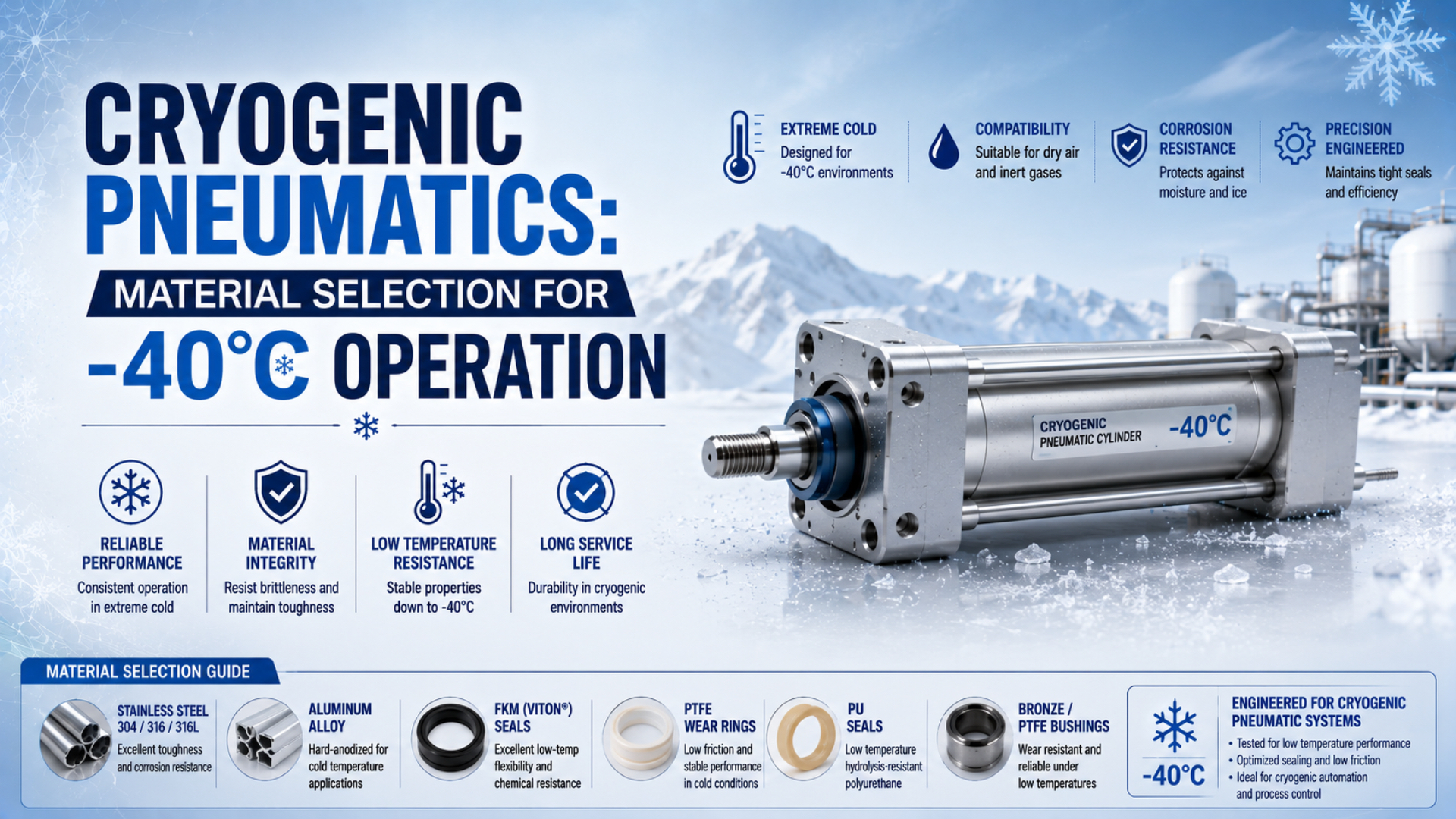
At -40°C, material selection starts with an important correction: this is severe low-temperature pneumatic service, not cryogenic service in the scientific sense. NIST places the cryogenic region below about 120 K, or -153°C. The article title uses the common market term, but the engineering specification should say exactly -40°C ambient, media, or cold-soak temperature.
A polymer family name or metal grade cannot qualify an actuator by itself. Release the application only when the exact seal profile, energizer, grease, cylinder configuration, accessories, compressed-air condition, and cold-start test all support the same minimum temperature.
Key Takeaways
- Treat -40°C as a defined low-temperature duty point, not a generic “cryogenic” label.
- A material datasheet screens candidates; the exact component and ordering code establish usable limits.
- The lowest-rated sensor, cable, tube, valve, or silencer can determine the assembly rating.
- Approve the design after cold-soak testing the first commanded cycle.
Is -40°C Really Cryogenic?
NIST notes that cryogenic temperatures are often defined below approximately 120 K, equivalent to -153°C (NIST). A -40°C freezer, test chamber, or outdoor installation is therefore better described in engineering documents as low-temperature or sub-zero pneumatic service, even when suppliers use “cryogenic” more loosely.
That distinction is not pedantic. True cryogenic systems involve different heat-transfer, material, fluid, and safety problems. Ordinary compressed air also cannot be discussed as though a conventional factory cylinder can simply continue toward -200°C. Nitrogen and oxygen liquefy far above that value, so the working fluid and architecture become fundamental constraints.
For a -40°C project, replace the label with measurable conditions:
| Required input | Example of a usable specification | Why it matters |
|---|---|---|
| Minimum ambient temperature | Cylinder body and accessories cold-soaked to -40°C | Establishes external material and electronics limits |
| Minimum media temperature | Compressed air entering the valve and cylinder | Controls internal seal, grease, and condensation behavior |
| Idle duration | Longest unpowered shutdown before the first stroke | Determines whether the whole assembly reaches the cold extreme |
| Duty after start | Load, speed, cycles, dwell, and pressure | Frictional and pneumatic heating may change later cycles |
| Air purity | Particle, water, and oil limits at a named sample point | Prevents “clean, dry air” from becoming an unverifiable requirement |
The same site may contain several different thermal cases. A continuously cycling actuator inside a freezer can run warmer than the room, while a valve mounted outside may see a warmer ambient but colder expanding air. Record actual locations instead of assigning one temperature to the entire machine.
What Does a Material Datasheet Prove at -40°C?
Parker lists approximate lower limits of -34°C for general-service nitrile, -55°C for low-temperature nitrile, -40°C for polyurethane, and -26°C for general fluorocarbon in its O-Ring Handbook (Parker). These values help screen polymer families, but they do not approve a dynamic cylinder seal at -40°C.
A bulk-material range answers only an early question: could a particular compound be worth evaluating? Dynamic sealing also depends on formulation, hardness, seal profile, energizer, squeeze, surface finish, speed, pressure, lubricant, thermal history, and the allowed leakage or breakaway force.
The stronger evidence is a documented component configuration. SMC lists its -XB7 cold-resistant cylinder option from -40°C to 70°C, while Festo lists the CRDSNU-TT low-temperature option down to -40°C (SMC; Festo). Parker describes a P1F low-temperature version validated for continuous operation to -40°C with dedicated seals and grease (Parker).
Those catalogs do not prove that any SMC, Festo, or Parker cylinder works at -40°C. They prove that named variants, with their stated restrictions, have model-specific evidence. Capture the complete ordering code, revision, temperature definition, pressure, speed, media, lubrication instructions, and excluded options.
Use four evidence gates. A candidate that fails one gate does not advance on the strength of a broader material claim.
How Should You Qualify Seals, Energizers, and Grease?
Parker’s P1F low-temperature design reaches -40°C by pairing validated sealing materials with a specifically formulated grease, while SMC’s -XB7 option likewise changes both seals and grease (Parker; SMC). This is why “use low-temperature NBR” or “add synthetic oil” is not a complete material specification.
Ask for the manufacturer-approved seal system, not only the base polymer:
- exact compound and seal-kit part number;
- piston seal, rod seal, static seals, wiper, wear bands, and any energizer;
- approved grease or factory lubrication option;
- pressure, speed, media, duty, and leakage limits;
- mating material, coating, surface finish, and assembly instructions;
- compatibility with food, cleanroom, washdown, or process restrictions;
- spare-kit storage life and relubrication instructions.
PTFE illustrates the risk of approving a material name. PTFE can retain useful properties across a wide temperature range, but a PTFE dynamic seal may rely on an elastomer energizer. The energizer can become the low-temperature limit, and the seal still needs the correct geometry, surface, pressure direction, and lubrication.
Grease selection follows the same rule. Pour point alone does not predict starting torque, channeling, oil separation, seal compatibility, or film retention in the assembled actuator. PFPE, silicone, ester, and hydrocarbon products each have different chemistry and process implications. Use the product approved for the exact cylinder option or obtain written validation for the substitute.
Do not assume an airline lubricator will repair a poor cold-start condition. SMC specifies no pneumatic-system lubrication for the -XB7 configuration, while Festo says lubricated operation is possible for CRDSNU but must remain lubricated once started (SMC; Festo). Follow the exact model instructions.
For a broader explanation of compound stiffness and dynamic sealing, see how temperature affects cylinder seal performance.
When Do Aluminum, Stainless Steel, and Coatings Matter?
NASA documented successful cryogenic use of 2000-, 5000-, and 6000-series aluminum alloys, and the Aluminum Association notes that some aluminum alloys become tougher at very low temperatures (NASA; Aluminum Association). The blanket claim that an aluminum cylinder barrel becomes brittle or develops microfractures at -40°C is therefore unsound.
Metal selection should start with the exact alloy, temper, product form, manufacturing route, coating, stress state, corrosion exposure, and joining method. “Aluminum” and “stainless steel” are families, not acceptance criteria.
Stainless steel can be appropriate for washdown, salt exposure, chemical compatibility, hygiene, or corrosion control. It is not automatically the superior -40°C cylinder material. An anodized aluminum profile may be fully suitable when the actuator manufacturer has qualified the complete design. Conversely, a stainless tube does not rescue an unqualified seal, grease, sensor, or cable.
Cooling also changes dimensions. For a uniform member, linear thermal movement can be estimated by:
For two connected materials over the same nominal length, their differential movement is:
Here, (\Delta L) is the length change, (\alpha) is the material’s coefficient of linear thermal expansion, (L) is the reference length, and (\Delta T) is the temperature change. Use consistent units. The differential form compares materials 1 and 2.
These equations are installation screening tools, not instructions to alter a manufacturer’s seal groove or internal clearance. Review the actual tolerance stack between cylinder mounts, load guide, rod or carriage connection, hard stops, tubing, and cable routing. Supplier drawings and project-specific loads remain controlling.
In our experience reviewing replacement BOMs, the most useful metal question is rarely “aluminum or stainless?” It is “where will differential movement go?” A self-aligning coupler or an intended sliding interface can absorb movement that a rigid connection would convert into side load. The side-loading guide covers that failure mechanism.
Which BOM Item Sets the Real -40°C Limit?
Parker lists a P1D low-temperature cylinder option to -40°C but warns that most related sensors provide full performance only to -25°C (Parker P1D). This 15°C mismatch demonstrates why the cylinder body’s rating cannot be copied onto the installed pneumatic axis. One part can therefore veto release.
Review every item that experiences the cold ambient or cold compressed air:
| BOM item | Evidence required | Typical missed detail |
|---|---|---|
| Cylinder | Complete model code and cold-option datasheet | Standard-series page quoted instead of selected option |
| Seal and grease kit | Kit number, compound package, lubricant, restrictions | Generic NBR, PUR, PTFE, or “low-temp grease” label |
| Position sensing | Switch, magnet, cable, connector, and input-module limits | Cylinder is rated lower than its sensor |
| Valve and solenoid | Ambient, media, voltage, duty, flow, exhaust, enclosure | Coil energizes but spool or poppet does not shift reliably |
| Tube and fittings | Material, pressure derating, bend radius, flex, seal material | Tube stiffens or fitting seal leaks after cold soak |
| Silencer and exhaust | Temperature, icing, contamination capacity, back pressure | Ice or oil aerosol restricts exhaust flow |
| Mounts and load coupling | Alloy, coating, alignment, articulation, fastener data | Thermal movement becomes rod or bearing side load |
| Shock absorber or cushion | Temperature and energy rating for selected configuration | Standard cushion is unavailable with the cold option |
Festo’s CRDSNU-TT catalog explicitly tells users to observe the operating range of proximity switches and shows option compatibility restrictions (Festo). SMC’s -XB7 specification can exclude auto switches and air cushioning. The ordering suffix may therefore change the control and stopping design, not just the seals.
Air preparation belongs in the same evidence matrix. Atlas Copco places typical refrigerated-dryer pressure dew point near 3°C and desiccant-dryer capability around -40°C, while warning that refrigerated dryers are not intended for subfreezing ambient operation (Atlas Copco). A 5-micron filter removes particles of a defined size; it does not remove water vapor.
Specify pressure dew point below the lowest internal air temperature with a documented project margin, then verify it at the relevant point of use. ISO 8573-1 treats particles, water, and oil as separate contaminant classes (ISO). The cold-weather system guide covers dryers, drains, piping, and winter commissioning, while the pressure dew point guide explains the measurement.
Building a -40°C Material Evidence Matrix
Three current cylinder families show why a -40°C project needs an evidence matrix: SMC -XB7 lists -40°C to 70°C, Festo CRDSNU-TT reaches -40°C, and Parker P1F combines dedicated seals with grease for continuous -40°C operation (SMC; Festo; Parker). The shared number hides different configurations.
A material evidence matrix is a release table that separates four kinds of evidence. This prevents a broad polymer range from being mistaken for a finished-machine rating.
| Evidence field | What to record | Release rule |
|---|---|---|
| Material screening | Exact material or compound, published test method, approximate range | Candidate only; no assembly approval |
| Component rating | Manufacturer, model, option code, revision, ambient/media range | Must cover the specified duty and restrictions |
| Configuration compatibility | Seal kit, grease, sensor, valve, tube, fitting, silencer, cushion, mount | Every installed item must be compatible |
| Application test | Temperatures, load, pressure, dwell, first-cycle data, leakage, position, stop | Must pass project acceptance limits |
Add an owner and document link to every line. If the supplier statement says only “suitable for cold service,” return it for the temperature definition, test conditions, and exact part number. If a component has no data below -20°C, do not extrapolate it to -40°C from its material name.
A focused request for quotation should include:
- minimum ambient, media, cold-soak, and continuous temperatures;
- maximum temperature and the full thermal-cycle profile;
- complete cylinder type, bore, stroke, mounting, orientation, and option code;
- load, speed, pressure, duty, dwell, external guidance, and stopping energy;
- pressure dew point and particle, water, and oil limits at a named sample point;
- seals, energizers, grease, wiper, rod, barrel, coating, sensor, cable, and connector;
- valve, tubing, fittings, silencer, coupler, guide, cushion, and shock absorber;
- leakage, breakaway, stroke-time, position, and first-cycle acceptance criteria;
- approved spare kit, lubricant, maintenance instructions, and traceability records.
This article concentrates on material evidence. The complete sub-zero cylinder design guide covers sizing, mounting, air quality, options, and the supplier RFQ in greater depth.
How Do You Validate the Complete Assembly After Cold Soak?
SMC’s -XB7 made-to-order specification lists a piston-speed range of 50 to 500 mm/s for the covered configuration (SMC). A successful warm cycle or an unloaded bench stroke does not prove that the installed assembly will start, move, sense, and stop at -40°C.
Create the acceptance plan before the chamber or winter test:
- Establish a warm baseline. Record the same load, supply pressure, port pressures, breakaway condition, stroke-time profile, leakage method, position signals, and stopping behavior that will be measured cold.
- Cold-soak the complete assembly. Include the cylinder, valve, tubing, fittings, sensor, cable, mounting structure, guide, load, and stopping device. Record temperatures at defined points after stabilization.
- Test the first commanded motion. Follow the approved machine-safety procedure and keep personnel outside the hazard zone. A passing fifth cycle cannot replace a required first-cycle start.
- Repeat across the duty envelope. Check the specified load, pressure, speed, dwell, direction, and credible low-flow or low-pressure conditions.
- Inspect after cycling. Look for leakage, frost, loose mounts, cable damage, coating damage, rod contamination, shifted stops, and evidence of side load.
Use project-specific acceptance limits:
| Measured result | What it tests | Acceptance basis |
|---|---|---|
| First-motion pressure or force | Seal/grease resistance, alignment, load | Available force and control margin |
| Port pressure and stroke time | Valve, tube, regulator, exhaust, friction | Required motion profile and rated speed |
| External and internal leakage | Seals, fittings, valve paths, assembly | Defined method, pressure, temperature, and limit |
| Position signal | Sensor, magnet, cable, connector, target position | Control and safety requirement |
| End-of-stroke behavior | Cushion, shock absorber, stop, back pressure | Allowed impact energy and repeatability |
Keep first-cycle and stabilized-cycle data separate. The difference can reveal lubricant drag, seal stiffness, restricted exhaust, moisture, misalignment, or a sensor that recovers only after self-heating. For leakage measurement, use a defined valve state and test method so valve flow is not incorrectly assigned to the cylinder; see the pneumatic cylinder leakage guide.
The correct release statement is not “materials suitable to -40°C.” It is “the documented configuration passed the specified -40°C cold-soak test under the stated load, pressure, air quality, and first-cycle acceptance limits.”
Cryogenic Pneumatics Material Selection FAQs
NIST places the cryogenic region below about -153°C, while industrial cylinder variants from SMC, Festo, and Parker document configurations reaching -40°C (NIST; SMC; Festo; Parker). These answers distinguish a useful material screen from evidence that can release an installed pneumatic assembly.
Is -40°C technically a cryogenic temperature?
No. NIST describes cryogenic temperatures as generally below approximately 120 K, or -153°C. At -40°C, specify low-temperature or sub-zero pneumatic service. If “cryogenic” remains in a commercial title, the engineering documents should still state the actual ambient, media, cold-soak, and continuous temperature conditions.
Can I approve a seal from a generic NBR, PUR, or PTFE range?
No. At -40°C, a generic material range is useful for screening, but dynamic approval requires the exact compound, seal profile, energizer, grease, mating surface, pressure, speed, media, duty, and leakage limit. Prefer a manufacturer-validated low-temperature cylinder option and capture its complete model code, restrictions, and spare-kit details.
Is stainless steel always better than aluminum at -40°C?
No. Stainless steel may be selected for corrosion, washdown, hygiene, or chemical exposure, but aluminum does not generically become brittle at -40°C. Choose the exact alloy, temper, product form, coating, stress state, joints, and validated actuator design. Also review differential contraction through the complete mounting and load path.
Does a -40°C cylinder rating cover its sensor and tubing?
No. Each accessory has its own ambient, media, mechanical, and electrical limits. Parker documents a -40°C P1D cylinder option while noting that most related sensors provide full performance only to -25°C. Verify the switch, cable, connector, valve, tube, fittings, silencer, cushioning, and mounting hardware separately.
What must pass during a -40°C cold-start test?
At -40°C, cold-soak the complete installed assembly, then test its first safe commanded cycle under representative load, pressure, air quality, and dwell. Record breakaway behavior, port pressures, stroke time, leakage, position signals, and stopping performance against written limits. Later self-warmed cycles cannot substitute when the first command is required to work.
Sources and technical references
- NIST: About Cryogenics
- SMC: Cold-Resistant Cylinder Options
- SMC: -XB7 Made-to-Order Specifications
- Festo: CRDSNU Standards-Based Cylinders
- Parker: Pneumatic Actuator Products Catalog
- Parker: P1D Pneumatic Cylinders
- Parker: O-Ring Handbook ORD 5700
- NASA: Aluminum-Alloy Cryogenic Service Report
- Aluminum Association: Aluminum Processing and Low-Temperature Behavior
- Atlas Copco: Refrigerated and Desiccant Dryer Pressure Dew Points
- ISO 8573-1:2010