

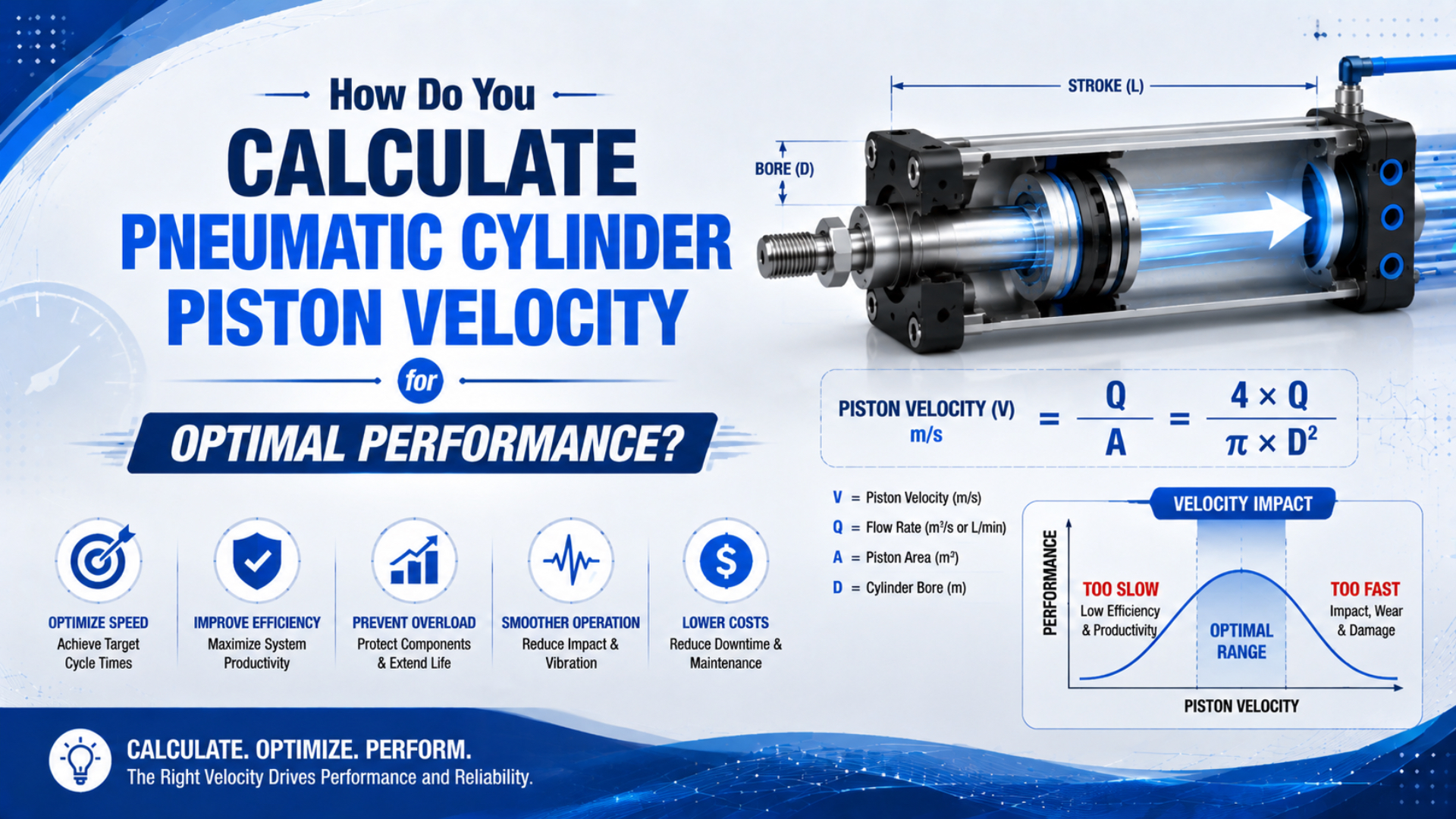
Pneumatic cylinder piston velocity is the rate at which the piston travels through the bore. Its first-pass calculation uses a simple volume balance: divide the air volume entering the active chamber each second by that chamber’s effective area. Choosing the right flow value is harder. Catalogues may state free-air flow, while the cylinder contains compressed air at several times atmospheric pressure.
Use three stages. Convert the stated free-air flow to approximate chamber flow, divide by the correct piston area, and then check the result against the valve, tubing, fittings, exhaust path, load, cushioning, and measured port pressures. Treat the answer as a first-pass speed, not a guaranteed machine result.
Key Takeaways
- Speed starts with flow divided by area.
- A 50 mm bore with a 20 mm rod has 16.0% less retract-side area, so direction matters.
- At 6 bar gauge, 200 L/min free air is about 28.6 L/min of chamber flow when temperatures are equal; valve, tubing, exhaust, and load checks still follow.
How Do You Calculate Pneumatic Cylinder Piston Velocity?
SMC publishes the relationship , where is piston speed in inches per second, is flow in SCFM, and is piston area in square inches. With a 2-inch bore supplied with 10 SCFM, that first-pass equation gives about 91.7 in/s at constant inlet pressure (SMC, retrieved 2026).
In unit-independent form:
is piston velocity, is actual volumetric flow at the cylinder chamber’s pressure and temperature, and is the effective piston area for the direction of travel. If is in mm³/s and area is in mm², velocity is in mm/s.
Do not insert a generic 0.85 or 0.90 efficiency factor into this equation. Such a factor hides several different effects, including flow-reference conditions, internal leakage, exhaust back pressure, friction, and valve restriction. Those effects should be handled with defined flow conversions, measured pressures, manufacturer data, and a final machine test. In our experience, writing the flow reference pressure and temperature beside every quoted flow value prevents more errors than adding another unexplained correction factor.
Most pneumatic catalogues state flow as normal or standard litres per minute, not as compressed volume inside the chamber. Parker distinguishes cylinder flow from compressor free-air flow and applies an absolute-pressure ratio when converting between them (Parker Schrader Bellows, retrieved 2026).
Reference conditions matter.
Under an ideal-gas assumption:
is free-air flow at reference pressure and reference absolute temperature . The terms and describe approximate chamber conditions; when the two temperatures are close, treat their ratio as 1 for a preliminary estimate.
This conversion also explains why 200 L/min from a valve catalogue cannot be divided directly by piston area. At 6 bar gauge, the absolute pressure is approximately 7 bar. Ignoring the pressure ratio can overstate chamber volume flow, and therefore calculated speed, by roughly seven times under the stated equal-temperature assumption.
Broader cylinder equations are covered in the pneumatic cylinder formula guide.
Extension and Retraction Use Different Effective Areas
A 50 mm bore with a 20 mm rod has 1,963.5 mm² of extension area but only 1,649.3 mm² of retract area. The rod removes 16.0% of the pressure-acting area, so equal chamber flow produces an ideal retraction velocity about 19.0% higher than extension velocity (Parker Cylinder Sizing Tool, retrieved 2026).
Extension uses the full piston circle:
Effective piston area is the chamber face on which pressure acts for the selected direction. On extension it is the full bore area; on retraction it excludes the rod cross-section.
For a single-rod, double-acting cylinder, the retract-side area is an annulus:
is bore diameter and is rod diameter. Enter both in the same unit to obtain area in that unit squared.
| Direction | Effective area | 50 mm bore, 20 mm rod | Consequence at equal flow |
|---|---|---|---|
| Extension | Full piston area | 1,963.5 mm² | Lower ideal speed |
| Retraction | Piston area minus rod area | 1,649.3 mm² | Higher ideal speed |
| Rodless cylinder | Check the product’s two chamber areas | Often similar, but model-specific | Do not assume without a drawing |
This 19.0% speed difference is a geometric result for the stated bore and rod combination. It does not predict that the machine will retract exactly 19.0% faster. Valve supply and exhaust characteristics may differ, a meter-out controller may be set differently on each side, and the retracting load may oppose motion.
Rod area affects both speed and force. If the calculation also needs pull-force verification, use the dedicated pneumatic cylinder rod-area guide rather than mixing force assumptions into the velocity equation.
The useful design comparison is not simply “extension versus retraction.” It is “effective area, available chamber flow, and opposing pressure for each direction.” Writing those three values in adjacent columns exposes whether a speed difference comes from geometry, flow restriction, or back pressure.
Pneumatic Cylinder Velocity Worked Example: 50 mm Bore at 200 L/min
Parker’s pneumatic application guide converts free-air demand with absolute pressure, using the ratio of gauge pressure plus 14.7 psi to atmospheric pressure. With the same temperature assumption, 200 L/min of free air at 6 bar gauge becomes about 28.6 L/min of compressed chamber flow at approximately 7 bar absolute (Parker, retrieved 2026).
Assume the following data:
- Bore diameter: 50 mm, which sets the full extension area
- Rod diameter: 20 mm
- Stroke: 100 mm between the selected end positions
- Available free-air flow: 200 L/min at the catalogue reference condition
- Working pressure: 6 bar gauge
- Reference pressure: approximately 1 bar absolute, rather than zero pressure
- Working and reference temperatures: assumed equal for this preliminary calculation, so their ratio is 1
- Supply and exhaust flow: treated as equal only for comparing the two ideal directions; the real circuit must be checked separately
First convert free-air flow to approximate chamber flow:
Then convert litres per minute to cubic millimetres per second:
The extension velocity is:
The ideal retraction velocity at the same chamber flow is:
Average full-stroke time follows from , where is stroke length:
| Direction | Effective area | Ideal velocity | Ideal time for 100 mm |
|---|---|---|---|
| Extension | 1,963.5 mm² | 242.5 mm/s | 0.412 s |
| Retraction | 1,649.3 mm² | 288.7 mm/s | 0.346 s |
These are ideal average values. They exclude valve response delay, tube filling, acceleration, cushion deceleration, friction, load variation, leakage, and exhaust back pressure. A catalogue’s 200 L/min rating may also be measured at pressure conditions that differ from the machine, so verify the rating method before using it.
Why Does the Real Cylinder Move Slower or Less Consistently?
A 2026 experimental study tested three pneumatic cylinders while recording piston position, velocity, both chamber pressures, and friction at 1.16 ms intervals. The results showed that speed emerges from coupled airflow, pressure build-up, chamber expansion, and friction, rather than from one fixed efficiency percentage (Actuators, 2026).
The ideal flow-area equation describes a volume balance, not the entire motion event. Several effects alter what the machine does:
| Effect | What happens during motion | What to measure or check |
|---|---|---|
| Valve restriction | Chamber flow falls as pressure conditions change | Manufacturer flow data and pressure at valve ports |
| Long or narrow tubing | Filling delay and pressure drop increase | Tube ID, length, fittings, and dynamic cylinder-port pressure |
| Exhaust restriction | Opposing chamber pressure reduces net force | Exhaust-side pressure during motion |
| Load and friction | Pressure must build before motion starts | Load, alignment, breakaway pressure, and velocity trace |
| Cushioning | Speed intentionally falls near end of stroke | Cushion setting and measurement window |
| Supply fluctuation | Available pressure and mass flow change between cycles | Regulator and branch pressure during peak demand |
The same 2026 study used valves rated for a maximum 720 L/min, yet still observed cylinder-dependent stick-slip at low speed. It also varied supply pressure from 3 to 7 bar and found that higher pressure shortened motion time within the tested system, but did not eliminate every small stick-slip event (Actuators, 2026). That result is a useful warning. Raising the regulator may increase available flow through a restriction, but it can also increase force, impact energy, leakage, and air use. Diagnose a slow cylinder from pressures and its full flow path before changing the setpoint.
Cycle consistency needs two velocity numbers. Average stroke velocity reveals throughput, while velocity over the middle 60% to 80% of travel reveals the flow-limited region without most acceleration and cushioning effects. When those values drift differently, the problem is probably not a single “cylinder efficiency” factor.
How Should Valves, Tubing, Ports, and Speed Controls Be Checked?
SMC’s AS speed-controller data shows a 32 mm bore, 50 mm stroke cylinder adjusted around 300 mm/s with 6 mm tubing at 0.5 MPa. SMC states that actual speed is determined by the combined effective areas of tubing, fittings, solenoid valves, silencers, and the controller, not by port thread alone (SMC, retrieved 2026).
Start at the cylinder and trace the complete supply and exhaust paths. Every restriction is in series with the next one. A large valve cannot compensate for a small elbow at the cylinder, and a large port cannot compensate for eight metres of narrow tubing.
Use this order:
- Confirm speed and motion direction.
- Record load, stroke, acceptable time, working pressure, and the point in the stroke where the target speed must be achieved.
- Calculate chamber flow from effective area and target velocity.
- Convert the result to the exact reference pressure and temperature used by the valve catalogue; otherwise two identical L/min values may represent different air mass flow.
- Compare supply and exhaust characteristics at the intended pressure ratio.
- Find the smallest internal passage through elbows, controllers, quick-exhaust valves, and silencers. Its thread label alone is not an internal-bore measurement.
- Check tube ID and length.
- Measure both cylinder-port pressures during motion, then compare the achieved central-stroke speed with the calculation.
ISO 6358-1 defines steady-state test methods for pneumatic components with fixed or variable internal flow paths. The standard remains current, has two amendments, and received a 2026 amendment covering measurement uncertainty. Its scope specifically excludes cylinders because cylinders exchange energy with the fluid during testing (ISO 6358-1, 2013; amended 2026). This boundary matters. Use ISO 6358-style data to compare valves and other flow-path components, then use a cylinder model and machine measurements for motion. A simple liquid-style expression such as does not capture the full compressible-air flow range or choked-flow behaviour.
For more detail, compare the valve flow coefficient guide, the pneumatic valve pressure-drop calculation, and the practical use of meter-out speed-control circuits.
How Do You Reverse the Calculation for a Target Stroke Time?
Parker’s application guide starts with stroke divided by time: its 30-inch stroke completed in 4 seconds equals 7.5 in/s, or 450 in/min. Parker then multiplies stroke speed by free-air consumption per inch to obtain the required free-air flow for valve and piping review (Parker, retrieved 2026).
The SI calculation follows the same sequence. First calculate target average velocity:
Then calculate required working-volume flow:
Finally convert working flow back to free-air flow:
Suppose the 50 mm bore cylinder must extend 150 mm in 0.50 s. The target average velocity is 300 mm/s. With 1,963.5 mm² extension area, the required working flow is 35.34 L/min. At 6 bar gauge, 1 bar reference pressure, and equal temperatures, that corresponds to about 247.4 L/min of free air.
Test both directions.
For retraction, the 1,649.3 mm² effective area needs approximately 29.69 L/min of working flow, or 207.8 L/min free air under the same assumptions. Extension is therefore the controlling flow direction in this example.
From our work, stating a target speed without naming the motion direction is a common source of undersized flow paths. Record both directions even when only one drives production time.
Do not add an unexplained 50% port margin to the result. Instead, select components using their documented flow method, account for known tube and fitting restrictions, and validate the achieved time. If the design starts with target time rather than available flow, use the Cylinder Flow Requirement Calculator as the next calculation step.
How Do You Verify Piston Velocity on the Machine?
The 2026 three-cylinder study used a 300 mm linear position sensor with accuracy better than 0.5% of full scale, two 1 MPa pressure sensors with accuracy better than 1% of full scale, and 1.16 ms sampling. That combination captured velocity, pressure build-up, and stick-slip together (Actuators, 2026).
For a production machine, the measurement can be simpler. Place two sensors at known positions and record the time between their transitions:
Average stroke velocity is measured displacement divided by the elapsed time across a defined travel window. It should not be confused with instantaneous peak velocity.
and are measured positions, and and are their timestamps. Use millimetres and seconds to obtain mm/s. Position the sensors away from the first acceleration zone and the final cushion zone when the goal is steady-travel speed.
For commissioning, record at least these values for both directions:
- Regulator pressure before the cycle starts
- Supply-side cylinder-port pressure throughout the central travel window
- Exhaust-side pressure, including its highest value after motion begins
- Valve command time and the first detected piston movement, so response delay remains separate from travel time
- Central-window travel time
- Total stroke time from command to the final position signal
- Load and mounting orientation
- Flow-control position, cushion setting, tube arrangement, and air temperature, recorded together so the next test can reproduce the setup
Central velocity correct? If so, investigate valve delay, tube filling, acceleration, and cushioning as separate time losses. A low central velocity points instead to sustained flow restriction or exhaust back pressure. Cycle-to-cycle variation calls for branch-pressure logging while the other actuators operate.
In our experience, one pressure gauge at the regulator rarely explains a speed problem. Two temporary gauges or transducers at the cylinder ports usually separate supply restriction from exhaust back pressure much faster, especially when the valve and cylinder are several metres apart.
Pneumatic Cylinder Velocity FAQs
ISO 6358-1 covers steady-state flow testing for pneumatic components but explicitly excludes cylinders, while SMC’s first-pass speed equation assumes constant inlet pressure. These two boundaries explain why a worksheet can estimate velocity yet still require machine testing under the real load, tubing, valve, and exhaust conditions (ISO, 2013; SMC, retrieved 2026).
Is piston velocity simply flow divided by area?
Yes, when flow means actual chamber volume per second and area means the effective area for that direction. SMC expresses the same relationship as in imperial units. The result remains a first-pass estimate because SMC also identifies port and tubing size as additional speed influences (SMC, retrieved 2026).
Should I use free-air flow or compressed chamber flow?
Convert free-air flow to approximate chamber flow before dividing by area. At 6 bar gauge, approximately 7 bar absolute, 200 L/min free air becomes about 28.6 L/min working volume when reference pressure is 1 bar absolute and temperatures are equal. Parker likewise distinguishes compressor free air from cylinder flow (Parker, retrieved 2026).
Why is retraction often faster than extension?
The rod reduces the retract-side effective area. A 50 mm bore with a 20 mm rod has 1,963.5 mm² extension area and 1,649.3 mm² retract area, so equal chamber flow gives a 19.0% higher ideal retract speed. Actual direction-to-direction speed still depends on valve flow, load, and back pressure.
Can higher supply pressure fix a slow cylinder?
Not reliably. In a 2026 study covering 3 to 7 bar, higher supply pressure reduced motion time within the tested system, but small stick-slip features could remain. Pressure changes flow through restrictions and changes force at the same time, so measure both cylinder-port pressures before raising the regulator (Actuators, 2026).
How should I measure cylinder velocity?
Use a defined travel window. For steady-travel speed, measure position change across the central 60% to 80% of the stroke instead of including both ends. The 2026 study sampled position and two chamber pressures every 1.16 ms; production troubleshooting can use two sensors plus synchronized port-pressure logging (Actuators, 2026).
Sources and technical references
-
SMC, Control Air Flow of Cylinders, retrieved July 19, 2026.
-
SMC, AS Series Speed Controller Flow Rate Characteristics, retrieved July 19, 2026.
-
Parker, Pneumatic Cylinder Application Engineering Guide, retrieved July 19, 2026.
-
Parker, Schrader Bellows Air Requirements, retrieved July 19, 2026.
-
ISO 6358-1:2013, Pneumatic Component Flow-Rate Characteristics, confirmed 2022, amendments through 2026, retrieved July 19, 2026.
-
Actuators, Experimental and System-Level Simulation Study of Stick-Slip Characteristics in Pneumatic Cylinders, 2026, retrieved July 19, 2026.