

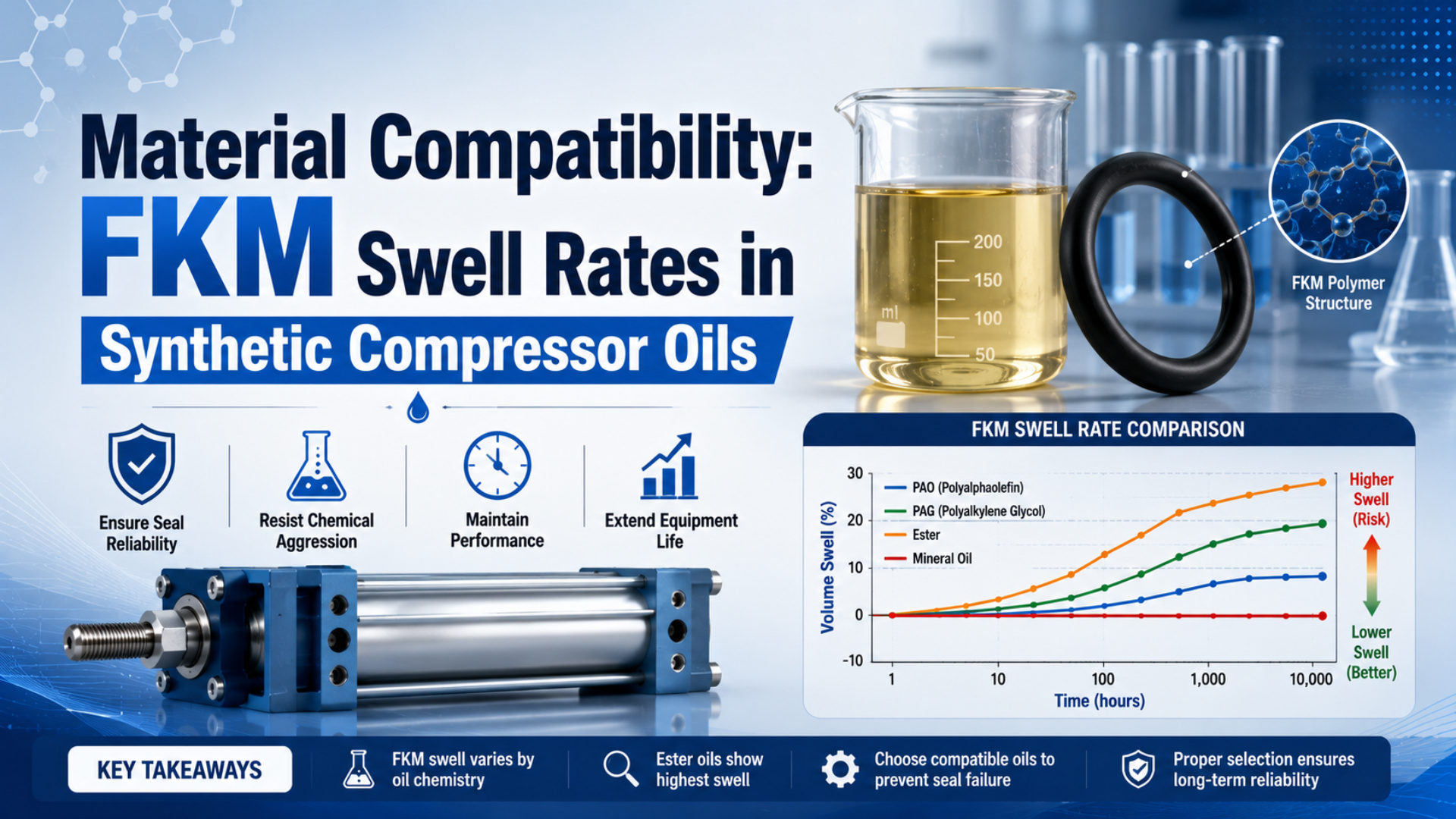
There is no defensible universal FKM swell rate for PAO, PAG, or ester-based compressor oils. A useful result belongs to one identified FKM compound, one complete lubricant formulation, one exposure mode, and one controlled test schedule. Change any of those inputs and the measured volume change can move enough to reverse a material decision.
That distinction matters because FKM is a polymer family, not a finished seal specification. A compressor lubricant is also more than its base-oil label. The approval question is therefore not “Is FKM compatible with PAG?” It is “Does compound X retain the required properties after exposure to oil Y under conditions Z?”
Key Takeaways
- ASTM D471 evaluates seven categories of liquid-related property change.
- PAO, PAG, and ester labels cannot replace exact oil, compound, and approval evidence.
- Set application-specific limits before testing.
- Requalify after an oil, additive package, seal compound, temperature, or exposure change.
What Do FKM Swell Rates Actually Measure?
ASTM D471-16a(2021) covers seven response categories, including changes in mass, volume, dimensions, hardness, tensile properties, and extracted matter. An FKM swell percentage reports one result after a stated liquid exposure. By itself, it cannot predict leakage, wear, extrusion, or installed service life (ASTM D471, 2021).
Volume swell is the percentage increase in a specimen’s volume after exposure. Negative change is possible too. The liquid can enter the polymer while plasticizers or other compound ingredients migrate out, so a small net volume change may hide two opposing processes. Parker describes this concurrent absorption-and-extraction behavior in its O-ring engineering guidance (Parker O-Ring Handbook, 2025).
The measurement is useful because it shows whether a liquid changes the compound’s geometry. It is incomplete because an installed seal also depends on hardness, elastic recovery, tensile behavior, gland fill, squeeze, pressure, speed, surface finish, and lubrication. A dynamic piston seal can reject a change that a lightly loaded static O-ring tolerates.
| Test response | What it can reveal | What it cannot prove alone |
|---|---|---|
| Volume change | Swelling or shrinkage after exposure | Installed sealing life |
| Mass change | Net absorption or extraction | Which ingredients moved |
| Hardness change | Softening or hardening | Dynamic wear resistance |
| Tensile strength and elongation | Retained mechanical behavior | Gland or surface suitability |
| Visual condition | Cracks, tackiness, distortion, deposits | Long-term leakage rate |
The practical lesson is simple: report a result as “compound, oil, temperature, duration, method, specimen, and property change.” A bare statement such as “FKM swells 8% in PAG” omits the information needed to reproduce or approve it.
Why Oil-Family Labels Cannot Predict Compatibility
Chemours compares nine Viton FKM families. It shows that polymer composition, fluorine level, and cure system change fluid resistance. “FKM” therefore cannot identify one swell response. The exact compound matters as much as the complete lubricant placed in contact with it (Chemours Viton Selection Guide, 2025).
A PAO, PAG, diester, polyol ester, or other label identifies the dominant base-fluid family. Commercial compressor oils also contain oxidation inhibitors, anti-wear chemistry, corrosion protection, demulsifiers, air-release agents, foam-control additives, and other formulation components. Atlas Copco lists six such functional groups in its compressor-oil guidance (Atlas Copco, accessed July 23, 2026).
Those facts rule out a universal compatibility ranking. Parker’s material table lists FKM as a candidate for PAO, polyol ester, synthetic ester, and polyalkylene-glycol fluids, while also marking certain combinations for testing. That is screening guidance, not proof that every FKM compound works in every oil within those families.
Exposure mode deserves separate attention. Compressor shaft seals and internal components may be directly wetted by lubricant. Downstream pneumatic-cylinder seals may encounter only oil carryover, condensate, assembly grease, or lubricator oil. Full immersion can be a useful screening test, but it should not be described as an exact simulation of intermittent downstream exposure.
For broader material screening, use the pneumatic valve seal material guide and the pneumatic cylinder seal selection guide. This guide focuses on qualifying one FKM compound against one compressor oil.
How Should You Build an ASTM D471 Test Matrix?
ISO 1817:2024 is the eighth edition of the international liquid-effect test standard. It covers both service liquids and reference liquids. Build the matrix around actual service oil and controlled comparators, then fix specimen, conditioning, temperature, duration, handling, and measured properties before exposure begins (ISO 1817, 2024).
Start with a written test objective. A supplier-screening test asks whether several compounds deserve further evaluation. An oil-change qualification asks whether the approved compound behaves acceptably in both the current oil and the candidate oil. A failure investigation may compare fresh oil, field-aged oil, and a retained reference sample.
| Matrix field | Minimum identification | Why it matters |
|---|---|---|
| Seal material | Supplier, compound code, nominal hardness, batch | FKM grades are not interchangeable |
| Oil | Manufacturer, product name, viscosity grade, batch or sample ID | The additive package is part of the exposure |
| Exposure | Direct immersion, one-sided contact, oil mist, mixed liquid | Contact mode changes severity and relevance |
| Test method | ASTM D471 or ISO 1817 procedure and specimen type | Makes the result reproducible |
| Schedule | Temperature, duration, conditioning, post-exposure timing | Diffusion and property change depend on time and heat |
| Responses | Volume, mass, hardness, tensile properties, visual condition | One metric cannot describe every failure mechanism |
| Acceptance | Numeric limit, seal location, static or dynamic duty | Prevents the result being judged after the fact |
Do not use a production O-ring measured only with calipers and call that an ASTM D471 volume test. Finished seals can be included when the selected procedure permits them, but dimensional checks do not replace the prescribed volume-change method, controlled conditioning, or property measurements.
How Do You Calculate and Interpret Volume Change?
Parker notes that fluid-immersion tests are often run for 70 hours, while some specifications require 1,000 or 2,000 hours. Duration is a test input, not a universal minimum. Compare results only when method, specimen, medium, temperature, duration, and measurement timing are aligned (Parker test-report guidance, 2022).
For an initial volume and post-exposure volume , the percentage change is:
Here, is volume change in percent, is the conditioned volume before immersion, and is the volume measured after exposure using the specified procedure. Use the standard’s prescribed measurement method rather than deriving volume from one O-ring diameter.
Positive indicates net swelling. Negative indicates net shrinkage. Neither direction is automatically safe. Swelling can raise gland fill, contact pressure, friction, and extrusion risk. Shrinkage can reduce squeeze or open a leakage path. The same percentage can have different consequences in different grooves and seal profiles.
A near-zero net change is not proof that nothing happened. Oil uptake can increase volume while extracted plasticizer decreases it. That balance may produce a modest volume result alongside a meaningful hardness or tensile change. Reading volume, mass, hardness, mechanical retention, and appearance together reduces this false-negative risk.
Parker offers fallback educational bands when no specification exists: below 20% volume change as compatible, 20–40% as moderate, and above 40% as incompatible. Those bands are screening guidance. They do not override a product drawing, customer specification, compound supplier limit, dynamic-seal requirement, or safety assessment.
Consider a comparison example. A 6% result after 70 hours at 23°C is not equivalent to a 6% result after 168 hours at 100°C. The percentages match, but the schedules do not. Compare the reports only after aligning every controlled input and the post-exposure measurement procedure.
For a deeper explanation of how compound properties interact with seal geometry and lubrication, see the cylinder piston-seal material science guide.
A Pass/Fail Limit Must Belong to the Application
Parker identifies seven comparison controls for seal-property tests: method, specimen, geometry, deformation, time, temperature, and contact medium. If those controls differ, the numbers are not directly comparable. Acceptance must also account for seal location, motion, gland fill, pressure, and consequence of failure (Parker O-Ring Handbook, 2025).
Set the acceptance criteria before the laboratory sees the results. That avoids choosing a convenient limit after the candidate oil has already produced a number. The limit can come from a drawing, customer specification, seal-compound data, validated historical baseline, or an engineering qualification program.
| Decision input | Screening question | Approval evidence |
|---|---|---|
| Volume change | Will gland fill or squeeze move outside the design window? | Drawing limit plus measured result |
| Hardness change | Will pressure resistance, friction, or recovery change? | Compound specification plus measured delta |
| Tensile retention | Has the material lost mechanical margin? | Required retained property |
| Appearance | Is there cracking, tackiness, blistering, or deposits? | Defined visual acceptance standard |
| Seal duty | Static, reciprocating, rotary, or oscillating? | Application-specific validation |
| Failure consequence | Is leakage merely inconvenient or safety-critical? | Documented risk and approval authority |
Material-family substitutions deserve the same discipline. HNBR, FFKM, NBR, and polyurethane may be useful candidates, but none is a universal replacement for FKM. Screen the exact alternative compound against the same oil and operating envelope. The temperature and seal-selection guide explains why published polymer temperature ranges are not installed cylinder ratings.
In our experience, “FKM 75” is not enough to release a replacement. A usable record includes the supplier’s compound designation, seal profile, nominal hardness, oil identity, exposure conditions, and test limits. Color and generic trade names are identification aids at best, not material approval evidence.
How Should a Compressor Oil Change Be Qualified?
Atlas Copco’s current guidance identifies six functional additive groups that can shape compressor-oil behavior, including oxidation, anti-wear, demulsification, air release, foam control, and low-temperature performance. Treat a brand, product, grade, or formulation change as a new compatibility input, even when the base-oil family is unchanged (Atlas Copco, accessed July 23, 2026).
Use the current approved combination as the baseline. Retain samples and records for the current oil and compound, then test the candidate under the same method and schedule. If the system has unexplained failures, include a field-aged oil sample because oxidation products, contamination, mixed lubricants, and cleaning residues may create a different exposure from fresh oil.
- Record the current oil manufacturer, product, viscosity grade, and approval status.
- Identify the exact FKM compound and every affected seal location.
- Map direct-wetted, oil-mist, carryover, condensate, grease, and cleaning-fluid exposures.
- Obtain the candidate oil’s technical and safety documents, but do not assume they reveal the complete proprietary additive package.
- Test current and candidate oils under the same controlled conditions.
- Review volume, mass, hardness, tensile behavior, and appearance against written limits.
- Complete equipment flushing, mixing, commissioning, and inspection instructions from the compressor and lubricant suppliers.
Do not mix oils merely to create a laboratory shortcut. The actual transition procedure may itself introduce a mixed-fluid exposure. If mixing can occur during changeover, it needs its own compatibility and operational review.
The same logic applies downstream. If compressor carryover is the suspected source of pneumatic-cylinder seal damage, verify the contamination path before blaming the base-oil family. Review separation, filtration, drains, condensate, maintenance history, and any point-of-use lubricator. Our guide to gasket and seal compatibility in pneumatic cylinders provides the wider exposure inventory.
What Should the Test Report and RFQ Record?
ASTM D471 contains seven liquid-effect response categories, while ISO 3601-5:2015 addresses elastomeric-material specifications for industrial O-rings. A procurement record should connect the test result to the named compound, seal location, oil, method, conditions, acceptance limits, and approving parties instead of attaching an isolated percentage (ISO 3601-5, 2015).
Use this minimum record:
- equipment and seal location;
- static or dynamic duty, pressure, speed, temperature, and exposure mode;
- seal drawing, profile, dimensions, supplier, and compound code;
- nominal hardness and material batch or certificate;
- oil manufacturer, product name, viscosity grade, batch, and sample condition;
- ASTM D471 or ISO 1817 procedure, specimen type, conditioning, time, and temperature;
- baseline and post-exposure volume, mass, hardness, tensile properties, and visual findings;
- calculation method, measurement timing, deviations, and laboratory identification;
- property-specific acceptance limits and their source;
- approval, rejection, conditional-use decision, and change-control trigger.
The record should also state what the test does not cover. Full immersion may not duplicate oil mist. A sheet specimen may not reproduce a molded seal’s cure history. A short test does not establish years of service. These limitations do not make the test useless; they define the next validation step.
This evidence package keeps the article distinct from a generic material chart. It also gives purchasing and engineering teams a shared language for supplier comparison, replacement review, and oil-change control.
FKM and Synthetic Compressor Oil FAQs
Parker’s fallback guidance uses three volume-change bands, below 20%, 20–40%, and above 40%, only when a specification lacks limits. The five answers below retain that caveat: named compound data and application-specific acceptance criteria outrank a generic chart or polymer-family label (Parker test-report guidance, 2022).
Is FKM always compatible with PAO compressor oil?
No. PAO is a useful base-fluid classification, and FKM is commonly screened for hydrocarbon oils, but neither term identifies a finished formulation. Approve the exact FKM compound against the exact PAO compressor oil, including its additive package, at the relevant temperature, duration, and exposure mode.
Does PAG compressor oil always cause excessive FKM swelling?
No. Parker lists FKM among candidate materials for polyalkylene-glycol fluids, with testing required for some configurations. That does not guarantee compatibility. It shows why a blanket PAG failure range is unreliable. Test the named compound and oil, then judge all required property changes against the application limit.
Is 10% volume swell an ASTM D471 failure?
Not automatically. ASTM D471 provides test procedures, not one universal 10% rejection criterion. A project specification may impose that limit, but it must identify the compound, liquid, conditions, property, and seal duty. Static and dynamic seals can require different margins even when their measured volume change is identical.
Can calipers measure FKM volume swell accurately?
Calipers can document selected dimensional changes, but one diameter does not establish ASTM D471 volume change for an O-ring. Use the procedure and specimen method specified by the governing test plan. Record dimensional inspection separately when seal geometry or gland fit is part of the engineering decision.
Should an oil change trigger a new compatibility test?
Yes, when the manufacturer, product, grade, formulation, or exposure condition changes and existing compound-level evidence does not cover the new state. Test the approved and candidate oils under matched conditions. Also review flushing and mixed-oil exposure because the transition can create a medium different from either fresh lubricant.
Sources and technical references
- ASTM International. ASTM D471-16a(2021), Standard Test Method for Rubber Property—Effect of Liquids. Retrieved July 23, 2026: https://store.astm.org/standards/d471
- International Organization for Standardization. ISO 1817:2024, Rubber, vulcanized or thermoplastic—Determination of the effect of liquids. Retrieved July 23, 2026: https://www.iso.org/cms/%20render/live/en/sites/isoorg/contents/data/standard/08/66/86602.html
- International Organization for Standardization. ISO 3601-5:2015, Specification of elastomeric materials for industrial applications. Retrieved July 23, 2026: https://www.iso.org/ics/23.100.60/x/
- Parker Hannifin. O-Ring Handbook. Retrieved July 23, 2026: https://www.parker.com/content/dam/Parker-com/Literature/Praedifa/Catalogs/Catalog_O-Ring-Handbook_PTD5705-EN.pdf
- Parker Hannifin. How to Read a Rubber Seal Test Report. Retrieved July 23, 2026: https://discover.parker.com/oes-webinar-how-to-read-a-rubber-seal-test-report
- Chemours. Viton Fluoroelastomers Selection Guide. Retrieved July 23, 2026: https://www.chemours.com/en/-/media/files/viton/viton-selection-guide.pdf
- Atlas Copco. How to Choose the Right Oil for Your Compressor. Retrieved July 23, 2026: https://www.atlascopco.com/en-uk/compressors/customerbenefit/choose-the-right-oil-for-your-compressor