

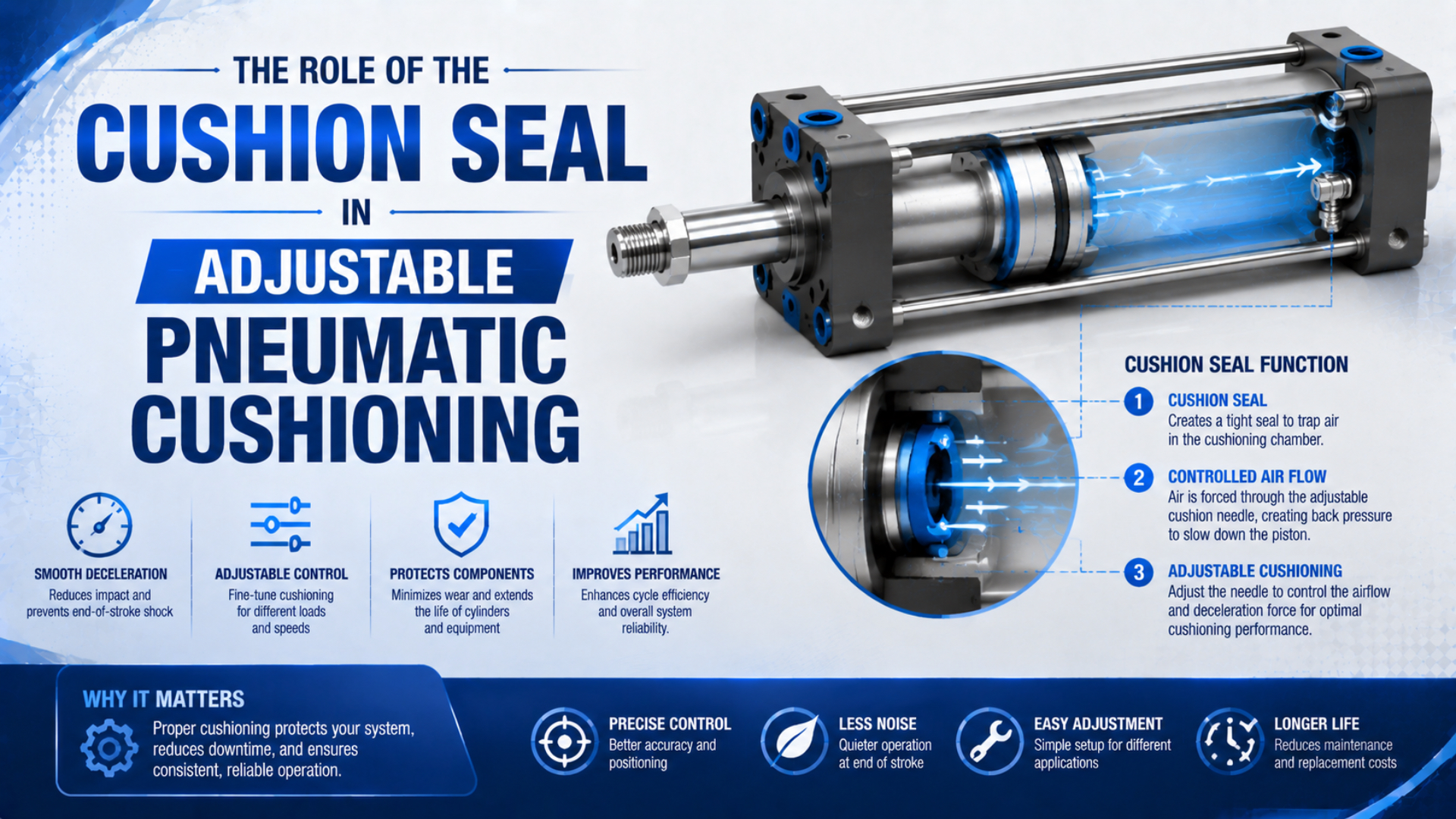
A cushion seal changes the exhaust route during the final part of a pneumatic cylinder stroke. When the cushion sleeve or spear enters the seal, the main exhaust path closes and trapped air must leave through the adjustable needle passage. On reversal, many purpose-designed seals also uncover a freer inlet path so the piston can leave the cushion zone without a sluggish start. That dual action is easy to miss. The seal is not the adjustment screw, and the screw is not the energy absorber. The moving piston compresses the trapped air; the seal creates the controlled chamber; the needle meters its discharge. Parker describes one cushioning-ring profile as both an end-position seal and a return-stroke valve (Parker Pneumatic Seals, 2025).
Key Takeaways
- A cushion seal closes the main exhaust path; the needle controls the remaining flow.
- Parker rates one dedicated profile to 16 bar and 1 m/s, not every cylinder seal.
- Slow reversal can come from the seal’s valve function, while hard impact may come from seal bypass, excess energy, or incorrect adjustment.
What Does a Cushion Seal Actually Do?
Parker rates its PP cushioning seal to 16 bar and 1 m/s, but those figures apply to that documented profile rather than every pneumatic cylinder. Its primary role is more general: seal against the cushion piston or spear at end position and act as a valve when motion reverses (Parker Pneumatic Seals, 2025).
Throughout the stroke, the main piston seal separates the working chambers. Its cushioning counterpart has a narrower assignment. It becomes active near one end of travel, where a sleeve, boss, taper, or spear enters its lip. Before engagement, air exits through the normal port. After engagement, the trapped volume discharges through the smaller cushion passage. SMC describes the same three-part relationship: the cushion ring contacts the cushion seal, compressed air is trapped around the stroke end, and the cushion valve regulates the exhaust of that trapped air (SMC Air Cylinder FAQ, retrieved 2026). Product families vary, but the functions remain distinct.
Cushion seal is the profile that isolates the trapped-air chamber. Cushion sleeve is the moving taper, boss, or spear entering that profile. Cushion needle is the restriction that meters air from the chamber.
| Part | Job during cushioning | What it does not determine alone |
|---|---|---|
| Cushion sleeve, spear, or boss | Enters the seal and closes the normal exhaust route | Final damping rate |
| Cushion seal or ring | Creates the trapped chamber and may provide return-flow check action | Allowable moving energy |
| Needle valve or cushion screw | Meters exhaust from the trapped chamber | Whether the seal lip is intact |
| Cylinder and external load | Supply the moving and drive energy that must be absorbed | Seal compatibility |
Calling every one of these parts a “cushion” makes troubleshooting harder. A damaged sleeve can imitate a leaking seal. A closed needle can imitate a blocked exhaust. Excess moving energy can overwhelm a healthy mechanism.
The Four Operating States of Adjustable Cushioning
Parker’s Series MA check-seal design uses four molded face grooves and allows the seal to float laterally and radially within set limits. Those details explain its two flow modes: the lip traps exhaust during cushion entry, while the grooves provide a lower-restriction path when pressure reverses (Parker Series MA, 2025).
This state change matters during fault finding. If the piston decelerates correctly but hesitates when it reverses, the metering adjustment can be acceptable while the return-flow path remains restricted. Dirt, a swollen lip, incorrect orientation, a wrong replacement profile, or a trapped seal can disturb that path. Across Parker’s SR range, the adjustable cushion option covers nine bore sizes from 0.75 to 3.0 inches, and the check seal floats forward during reversal to create a high-flow path to the piston face (Parker SR Series, retrieved 2026).
If the cylinder leaves the end position normally but strikes the cap on arrival, look at the sealing state instead. The sleeve can stop short of the lip, a worn lip can bypass air, or trapped energy can exceed the cylinder’s allowable cushion chart.
One component therefore produces two diagnostic signatures. Arrival tests its sealing function. Departure tests its valve function. Checking both directions is more useful than judging the component from impact noise alone.
What Does the Needle Adjust?
Festo identifies five variables that affect adjustable PPV cushioning: moving mass, speed at cushioning, target deceleration, working pressure, and internal cylinder resistance. The needle changes only the exhaust restriction; it cannot repair a damaged cushion lip or increase the manufacturer’s permissible energy envelope (Festo Cylinder Cushioning, 2022).
Closing the needle reduces the bleed area. Pressure then rises more quickly in the trapped end chamber and the piston slows more strongly. Opening it reduces that back pressure. Neither direction is automatically correct, and a copied turn count has little value across different bores, end covers, loads, or product families. SMC’s general air-cylinder guidance recommends starting from a closed valve and opening it gradually, while also noting that its RQ and CXS series use different cushion arrangements (SMC Air Cylinder FAQ, retrieved 2026). That is a manufacturer-specific procedure, not permission to force every cushion screw against its seat.
Hardware also changes the safe adjustment boundary. Parker’s C41 catalog places the cushion screws beside the ports and secures them against accidental removal under pressure (Parker C41 Cylinders, retrieved 2026).
Use the exact cylinder manual. Some designs warn against continuous operation at a fully closed setting. Stop if adjustment produces no meaningful change, because that points toward bypass, a blocked passage, incomplete sleeve engagement, or an energy problem rather than a simple setting error.
For the full commissioning sequence, see the pneumatic cushion needle adjustment guide. This article stays with the seal’s role.
How Can You Separate Seal Bypass From Other Faults?
Catalog guidance from Parker says piston speed at the start of cushioning can be about 50% higher than average stroke speed. A hard stop can therefore overload an intact seal even when stroke-time calculations look acceptable; test entry speed, load, and both stroke directions before blaming the seal (Parker P1F ISO 15552 Catalogue, retrieved 2026).
Start with the symptom, not the spare part. Seal bypass changes one end more than the other and responds weakly to needle adjustment. Energy overload follows mass or speed. External exhaust restriction affects more of the stroke and can change both ends.
Use a controlled sequence:
- Record which end strikes and whether the fault occurs on every cycle.
- Reduce speed and load within the approved test procedure.
- Check whether small needle changes alter the final travel.
- Compare arrival behavior with departure from the same end.
- Inspect only after isolating compressed air and any gravity or spring load.
In our experience reviewing cylinder replacement requests, the most useful split is “hard on arrival, slow on departure.” That combination directs attention to both sides of the cushion seal’s behavior. A general note such as “cushion failed” does not. For the complete isolation test, use the cylinder cushion failure diagnostic guide. When moving energy is the likely branch, use the Cylinder Cushion Energy Calculator as a screening aid, then compare the result with the exact cylinder catalog.
Material, Geometry, and Installation Are One Specification
One Parker catalog lists standard NBR at about 85 Shore A, FKM at about 90 Shore A, and polyurethane at about 94 Shore A for its PP cushioning profile. Those numbers show why material name alone is insufficient: hardness, lip geometry, groove dimensions, speed, temperature, and media must be evaluated together (Parker Pneumatic Seals, 2025).
Cushion-seal compound is not automatically the same as the piston seal, rod seal, or needle O-ring. SMC’s CM2 construction data, for example, identifies a urethane cushion seal and an NBR cushion-needle seal in the same cylinder family (SMC CM2 Construction, retrieved 2026).
| Selection input | Why it matters to the cushion seal | Evidence to request |
|---|---|---|
| Sleeve or spear diameter | Sets lip interference and sealing contact | Measured diameter and end-cover section drawing |
| Groove diameter and width | Controls whether a floating or fixed profile can move correctly | Manufacturer drawing, not only bore size |
| Compound and hardness | Affect wear, temperature response, swelling, and lip flexibility | Exact material code and temperature range |
| Lubricated or non-lubricated air | Changes installation grease and running film requirements | Air preparation and lubricant record |
| Cleaning chemicals or washdown | Can swell, harden, or extract additives from elastomers | Chemical name, concentration, temperature, exposure time |
| Surface finish and edge condition | Sharp edges can cut the lip during assembly | Close-up photos and dimensional inspection |
Installation guidance from Parker tells technicians to remove contamination from the groove, protect the sealing lip from sharp edges, and apply initial lubrication. These are profile-specific requirements, not optional housekeeping. A nick created during assembly can look like rapid material incompatibility after the cylinder returns to service. For broader context, the industrial cylinder seal selection guide explains rod, piston, wiper, static, and cushion-seal roles. Don’t substitute one profile for another because the diameters appear close.
When Should a Cushion Seal Be Replaced?
Parker publishes a maximum 1 m/s sliding speed for its PP profile, with listed temperature ranges of -20°C to +80°C for one NBR version and -35°C to +80°C for one polyurethane version. Replacement timing must therefore follow condition and the exact catalog envelope, not a universal cycle count (Parker Pneumatic Seals, 2025).
Replace or rebuild after the diagnosis confirms damage, not merely because the cylinder is loud. Useful evidence includes a cut or permanently deformed lip, missing material, chemical swelling, hardening, loss of adjustment response after passages are confirmed clear, or persistent bypass with the correct sleeve engagement.
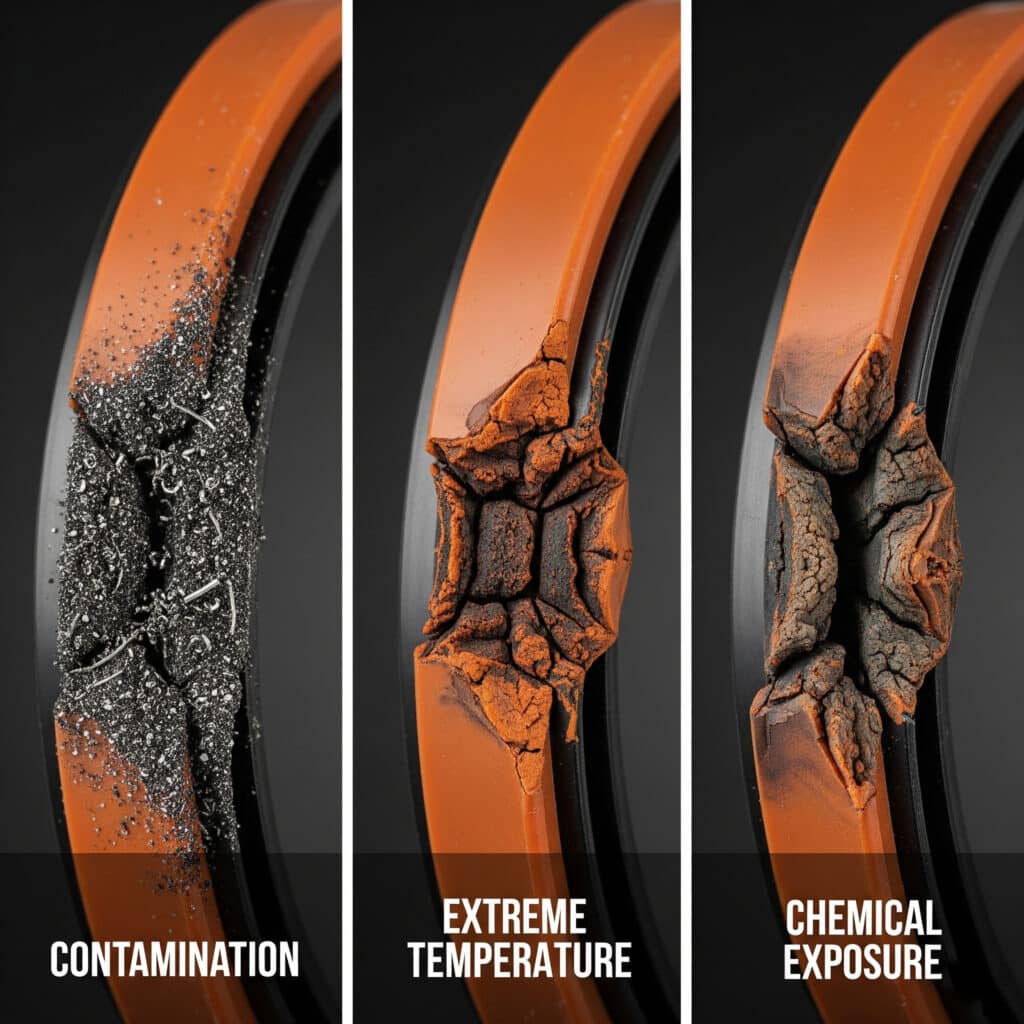
Illustrative seal damage patterns. Appearance alone cannot identify the compound, exposure history, or whether a cushion seal is responsible for an end-stroke fault.
Do not replace only the visible elastomer when another part caused it to fail. Inspect the cushion sleeve or spear for scoring and burrs, the end-cover bore for damage, the needle and bleed passage for contamination, and the guide system for side load. Reusing a damaged mating surface can cut a new lip during the first strokes. Air quality belongs in the same inspection. Water, rust, pipe scale, lubricant changes, and debris can collect in small cushion passages or abrade the sealing edge. If contamination is present, connect the cylinder repair with the plant’s compressed-air quality review instead of treating the seal as an isolated consumable.
Never use cushioning as an energy-isolation method. Before opening an end cover, isolate the air supply, exhaust trapped pressure, secure vertical or spring-loaded mechanisms, and follow the cylinder manufacturer’s disassembly instructions.
Service Records and Replacement RFQ Data
A Parker PP dimensional table lists more than a dozen cushioning-seal sizes, from 14 x 22 mm through 78 x 95 mm. That range shows why “seal for a 50 mm cylinder” is not a complete identifier; the profile, sleeve, groove, compound, and end-cover design still have to match (Parker Pneumatic Seals, 2025).
Record the setting before disassembly. Count turns only when the manual allows that method, and never force the screw against its seat to create a reference. Photograph the end cover, port layout, cushion screw, sleeve or spear, removed seal orientation, and any damage.
We’ve found that a pre-cleaning photograph preserves debris tracks and one-sided wear that disappear after parts are wiped. Take that image before measuring the lip or groove.
For a replacement RFQ, provide:
- Cylinder manufacturer, series, bore, stroke, and full model code.
- Head-end, cap-end, or both-end cushion location.
- Sleeve or spear diameter and clear photographs with a scale.
- Groove dimensions when the original part number is unavailable.
- Operating pressure, measured stroke time, load, orientation, and cycle rate.
- Air lubrication, temperature, washdown chemicals, and contamination history.
- Symptom on arrival, symptom on reversal, and response to a small approved adjustment.
- Existing seal-kit number, material marking, and end-cover drawing if available.
The arrival-versus-departure record adds information that a static photograph cannot. It tells the reviewer whether the request concerns sealing, return-flow valve action, or both. Pair that behavior with dimensions and operating conditions before selecting a replacement compound.
Cushion Seal FAQs: What Should Technicians Check?
SMC names two cylinder families, RQ and CXS, whose air-cushion designs do not use conventional cushion rings. That exception is a useful warning: visible adjustment hardware does not prove that a standard cushion-seal profile is inside. Start every repair with the exact series construction and service instructions (SMC Air Cylinder FAQ, retrieved 2026).
Is a cushion seal the same as a piston seal?
No. The piston seal separates the two working chambers through most of the stroke. The cushion seal becomes active near an end position when a sleeve, boss, or spear enters it. It closes the normal exhaust path and, in some designs, also provides a freer supply path when motion reverses.
Can a new cushion seal fix every hard end-stroke impact?
No. A hard impact can come from excessive entry speed, too much moving mass, a needle setting that is too open, incomplete sleeve engagement, external exhaust changes, or a damaged seal. Reduce energy safely and test adjustment response before opening the cylinder or ordering a seal kit.
Why can a cylinder decelerate correctly but hesitate on reversal?
Purpose-designed cushion seals can also act as check valves. They seal during cushion entry, then shift or vent to admit supply air during reversal. Dirt, swelling, incorrect orientation, or the wrong profile can restrict that return-flow path even when the metered exhaust produced an acceptable stop.
Can cushion-seal material be selected from temperature alone?
No. Temperature is only one input. Match the compound with lip geometry, hardness, groove size, sleeve finish, pressure, speed, lubrication state, compressed-air contaminants, cleaning chemicals, and installation method. Use the cylinder or seal manufacturer’s exact profile data rather than a generic NBR, FKM, or polyurethane chart.
What is the minimum information needed for a replacement request?
Provide the full cylinder model, bore, stroke, cushion end, seal-kit number if known, sleeve or spear diameter, groove dimensions, photos, pressure, stroke time, load, orientation, temperature, air preparation, and chemical exposure. Also describe arrival impact, reversal delay, and whether approved needle adjustment changes the symptom.
Sources and technical references
- Parker Prädifa. Pneumatic Seals, Cushioning Seal PP and V6. Product catalogue PTD3351 EN. Retrieved July 19, 2026.
- Parker Hannifin. Series MA Air Cylinders and Pneumatic Check Seal Cushion. Retrieved July 19, 2026.
- Parker Hannifin. P1F ISO 15552 Pneumatic Cylinders Technical Catalogue. Retrieved July 19, 2026.
- Parker Hannifin. SR Series Stainless Steel Body Air Cylinders. Retrieved July 19, 2026.
- Parker Hannifin. C41 Pneumatic Cylinders. Retrieved July 19, 2026.
- SMC Corporation. What Is the Function of the Cushion Valve on Air Cylinders?. Retrieved July 19, 2026.
- SMC Corporation. CM2 Cylinder Construction and Cushion-Seal Materials. Retrieved July 19, 2026.
- Festo. Cylinder Cushioning: The Three Most Common Methods. Published 2022. Retrieved July 19, 2026.