

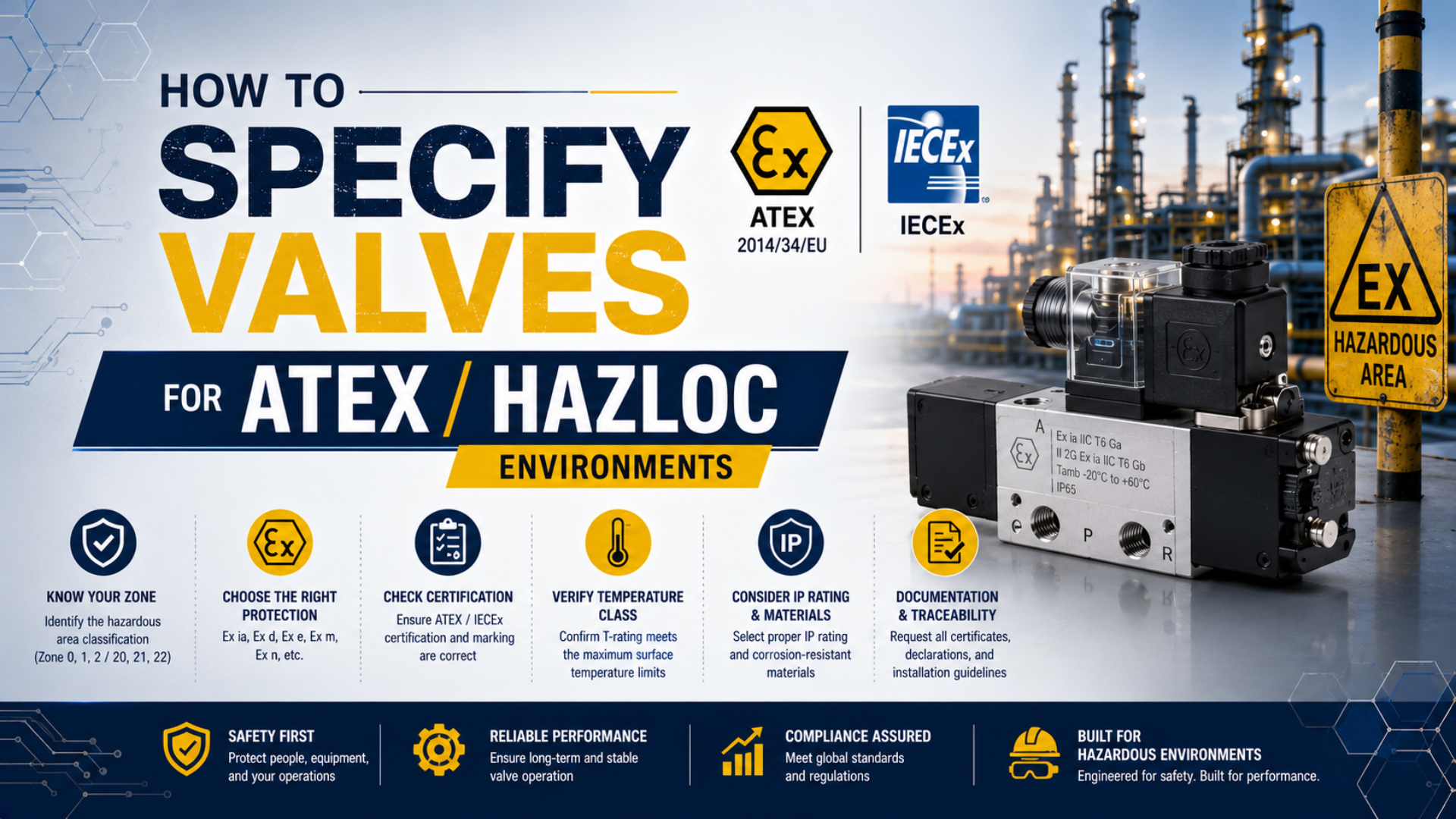
Specify an ATEX or HazLoc valve from the classified-location document, then verify the exact product marking, certificate scope, ambient range, temperature code, electrical entry, valve function, process compatibility, and installation conditions. ATEX, IECEx, and North American approvals are separate evidence paths. One label cannot be assumed to satisfy another jurisdiction.
OSHA recognizes nine hazardous-location designations in 29 CFR 1910.307, while EU workplace rules define six gas and dust zones. A useful RFQ therefore starts with the site’s classification and applicable jurisdiction, not with a request for a generic “explosion-proof valve” (OSHA, accessed 2026; EUR-Lex, 1999).
Key Takeaways
- ATEX, IECEx, and North American HazLoc evidence are not interchangeable.
- Match the complete valve assembly, not only the solenoid coil.
- Copy the full marking and certificate conditions into the technical review.
- Let the site classification and authority having jurisdiction control final acceptance.
For an EU-only chemical-plant selection, use the narrower ATEX solenoid valve guide. This article addresses the harder procurement problem: writing one valve specification that keeps EU and North American approval evidence separate.
Why Can’t ATEX and HazLoc Be Treated as Equivalent?
OSHA states that an ATEX certificate or CE mark does not replace the specific NRTL mark required for covered equipment in the United States. The EU product directive, Directive 2014/34/EU, uses its own conformity procedures and marking rules. Dual-market equipment must carry evidence accepted by each destination (OSHA NRTL FAQ, accessed 2026; EUR-Lex, 2014).
ATEX is the EU legal framework for equipment and protective systems intended for potentially explosive atmospheres. Directive 2014/34/EU governs covered products placed on the EU market. Directive 1999/92/EC separately assigns workplace explosion-risk duties to employers, including area classification and the explosion protection document. HazLoc is a North American shorthand for hazardous classified locations. In the United States, OSHA 29 CFR 1910.307 addresses electrical equipment and wiring in such locations and points to Class/Division or Class I Zone designations. Product acceptance commonly depends on an NRTL listing or labeling within the laboratory’s recognized scope and on the authority having jurisdiction.
IECEx is an international conformity-assessment system based on IEC and ISO standards. Its online certificate system provides the controlled certificate record. IECEx can support projects across jurisdictions, but national or regional law still decides whether additional approval is required (IECEx Certified Equipment Scheme, accessed 2026).
A dual-market specification should contain separate ATEX and HazLoc acceptance columns. An “equivalent certification” row hides the exact evidence the reviewer needs: marking, issuing body, certificate status, model coverage, special conditions, and installation rules.
From our analysis of current EU, IECEx, and OSHA requirements, the safest procurement pattern is to keep the site’s classification unchanged and review each market’s evidence on its own terms.
How Do You Turn Area Classification into a Valve Specification?
Directive 1999/92/EC defines Zones 0, 1, 2 for gas, vapour, or mist and Zones 20, 21, 22 for combustible dust. OSHA separately lists nine Class/Division and Class I Zone designations. Copy the project’s actual classification instead of translating it from memory (EUR-Lex, 1999; OSHA, accessed 2026).
Obtain the signed hazardous-area drawing, equipment schedule, or explosion protection document from the facility. A valve vendor should not invent the zone extent, substance group, or temperature requirement from a process description. In the United States, OSHA requires documented classified areas to be available to people who design, install, inspect, maintain, or operate the electrical equipment.
Record these site inputs before selecting a model:
- installation country and authority having jurisdiction;
- applicable classification scheme and exact area designation;
- gas, vapour, mist, dust, fibre, or flying hazard;
- gas or dust group and the named substance;
- required temperature class or maximum surface temperature;
- minimum and maximum ambient temperature at the valve;
- indoor, outdoor, washdown, corrosion, impact, vibration, and dust exposure, including nameplate readability, impact protection, drainage, and whether residue can reach or block the cable entry;
- electrical supply, control method, cable construction, and grounding concept;
- pneumatic function, port size, pressure range, flow, fail state, and duty cycle;
- process medium, external chemical exposure, seal requirements, and leakage limit.
Do not write Zone 1 / Division 1 as if the two labels were interchangeable. OSHA’s rulemaking explains that the Class I Zone system has three levels while the Division system has two; Zone 0 and Zone 1 fall within the broader Division 1 side of its comparison. The project’s adopted scheme must remain explicit (OSHA Electrical Standard Final Rule, 2007).
The valve’s functional design is a separate decision. Establish whether the circuit needs a 2/2, 3/2, or directional spool valve; direct acting or pilot operation; minimum differential pressure; manual override; spring return; and de-energized state. The direct-acting and pilot-operated valve comparison covers that pneumatic boundary.
What Must Match on an ATEX or IECEx Marking?
Directive 2014/34/EU defines three Group II equipment categories, while ISO 80079-36:2016 covers non-electrical equipment with its own potential ignition sources across Groups I, II, and III. The applicable assessment depends on the product boundary and intended use, not on the word “pneumatic” (EUR-Lex, 2014; ISO, 2016).
For an EU project, request the exact EU Declaration of Conformity and compare its manufacturer, product family, model code, directives, standards, and authorized signature with the quotation and nameplate. Category 3 Group II equipment can use internal production control under the directive, so a missing notified-body number is not automatically a defect. The required conformity route must be checked for that category and product type.
Read the whole marking string.
An illustrative gas marking such as II 2G Ex db IIC T4 Gb contains several different decisions:
| Marking element | Question for the reviewer |
|---|---|
II |
Is the equipment group correct for a non-mining surface installation? |
2G |
Does the ATEX category and atmosphere type match the workplace zone? |
Ex db |
Is the protection concept permitted and installed exactly as certified? |
IIC |
Does the gas group cover the substance named by the site? |
T4 |
Is the maximum surface-temperature class acceptable at the stated ambient? |
Gb |
Does the Equipment Protection Level match the required level? |
This is only a reading example. Never construct an approval marking from the table. Copy it from the controlled nameplate, declaration, certificate, and schedule.
Check suffixes and limits. An X suffix signals special conditions for safe use. A U suffix identifies an Ex component that normally requires additional assessment when incorporated into complete equipment. Ambient range, cable-entry restrictions, approved fasteners, duty cycle, orientation, enclosure conditions, and process-temperature limits can be as important as the main marking.
IECEx adds a useful public check. The IECEx scheme says equipment is not IECEx certified unless its certificate appears in the official Online Certificate System. Confirm the exact model, certificate status, revisions, conditions, and whether the record covers complete equipment, a component, or unit verification (IECEx FAQ, accessed 2026).
Check the exact model, not its family name.
What Must Match for North American HazLoc Approval?
OSHA 1910.307 requires covered electrical equipment to be intrinsically safe, approved for the hazardous location, or demonstrated safe under the rule’s permitted route. Approved equipment must match the class and the ignitable properties of the specific gas, vapour, dust, or fibre present (OSHA 1910.307, accessed 2026).
Do not accept a generic statement such as “UL components used” or “designed to NEC.” Check the registered certification mark on the product and confirm that the issuing NRTL is recognized for the applicable product standard. Then match the listing record or controlled documentation to the complete quoted model.
For a Class/Division installation, record at least:
- Class I, II, or III;
- Division 1 or 2;
- material group;
- temperature code or marked operating-temperature range;
- ambient-temperature basis and any extended ambient marking;
- enclosure and environmental rating required by the installation;
- exact voltage, frequency, power, and duty;
- permitted wiring method, conduit seal, cable entry, connector, and grounding, including any required sealing-fitting location and minimum engagement stated by the approval;
- control drawing and entity parameters for an intrinsically safe loop;
- model options and accessories included within the listing.
For a Class I Zone installation, retain the full Zone designation and the protection, group, temperature, and EPL information required by the adopted code. OSHA permits the Class I Zone system as an alternative to the Division system only when the classified space is handled consistently under the rule. Do not mix labels from both schemes on one location line. OSHA also states that ATEX certification is not the required U.S. approval. Equipment intended for covered hazardous-location use in the United States normally needs the specific mark of an OSHA-recognized NRTL qualified for that equipment. Canadian and other North American projects must be checked against their own adopted code, certification, provincial, and site requirements rather than copied from a U.S. schedule. A U.S. listing alone does not prove acceptance in Canada. The project authority must confirm the final approval basis in writing.
How Do You Verify the Complete Valve Assembly?
IECEx distinguishes three product-certification options: a Certificate of Conformity for complete equipment, a component certificate, and unit verification for a specific unit or limited series. A certified coil or component does not automatically certify the assembled valve (IECEx Certified Equipment Scheme, accessed 2026).
A coil is not the whole valve.
Treat the certified boundary as a controlled bill of materials:
| Assembly item | Evidence to compare |
|---|---|
| Valve body | Exact model, function, pressure, port, material, revision, and allowed medium |
| Solenoid coil | Marking, voltage, frequency, power, duty, ambient range, and protection concept |
| Connector or terminal box | Approved part number, orientation, wiring method, and enclosure conditions |
| Cable gland or conduit entry | Certification, thread, cable diameter, group, temperature, sealing, and IP conditions |
| Blanking element | Approved type for every unused entry |
| Seals and internal parts | Compound, temperature, chemical compatibility, and approved option code |
| Manual override | Whether it is fitted, permitted, lockable, or restricted by the certificate |
| Manifold and accessories | Whether adapters, silencers, regulators, and mounting parts remain inside the assessed configuration |
An ordinary valve fitted with an Ex coil is not automatically an approved assembly. The coil may be certified as a component, or its certificate may name only certain valve families, connectors, glands, and mounting arrangements. Ask the manufacturer to identify the precise certified product boundary in writing.
The weakest link is often a small accessory. A correct coil paired with an unapproved connector, reducer, blanking plug, or cable gland can break the claimed protection concept even though the main valve part number looks right.
Stop there.
For replacement work, capture the old nameplate and installed accessories before requesting alternatives. The solenoid valve OEM replacement checklist covers function, pressure, electrical, dimensional, and connection checks that remain necessary after the hazardous-location evidence passes.
RFQ Evidence and Acceptance Checklist
Directive 2014/34/EU requires product instructions to include the information needed for safe installation, use, maintenance, and assessment of suitability. A complete engineering RFQ should request controlled documents before the purchase order, not after the valve reaches the site (EUR-Lex, 2014).
Provide the supplier with:
- Project country, site, tag number, and authority having jurisdiction.
- Controlled hazardous-area classification and named hazardous substance.
- Required ATEX, IECEx, NRTL, or other jurisdiction-specific evidence in separate fields.
- Ambient, process, corrosion, ingress, washdown, vibration, and impact conditions.
- Valve function, normal state, fail state, ports, flow, pressure, medium, leakage, and cycle rate.
- Electrical voltage, frequency, power, duty, control output, cable type, and entry thread.
- Required connector, gland, blanking element, manual override, manifold, and accessories.
- Documentation language, nameplate photograph, drawing, and traceability requirements.
Request these deliverables for technical review:
- exact order code and complete marking string;
- current EU Declaration of Conformity for an ATEX claim;
- certificate and schedule where applicable;
- IECEx Online Certificate System record when IECEx is required;
- NRTL listing evidence and product marking for a U.S. HazLoc claim;
- installation, operation, inspection, and maintenance instructions;
- every special condition for safe use;
- control drawing and entity parameters for an intrinsically safe circuit, including associated-apparatus limits, grounding concept, segregation rules, and permitted cable capacitance and inductance where applicable;
- permitted glands, plugs, connectors, accessories, and replacement parts;
- written confirmation of media and external chemical compatibility;
- dimensional drawing and nameplate layout;
- deviations from the requested specification, stated line by line.
Reject phrases such as “ATEX ready,” “HazLoc compatible,” “equivalent certification,” or “certified components used” unless the supplier maps them to the exact model and controlled evidence. Marketing language is not a substitute for a declaration, listing, certificate, schedule, or installation instruction.
Use a separate deviation register. If the supplier proposes a different protection concept, group, temperature code, ambient range, connector, gland, seal, or valve function, the engineering reviewer should accept or reject that deviation explicitly. Silence in a quotation should not count as compliance.
Calculator tools: none. Area classification, ignition risk, certificate validity, and jurisdictional acceptance cannot be established with a pneumatic calculator. Valve flow can be checked later with the site’s approved sizing method after the safety and certification boundary is fixed.
Installation, Inspection, and Replacement Control
IEC 60079-14:2024 covers electrical installation design, equipment selection, erection, documentation, competency, and initial inspection. IEC 60079-17:2023 covers inspection and maintenance of hazardous-area electrical installations. Neither standard supports one universal annual interval for every valve (IEC 60079-14, 2024; IEC 60079-17, 2023).
Record what is installed.
Before energization, compare the installed nameplate and accessories with the approved equipment schedule. Confirm cable gland and blanking elements, thread engagement, seals, bonding, enclosure integrity, control wiring, ambient limits, pneumatic connections, flow direction, pressure, and fail state. Keep the exact configuration for later replacement review. Set inspection scope and frequency from the adopted standard, manufacturer instructions, protection concept, environmental severity, operating history, previous findings, consequence of failure, national rules, and the site’s explosion protection document. A function test alone cannot reveal every incorrect gland, damaged flame path, loose bonding connection, or unauthorized component change.
Repairs and substitutions require controlled review. Do not machine flame paths, replace certified fasteners with ordinary hardware, drill cable entries, repair encapsulated coils informally, or substitute glands and plugs by thread size alone. If the exact replacement is unavailable, reopen the approval process for the proposed complete configuration.
Explosion protection does not establish machine functional safety. If the valve participates in stored-energy isolation or guard control, assess that function separately. The safety exhaust valve integration guide explains the difference between hazardous-atmosphere approval and a validated pneumatic safety function.
A valve remains traceable only while the installed configuration matches the approved record. Maintenance should treat the nameplate, connector, gland, blanking plug, coil, body, and accessories as one controlled assembly rather than unrelated spare parts.
For cold outdoor locations, certificate ambient limits and pneumatic freeze risk must both pass. The sub-zero pneumatic valve specification guide addresses materials, moisture, seals, and pilot behavior outside the explosion-protection decision.
ATEX / HazLoc Valve FAQs
OSHA 1910.307 lists nine hazardous-location designations, but a designation alone does not approve a valve. The model must also match the substance group, temperature, ambient range, protection or approval method, wiring, complete assembly, and applicable jurisdiction. These five answers address the specification errors most likely to survive a quick catalog review.
Can an ATEX-certified valve be used in a U.S. HazLoc installation?
Not on the ATEX certificate alone. OSHA states that ATEX certification and the CE mark do not replace the required U.S. product approval. Verify the exact valve’s NRTL mark, listing scope, Class/Division or Zone designation, group, temperature code, configuration, and acceptance by the authority having jurisdiction.
Is Zone 1 the same as Class I, Division 1?
No. The U.S. Class I Zone system has three levels, while the Division system has two. OSHA’s comparison places both Zone 0 and Zone 1 within the broader Division 1 side. Keep the site’s adopted classification unchanged and select equipment under that scheme instead of relabeling the location.
Does an Ex-certified coil make the complete valve certified?
Not automatically. IECEx distinguishes complete-equipment certificates from component certificates, and the certified scope may restrict the valve family, connector, gland, voltage, orientation, or accessories. Obtain evidence that the exact assembled order code is covered. A coil certificate by itself does not establish approval for an arbitrary valve body.
Does IP65 or IP66 make a valve explosion protected?
No. An IP rating describes enclosure protection against specified solid and water ingress tests. Explosion protection requires the applicable marking, protection concept, conformity evidence, installation, and conditions of use. The certificate may require an IP level, but the IP rating cannot replace ATEX, IECEx, or HazLoc approval.
How often should an ATEX or HazLoc valve be inspected?
There is no universal annual interval. Use the adopted inspection standard, manufacturer instructions, protection concept, environment, operating history, previous defects, consequence of failure, and local rules. IEC 60079-17:2023 supplies the inspection and maintenance framework for applicable electrical installations; the site program determines the justified interval.
Sources and technical references
- European Union, Directive 2014/34/EU, product scope, three Group II categories, conformity procedures, marking, instructions, technical documentation, manufacturer duties, and the different notified-body involvement that applies by product type and category. Retrieved 2026-07-22.
- European Union, Directive 1999/92/EC, workplace duties and Zone 0/1/2 and Zone 20/21/22 definitions. Retrieved 2026-07-22.
- OSHA, 29 CFR 1910.307 Hazardous (classified) locations, U.S. classification, documentation, approval, group, and temperature-marking requirements. Retrieved 2026-07-22.
- OSHA, 29 CFR 1910.399 Definitions, Class I Zone and Class/Division definitions. Retrieved 2026-07-22.
- OSHA, NRTL Program Frequently Asked Questions, NRTL marks and the treatment of CE and ATEX evidence in the United States. Retrieved 2026-07-22.
- IECEx, Certified Equipment Scheme Overview, certificate options, online records, testing, and quality assessment. Retrieved 2026-07-22.
- ISO, ISO 80079-36:2016, non-electrical Ex equipment method, construction, testing, and marking scope. Retrieved 2026-07-22.
- IEC, IEC 60079-14:2024, installation design, selection, erection, documentation, competency, and initial inspection. Retrieved 2026-07-22.
- IEC, IEC 60079-17:2023, inspection and maintenance of electrical installations in explosive atmospheres. Retrieved 2026-07-22.