

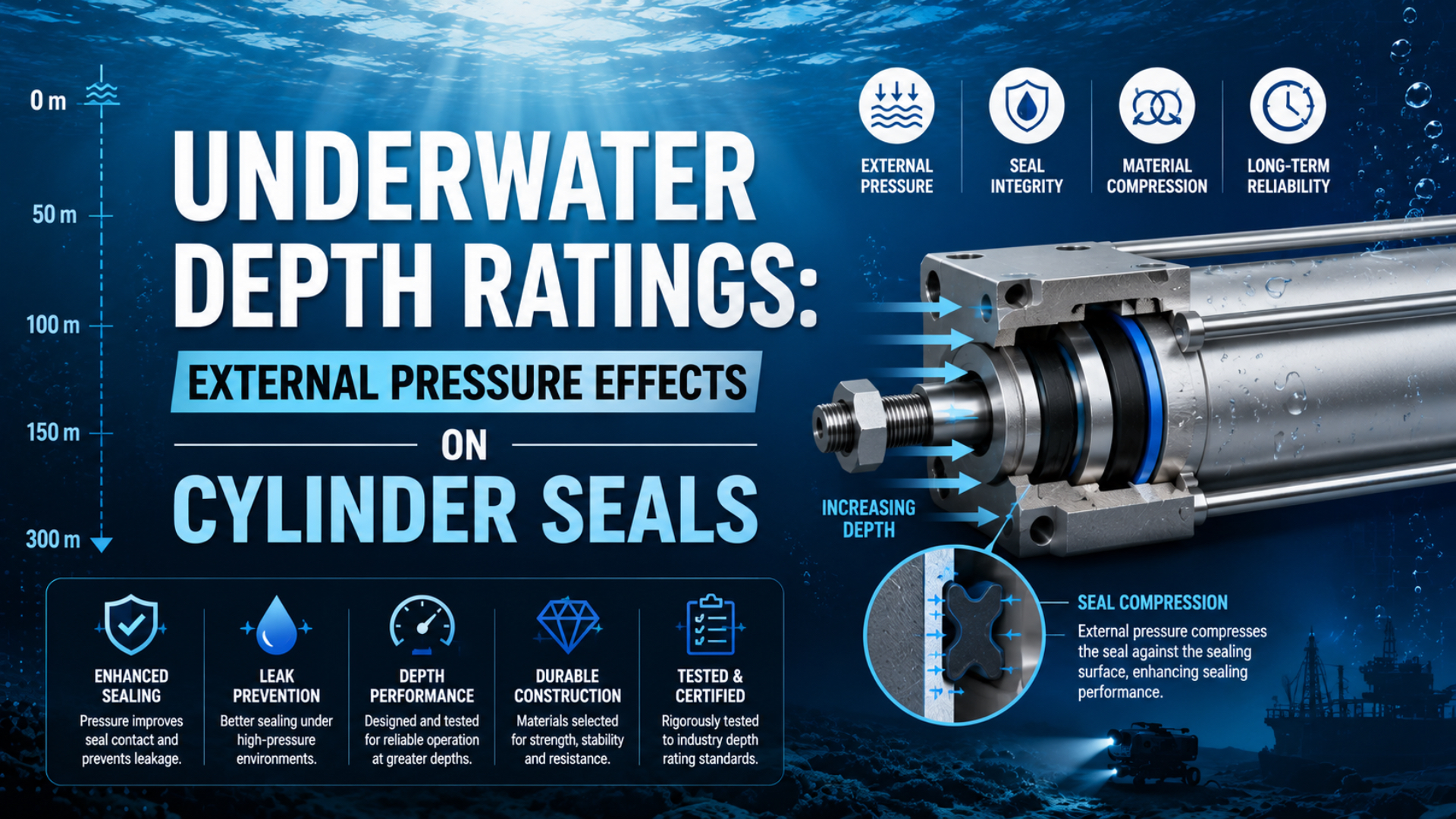
Underwater depth ratings are configuration-specific operating limits, not numbers inferred from seal material or normal working pressure. Depth raises ambient absolute pressure and changes the load across every seal and wall. It also increases exhaust back pressure while exposing external surfaces to water. The safe limit belongs to the complete assembly and its operating states. NOAA uses an increase of about one atmosphere for every 10.06 m of seawater depth (NOAA Ocean Service, updated 2024). At 30 m, ambient pressure is therefore close to 4 bar absolute. That number is only the starting condition. It does not prove that a standard pneumatic cylinder can be submerged.
Key Takeaways
- Calculate site ambient pressure.
- Map absolute pressure across every seal and structural wall.
- Keep water-resistant splash ratings separate from documented submersible qualification.
- Require production-configuration analysis and hyperbaric tests covering powered motion, shutdown, supply loss, and recovery.
For the pressure terminology used below, review the distinction between absolute and gauge pressure before converting a regulator setting into an underwater pressure differential.
What Does Water Depth Actually Change?
NOAA reports that seawater pressure rises by about one atmosphere every 10.06 m (NOAA Ocean Service, updated 2024). Ambient absolute pressure is the total pressure at the installation depth, referenced to a vacuum. Depth changes this external pressure without creating a universal seal-failure depth. Water density, geometry, internal pressure, and operating state still vary.
The hydrostatic pressure increase is:
Here, is hydrostatic gauge pressure in pascals, is water density in kilograms per cubic metre, is gravitational acceleration in metres per second squared, and is depth in metres.
Ambient absolute pressure is:
Use the actual site density when it is known. Salinity, temperature, and location alter density, so the NOAA 10.06 m relationship is a practical seawater approximation rather than a substitute for project data.
At the surface, a component sees roughly 1.013 bar absolute outside. At 30 m in representative seawater with , the hydrostatic increase is:
The corresponding ambient pressure is approximately 4.03 bar absolute. A pressure table that labels 30 m as simply “4 bar external” is incomplete unless it states that the value is absolute and records the density assumption.
Why Is Pressure Differential More Important Than Underwater Depth Ratings?
API Technical Report 17TR12 requires subsea equipment analysis to consider external pressure and internal pressure (API, 2015). The same analysis must cover closure differentials and structural loads. Every potential operating scenario belongs in scope. This matters because one cylinder has several pressure boundaries. Each boundary can see a different worst case. Pressure differential is the signed difference between absolute pressure on the two sides of a boundary. For any seal or wall, calculate it as:
A positive result loads the boundary from inside to outside. A negative result reverses that direction. Magnitude matters for stress and extrusion. Sign determines seal orientation and backup-ring position. It also identifies a possible water-entry path.
Suppose a surface air source supplies 6 bar gauge. That equals about 7.013 bar absolute before line losses. At 30 m, the 4.03 bar ambient pressure leaves only about 2.98 bar between supply and local seawater. It does not leave 6 bar. Flow through the tube and fittings reduces cylinder chamber pressure further. So do restrictions inside the valve and ports.
Cylinder force also depends on the pressure in both chambers:
and are absolute chamber pressures. is piston area. is rod area. Finally, represents friction. If the exhausting side discharges into local ambient pressure, its back pressure rises with depth. The back-pressure force calculation explains why supply pressure alone cannot predict available thrust.
The most severe structural state may occur when the system is shut down, depressurized, or descending before air is applied. Operating pressure can partially oppose external water pressure, while a trapped or vented cavity may face the full external differential. A depth review that checks only the powered stroke misses this state.
How Can External Pressure Load Cylinder Seals?
Parker’s O-Ring Handbook states that extrusion depends on pressure and elastomer hardness (Parker Hannifin, accessed 2026). Clearance gap and deformation of the surrounding metal also matter. External pressure can therefore reverse the loaded side of a seal, but it does not make every seal fail at one fixed depth. An O-ring begins sealing through installed squeeze. Pressure then increases contact force and pushes the elastomer toward the low-pressure clearance. A backup ring is a harder support element placed on that low-pressure side. If pressure can reverse, the gland may need support on both sides or a seal profile qualified for bidirectional loading.
ISO 3601-4 specifies five types of anti-extrusion rings and ties them to selected O-ring sizes and housing dimensions (ISO 3601-4, confirmed 2023). The standard supplies dimensional rules. It does not assign a water depth to an O-ring, backup ring, or elastomer family.
Dynamic rod sealing adds another boundary. The rod seal must retain pneumatic pressure during movement, exclude water and sediment from outside, preserve lubrication, and tolerate any reversed differential during idle or recovery. A scraper designed for coolant splash isn’t automatically a pressure-exclusion seal.
Use the extrusion-gap failure guide when reviewing clearance and backup support. Use the cylinder seal material guide separately for temperature, lubricant, and chemical compatibility.
| Seal review item | Evidence required | Why a material name is insufficient |
|---|---|---|
| Pressure direction | Pressure map for powered, vented, shutdown, and recovery states | The loaded side can change |
| Extrusion gap | Maximum clearance including tolerance, wear, and structural deflection | Gap size controls elastomer support |
| Seal profile | Drawing and pressure direction approved by the seal supplier | O-rings, U-cups, rod seals, and wipers behave differently |
| Compound | Exact formulation and compatibility data | NBR, EPDM, and FKM are families, not single materials |
| Dynamic surface | Rod finish, hardness, runout, speed, and contamination protection | A compatible compound can still wear rapidly |
| Leakage path | Tandem arrangement, interspace vent, purge, or monitoring method | Redundancy needs a defined destination for leakage |
Which Failure Modes Must Be Checked Beyond the Rod Seal?
SMC’s stainless water-resistant cylinder catalog allows splash-zone use yet explicitly warns against immersion under water pressure (SMC, accessed 2026). Its catalog explains that water can enter the cylinder. Liquid may then move back through the piping. A subsea review must therefore cover the entire pneumatic path, not just the rod seal.
External collapse or distortion: Internal working-pressure ratings do not establish resistance to external pressure. The tube and covers must retain shape under the worst differential. Tie rods, bearings and sensor grooves also need alignment checks. Inspect any hollow rod separately.
Water migration through ports and exhausts: A submerged exhaust opening sees local ambient pressure. It can admit water after pressure is removed. Return lines and check devices need defined failure behavior. So do purge components and valves.
Tube and cable collapse: Pneumatic tubes and sensor cables require their own external-pressure ratings. Connectors and switch housings also need documented immersion limits. A qualified cylinder connected to an unqualified tube is still an unqualified system.
Corrosion and galvanic attack: Stainless steel does not resist every aqueous environment. Mixed stainless and aluminum parts can create galvanic couples. Plated steel or carbon components introduce more paths. The separate stainless-rod and aluminum-head corrosion analysis covers isolation and drainage details.
Lubricant loss and contamination: Water and abrasive particles can displace grease or enter the bearing region. Seal material compatibility alone cannot validate the lubricant. Surface finish and service interval need separate evidence.
The system boundary extends back to the valve and air preparation equipment. SMC warns that water entering a submerged cylinder can travel through the piping and damage the solenoid valve. Procurement should therefore identify the location and depth of every wetted connection, not stop at the actuator model number.
A Defensible Workflow for Underwater Depth Ratings
API 17TR12 separates functional specification, system analysis, design assessment, documentation, depth verification, and validation testing (API, 2015). Applying that sequence to a pneumatic cylinder replaces the unsafe shortcut of converting normal working pressure directly into a depth rating.
This baseline allows the reviewer to compare every powered motion state against every shutdown or recovery state before approving the seal profile plus structural arrangement for the specified installation depth and service duty.
- Define the environment. Record maximum depth, water density, temperature range, salinity, contaminants, current, immersion duration, and required life.
- Map every pressure state. Include descent, normal extension, normal retraction, dwell, venting, emergency stop, loss of supply, ascent, and storage.
- Identify every pressure boundary. Include piston and rod seals, end-cap joints, sensor pockets, tube walls, fittings, valve cavities, cable glands, and any hollow components.
- Calculate force and structure. Use absolute chamber pressures for actuator force. Check external collapse, cover deflection, fasteners, bearing alignment, and extrusion gaps separately.
- Select seals and materials. Obtain compound-specific compatibility data and confirm the gland for both pressure directions. Specify corrosion control and lubricant compatibility.
- Build a test article. Use production materials, tolerances, seals, fittings, tubes, sensors, and assembly processes.
- Run hyperbaric functional tests. Cycle the complete assembly under actual or simulated ambient pressure, including pressure-loss and shutdown states.
- Document the rating envelope. State depth, water density, temperatures, supply and exhaust architecture, cycle limits, leakage criteria, inspection interval, and excluded conditions.
What Should a Hyperbaric Qualification Test Demonstrate?
API Spec 16C requires certain moving subsea assemblies to complete functional cycles while continuously exposed to external hyperbaric pressure, followed by pressure-hold checks (API, 2025). A general pneumatic cylinder is outside that specification’s scope, but the test principle is directly useful.
Test the exact production configuration, not a bare cylinder with temporary fittings. The chamber should reproduce maximum rated water depth or the approved simulated pressure. Supply and exhaust plumbing must match the intended architecture, including tube lengths, submerged valves, check devices, sensors, and connectors.
At minimum, the protocol should measure:
- external chamber pressure;
- water temperature throughout the test;
- dynamic supply pressure measured at the cylinder inlet;
- both chamber pressures where the instrumentation does not alter flow or dead volume;
- extension and retraction time under the rated load;
- breakaway pressure, steady friction and end-of-stroke behavior recorded as separate acceptance values;
- external leakage before cycling and internal leakage during every dwell period;
- water intrusion into the cylinder, tube, valve, sensor and connector cavities after pressure release;
- dimensional change, binding, corrosion, lubricant displacement and microscopic seal damage found during the documented post-test teardown, with photographs tied to the test article serial number and each acceptance criterion.
Include fault states. Hold the assembly at depth with supply removed, cycle after a long dwell, simulate exhaust blockage, and verify ascent after any trapped pressure has been handled safely. Acceptance limits must be numeric and agreed before the test. Do not convert one successful short test into an unlimited service rating. Depth, cycle count and dwell time define part of the qualification envelope. Temperature and water chemistry define another part. Load and maintenance complete it. When any condition changes, document it. Then decide whether analysis is sufficient. If not, repeat the affected tests.
Material Selection Without Fake Depth Labels
ISO 3601-2:2025 covers housing dimensions for industrial O-rings used in cylinder bores and rods (ISO, 2025). Its scope includes hydraulic or pneumatic service. Backup rings are also included. The standard notes that special applications require agreement between manufacturer and user. However, it does not map elastomer families to underwater depths. NBR, EPDM and FKM can each represent numerous formulations. Choose the compound only after defining the media on both sides. Next, consider lubricant and temperature. Decompression rate, sliding speed and surface finish also affect the decision. Required life belongs in the same review. Fillers and cure systems can change performance within one elastomer family. So can hardness, compression set and water resistance.
Backup rings solve a geometric support problem. They do not protect the rod coating from corrosion. Nor do they stop water passing through a fitting. Tube collapse requires a separate check. Reversed-pressure behavior of the piston seal does too. Likewise, stainless external parts do not turn a splash-rated cylinder into a submersible actuator.
For salt water, review the complete material couple and crevice geometry. A stainless rod attached to an aluminum head may need electrical isolation and drainage. Coating controls may also be necessary. Some designs use replaceable sacrificial elements. A material table without assembly details cannot capture those paths. A defensible depth rating is closer to a tested configuration code than a catalog material property. Changing the seal compound or rod coating can break the evidence chain. So can a different tube supplier or fitting bore. Sensors and grease also matter. Assembly tolerance can change even when the cylinder’s marketing name stays the same.
What Should Buyers Put in the Underwater Cylinder RFQ?
SMC distinguishes water-resistant splash service from immersion and warns that water pressure can cause early liquid entry and downstream valve damage (SMC, accessed 2026). An RFQ should therefore request configuration-specific external-pressure evidence instead of accepting “marine grade” or “stainless” as a depth rating.
| RFQ field | Required information |
|---|---|
| Environment | Maximum and minimum depth, water density, temperature, salinity, contaminants, current, and immersion duration |
| Motion duty | Bore, rod, stroke, load, orientation, cycle rate, speed, cushioning, dwell, and required life |
| Pneumatic architecture | Supply source, regulator location, tube length and ID, valve location, exhaust destination, and shutdown behavior |
| Pressure states | Minimum dynamic supply, maximum internal pressure, ambient pressure, trapped cavities, vented states, and ascent/descent cases |
| Seal design | Profiles, pressure directions, gland dimensions, extrusion gaps, backup support, compounds, and lubricant |
| Structure | External-collapse analysis, cover deflection, rod and bearing alignment, fasteners, and sensor cavities |
| Corrosion control | Material grades, coatings, isolation, crevice controls, drainage, and inspection method |
| Qualification | Hyperbaric pressure, cycle count, load, dwell, leakage limits, water-ingress criteria, and post-test inspection |
| Documentation | Drawings, calculations, material certificates, test report, traceability, maintenance instructions, and change control |
Keep the normal internal cylinder working-pressure rating in the package, but label it separately from the external water-depth qualification. If force is marginal after ambient and exhaust pressure are included, review the minimum operating pressure calculation before increasing regulator pressure.
Final Engineering Rule
NOAA’s 10.06 m-per-atmosphere relationship establishes ambient pressure, while API 17TR12 requires external pressure to be evaluated with internal pressure, structural loads, operating scenarios, and validation (NOAA, updated 2024; API, 2015). Together, they show why no universal seal-based depth formula is defensible.
Calculate the ambient pressure first. Then map both sides of every seal and wall. Cover powered motion, exhaust, shutdown, descent and ascent. Confirm force and extrusion support. Next, check external stability and corrosion control. Finally, qualify the tubing, valves, sensors and connectors.
The final rating must identify one tested configuration and its conditions. A supplier should provide external-pressure calculations plus hyperbaric functional evidence for that configuration. Without both, treat the cylinder as unqualified for immersion. Its material description and normal pneumatic pressure rating cannot fill the evidence gap.
Underwater Pneumatic Cylinder FAQs
At 30 m in representative seawater, ambient pressure is about 4.03 bar absolute. This result uses NOAA’s 10.06 m-per-atmosphere approximation (NOAA, updated 2024). The four questions below separate splash resistance from a genuine underwater depth qualification. They also test internal-pressure claims and the supporting evidence.
Is a water-resistant pneumatic cylinder submersible?
No. Water-resistant commonly describes splash, washdown, or coolant exposure. SMC’s stainless water-resistant cylinder documentation explicitly warns against immersion under water pressure because liquid can enter the cylinder and piping. Submersible use requires a documented external-pressure rating. The selected seals and connections must also pass functional testing at the specified depth.
Can higher supply pressure extend operating depth?
It can increase available pressure differential. That may restore actuator force within the system’s tested envelope. However, every component must remain inside its internal rating. Higher supply pressure does not prove resistance to external collapse or water ingress. Nor does it establish reverse-pressure seal support. Recalculate both chamber pressures before changing the rating, then retest the complete configuration.
Do backup rings give an O-ring a specific water-depth rating?
No. ISO 3601-4 defines anti-extrusion ring types and dimensions. Parker relates extrusion risk to pressure, clearance gap and component deflection. A backup ring supports the elastomer on a defined low-pressure side. Depth qualification still requires the actual gland and compound. It must also cover pressure direction, motion, structure and test conditions.
What evidence should an underwater cylinder supplier provide?
Request a pressure-state map and external-collapse assessment. The evidence package should include seal drawings, material specifications and a pneumatic force calculation. It also needs a hyperbaric functional test report. That report should identify depth and water conditions. It should record the production configuration, test load, cycles and dwell. Leakage limits, ingress findings and post-test inspection results complete the record.
Sources and technical references
The source set uses official government, standards-body, manufacturer, and subsea-industry material. Retrieval dates are included so later engineering reviews can confirm edition status and product precautions.
- NOAA Ocean Service: How does pressure change with ocean depth?, hydrostatic pressure increase of one atmosphere per 10.06 m of seawater. Updated 2024-06-16; retrieved 2026-07-26.
- API Technical Report 17TR12: Consideration of External Pressure in the Design and Pressure Rating of Subsea Equipment, external-pressure design scenarios, assessment, documentation, depth verification, and validation framework. Published 2015; retrieved 2026-07-26.
- API Specification 16C, Third Edition, Errata 3, dynamic operation under external hyperbaric pressure and follow-up pressure testing for specified subsea equipment. Published 2025-12-16; retrieved 2026-07-26.
- Parker O-Ring Handbook ORD 5700, pressure, clearance, hardness, extrusion, component deflection, and backup-ring guidance. Retrieved 2026-07-26.
- Trelleborg O-Rings and Back-up Rings, internal and external sealing arrangements plus backup-ring function. Edition June 2024; retrieved 2026-07-26.
- ISO 3601-2:2025, O-ring housing dimensions for general industrial hydraulic and pneumatic applications, including cylinder bores and rods. Published 2025-11; retrieved 2026-07-26.
- ISO 3601-4:2008, anti-extrusion ring types, dimensions, and tolerances. Confirmed 2023; retrieved 2026-07-26.
- SMC CJ5-S/CG5-S Stainless Steel Cylinder Specific Product Precautions, splash-service context and explicit warning against immersion under water pressure. Retrieved 2026-07-26.