

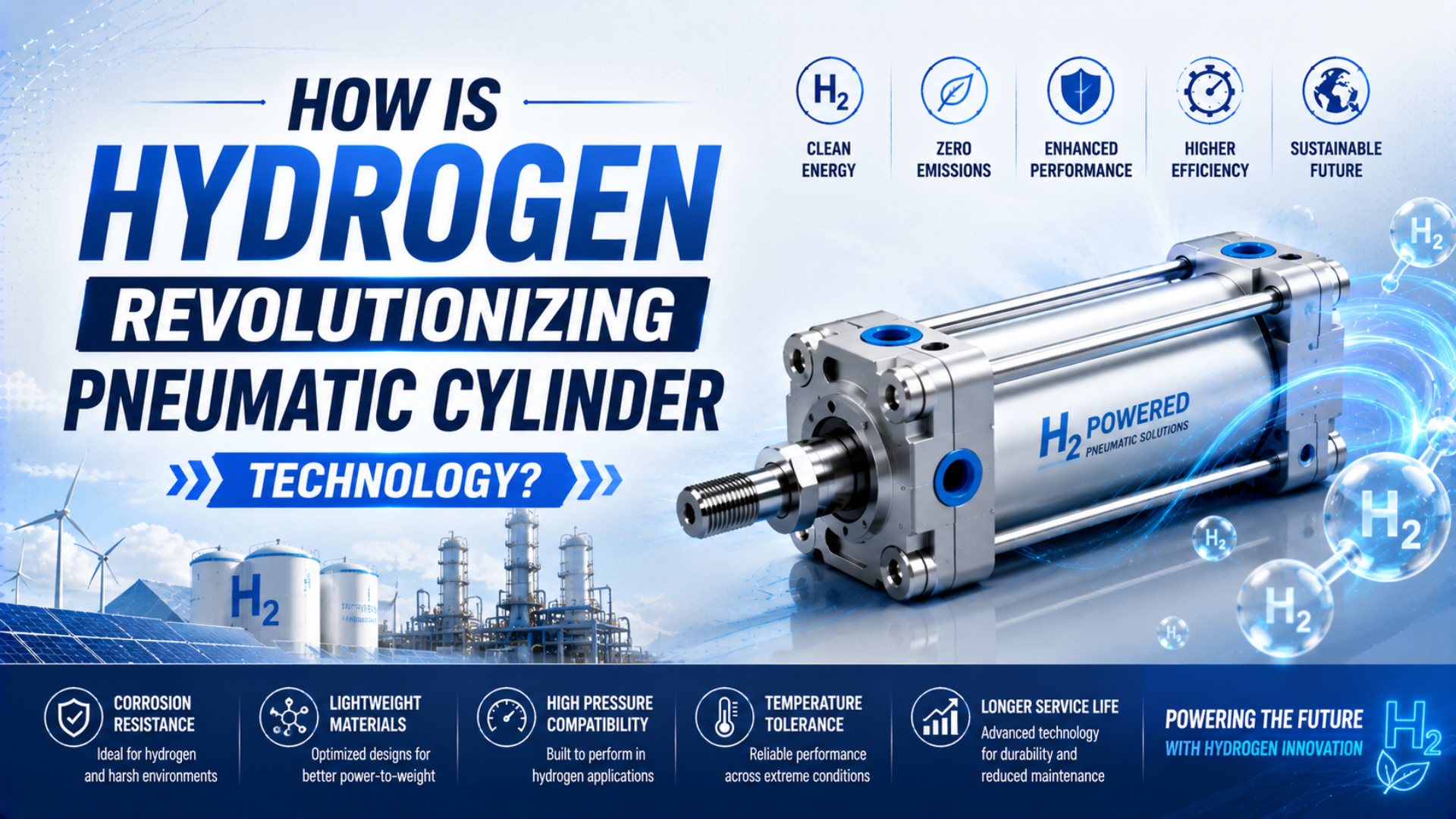
Hydrogen is changing pneumatic cylinder selection, but it is not replacing compressed air inside an ordinary pneumatic cylinder. The change happens at the system boundary. Engineers must decide whether an actuator is merely installed near hydrogen or whether any of its parts actually contain hydrogen. That decision controls the pressure rating, materials review, sealing evidence, hazardous-area marking, exhaust routing, sensors, and validation documents that belong in the specification.
Hydrogen pneumatic cylinder technology is best understood as the selection and integration of air-driven actuators around hydrogen equipment. It is not permission to fill an ordinary pneumatic cylinder with hydrogen.
A standard SMC CM2 air cylinder lists air as its fluid and 1.0 MPa as its maximum operating pressure (SMC CM2 Air Cylinder Catalogue, accessed 2026). By contrast, vehicle refueling protocols address hydrogen pressure classes as high as 70 MPa (SAE International, 2020). Those numbers belong to different circuits. Treating them as one cylinder specification creates a serious procurement error.
Key Takeaways
- Ordinary pneumatic cylinders use compressed air, even when installed at a hydrogen plant.
- H70 process pressure applies to hydrogen-wetted dispensing equipment, not the actuator air circuit.
- Ex marking, exhaust routing, materials compatibility, and fail-state validation must be specified separately.
The U.S. Department of Energy’s Hydrogen Safety Panel webinar provides useful system-level context for safety planning, design reviews, incident learning, and maintenance. It does not approve a particular cylinder or valve configuration.
Hydrogen Pneumatic Cylinder Technology Starts at the System Boundary
SMC’s CM2 catalogue lists air as the working fluid, 1.0 MPa as maximum operating pressure, and 1.5 MPa as proof pressure (SMC, accessed 2026). Parker’s ATEX catalogue prohibits explosive gas mixtures from driving its listed P1D-T cylinders in service.
The correct design question is not, “Is this a hydrogen cylinder?” Ask two narrower questions:
- Does hydrogen enter the component?
- Is the component installed where a hydrogen-air explosive atmosphere may occur?
Those questions create three useful component classes:
| Component class | Typical example | Working medium | Main evidence |
|---|---|---|---|
| Air-driven actuator outside a classified area | Cylinder moving a remote fixture | Treated compressed air | Normal cylinder rating, load, speed, mounting, air quality |
| Air-driven actuator inside or adjacent to a classified area | Pneumatic actuator operating an isolation valve | Treated compressed air | Application-specific Ex suitability, grounding, sensors, exhaust route, temperature limits |
| Hydrogen-wetted process component | Shut-off valve body, check valve, dispenser hose | Hydrogen | Hydrogen pressure rating, material and seal compatibility, leakage, cycling, applicable hydrogen standard |
The valve stem is the boundary that often gets missed. Hydrogen may contact the valve body, seat, stem seal, and upstream tubing while the actuator housing contains only air. The complete assembly still needs a common mechanical, fire-and-explosion, control, and failure review, but its two pressure domains must remain explicit.
Where Do Pneumatic Cylinders Work in Hydrogen Facilities?
ISO 19880-2:2025 separates dispenser functions such as flow measurement, pressure sensing, temperature sensing, cooling, control, and hose delivery. It also directs individual valves and hoses to their own standards. This architecture leaves room for air-driven motion while keeping hydrogen containment in purpose-qualified process components.
Pneumatic cylinders and actuators can perform useful work in hydrogen production, compression, storage, transport, testing, and dispensing equipment. Common roles include:
- opening or closing a hydrogen process valve through an external stem;
- driving an isolation damper, ventilation device, panel, latch, or service fixture;
- positioning a test fixture that is purged and separated from the gas path;
- operating compressor auxiliaries that do not place hydrogen inside the air cylinder;
- moving guards or handling equipment outside the hydrogen containment boundary.
A supplier needs the real mechanical task. State the required thrust or torque, stroke or angle, cycle time, duty cycle, mounting orientation, side load, fail position, ambient temperature, and available air pressure. The usual cylinder-sizing rules still apply. The minimum cylinder operating-pressure guide explains why breakaway friction and downstream back pressure cannot be ignored.
The location adds another layer. A cylinder outside the classified area may need only normal industrial environmental protection. Move the same unit into a classified zone and its mechanical construction, accessories, mounting, electrostatic behavior, surface temperature, and exhaust arrangement can become part of the ignition assessment.
Do not assume that pneumatic automatically means safe. A non-electrical actuator can still create hot surfaces, friction, impact, static charge, or mechanical sparks. Its switch or solenoid adds an electrical ignition question. Start with the area classification and assess the assembled package, not just the cylinder tube.
Which Hazardous-Area Checks Apply to the Actuator?
ISO 80079-36:2016 defines requirements for non-electrical Ex equipment under stated reference conditions of -20°C to 60°C and 80 to 110 kPa (ISO, 2016). Those scope values are not an actuator rating. They show why zone, gas group, protection level, temperature class, and ambient range must be checked explicitly.
Hydrogen has a wide flammable range in air and lower ignition energy than gasoline or natural gas. The U.S. Department of Energy therefore identifies ventilation and leak detection as important engineering controls and notes that hydrogen’s nearly invisible flame may require special detectors.
For the pneumatic actuator package, verify:
- Area classification: Obtain the zone or division, gas group, required equipment protection level or category, and the drawing that defines the classified boundary.
- Complete marking: Match the exact cylinder, valve, coil, switch, connector, cable gland, silencer, and accessory configuration to the required certification and temperature limits.
- Mechanical ignition sources: Review rubbing, impact, bearing failure, misalignment, loose parts, particle ingress, and possible hot surfaces under foreseeable faults.
- Electrical ignition sources: Select coils and sensors for the actual hazardous location. The ATEX solenoid-valve guide explains why a compliant coil does not automatically qualify the valve-and-actuator assembly.
- Grounding and bonding: Follow the manufacturer’s installation instructions and the site’s equipotential bonding design. Do not improvise a universal resistance target from a different standard.
- Exhaust routing: Determine whether exhaust can release inside the classified area. Parker’s P1D-T instructions require a silencer or, preferably, discharge outside the Ex area for the specified product.
- Ambient and process heat: Consider solar load, compression equipment, cold hydrogen hardware, heaters, and abnormal operating states. An Ex temperature class is not a general high-temperature cylinder approval.
An enclosure rating answers a different question. NEMA or IP ratings address ingress and environmental protection, while Ex certification addresses ignition risk. Use the NEMA 4 versus NEMA 4X enclosure guide for washdown and corrosion screening, then complete the hazardous-location review separately.
Could an air exhaust become a problem even if it contains no hydrogen? Yes. Exhaust can disturb local airflow, spread contamination, generate noise, cool a surface, or enter an enclosure. If the actuator could ingest an external atmosphere during pressure or temperature changes, include that path in the risk assessment. ISO 80079-36 specifically recognizes that external atmosphere can be drawn into equipment through natural breathing.
Hydrogen-Wetted Components Need a Separate Materials Review
Sandia’s Technical Reference for Hydrogen Compatibility of Materials separates two concerns: hydrogen transport through a material and degradation of mechanical properties such as fracture or fatigue resistance. It also warns that susceptibility depends on pressure, temperature, alloy strength, microstructure, and loading rather than a material name alone.
First determine which parts are hydrogen-wetted. In a pneumatically actuated process valve, that list may include the valve body, seat, stem, stem seal, bonnet, fittings, and process tubing. The external air cylinder, its piston seal, and its air ports may never see hydrogen unless a process seal fails or the architecture intentionally connects the circuits.
For every wetted metal, record the exact alloy, strength level, product form, heat treatment, weld condition, cold work, surface finish, stress concentration, loading mode, pressure history, temperature, and expected cycle count. Sandia notes that high-strength microstructures tend to be more susceptible to hydrogen-assisted fracture than lower-strength forms. That is a screening direction, not a universal strength cutoff.
Seals need component-specific evidence too. Ask for the exact compound, not just NBR, FKM, EPDM, or FFKM as a family name. Gas permeation, rapid pressure changes, temperature, squeeze, surface finish, lubricant, decompression history, and extrusion clearance all affect performance. The gas-permeation guide and explosive-decompression guide explain why a polymer label cannot establish service life.
Hydrogen compatibility applies to an evidence envelope, not a shopping list. A test on one heat of alloy, one seal compound, or one pressure cycle does not qualify every geometry and temperature. The RFQ should preserve the tested pressure, temperature, gas purity, loading, cycle profile, specimen or component geometry, and acceptance criteria.
Coatings can reduce exposure in a defined design, but they should not be presented as an absolute hydrogen barrier. Edges, damage, threads, seal interfaces, diffusion, adhesion, and inspection access remain relevant. If coating integrity is safety-significant, its preparation, thickness, allowable defects, repair procedure, and inspection method belong in the controlled manufacturing specification.
Why Is 70 MPa Refueling Pressure Not a Pneumatic Cylinder Rating?
SAE J2601_202005 covers two vehicle refueling pressure classes, 35 MPa and 70 MPa, plus delivery-temperature categories of -40°C, -30°C, and -20°C (SAE International, 2020). These are refueling protocol conditions, not permission to apply 70 MPa hydrogen to a standard pneumatic actuator.
ISO 19880-3:2018 addresses high-pressure gas valves used at hydrogen stations up to H70. Its scope includes check valves, excess-flow valves, flow-control valves, hose-breakaway devices, manual valves, pressure-safety valves, and shut-off valves. Notice what the list describes: process valves and safety devices.
The pneumatic actuator moves one of those devices from outside the hydrogen pressure boundary. Its air supply can remain within the selected actuator’s catalogue range while the attached process valve is qualified for an H70 application. Those different ratings can coexist because the valve stem, bonnet, seals, and mechanical coupling separate the fluids.
| Specification | Pneumatic actuator side | Hydrogen process side |
|---|---|---|
| Fluid | Treated compressed air | Hydrogen at specified purity |
| Pressure basis | Cylinder and control-valve catalogue limits | Process design pressure, transients, relief basis, applicable hydrogen component standard |
| Temperature basis | Supply air, ambient, duty and accessory limits | Gas temperature, pre-cooling, decompression, ambient and process heat |
| Main leakage concern | Air loss, motion error, unintended exhaust | Hydrogen containment and hazardous release |
| Material review | Cylinder seals, lubricant, corrosion, ambient exposure | Hydrogen-wetted metals, polymers, joints and pressure boundary |
| Failure response | Retract, extend, hold, vent or remain in place | Isolate flow, relieve safely, detect leakage and place system in a defined safe state |
Pressure units can hide this boundary. Converting 70 MPa to 700 bar is mathematically correct, but copying 700 bar into a pneumatic-cylinder RFQ is not. Keep separate fields for process design pressure, actuator supply pressure, pilot pressure, exhaust pressure, and any pressure that can cross the stem or diaphragm after a seal failure.
What Belongs in a Hydrogen-Project Actuator RFQ?
ISO 19880-3 covers seven high-pressure hydrogen valve categories up to H70, while Parker’s ATEX cylinder instructions contain seven installation checks for the cited P1D-T configuration. An effective RFQ must therefore identify both the process-valve obligation and the air-actuator installation obligation instead of requesting a generic “hydrogen-compatible cylinder.”
Send the supplier a boundary-based specification:
Process and media
- State whether hydrogen enters the offered component in normal operation, during a seal failure, or never.
- Give hydrogen purity, normal pressure, design pressure, pressure transients, temperature range, decompression rate, flow direction, leakage class, and cycle profile.
- Identify purge media, cleaning chemicals, external corrosives, moisture, dust, and washdown exposure.
Hazardous location
- Supply the zone or division drawing, gas group, equipment protection level or category, temperature class, maximum surface-temperature requirement, and ambient range.
- Name the applicable jurisdiction, directives, standards, notified or approved body requirements, and certificate format.
- List every electrical and non-electrical accessory included in the certification boundary.
Pneumatic and mechanical duty
- Specify actuator supply pressure at the point of use, minimum pilot pressure, exhaust back pressure, air-quality class, bore or torque requirement, stroke or angle, cycle time, duty cycle, load, mounting, side load, and allowable impact.
- Define the required fail state after loss of air, power, control signal, or process containment.
- State manual override, lockout, position indication, partial-stroke testing, and proof-test needs.
Materials and seals
- Request exact wetted and non-wetted material designations, strength condition, heat treatment, coating, seal compound, lubricant, and manufacturing traceability.
- Require test conditions and acceptance criteria for any hydrogen-compatibility claim.
- Ask the supplier to identify excluded conditions and unsupported extrapolations.
The chemical-compatibility seal guide can help organize the media and temperature questions. It cannot replace finished-component validation for hydrogen service.
What should never appear alone in the RFQ? Phrases such as “hydrogen-ready,” “explosion-proof,” “700 bar capable,” or “zero leakage.” Each needs a component boundary, standard, test method, operating envelope, acceptance value, and named configuration.
How Should the Assembly Be Validated and Maintained?
Parker’s cited ATEX catalogue requires its P1D-T cylinder to be grounded, supplied with compressed air, and checked against equipment group, category, zone, temperature class, and maximum surface temperature. Those requirements apply to the named configuration. The installed valve-actuator package still needs system-level commissioning and maintenance evidence.
Commissioning should verify normal movement and the response to credible faults. Test loss of control power, loss of instrument air, low pilot pressure, stuck or slow movement, disagreement between commanded and indicated position, leak-detection alarm, ventilation failure, emergency shutdown, and manual intervention. Use approved procedures that do not create an uncontrolled hydrogen release.
If the valve performs a safety function, define the required risk reduction at the machine or process level. A component described as SIL-capable does not make the loop compliant by itself. Architecture, diagnostics, proof-test coverage, systematic capability, failure-rate data, and common-cause controls remain relevant. The SIL-rated solenoid-valve guide covers that distinction.
Maintenance instructions should identify inspection intervals, leak-test methods, stroke or partial-stroke tests, grounding checks, exhaust-path checks, allowed spare parts, seal replacement limits, lubrication restrictions, fastener torque, repair authority, and certificate retention. Record any change to the valve, actuator, sensor, coil, bracket, silencer, tubing, or software that could alter the validated configuration.
The strongest maintenance record links every observation to its boundary. Air leakage points to actuator performance. Hydrogen leakage points to process containment. Slow travel may involve air pressure, friction, icing, valve torque, or mechanical alignment. Classifying the symptom before replacing parts prevents an air-side repair from hiding a process-side hazard.
Hydrogen Pneumatic Cylinder FAQs
The U.S. Department of Energy gives hydrogen a 4% to 75% flammability range in air (DOE code-official training, accessed 2026). That wide range makes leak prevention, ventilation, ignition control, area classification, and clear fluid boundaries more useful than calling one cylinder “hydrogen-proof.”
Can hydrogen be used to drive a standard pneumatic cylinder?
No. A standard pneumatic cylinder is designed for compressed air within its published pressure and temperature limits. Parker’s cited ATEX instructions explicitly prohibit explosive gas mixtures from driving the specified cylinder. If hydrogen must enter an actuator or pressure chamber, it becomes a specialized hydrogen-wetted component requiring purpose-specific design, materials, testing, and approval.
Does a 70 MPa hydrogen dispenser need a 70 MPa pneumatic actuator?
No. SAE J2601 uses 70 MPa as a hydrogen refueling pressure class. The air actuator normally operates in a separate, much lower pressure circuit and moves a hydrogen-rated process valve through a stem or coupling. Specify the process pressure and actuator supply pressure in separate RFQ fields so one cannot be copied onto the other.
Is an ATEX or Ex marking enough for hydrogen service?
No. The exact marking must match the area classification, gas group, protection level or category, temperature class, ambient range, and installed configuration. The assessment also includes the process valve, cylinder, solenoid, switches, cable entries, grounding, exhaust, mounting, and foreseeable mechanical faults. Ex marking addresses ignition risk, not every pressure, material, or functional-safety requirement.
When does hydrogen embrittlement matter to the pneumatic actuator?
It matters when a load-bearing metal actually contacts hydrogen in normal service or a credible failure condition. External proximity alone does not make every cylinder part hydrogen-wetted. Identify the containment boundary, then evaluate the exact alloy, strength, microstructure, stress, pressure, temperature, and cycle history using service-relevant data rather than a universal material ranking.
What documents should a hydrogen-project actuator RFQ request?
Request the boundary drawing, process and actuator pressures, media and temperatures, area-classification basis, exact Ex marking, certificates, materials and seal compounds, hydrogen test conditions, leakage criteria, fail position, functional test plan, installation limits, maintenance instructions, traceability, and approved spares. Also ask the supplier to state exclusions and evidence that does not apply to the offered configuration.
Sources and technical references
- Parker Pneumatic ATEX Components Catalogue, compressed-air requirement, Ex-area installation checks, grounding, and exhaust guidance.
- SMC CM2 Air Cylinder Catalogue, standard cylinder fluid and pressure ratings.
- U.S. Department of Energy, Safe Use of Hydrogen, hydrogen properties, ventilation, leak detection, and flame detection.
- ISO 80079-36:2016, non-electrical equipment for explosive atmospheres.
- ISO 19880-2:2025, hydrogen dispensers and dispensing systems.
- ISO 19880-3:2018, high-pressure hydrogen-station valves up to H70.
- SAE J2601_202005, 35 MPa and 70 MPa vehicle refueling protocols.
- Sandia Technical Reference for Hydrogen Compatibility of Materials, material-property evidence for hydrogen service.