

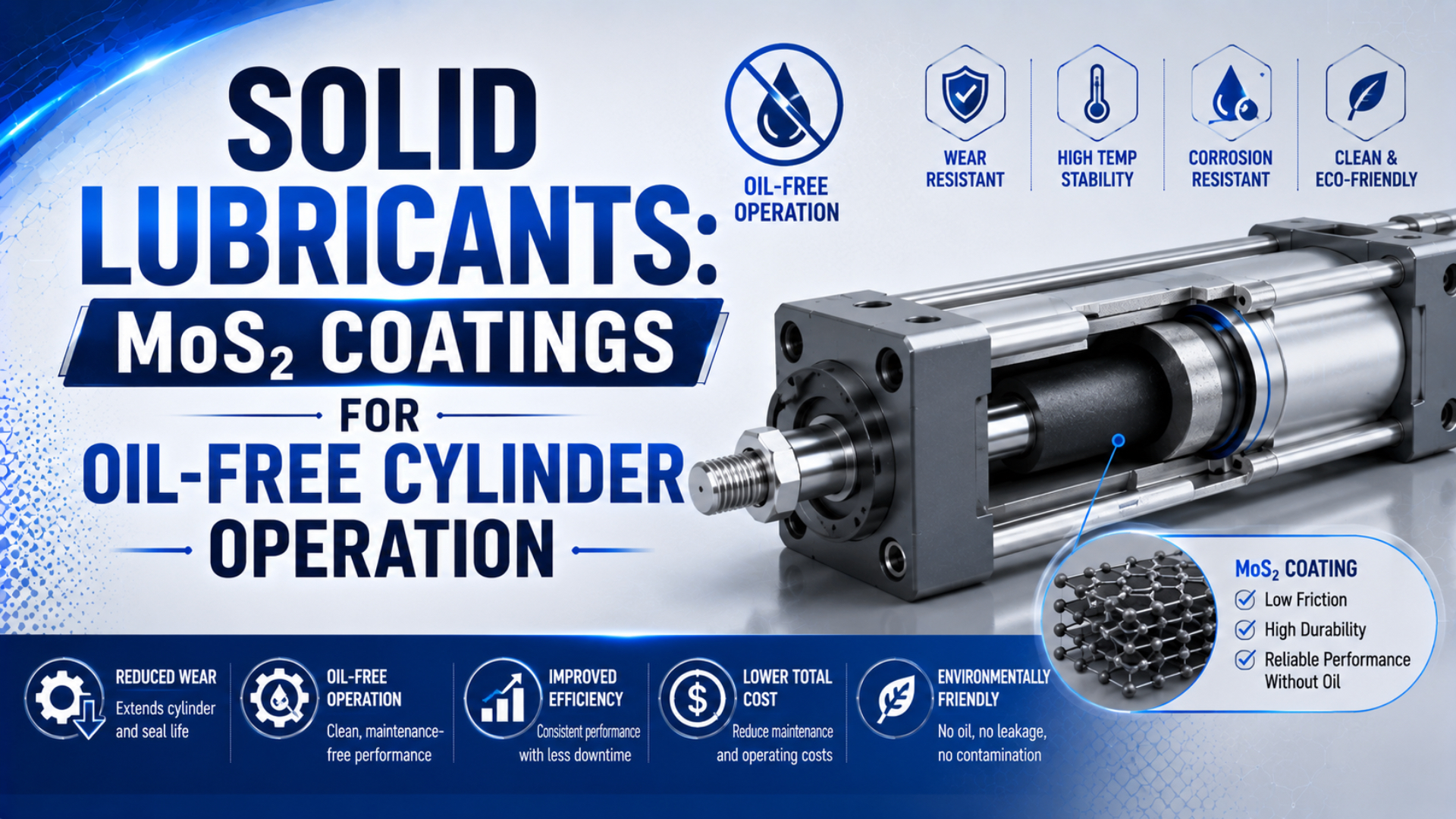
An MoS2 coating can reduce friction where liquid oil is undesirable, but it does not turn every pneumatic cylinder into a grease-free, maintenance-free actuator. The result depends on the coating family, binder, surface preparation, humidity, temperature, counterface, seal system, load, and acceptance test. That distinction matters because “oil-free air,” “non-lube cylinder,” and “dry-film lubricant” describe different boundaries. A coated bore may still operate with factory-applied seal grease. A coating that performs well in dry nitrogen may behave differently in a humid packaging room. Food or cleanroom suitability requires evidence for the complete construction, not the MoS2 powder alone.
Those boundaries are not interchangeable.
Key Takeaways
- NASA compared 6 sputtered MoS2 coatings and found different friction, wear, and endurance results across moist air, dry air, and dry nitrogen (NASA).
- A non-lube cylinder can still contain factory-applied lubricant.
- Specify the coating process, environment, seals, and assembly-level acceptance tests instead of asking only for “MoS2 coating.”
What Does Oil-Free Cylinder Operation Actually Mean?
SMC specifies ISO VG32 turbine oil if additional lubrication is introduced into certain factory-lubricated cylinders, then warns that the oil supply must continue (SMC Guided Cylinder Manual). That single requirement shows why “non-lube” does not mean that every sliding interface is dry.
Separate these four conditions before selecting a cylinder:
| Term | Engineering meaning | What it does not prove |
|---|---|---|
| Oil-free compressed air | Supplied air meets a stated oil limit at a defined measurement point | The cylinder contains no assembly grease |
| Non-lube cylinder | The specified cylinder can operate without routine airline oil within its rated envelope | Every seal, guide, and bearing surface runs dry |
| Dry-film lubricant | A solid lubricant is held on a prepared surface by a defined deposition or bonding method | The coating lasts for the cylinder’s entire life |
| Grease-free construction | No grease is used inside a stated product boundary | Food-contact, cleanroom, or vacuum approval |
A non-lube cylinder is an actuator designed to work without routine airline oil inside its stated operating envelope. It may still depend on lubricant installed during assembly. An MoS2-coated bore addresses only some sliding contacts; piston seals, wipers, guide bands, carriage bearings, and rodless-cylinder sealing bands may use other materials or lubricants. Air-supply requirements are covered separately in the guide to dry, non-lubricated air and pneumatic cylinders.
A better purchasing question is not “Is this cylinder oil-free?” Ask which surfaces carry MoS2, which interfaces retain grease, what may enter the exhaust, and under which conditions the complete actuator was tested. Those answers define the actual cleanliness boundary.
Why Can MoS2 Reduce Friction Without Liquid Oil?
In NASA’s solid-lubrication review, bonded films, sputtered films, and other MoS2 coatings are distinct systems because load, film thickness, oxygen pressure, humidity, and temperature change their friction and wear (NASA, 2000). The useful property comes from the coating system, not from the chemical name alone.
Molybdenum disulfide (MoS2) is a layered solid lubricant made of sulfur-molybdenum-sulfur sheets. Bonding within a sheet is strong, while adjacent sheets shear more easily along their basal planes. When the coating and counterface are suitable, this structure can form a transfer film and reduce sliding resistance without a continuously replenished liquid film. That mechanism is especially valuable in vacuum and dry environments, where conventional oils may evaporate, migrate, thicken, or contaminate nearby surfaces. It can also reduce the need for an airline lubricator in a cylinder designed and qualified for that operating mode.
The working film is consumable.
Three limits are easy to miss. MoS2 does not replenish itself after the working film has worn through. Debris, abrasive particles, edge loading, and poor surface finish can damage a thin coating quickly. Most important, the friction coefficient of a material sample is not a service-life prediction for an assembled cylinder.
“Deck of cards” explains interlayer shear, but it cannot establish coating life. Service life requires a defined film, counterface, pressure, speed, stroke, atmosphere, failure criterion, and test method.
MoS2 Coating Processes for Pneumatic Cylinders
One NASA evaluation applied an organopolysiloxane-bonded MoS2 film at approximately 10 to 20 micrometres before curing it, but that thickness and process belonged to the tested formulation (NASA, 1975). It is not a universal recipe for an aluminium cylinder barrel.
Each coating family creates different engineering trade-offs:
| Coating family | How the film is formed | Typical advantage | Main specification risk |
|---|---|---|---|
| Resin-bonded dry film | MoS2 in a binder is applied and cured | Covers complex surfaces | Binder, cure, thickness, adhesion, outgassing, temperature |
| Sputtered or PVD film | MoS2 is vacuum-deposited | Thin, uniform film without organic resin | Surface preparation, film structure, humidity, edge coverage |
| Burnished or impinged film | Powder is worked onto the surface | Simple, very thin layer | Coverage, adhesion, wear life, repeatability |
| Composite film | MoS2 is combined with other solids, metals, ceramics, or binders | Tunable for a defined duty | Performance cannot be inferred from MoS2 content |
Process identity matters more than the label.
A resin-bonded MoS2 film is a cured coating attached to a prepared substrate. It does not become a metallurgical part of the cylinder wall. NASA’s solid-lubrication design guide describes bonded films as paint-like coatings whose performance depends on binder adhesion and cohesion (NASA, 1971).
A production drawing should name the substrate alloy and temper, pretreatment, surface roughness before coating, coating family, product or approved equivalent, dry-film thickness range, cure limits, masked areas, post-coat bore tolerance, adhesion test, and inspection sampling. SAE AS5272 and AS5528 show how tightly a heat-cured solid-film process can be controlled, although their aerospace scope should not be presented as automatic approval for a pneumatic cylinder (SAE AS5272; SAE AS5528).
Why Do Humidity, Oxygen, and Temperature Change MoS2 Performance?
In a NASA comparison, 6 sputtered MoS2 coatings from 5 vendors were tested in three atmospheres: 50% relative-humidity air, dry air below 100 ppm water, and dry nitrogen (NASA, 2002). Friction, wear, and endurance differed, so one catalogue value cannot represent every installation.
MoS2 is often strongest in vacuum, dry inert gas, or carefully controlled dry air. Adsorbed water and oxygen can change the transfer film and promote oxidation at exposed sites. In one NASA study, high humidity increased friction and wear and reduced the ability of MoS2 powder to adhere to the surface (NASA humidity study).
Atmosphere belongs in the coating specification.
Temperature claims need two separate limits:
- Coating-system limit: MoS2, binder, substrate, and any pretreatment must retain the required friction, adhesion, and wear resistance in the actual atmosphere.
- Cylinder-assembly limit: Seals, grease, guides, cushioning parts, magnets, adhesives, and sensors must all remain within their own ratings.
Above roughly 350°C, oxidation increased friction in the evaluated NASA MoS2 system (NASA high-temperature study). A statement such as “MoS2 works from -180°C to 400°C” therefore cannot be applied to a standard pneumatic cylinder. Even if the solid lubricant survives, common elastomer seals and bonded films may not.
Material limits are not assembly limits.
Coating, Seal, and Cylinder Surface Interaction
ISO 19973-3 reports pneumatic-cylinder reliability in cycles or accumulated travel under stated test conditions, giving two useful exposure measures instead of a universal lifetime percentage (ISO 19973-3, 2015). A coating claim without the tested seals, bore, duty, atmosphere, and failure threshold is incomplete.
Treat the coated bore as one half of a tribological pair. The other half is the seal or guide material moving across it. A harder or rougher film may improve wear in one pair but abrade a softer seal in another. A film that lowers running friction may still produce high breakaway friction after a long dwell. Coating debris may also change leakage or particle-release performance.
Check these interfaces during design review:
- Bore and piston seal: verify diameter and surface finish.
- Rod or carriage guidance: determine whether the coating carries side load or merely seals pressure. Record the guide material, contact pressure, lubrication, alignment limit, and expected wear path instead of assigning every guidance problem to the lubricant.
- Sealing bands: identify separate lubrication requirements for the bands, bore, piston seals, and carriage in a rodless cylinder.
- Cushioning components: verify that film wear or debris cannot disturb cushion seals, needles, or small passages. Repeat the check after the endurance test, when transferred material is present.
- Cleaning exposure: test the complete coating and seal system against actual washdown chemicals.
Factory lubrication may still be necessary even when the bore has a solid film. Adding oil later is not automatically harmless, either. Oil can alter the original grease distribution, collect particles, affect seal friction, or create the very exhaust contamination the dry-film design was intended to avoid.
Seal-selection variables are covered in the guide to pneumatic cylinder seal materials. If low-speed instability is the concern, review self-lubricating seals and their operating limits separately from the coating decision.
Can an MoS2 Coating Make a Cylinder Food-Safe or Cleanroom-Suitable?
ISO 21469:2006 sets hygiene requirements for lubricants that may have incidental product contact, while NSF uses the H1 designation for lubricants intended for incidental food-contact situations (ISO 21469; NSF). Neither designation makes generic MoS2 powder or an undocumented coating automatically food-safe.
Compliance evidence must cover the supplied product and its intended boundary. For a resin-bonded coating, that includes the binder, pigments, additives, cure state, substrate preparation, possible wear debris, cleaning chemicals, and traceability. If the coating can contact food or a food-contact surface, the applicable regulatory and customer requirements need explicit review. Cleanrooms require the same caution. Removing an airline lubricator may reduce one source of oil aerosol, but the cylinder can still emit seal wear particles, coating debris, grease vapour, exhaust contaminants, and particles drawn from the surrounding machine. Exhaust routing, material declarations, outgassing, cleaning, and particle testing remain part of the installed-system qualification.
Cleanliness is an assembly-level property.
“No intentional oil mist” is a useful design statement. “Zero contamination” is not. The first identifies a controlled source; the second makes an unlimited claim across particles, vapours, wear debris, maintenance materials, and process exposure.
Wider qualification guidance appears in the critical cleanroom cylinder specification guide and the separate article on non-lube cylinders in cleanroom environments.
How Should an MoS2-Coated Cylinder Be Qualified?
Six coatings from 5 vendors produced different friction, wear, and endurance results even though every specimen was described as sputtered MoS2 (NASA, 2002). Supplier qualification should therefore begin with a complete coating identity and finish with a representative assembled-cylinder endurance test.
Coupon data is only the first gate.
Use three test levels:
- Coating and coupon screening. Verify composition, binder or deposition method, thickness, cure record, adhesion, roughness, hardness where relevant, and resistance to the actual atmosphere and cleaning media.
- Tribological-pair testing. Test the production seal or guide compound against the production-coated substrate. Measure breakaway and running friction, wear, debris, surface change, dwell behaviour, and lubricant compatibility.
- Cylinder assembly testing. Run the complete actuator at representative pressure, speed, stroke, load, side-load control, cycle rate, dwell, temperature, humidity, air quality, cushioning, and mounting condition.
Define acceptance before the test starts. Useful criteria include:
| Acceptance item | Record before testing | Monitor during and after testing |
|---|---|---|
| Dimensional condition | Bore size, roundness, coating thickness, roughness | Wear track, thickness loss, peeling, scoring |
| Motion | Breakaway pressure, running friction, stroke time | Drift from baseline, stick-slip, dwell restart |
| Sealing | Initial internal and external leakage | Leakage trend and failure threshold |
| Cleanliness | Initial particle or residue condition | Wear particles, transferred film, exhaust contamination |
| Durability | Planned cycles or accumulated travel | Inspection intervals, stop criteria, failure mode |
| Traceability | Coating batch, cure record, seal lot, assembly record | Test data, inspection images, disposition |
Life claims need test context.
Avoid approving a coating from a single friction coefficient. Also avoid accepting “millions of cycles” unless the supplier states the exact cylinder, environment, pressure, speed, load, stroke, failure definition, sample size, and test record. A life result for a short-stroke bench specimen does not automatically transfer to a long-stroke rodless cylinder.
If the cylinder has coating damage concentrated on one side, inspect alignment and side loading on linear actuators before treating the problem as a lubricant shortage.
What Should Be Included in the RFQ and Drawing?
SAE separates the solid-film material specification AS5272 from the application-process specification AS5528, creating two controlled documents rather than one generic “MoS2” note (SAE AS5272; SAE AS5528). A pneumatic-cylinder RFQ should use the same discipline even when those aerospace standards are not contractually applicable.
Organize the RFQ into two evidence blocks:
| Application block | Required information |
|---|---|
| Cylinder and motion | Type, bore, stroke, pressure, speed, load, cycle rate, dwell, mounting, guidance, accumulated travel |
| Environment | Humidity, oxygen, temperature, particles, oil content, washdown chemicals, cleaning method |
| Interfaces | Piston, rod, wiper, bands, guides, bearings, seals, grease, and other retained lubricants |
| Compliance | Food, pharmaceutical, cleanroom, silicone-free, vacuum, outgassing, and restricted-substance requirements |
| Manufacturing block | Required information |
|---|---|
| Substrate | Alloy, heat treatment, pre-coat dimensions, preparation, masked areas, post-coat tolerances |
| Coating | Family, approved product, application method, thickness, cure, adhesion, appearance |
| Acceptance | Leakage, friction, stick-slip, wear, debris, corrosion, endurance, cleanliness |
| Traceability | Coating batch, process records, inspection reports, test samples, change notification, nonconformance disposition |
Qualification must survive supplier changes.
Do not freeze a coating note without allowing controlled requalification. Suppliers sometimes change binders, cure schedules, pretreatments, or deposition equipment while keeping the same broad product description. Those changes can affect friction, adhesion, seal wear, and cleanliness even when “MoS2” remains on the certificate.
A defensible conclusion is narrower than “MoS2 eliminates oil forever.” A specified and qualified MoS2 coating can reduce reliance on liquid lubrication at selected interfaces. Approval belongs to the complete cylinder configuration operating in its stated environment.
MoS2 Coating FAQs
Testing 6 sputtered MoS2 coatings in moist air, dry air, and dry nitrogen produced coating-dependent results (NASA, 2002). These four questions keep purchasing and maintenance decisions tied to the tested coating system rather than to an unrestricted material claim.
Does an MoS2-coated cylinder contain no grease?
Not necessarily. The bore may carry a dry-film lubricant while piston seals, wipers, guides, carriage bearings, or sealing bands retain factory-applied grease. Request a lubrication map showing every sliding interface, the lubricant used there, and what can enter the exhaust. “Non-lube” usually means no routine airline oil, not a completely dry assembly.
Will adding airline oil damage the MoS2 coating?
It depends on the coating, binder, oil, seals, and original factory lubricant. Do not assume that oil is harmless or beneficial. SMC warns that once added oil displaces the original lubricant in certain cylinders, lubrication must continue. Obtain written approval and test compatibility before changing the established lubrication state.
How long does an MoS2 coating last in a pneumatic cylinder?
There is no transferable universal cycle life. Endurance depends on coating type, thickness, adhesion, atmosphere, counterface, load, speed, stroke, dwell, contamination, and failure criteria. Accept a life claim only when the supplier identifies the tested cylinder configuration and provides results under conditions representative of the intended machine.
Is an MoS2-coated cylinder automatically suitable for food processing?
No. MoS2 chemistry alone does not establish food-contact compliance. Review the complete coating formulation, binder, cure state, substrate, possible wear debris, cleaning chemicals, lubricants, and product-contact boundary. Require the applicable declarations or certifications for the supplied construction, then qualify the installed exhaust and contamination controls.
Sources and technical references
NASA: Solid Lubrication Fundamentals and Applications; NASA: Comparison of Several Different Sputtered MoS2 Coatings; NASA: Influence of Humidity on MoS2 Lubrication; NASA: Solid Lubrication Design Guide; SMC Guided Cylinder Operation Manual; ISO 21469:2006; and ISO 19973-3:2015.