

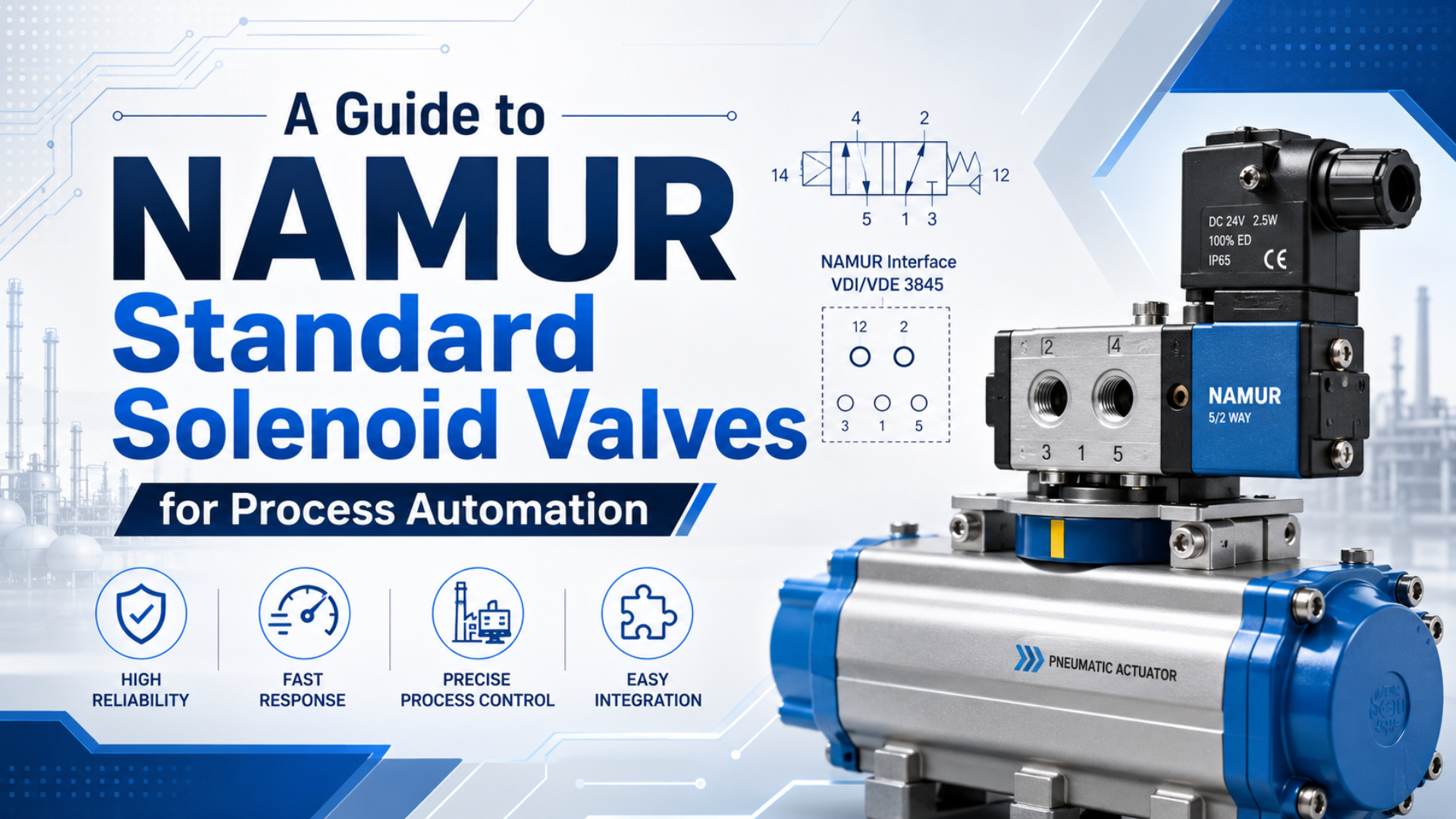
A NAMUR solenoid valve is a pneumatic directional valve designed to mount directly on a compatible part-turn actuator through a standardized interface. The direct-mounted arrangement can remove external pilot tubing between the valve and actuator. It does not automatically provide position feedback, diagnostics, functional safety, or hazardous-area approval.
That distinction matters because engineers often use “NAMUR” for three separate things: a pneumatic actuator accessory interface, a two-wire proximity-sensor circuit, and the process-industry user association itself. They are related by industry history, but they are not interchangeable specifications.
Key Takeaways
- VDI/VDE 3845 defines actuator accessory interfaces.
- NAMUR NE 19 allows direct solenoid mounting without pilot tubing, but it does not specify diagnostics or hazardous-area approval.
- Approve a replacement only after matching the interface, 3/2 or 5/2 function, pressure, flow, coil, exhaust path, actuator state, environment, and certificate.
This guide focuses on pneumatic solenoid valves mounted to quarter-turn actuators used on ball, butterfly, and plug valves. For general valve construction, start with how pneumatic solenoid valves control airflow.
What Is a NAMUR Solenoid Valve?
VDI/VDE 3845 Part 1 is an 8-page interface standard for pneumatic control valves and auxiliary equipment, while NAMUR NE 19 describes direct solenoid-valve mounting without external piping (VDI, 2010; NAMUR, 2017). The result is a compact pneumatic connection between valve and actuator.
The valve routes pilot air to the actuator chambers. On a spring-return actuator, a 3/2 function can pressurize one chamber and exhaust it for spring return. On a double-acting actuator, a 5/2 function alternates pressure and exhaust between two chambers. Some products use a changeover plate so one body can serve either arrangement. “NAMUR valve” therefore describes the mounting and port interface, not a complete performance class. Two compatible-looking valves can still differ in flow, pressure range, pilot principle, coil power, connector, manual override, exhaust treatment, materials, temperature limit, and approvals.
Treat the interface as one gate in a replacement decision. Standardized bolt and port geometry can remove adapters, yet it cannot make an electrically or pneumatically unsuitable valve safe. Mechanical fit is necessary. It is never the whole specification.
NAMUR, VDI, IEC, and ISO Interface Boundaries
ISO 5211:2026 contains 27 pages covering part-turn actuator attachments to industrial valves, while IEC 60947-5-6 is a separate 27-page standard for two-wire proximity sensors and switching amplifiers (ISO 5211, 2026; IEC 60947-5-6, 1999). Neither standard alone defines a NAMUR solenoid valve assembly.
Use this interface stack when reviewing a process-valve package:
| Layer | Main reference | What it governs | What it does not prove |
|---|---|---|---|
| Process valve to actuator | ISO 5211 | flange, drive and torque-reference interface | solenoid-valve function or coil approval |
| Actuator to auxiliary equipment | VDI/VDE 3845 | mounting interfaces for actuator accessories | universal diagnostics or fail-safe behavior |
| Direct solenoid mounting | NAMUR NE 19 | tubeless mounting concept and adaptation | electrical voltage, flow or Ex certificate |
| Position sensing circuit | IEC 60947-5-6 | two-wire proximity sensor and switching-amplifier interface | solenoid coil or connector standard |
| Hazardous-area protection | IEC 60079 series, ATEX or IECEx scheme | ignition protection, marking and installation requirements | pneumatic function or actuator torque |
The phrase “NAMUR signal” usually points to the proximity-sensor circuit. The phrase “NAMUR solenoid valve” usually points to the actuator-mounted pneumatic interface. Mixing them can lead to a purchasing error in which the sensor input is specified correctly but the valve coil, flow path, or mounting plate is wrong. For a complete actuated valve, ISO 5115:2023 covers design considerations for part-turn actuated valve assemblies, including the valve, actuator and mounting kit (ISO 5115, 2023). It belongs beside the interface standards, not underneath them.
How Does Direct NAMUR Mounting Change the Pneumatic Circuit?
Emerson’s ASCO 551 actuator package documents direct NAMUR mounting and 3/2-to-5/2 conversion through a selector plate (Emerson ASCO 551, 2009). This illustrates the real interface advantage: a defined port face can replace external pilot tubes and separate fittings.
Direct mounting can reduce potential leak points and installation parts. It also shortens the pilot-air path between the valve and actuator. Those benefits depend on correct sealing, clean mounting faces, aligned ports, suitable fasteners, and the right conversion plate orientation.
The simplified air paths are:
- 3/2, spring return: supply feeds one actuator chamber when energized; de-energizing exhausts that chamber so the spring drives the actuator to its mechanical fail position.
- 5/2, double acting: supply alternates between two actuator chambers while the opposite chamber exhausts.
- 5/3, double acting: the center function may block, pressurize, or exhaust ports depending on the selected spool. Do not infer the center state from “NAMUR” alone.
Before installation, compare the actuator’s port face with the valve drawing. Check the locating feature, bolt spacing, sealing method, port assignment, and whether a selector plate changes the 3/2 or 5/2 function. A reversed plate can change the pneumatic behavior even though every bolt fits.
Which Valve Function Produces the Required Fail State?
Bürkert Type 6519 is available in 3/2, 5/2 and 5/3 functions, and its current product documentation states that SIL2 can be achieved only for specified monostable functions and a suitable safety-system architecture (Bürkert Type 6519, 2026). NAMUR mounting by itself does not create a safe state.
Start with the actuator:
| Actuator arrangement | Typical valve function | Loss-of-power behavior to define |
|---|---|---|
| Spring return, single acting | 3/2 monostable | spring drives open or closed after pilot air exhausts |
| Double acting | 5/2 monostable | spring-return spool selects one pneumatic direction |
| Double acting, retained command | 5/2 bistable | last spool position may remain after coil power is removed |
| Double acting, defined center state | 5/3 | center ports block, exhaust or pressurize as specified |
“Fail closed” belongs to the complete actuated-valve assembly. The process valve orientation, actuator spring direction, valve circuit, tubing or port plate, and available air during the fault all affect the result. A normally closed solenoid coil description does not automatically mean the process valve fails closed. Separate electrical failure from air-supply failure. A spring-return package can often move to a mechanical state after either event, provided the exhaust path remains available. A double-acting actuator may need stored air, a dedicated pneumatic circuit, or another safety measure. Test each fault separately.
For pilot-stage details, use the guide to pilot-operated pneumatic valves. For direct versus pilot force paths, see direct-acting and pilot-operated solenoid valves.
What Must Match Before You Replace a NAMUR Valve?
Current Bürkert Type 6519 product entries include examples from 900 to 1,800 l/min, pressure ranges beginning at 2 or 3 bar, and temperatures extending from -30°C to 80°C for specific variants (Bürkert Type 6519, 2026). These are SKU-level values, not universal NAMUR limits.
Use a compatibility worksheet:
- Mechanical interface: confirm the NAMUR port face, locating feature, bolt pattern, selector plate and seal arrangement.
- Pneumatic function: match 3/2, 5/2 or 5/3 behavior, normal state, spool return and actuator type.
- Pressure: check minimum pilot pressure, maximum pressure and whether external pilot supply is required.
- Flow: compare manufacturer flow data at compatible conditions, not port thread alone.
- Electrical: match voltage, AC/DC, tolerance, power, connector, duty rating, suppression and control output.
- Exhaust: document silencers, speed controls, breather blocks and whether exhaust ports must be piped.
- Environment: verify temperature, enclosure, corrosion resistance, washdown exposure and air quality.
- Approvals: confirm the exact article number, coil and complete assembly certificate.
The OEM solenoid-valve compatibility guide expands these gates. If flow is uncertain, use the separate Cv valve-sizing guide. This article does not insert a calculator because NAMUR compatibility is primarily an interface and configuration decision, not one formula.
Do not assume that matching 24 V DC is enough. Connector form, coil power, suppression polarity, inrush behavior, permissible voltage tolerance and hazardous-area parameters can all differ. A control output that drives one low-power coil may not switch another safely.
Does NAMUR Compliance Mean Hazardous-Area Approval?
IEC 60947-5-6 says a two-wire NAMUR proximity sensor may be used in an explosive atmosphere only when it also complies with IEC 60079-11; IEC 60079-11:2023 itself contains 209 pages of intrinsic-safety requirements (IEC 60947-5-6, 1999; IEC 60079-11, 2023). A mounting flange is not an Ex certificate.
Check the complete marking and certificate for the selected valve and coil. Bürkert lists standard, Ex mb, Ex eb mb and Ex ia variants within Type 6519, which proves that protection type is an option within a family, not an automatic result of NAMUR mounting (Bürkert Type 6519 datasheet, 2026).
At minimum, the hazardous-area review should match:
| Check | Evidence to record |
|---|---|
| Area classification | Zone or Division and required equipment protection level |
| Substance | gas or dust group |
| Thermal limit | temperature class, maximum surface temperature and ambient range |
| Protection concept | exact Ex ia, Ex mb, Ex d or other marking |
| Intrinsic-safety circuit | entity parameters and barrier compatibility |
| Installation | cable gland, connector, earthing and enclosure requirements |
| Certificate | certificate number and any special conditions marked with “X” |
An IP rating addresses enclosure protection against solids and water. It does not mean explosion proof. Use the dedicated ATEX solenoid-valve guide for area classification, marking and certificate checks.
Where Do NAMUR Solenoid Valves Fit Best?
Emerson’s ASCO 551 documentation shows direct NAMUR actuator mounting, while Bürkert Type 6519 supports both NAMUR flange and threaded-port variants (Emerson ASCO 551, 2009; Bürkert Type 6519, 2026). Direct mounting is useful when the actuator package benefits from fewer external pilot lines.
Common applications include on-off ball valves, butterfly valves and plug valves in chemical processing, utilities, water treatment, bulk handling and general process skids. The industry name does not select the valve. The actuator torque, cycle demand, environment, process hazard and required failure behavior do. Direct mounting is less compelling when the solenoid must be remote from heat, vibration, washdown or a hazardous boundary. A remote valve island may simplify wiring and maintenance for dense machine automation. Threaded mounting may also be preferable when the actuator lacks the required port face or when a special pneumatic circuit sits between valve and actuator.
Ask whether technicians can reach the manual override, connector and silencers after installation. A compact package that cannot be inspected or safely isolated may cost more to maintain than a slightly larger layout.
What Should a NAMUR Valve RFQ Include?
ISO 5115:2023 defines design considerations for a part-turn actuated valve package that includes the process valve, actuator and mounting kit (ISO 5115, 2023). A NAMUR valve RFQ should extend that package record to the pilot valve, coil, exhaust hardware, certificates and required fault response.
Send these fields:
| RFQ field | Required information |
|---|---|
| Process valve | type, size, normal position, required fail position |
| Actuator | manufacturer, model, single/double acting, spring direction, torque data |
| NAMUR interface | drawing, port pattern, seal and selector-plate details |
| Pneumatic circuit | 3/2, 5/2 or 5/3, monostable/bistable, internal/external pilot |
| Air supply | pressure range, air quality, expected flow and cycle rate |
| Electrical | voltage, AC/DC, power limit, connector, suppression, control output |
| Environment | temperature, ingress, corrosion, vibration, outdoor exposure |
| Hazardous area | Zone/Division, group, temperature class, protection concept, certificate |
| Acceptance test | energize, de-energize, air-loss and manual-override behavior |
Include photos of the existing nameplate and port face, plus the circuit diagram. If the replacement changes the function, coil, approval or failure behavior, treat it as an engineering change rather than a maintenance substitution.
When the old nameplate or interface drawing is incomplete, send the available photos and operating conditions through the technical contact page. Confirm the supplier identity and support route on the company information page before accepting an undocumented substitute for a process-control assembly.
Conclusion
VDI/VDE 3845 is an 8-page interface standard, while current product families such as Bürkert Type 6519 still span 3/2, 5/2 and 5/3 functions, multiple flow rates and several Ex options (VDI, 2010; Bürkert, 2026). Standardized mounting narrows compatibility work; it does not eliminate it.
Select the actuator state first, then the pneumatic function, pressure and flow. Match the coil, connector, exhaust path, environment and exact approvals. Finally, test electrical loss and air-supply loss separately. That sequence turns “NAMUR compatible” from a vague catalog phrase into a documented process-automation decision.
FAQs About NAMUR Standard Solenoid Valves
NAMUR NE 19 describes a direct solenoid-to-actuator interface without external piping, while ISO 5211:2026 separately defines the process-valve-to-actuator attachment (NAMUR, 2017; ISO 5211, 2026). These interfaces solve different mechanical connections and should be checked separately during replacement.
Does every NAMUR solenoid valve fit every pneumatic actuator?
No. The actuator and valve must use compatible port geometry, mounting holes, seals and plate orientation. Then the 3/2, 5/2 or 5/3 function, pressure, flow, coil and exhaust arrangement must match. Standardized mounting improves interchangeability, but the drawing and circuit remain part of the approval.
Does a NAMUR valve include position feedback?
Not automatically. VDI/VDE 3845 covers interfaces for several actuator accessories, while IEC 60947-5-6 defines a separate two-wire proximity-sensor circuit. A solenoid valve can mount through the NAMUR interface without any position transmitter. Specify the switch box, positioner or sensor package separately when feedback is required.
Is a 3/2 or 5/2 NAMUR valve required?
A spring-return actuator commonly uses a 3/2 valve because one chamber is pressurized and exhausted. A double-acting actuator commonly uses 5/2 control because pressure alternates between two chambers. Some products convert between the functions with a plate. Confirm the actuator drawing and required fault state before choosing.
Does NAMUR mounting make a valve fail-safe?
No. Bürkert states that SIL2 can be achieved only for specified monostable Type 6519 functions and a suitable safety-system architecture. The process fail state depends on the valve function, actuator springs, assembly orientation, air availability, exhaust path and safety logic. Test power loss and air loss as separate faults.
Can a NAMUR valve be used in an explosive atmosphere?
Only when the exact valve, coil and installation have the required approval. IEC 60079-11:2023 governs intrinsically safe apparatus, while manufacturers may offer Ex ia, Ex mb, Ex d or other variants. Match the certificate, Zone or Division, group, temperature class, ambient range and installation conditions.
Sources
VDI. VDI/VDE 3845 Part 1, Interfaces of valves and auxiliary equipment. Scope, publication date and document length. Retrieved 2026-07-11.
NAMUR. NE 19 revision notice. Direct mounting of a solenoid valve to a pneumatic actuator without piping. Retrieved 2026-07-11.
ISO. ISO 5211:2026, Industrial valves, part-turn actuator attachments and ISO 5115:2023, Industrial valves, part-turn valve actuation. Interface and actuated-valve package scopes. Retrieved 2026-07-11.
IEC. IEC 60947-5-6:1999 and IEC 60079-11:2023. NAMUR proximity-sensor interface and intrinsic-safety requirements. Retrieved 2026-07-11.
Bürkert. Type 6519 product page and 2026 Type 6519 datasheet. Functions, NAMUR flange, flow, pressure, temperature, Ex options and conditional SIL2 statement. Retrieved 2026-07-11.
Emerson. EL-O-MATIC actuators with ASCO Series 551 solenoid valves. Direct NAMUR mounting, exhaust arrangement and 3/2-to-5/2 conversion. Retrieved 2026-07-11.
AutomationDirect. Understanding Pneumatic Valve Ports and Ways. Video background for 3/2, 5/2 and 5/3 port functions. Retrieved 2026-07-11.