

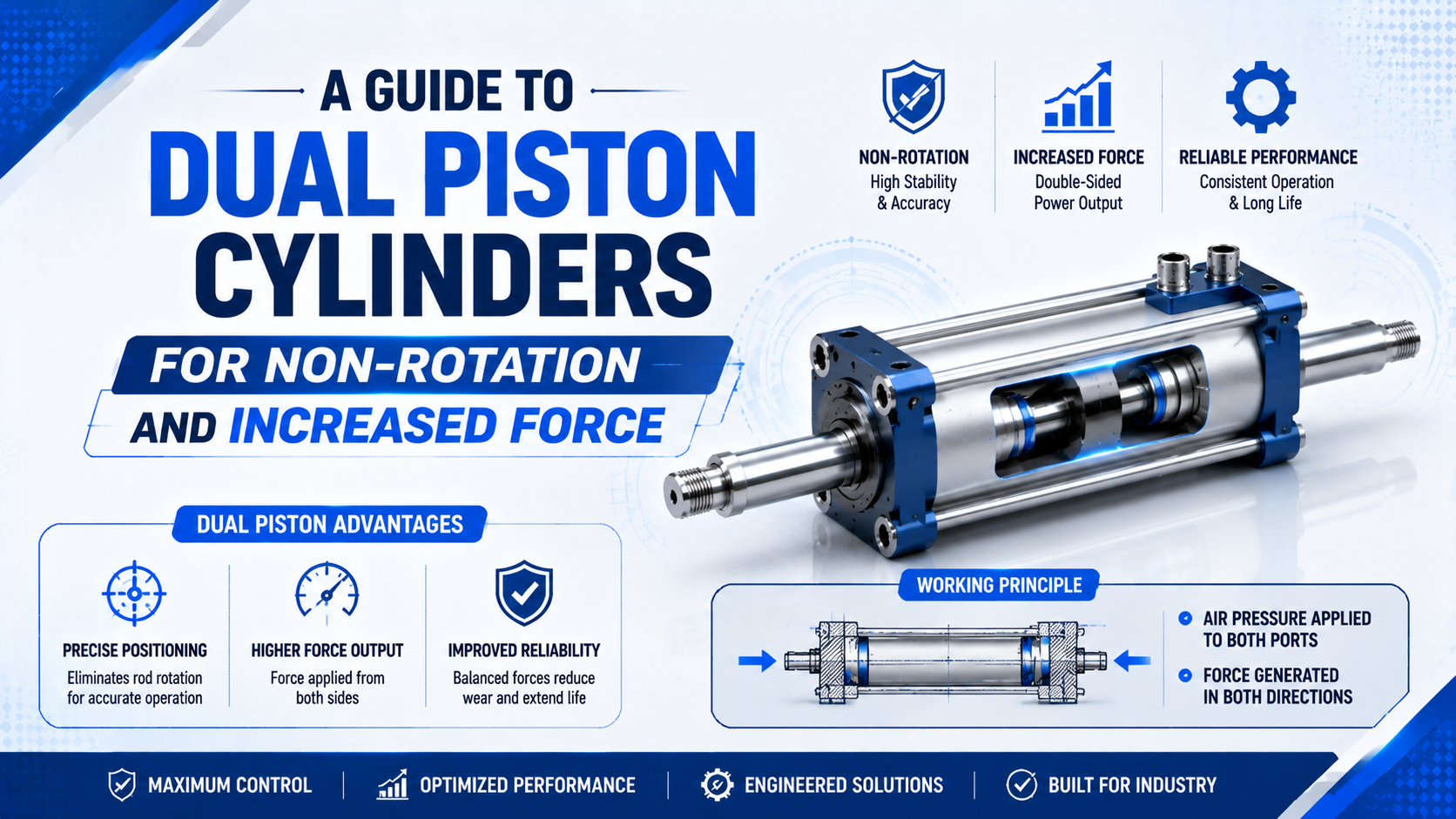
A dual piston cylinder is a pneumatic actuator that places two pistons in parallel and connects their rods to one output plate. The two effective pressure areas add, so identical pistons can produce twice one piston’s theoretical axial force at the same pressure. Their spaced rods constrain rotation, but they do not create zero backlash or unlimited moment capacity.
That answer needs one boundary. SMC’s CXS2 is a specific double-piston, dual-rod family that claims twice the output force and ±0.1° non-rotating accuracy; its range covers 6, 10, 16, 20, 25, and 32 mm bores (SMC CXS2, accessed July 19, 2026). Those figures describe that product family, not every cylinder sold under a similar name.
Key Takeaways
- Two identical pistons give twice one piston’s theoretical force because their effective areas add.
- Extension and retraction require different area sums when rods occupy pressure area.
- Spaced rods constrain rotation, but model-specific angular, moment, speed, and energy limits still apply.
- Twice the swept area also means roughly twice the geometric air volume for the same stroke.
What Is a Dual Piston Cylinder?
SMC describes CXS2 as a double-acting cylinder with double-piston construction and six bore choices from 6 to 32 mm (SMC CXS2, accessed July 19, 2026). In this guide, “dual piston” means two separate pressure areas driving one mechanically linked output plate in parallel.
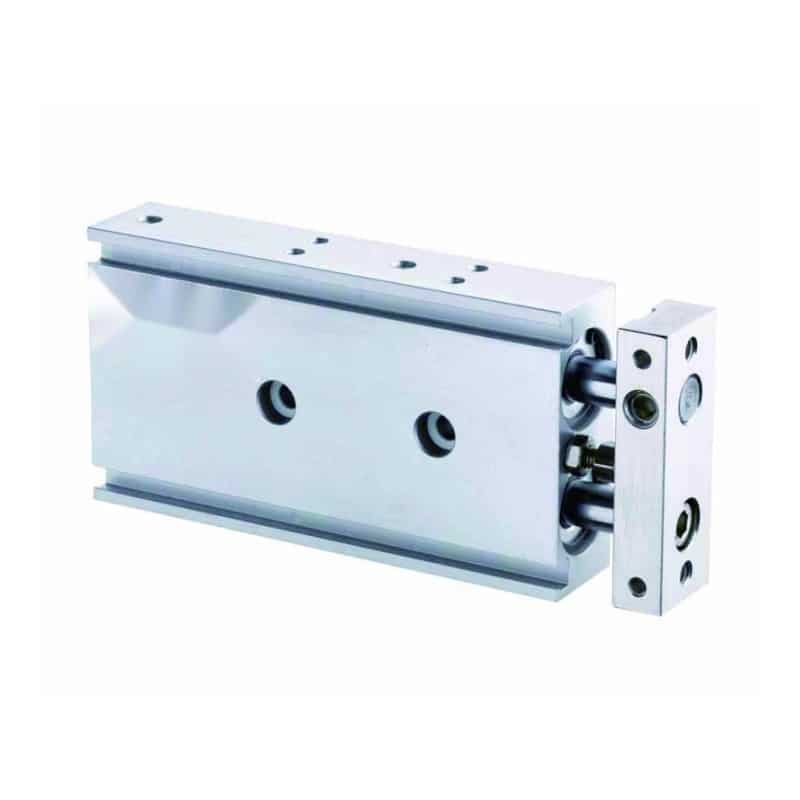
The basic construction has five functional parts:
- Two cylinder bores or pressure chambers arranged side by side
- Two pistons exposed to coordinated supply and exhaust pressure
- Two piston rods connected to one rigid output plate
- Bearings or bushings that control rod alignment and plate motion
- A common body and mounting datum that transfers the load into the machine
Both piston forces act in the same travel direction. The output plate sums those axial forces and spaces the rods far enough apart to resist rotation better than a single round rod. This architecture is useful when a compact tool needs more thrust and a stable mounting face without adding a separate anti-rotation key.
It is not automatically a precision slide. Rod and bearing clearance, body stiffness, plate stiffness, mounting flatness, side load, and tooling overhang still determine how the output face behaves. For detailed bearing and three-axis moment selection, use the separate compact guide cylinder guide.
The most reliable way to identify this architecture is to count pressure areas, not rods. Two visible rods may belong to two pistons, two guide shafts, or one through-rod piston. Ask for a section drawing and extension/retraction effective-area table before using the words “dual piston” in a calculation or purchase order.
Three Cylinder Names That Should Not Be Interchanged
ISO 15552:2018 covers interchangeable mounting dimensions for single- or double-rod pneumatic cylinders with 32 to 320 mm bores and a maximum rated pressure of 1,000 kPa (ISO 15552:2018, confirmed in 2025). In that standard, “double rod” does not mean two parallel pistons. Procurement language must identify the internal architecture.
A parallel twin-piston cylinder is a side-by-side actuator whose two rods drive one plate. A tandem cylinder is an inline actuator whose piston stages transmit force through one common output rod. A through-rod cylinder is a one-piston design with its rod exiting both end caps. All three can look like “double” cylinders in a short description.
| Common name | Typical internal arrangement | Force consequence | Rotation and load consequence |
|---|---|---|---|
| Parallel twin-piston cylinder | Two pistons, two rods, one plate | Adds both driven areas | Rod spacing resists rotation; check moments |
| Inline tandem cylinder | Two stages on one output rod | Adds active stage areas | Does not inherently prevent rod rotation |
| Through-rod cylinder | One piston; rod exits both ends | Uses one piston area | Round rod still needs rotational constraint |
| Guided cylinder or slide | One or more pistons plus guides | Depends on actual driven area | Guide ratings govern side load and moment |
This distinction changes both sizing and replacement. A one-piston through-rod cylinder cannot replace a two-piston CXS-style actuator on “same bore” alone. Conversely, a twin-piston cylinder may generate the required thrust but fail an offset moment that a larger guided slide could carry. The separate tandem-cylinder guide covers inline force stages and their axial-length tradeoff.
If non-rotation is the main problem and higher force is incidental, compare keyed rods, oval pistons, guide cylinders, external linear guides, and rodless slides in the non-rotating cylinder options guide. It is usually cheaper to choose the right constraint method than to buy an architecture for the wrong reason.
How Do Two Pistons Increase Theoretical Force?
Parker defines theoretical pneumatic-cylinder force as pressure at the cylinder multiplied by effective piston area, (Parker 0900P actuator catalog, accessed July 19, 2026). A dual-piston cylinder follows the same law: add the two driven areas first. Two identical areas therefore give exactly twice one piston’s theoretical force.
For extension, total driven area is:
Here, is total extension area, while and are the cap-end piston areas. For two round pistons with diameters and :
Theoretical extension force is:
Here, is active cap-end pressure measured at the cylinder during the force condition. Use consistent units: MPa multiplied by mm² gives newtons because 1 MPa equals 1 N/mm².
Retraction loses the area occupied by each rod:
The rod areas are and . Theoretical retraction force is , where is active rod-end pressure.
These equations are theoretical. During extension, pressure on the rod side pushes back while seals and external guides resist motion. A useful net-force model is:
Here, the second is rod-side back pressure during extension and is measured or justified friction and mechanical resistance. Dynamic port pressure, not the regulator’s unloaded gauge, belongs in the equation. See the separate guides to pneumatic cylinder theoretical force and exhaust back pressure for those two inputs.
Worked Example: Two 25 mm Pistons at 0.6 MPa
Parker’s force table gives approximately 295 N theoretical extension force for one 25 mm piston at 6 bar, which is 0.6 MPa (Parker P1P catalog, accessed July 19, 2026). Two equal pistons therefore provide about 589 N before rod-side pressure, seal friction, guide resistance, and load dynamics are deducted.
For example, assume this geometry:
| Input | Value |
|---|---|
| Number of pistons | 2 |
| Piston diameter | 25 mm each |
| Rod diameter | 10 mm each |
| Active pressure | 0.6 MPa |
| Stroke | 100 mm |
One piston area is:
The two-piston extension area is . Theoretical extension force is:
Each 10 mm rod occupies 78.5 mm², so total retraction area is . At the same 0.6 MPa active pressure, theoretical retraction force is 494.8 N.
Now add transparent real-circuit assumptions. If rod-side back pressure during extension is 0.05 MPa and measured friction plus external guide resistance is 50 N, estimated net extension force becomes:
The 0.05 MPa and 50 N values are worksheet assumptions, not universal allowances. Measure or conservatively justify them for the actual model, mounting, lubrication state, temperature, speed, and load. Then add acceleration, gravity, process force, and the supplier’s sizing method before selecting the cylinder.
How Does the Design Resist Rotation?
SMC publishes ±0.1° non-rotating accuracy for CXS2 and attributes it to the dual-rod construction (SMC CXS2, accessed July 19, 2026). The mechanism is geometric constraint: two spaced rods tied by one plate resist relative angular motion better than one round rod that can turn inside its bearing.
The rods and their bearings create a couple. When an external torque tries to rotate the plate, one rod-bearing set reacts load in one direction and the other reacts in the opposite direction. Wider rod spacing generally improves mechanical advantage, but shaft diameter, bearing clearance, body stiffness, plate stiffness, stroke, and mounting flatness control the actual result.
“Non-rotating” does not mean zero angular movement. The published ±0.1° figure is an accuracy limit for one product family under its stated conditions. Tooling can add more angular error through bracket deflection, fastener clearance, plate bending, and an off-center process force.
The mounting surface matters too. SMC’s CXS precautions give 0.05 mm or less as a reference flatness for the mounting surface and warn that poor flatness can prevent the specified rod-operation accuracy (SMC CXS precautions, accessed July 19, 2026). Measure the machine datum, not only the cylinder body.
In our experience, buyers often specify “no rotation” when the process actually needs a maximum angular error at the tool tip. Those are different requirements. Convert the allowed tool-tip displacement and overhang into an angular tolerance, then compare it with cylinder accuracy, bearing clearance, mounting error, and bracket deflection together.
Why Does More Force Also Need More Airflow?
Two 25 mm pistons have 981.7 mm² total extension area, exactly twice one piston’s 490.9 mm². Parker’s catalog links air displacement to piston area and stroke as well as force to pressure and area (Parker 0900P actuator catalog, accessed July 19, 2026). The same geometry that doubles theoretical force also doubles swept chamber volume.
For extension, geometric swept volume is:
Here, is chamber volume displaced over stroke . With the 100 mm example, one piston sweeps 49.1 cm³ and two sweep 98.2 cm³. Retraction volume uses the summed annular area instead.
Free-air consumption also depends on absolute pressure ratio, dead volume, cycle rate, temperature reference, and whether both directions are powered. The geometric 2× comparison remains valid only when the two pistons and strokes are identical and the reference conditions are the same. Use the Air Consumption Calculator for one identical bore, then multiply by two as a first estimate and verify against the selected catalog.
Flow determines speed. If a twin-piston cylinder replaces a single piston but keeps the same valve, fittings, and tubing, filling twice the volume can increase stroke time and dynamic pressure drop. The pressure gauge may still show the correct static setting while the cylinder port falls below it during acceleration.
Do not promise unchanged speed from pressure alone. Check target stroke time, required flow, valve conductance, tube inside diameter, supply pressure at peak demand, and exhaust back pressure. A larger valve may restore speed, but cushioning and kinetic-energy limits must then be reviewed because the moving plate can reach the stop faster.
Which Loads Can a Dual Piston Cylinder Carry?
SMC lists 0.016 J allowable kinetic energy and 800 mm/s maximum piston speed for CXS2, while also offering slide-bearing and ball-bushing versions (SMC CXS2, accessed July 19, 2026). Those model-specific limits show why axial force alone cannot justify a payload rating in kilograms.
Resolve the installed load into:
- Axial process force along the travel direction
- Moving mass and required acceleration
- Gravity force in the mounted orientation
- Side force across the output plate
- Roll, pitch, and yaw moments about the catalog datum
- Tooling overhang and center-of-gravity location
- Normal stopping energy and credible fault-stop energy
An offset force creates moment:
Here, is applied moment, is the force, and is the perpendicular offset from the manufacturer’s reference point. A 100 N side force acting 80 mm from the guide datum creates 8 N·m. Compare that demand with the correct axis, stroke, bearing version, and life condition in the selected catalog.
Impact energy rises with the square of velocity:
Here, includes the moving plate, adapters, tool, and payload; is velocity immediately before deceleration. Doubling speed makes the translational kinetic-energy term four times as large. Internal bumpers or cushions do not automatically absorb an offset load safely.
Use an external guide when the tool’s side load or moment exceeds the dual-rod cylinder’s published capacity, or when required deflection is tighter than the integrated structure can hold. The side-loading guide explains why extra axial thrust does not repair an overloaded bearing or bent mounting plate.
Selection Checklist for Dual Piston Cylinders
AirTAC’s TN/TR documentation lists 10, 16, 20, 25, and 32 mm TN bores and recommends filtration to 40 µm or finer, while warning against radial load during operation (AirTAC TN/TR catalog, accessed July 19, 2026). Exact ranges differ by family, so selection must end with a complete ordering code and load case.
Use this sequence:
-
Confirm architecture. Obtain a section drawing showing piston count, rod count, porting, bearings, and the shared output plate.
-
Define both strokes. Record travel, orientation, target time, dwell, end position, stopping method, and whether extension or retraction performs the work.
-
Build the force balance. Include process load, gravity, acceleration, back pressure, spring force, friction, and the correct summed effective area.
-
Measure dynamic pressure. Check both cylinder ports during the hardest motion, not only the regulator before cycling.
-
Calculate air and flow. Sum the swept volumes, apply the catalog’s reference conditions, and check simultaneous machine demand.
-
Map external loads. Give mass, center of gravity, side force, moment about each axis, tooling overhang, and load position throughout the stroke.
-
Check speed and energy. Compare normal speed, moving mass, cushion setting, impact energy, and fault-stop condition with model limits.
-
Freeze the mounting datum. Specify surface flatness, bolt pattern, fastener grade, alignment method, fitting clearance, sensor space, and tool-removal path.
-
State the environment. Include air quality, temperature, water, dust, weld spatter, chemicals, washdown, and lubrication restrictions.
-
Document acceptance. Define maximum cycle time, minimum force, end-position tolerance, angular error at the tool, pressure trace, and test load.
A good RFQ contains two separate capacity statements: axial force from the two pressure areas, and external-load capacity from the guide and mounting system. Combining them into one “maximum load” number hides the failure mode. A cylinder can pass the thrust calculation while its plate, bearing, or machine bracket fails the moment check.
ISO 4414:2010 applies general safety requirements to pneumatic systems across design, installation, operation, and maintenance (ISO 4414, confirmed in 2021). Use a risk assessment for suspended loads, clamping, stored energy, pressure loss, and maintenance access. Higher force does not replace load holding, guarding, or safe exhaust design.
Conclusion: When Is a Dual Piston Cylinder the Right Choice?
SMC’s CXS2 combines two pistons, ±0.1° non-rotating accuracy, 0.016 J allowable kinetic energy, and bores from 6 to 32 mm in one product-specific package (SMC CXS2, accessed July 19, 2026). A dual-piston cylinder is a strong candidate when both compact axial thrust and constrained tool rotation are required.
Choose it after confirming the architecture, not from the phrase “dual rod.” Sum both extension and retraction areas, use pressure at the actuator, deduct opposing pressure and resistance, and verify the load at production speed. Then check air demand, valve flow, angular accuracy, side load, moments, mounting flatness, and stopping energy against the exact ordering code.
If force is the only problem, a larger conventional bore may be simpler. If moment capacity and deflection dominate, a dedicated guided slide or external linear guide may be better. If equal force in both directions matters, a one-piston through-rod cylinder solves a different problem. The correct design is the one whose pressure areas and mechanical load path both match the machine.
Dual Piston Cylinder FAQs: What Should Engineers Ask?
SMC’s CXS2 publishes twice-the-output-force construction, ±0.1° non-rotating accuracy, 800 mm/s maximum piston speed, and 0.016 J allowable kinetic energy for one named family (SMC CXS2, accessed July 19, 2026). These answers separate its useful architecture from claims that require exact model data.
Do dual piston cylinders always produce exactly twice the force?
Only in the theoretical comparison of two identical piston areas at the same active pressure versus one identical piston. Actual net force also depends on rod-side back pressure, rod areas during retraction, seal and guide friction, dynamic pressure drop, acceleration, gravity, and process resistance. Use the exact model’s effective-area and force tables.
Is a dual-rod cylinder always a dual-piston cylinder?
No. “Dual rod” can describe two parallel driven rods, two guide shafts, or one piston rod extending through both end caps. Count the pistons and pressure areas on a section drawing. ISO 15552 explicitly includes single- and double-rod cylinders, but its terminology does not imply two parallel pistons.
Do two pistons consume twice as much compressed air?
Two identical pistons with the same stroke have twice one piston’s geometric swept volume, so their first-order air estimate is twice as high under equal pressure and reference conditions. Actual free-air consumption also includes both stroke directions, absolute pressure ratio, dead volume, leakage, cycle rate, and the selected manufacturer’s calculation convention.
Can a dual piston cylinder eliminate rotation completely?
No. Spaced rods strongly constrain rotation, but bearings retain clearance and structural parts deflect. SMC specifies ±0.1° for CXS2 rather than zero movement. Convert the machine’s tool-tip tolerance into an angular requirement, then include cylinder accuracy, mounting flatness, bracket stiffness, tooling overhang, side load, and wear.
When should I use an external guide instead?
Use an external guide when side force, offset moment, deflection, stroke, contamination, or required life exceeds the integrated dual-rod cylinder’s published capacity. External guidance can also separate the load path from the piston seals. Check every axis and stroke position; additional piston force cannot compensate for an overloaded bearing or flexible bracket.
Sources and technical references
- SMC CXS2 Dual Rod Cylinder, double-piston force, non-rotating accuracy, speed, energy, bearings, and bore range.
- SMC CXS Series Precautions, mounting-flatness and handling guidance.
- AirTAC TN/TR Catalog, bore range, thrust tables, filtration, environment, and radial-load precautions.
- Parker Pneumatic Actuator Products 0900P, pressure-area force equation and air-displacement engineering data.
- Parker P1P Compact Cylinder Catalog, theoretical push/pull force and air-consumption tables.
- ISO 15552:2018, interchangeable dimensions and single-/double-rod terminology for specified cylinder families.
- ISO 4414:2010, general pneumatic-system safety requirements.