

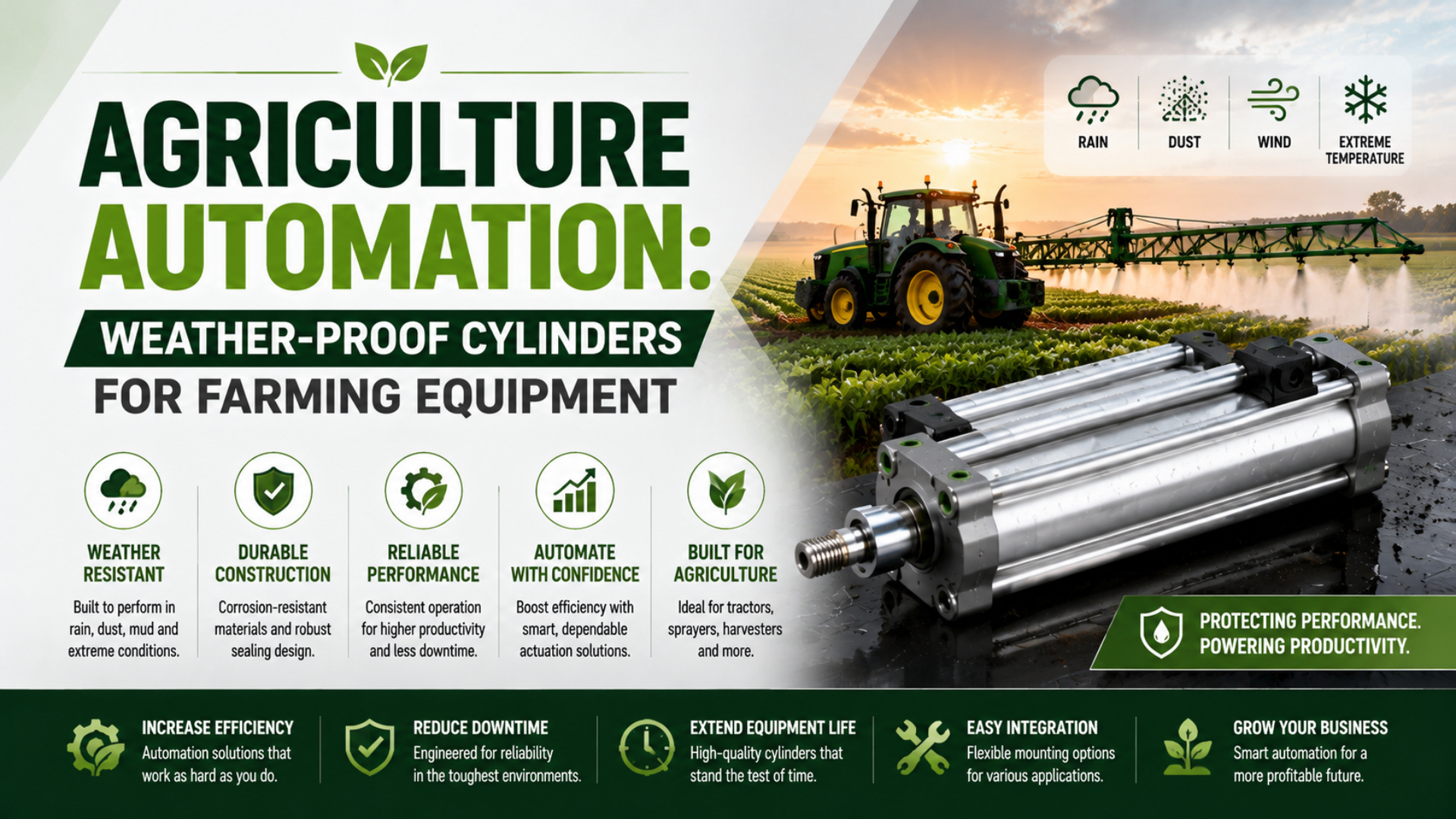
A weather-resistant agricultural pneumatic cylinder is not defined by one coating, seal compound, or IP number. It is a complete actuator configuration matched to the actual dust, water, chemicals, temperature, sunlight, vibration, mounting loads, air quality, and maintenance access on the machine.
John Deere documents a planter pneumatic downforce system adjustable from 0 to 181.4 kg and supplied through 9.5 mm air lines. That real application shows where pneumatics can work in farming, but it does not prove that a generic factory cylinder can survive outdoors (John Deere).
Key Takeaways
- Define every exposure before choosing materials or seals.
- Treat IP codes as product-specific enclosure evidence.
- Verify the cylinder, sensors, valves, fittings, and air supply together.
- Use model-specific temperature and chemical-compatibility data.
- Release equipment only after documented inspection and field validation.
Where Do Pneumatic Cylinders Actually Fit on Farm Equipment?
John Deere’s documented pneumatic planter system applies 0 to 181.4 kg of adjustable downforce and uses 9.5 mm delivery lines. It is a useful boundary example: pneumatics suit controlled force, positioning, gating, clamping, and ventilation tasks when clean compressed air is available and the required motion remains within the system’s verified capacity (John Deere).
Agricultural machinery often combines several motion technologies. Hydraulic power commonly handles high-force mobile functions already served by the tractor circuit. Electric actuators fit programmable positioning where electrical protection and feedback are manageable. Pneumatics make sense when the machine has an air source and benefits from simple linear motion, compliant force, fast cycling, or clean actuation.
That distinction prevents the first specification error: calling every exposed linear actuator a pneumatic cylinder. Confirm the energy source, working pressure, load, stroke, speed, duty cycle, available air volume, and safe state before selecting hardware. The broader hydraulic-versus-pneumatic comparison explains the system-level tradeoffs.
Typical pneumatic opportunities include:
- planter and seeding adjustments supplied by an onboard compressor;
- greenhouse vents, louvers, gates, and sorting mechanisms;
- stationary feed, packaging, and material-handling equipment;
- light-duty position changes on implements with an existing air circuit;
- pneumatic controls inside protected cabinets or enclosures.
Do not replace a hydraulic cylinder with a pneumatic cylinder because the mounting dimensions look similar. Pressure, force density, load holding, shock, hose behavior, control architecture, and failure state are different.
Build an Exposure Map Before Selecting a Cylinder
Festo’s CRDSNU catalog separates four environmental variants and lists ambient ranges from -40°C to +120°C depending on the chosen configuration. The spread is evidence that “outdoor capable” cannot be a family-wide assumption. Record each exposure at the cylinder, sensor, valve, fitting, and tube before requesting a model (Festo CRDSNU, 2024).
Start with the worst credible condition, not the annual average. A cylinder may begin work after standing cold overnight, heat under direct sun, receive fertilizer mist during operation, and then be washed before storage. The combined sequence matters because temperature, media, abrasion, and pressure act on the same seals and surfaces.
| Exposure | Data to record | Design questions | Evidence to request |
|---|---|---|---|
| Dust and soil | Particle type, concentration, direction, packing tendency | Is a standard wiper enough? Can mud accumulate behind a boot? | Scraper option, rod finish, ingress test scope |
| Rain and wash water | Spray direction, pressure, duration, standing water | Can water reach sensors, ports, exhausts, or cavities? | Component-specific test report and connector rating |
| Fertilizer and pesticides | Exact product, concentration, carrier, temperature, contact time | Which elastomers, metals, coatings, and labels are exposed? | Written compatibility from each material supplier |
| Temperature | Minimum start, continuous range, solar surface temperature | Do seals, grease, sensors, tubing, and exhaust remain functional? | Complete option-code temperature range |
| UV and weathering | Sun hours, storage orientation, seasonal duration | Are boots, cables, tubes, labels, and coatings UV stabilized? | Outdoor exposure or material-aging evidence |
| Vibration and shock | Frequency, acceleration, impacts, transport condition | Can fittings loosen or the rod see transverse load? | Mounting calculation and fastener-retention method |
| Cleaning and storage | Chemicals, tools, drainage, preservation | Will cleaning drive contamination into the rod seal? | Approved cleaning and storage procedure |
Exposure envelope is the quantified set of operating, cleaning, transport, and storage conditions. Verified configuration is the exact cylinder option code plus its approved sensors, valves, fittings, tubing, lubricant, mounts, and protection. Release evidence is the supplier documentation and installed-machine test record showing that configuration passed the defined acceptance limits.
The most useful agricultural specification is a sequence map, not a list of adjectives. “Dusty, wet, and corrosive” is vague. “Dry abrasive soil during 10-hour operation, fertilizer splash at the rod end, low-pressure rinse, then outdoor storage below freezing” gives the supplier conditions that can be checked.
What Does “Weather-Proof” Need to Mean in the RFQ?
IEC 60529 classifies enclosure protection for electrical equipment rated up to 72.5 kV. That scope matters: an IP code can support a sensor, connector, valve coil, or electrical enclosure claim, but it should not be treated as universal proof that an entire mechanical cylinder assembly is weather-proof (IEC 60529).
Ask what was tested, in which configuration, and with which accessories. A cylinder may include a mechanical actuator, magnetic sensor, cable connector, valve, manifold, and protective cover. Their exposure boundaries differ. One IP-rated sensor does not automatically qualify the rod seal, open exhaust, tube fitting, or complete machine.
Define the requested outcome in measurable terms:
- no harmful water or dust ingress within the named test scope;
- no unacceptable corrosion, swelling, cracking, label loss, or coating damage;
- full stroke without sticking after exposure;
- leakage and speed within agreed limits at the specified pressure;
- sensor switching and connector integrity throughout the test;
- fasteners, mounts, rod end, and accessories remaining secure;
- documented inspection criteria for cosmetic versus functional change.
Avoid unsupported labels such as “marine grade,” “agricultural grade,” “all-weather,” or “chemical proof.” Replace each with a material grade, finish, test method, exposure condition, acceptance limit, and responsible approver.
The general article on environmental factors in actuator selection compares pneumatic and electric architectures. This article goes one level deeper by turning farm exposure into a cylinder RFQ and release decision.
Which Materials, Scrapers, and Seals Match the Exposure?
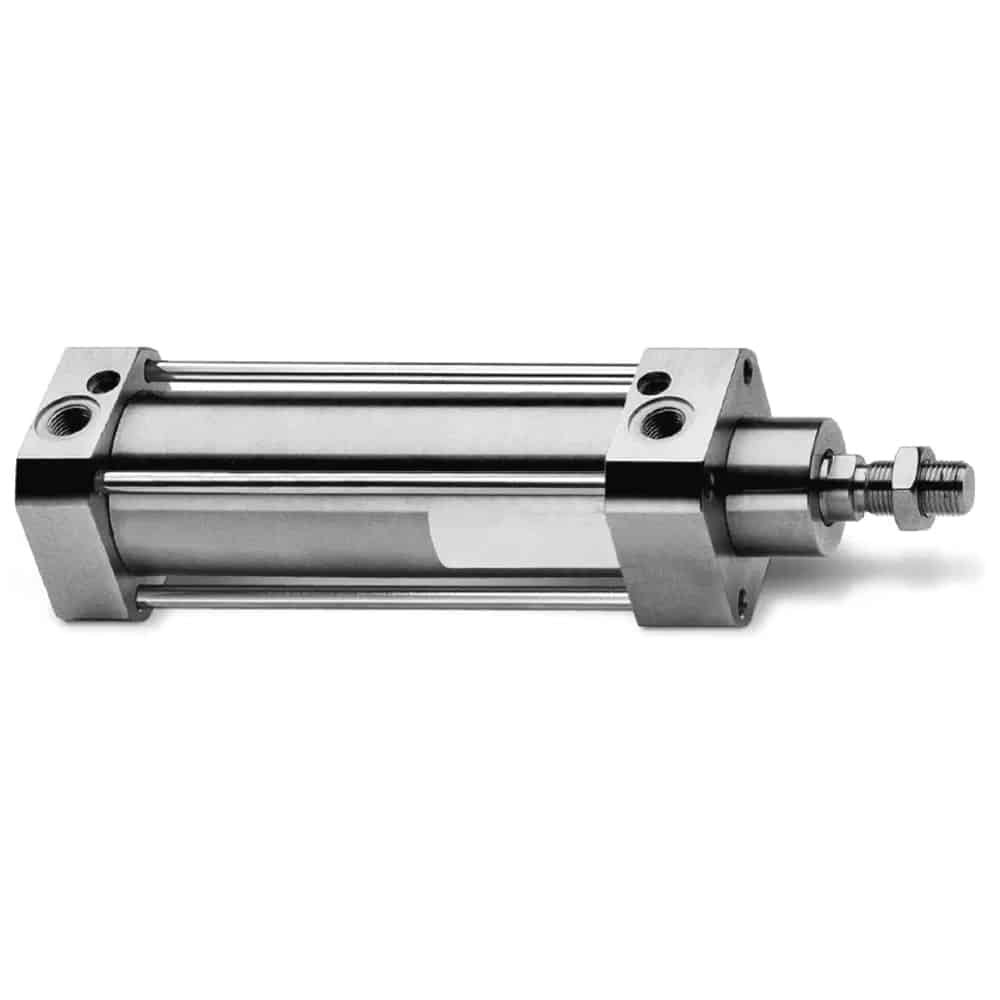
Festo lists CRDSNU piston diameters from 12 to 63 mm, strokes from 1 to 500 mm, and four scraper choices: PUR, FKM, hard scraper, and PE-UHMW dry-running versions. The catalog proves that even one stainless cylinder family needs option-level selection rather than a single “best” weather seal (Festo, 2025).
Start with the contamination mechanism:
- Fine dust: prioritize a suitable rod scraper, protected guidance, and a layout that does not draw dirt toward the seal.
- Mud or fibrous material: prevent packed contamination around the rod end and verify that any boot can drain and move freely.
- Chemical splash: identify the exact formulation, carrier, concentration, temperature, and contact time before choosing elastomers.
- Standing moisture: review rod, tube, end caps, fasteners, mounts, ports, and galvanic pairs, not only the visible barrel.
- Low temperature: qualify the complete seal and lubricant option at cold start, including sensors and tubing.
- Direct sun: check external polymers, cable jackets, tube, labels, boots, and coating weatherability.
Parker’s O-Ring Handbook says compound selection must consider pressure, temperature, and the medium, and describes the final choice as a compromise. It also notes that special FKM compounds can offer low-temperature flexibility, which is different from claiming that every FKM seal is suitable for freezing farm service (Parker, 2024).
In our experience, the rod wiper receives too much attention and the surrounding interfaces receive too little. Corrosion often begins at fasteners, rod-end threads, sensor grooves, port fittings, or dissimilar-metal joints. A stainless tube does not protect an untreated mounting bracket or a connector that holds water.
Use the pneumatic seal-material guide for compound-screening questions and the galvanic corrosion analysis for dissimilar-metal interfaces. Both are screening aids; the exact agricultural chemical still needs written compatibility evidence.
Protect the Entire Pneumatic Circuit, Not Only the Cylinder
ISO 8573-1 classifies compressed-air purity by particles, water, and oil, and also identifies gaseous and microbiological contaminants. Those categories remain relevant on farm equipment because an outdoor cylinder can fail from contamination delivered inside the circuit even when its external materials are correctly selected (ISO 8573-1, 2010).
Map the air path from intake to exhaust:
- compressor intake location and dust loading;
- receiver drainage and water separation;
- filtration and drying appropriate to the coldest line condition;
- regulator, shutoff, soft-start, and residual-pressure controls;
- valve and manifold enclosure or direct exposure;
- tubing material, routing, bend protection, and UV resistance;
- fittings, silencers, and exhaust orientation;
- cylinder ports, cushioning, sensors, and local isolation.
Condensation is a system problem. Air can leave a warm compressor and cool in long exposed tubing. If the pressure dew point and line temperature are not coordinated, water can form near the valve or actuator. Freezing adds another failure mode at restrictions and exhausts.
Keep the specified purity class tied to a measurement location. ISO 8573-1 states that purity can be specified or measured independently of location, so the RFQ should name where the required class applies. A compressor-room reading does not prove the same condition at an exposed implement.
For additional system controls, see the ISO 8573-1 air-quality guide and the article on air lubrication and cylinder seal materials.
How Should Mounting and Mechanical Loads Be Verified?
ISO 15552 covers detachable-mount pneumatic cylinders from 32 to 320 mm bore at a maximum rated pressure of 1,000 kPa, or 10 bar. Its purpose is dimensional interchangeability; it does not certify a cylinder for fertilizer exposure, side load, outdoor storage, or a specific agricultural machine (ISO 15552, confirmed 2025).
Use the mounting standard to control interfaces, then verify the actual load path. Record:
- bore, stroke, rod diameter, working pressure, and required force;
- mounting style, pin orientation, bracket stiffness, and alignment;
- rod-end joint and allowance for angular movement;
- transverse force, moment, shock, vibration, and transport restraint;
- speed, moving mass, end-of-stroke energy, and cushion strategy;
- load holding and safe behavior after air loss;
- hose or tube forces at ports through the full motion;
- access for isolation, removal, and inspection.
Agricultural frames flex. Implements fold, bounce during transport, and accumulate soil around pivots. A cylinder aligned in the workshop can see side load after the structure deflects. Use spherical or floating connections only for the misalignment they are designed to accommodate; they do not replace external guidance where the load requires it.
The cylinder side-loading guide explains how transverse load affects the rod bearing and seal. For standardized replacements, use the ISO 15552 interchangeability checklist without assuming that matching bolt dimensions proves environmental suitability.
What Acceptance Tests and Maintenance Records Are Needed?
ISO 4254-1:2013 is the fifth edition of the agricultural-machinery safety standard, has one amendment, and was confirmed current in 2026. Its scope includes verification and information about residual risks, reinforcing a practical rule: environmental cylinder acceptance belongs inside the machine’s documented safety and validation process (ISO).
Create a test plan around the agreed duty sequence. It can include:
- incoming inspection against the complete model and option code;
- material, coating, seal, lubricant, sensor, and accessory verification;
- baseline leakage, stroke time, breakaway behavior, and sensor checks;
- exposure to the defined water, dust, chemical, temperature, and vibration conditions;
- repeat functional measurements after exposure and cleaning;
- inspection for corrosion, pitting, swelling, cracks, packed debris, loose fittings, and damaged cables;
- safe-state and residual-pressure verification;
- teardown of representative units when hidden damage cannot be assessed externally.
Do not invent a universal inspection interval. Set checks from the manufacturer instructions, operating hours, exposure events, seasonal storage, observed deterioration, and consequence of failure. A greenhouse vent cylinder and a planter adjustment cylinder do not share the same duty or access.
NIOSH’s farm-equipment checklist advises stopping the engine, disconnecting the power source, and waiting for all movement to stop before servicing, adjusting, cleaning, or unclogging covered equipment. Apply the governing local rules and machine procedure, then isolate and dissipate pneumatic energy before touching the actuator (NIOSH).
The broader cylinder and actuator maintenance comparison can help define technician skills, spares, and fault detection. The agricultural record should add weather events, chemicals used, cleaning history, storage condition, and any changes to the implement.
Use a Release Gate for Agriculture Automation
ISO 4414 is an edition-three standard covering pneumatic-system design, construction, modification, installation, adjustment, maintenance, cleaning, reliable operation, energy efficiency, and environment. Its system scope supports the correct release decision: approve the assembled agricultural function, not an isolated cylinder selected from one catalog row (ISO 4414, confirmed 2021).
A credible release package connects four records: the exposure map, the complete configured bill of materials, the supplier evidence matrix, and the installed-machine test report. If any one is missing, “weather-proof” remains a description rather than a controlled engineering claim.
Name the approved bill of materials in the release record. A substitution from PUR to FKM, stainless to coated carbon steel, one proximity switch to another, or one grease to another can change the verified environmental envelope. Supplier availability is not evidence of equivalence.
Agriculture Pneumatic Cylinder FAQs: What Should Equipment Designers Ask?
IEC 60529 applies its IP classification to electrical-equipment enclosures up to 72.5 kV, while ISO 15552 defines a 10 bar dimensional cylinder series. These separate scopes explain the recurring buyer questions below: mounting interchangeability, ingress evidence, seal compatibility, and outdoor reliability must be verified independently (IEC; ISO).
Is a weather-proof pneumatic cylinder the same as an IP67 cylinder?
No. “Weather-proof” is an informal description, and IEC 60529 addresses enclosure protection for electrical equipment. Ask which assembled component carries an IP claim and what the test covered. Then evaluate the mechanical cylinder, rod seal, ports, sensors, connectors, valves, exhausts, and accessories against the actual farm exposure.
Which seal material is best for fertilizers and pesticides?
There is no universal best compound. Obtain the exact chemical formulation, carrier, concentration, contact time, and temperature, then request written compatibility for the dynamic seal, scraper, static seals, grease, tubing, coatings, and labels. Parker’s handbook treats pressure, temperature, and media resistance as a combined selection problem.
Does ISO 15552 interchangeability make a cylinder suitable for outdoor farming equipment?
No. ISO 15552 standardizes basic, mounting, and accessory dimensions for 32 to 320 mm cylinders rated up to 1,000 kPa. It does not certify corrosion resistance, chemical compatibility, side-load capacity, sensor ingress protection, UV stability, or survival in a specific agricultural duty cycle.
Should every agricultural pneumatic cylinder use a rod boot?
Not automatically. A boot can shield the rod, but it can also trap mud, fertilizer, water, or ice if its material, drainage, stroke, and mounting are wrong. Compare a boot with hard scrapers, shields, rod orientation, protected mounting, and cleaning access, then validate the selected arrangement through the full stroke.
How often should a farm pneumatic cylinder be inspected?
Set the interval from the manufacturer instructions, operating hours, contamination severity, seasonal storage, exposure events, failure consequence, and observed trend. Inspect after unusual chemical contact, flooding, impact, freezing, or damaged guarding. Record leakage, stroke behavior, corrosion, rod condition, mounting security, tubing, connectors, and safe isolation rather than relying on a universal annual schedule.
Sources and technical references
External engineering and agricultural references
ISO 4414:2010, Pneumatic fluid power safety requirements: System and component design, installation, operation, maintenance, cleaning, energy efficiency, safety, and environmental considerations. Retrieved 2026-07-26.
ISO 15552:2018, Pneumatic cylinders with detachable mountings: Dimensional interchangeability for 32-320 mm bore cylinders with a maximum rated pressure of 1,000 kPa. Confirmed 2025; retrieved 2026-07-26.
ISO 8573-1:2010, Compressed-air purity classes: Particle, water, oil, gaseous, and microbiological contaminant classification. Retrieved 2026-07-26.
ISO 4254-1:2013, Agricultural machinery safety: General safety and verification requirements for covered agricultural machinery. Confirmed 2026; retrieved 2026-07-26.
IEC 60529, Degrees of protection provided by enclosures: IP-code scope for electrical-equipment enclosures. Retrieved 2026-07-26.
Festo, Stainless steel round cylinder CRDSNU: Piston and stroke ranges, scraper choices, temperature variants, and corrosion-resistant construction. July 2025.
Festo, CRDSNU catalog: Complete option codes, air-quality requirement, pressure, temperature, corrosion-resistance class, force, and accessory limitations. June 2024.
Parker, O-Ring Handbook: Elastomer selection across pressure, temperature, media, low-temperature flexibility, and dynamic sealing. Retrieved 2026-07-26.
John Deere, 1705 Planter: Pneumatic downforce range, air-line size, and compressor-system information. Retrieved 2026-07-26.
NIOSH, Guarding of Farm Equipment: Farm-equipment servicing, power disconnection, and motion-control checklist. Retrieved 2026-07-26.